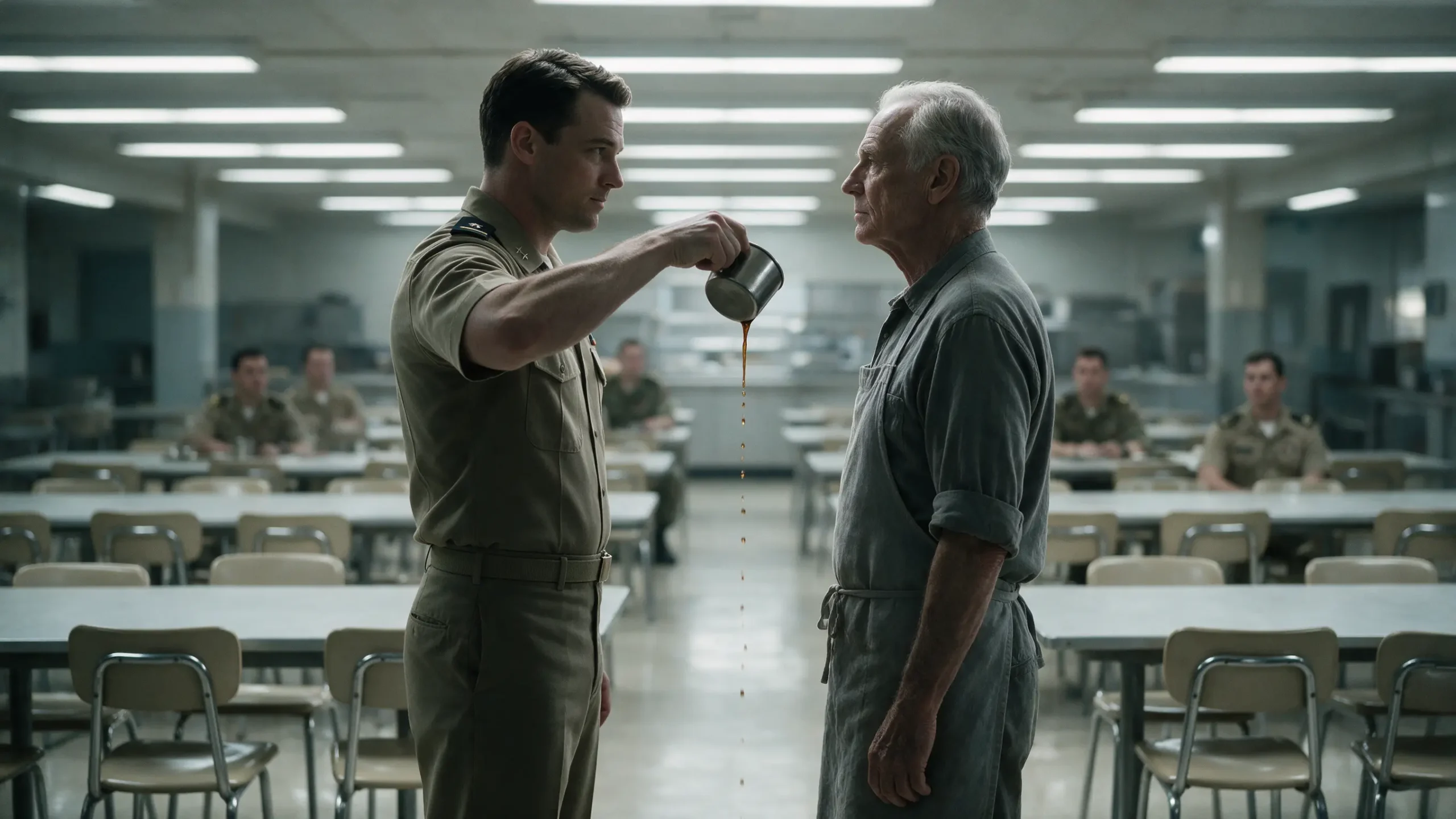
Wayne Jenkins had been pushing the same broom down the same marble corridor for twenty years.
He didn’t mind. The Hart Senate Building was quiet in the early hours—just the dry rasp of bristles and the cold smell of limestone and floor wax. His palms fit the hickory handle like it had been made for them.
Then the boot came down.
Black box-calf leather. Mirror-polished. The sole pressed flat against the bristle head and stopped the broom cold.
Wayne looked up slowly.
Three West Point cadets in dress uniform stood in a row. The one in front had a jaw that jutted out like a dare. His name tag said PETERSON.
“What is this, bring your grandpa to work day?”
Wayne didn’t answer right away. He looked at the boot on his broom.
“Son,” he said quietly, “I’m just trying to keep the place clean.”
“Your job,” Peterson said, “is to be invisible.”
He lifted his boot and kicked the dust pile Wayne had spent ten minutes gathering. Gray lint scattered across the white marble like ash.
The two boys behind him laughed.
Wayne didn’t move. His right thumb found a notch carved into the broom handle—the numbers 937. He pressed his thumb against them the way a man holds a rosary.
The second cadet—taller, with a thin blond crease of a mustache he hadn’t earned yet—stepped sideways to block the corridor. “You should probably step aside, old timer. Official business.”
“Is that right,” Wayne said. It wasn’t a question.
“You know what we could do?” the blond one said to Peterson, his voice dropping to the register boys use when they want to sound like men. “Section twelve of the building conduct code. We report him for obstruction of official movement. He loses the contractor badge.”
Peterson’s eyes lit up the way a lighter catches gas. “Write that down.”
“I already am,” the third cadet said from the rear, pulling out his phone.
Wayne watched the phone come up. His expression didn’t change.
“You boys been practicing that?” he said.
Peterson looked back at him sharply. “What?”
“The part where you surround an old man with a broom and call it official business.” Wayne shifted his weight, letting the handle lean against his hip. “You practice that, or does it come natural?”
The blond cadet’s jaw tightened. “He’s mouthing off.”
“I heard him,” Peterson said. He stepped closer, crowding the space. “You think that’s funny? You think the people who run this building are going to take the word of a janitor over three commissioned-officer candidates from the United States Military Academy?”
“I haven’t said a word about anybody’s word,” Wayne said. “I’m asking if you practiced the part where three of you corner one man by himself in a hallway. Because somebody taught you that, or didn’t teach you something better.”
Peterson’s face went through several shades of red. He glanced back at his cadets. The third one lowered his phone an inch.
“You’ve got some nerve,” Peterson said.
“No, son.” Wayne’s voice stayed level. “I’ve got forty-seven years of experience knowing the difference between authority and a performance of authority. You boys are performing.”
Peterson leaned in close. His cologne was sharp and cheap. He pointed at the tiny silver star pin on Wayne’s breast pocket. “What’s that? Your perfect attendance award?”
The blond cadet snickered.
Wayne’s mind slipped for just a second.
The marble floor went warm and wet. The smell of limestone vanished, replaced by burnt aviation fuel and elephant grass and the hot copper tang of blood on a poncho liner. He saw Sergeant Miller’s nineteen-year-old face—green greasepaint, terrified eyes—pressing a small piece of metal into his palm through a Huey door. For luck, Jenkins. So you remember how to get back.
“Hey!” Peterson grabbed the broom handle and yanked. “Look at me when I’m talking to you!”
The handle didn’t move.
Peterson’s fingers slipped. His face changed.
Wayne’s grip had locked down on the wood with a pressure that belonged to a different kind of man than the one standing in a gray work shirt. Peterson stared at the old man’s hands—the knuckles pale yellow, the joints mapped with small, pale scars.
“Let go of the broom,” Peterson said. His voice was thinner now.
“You let go first,” Wayne said softly.
From the alcove behind the pillar, Sarah watched.
She was an intern in Senator Bradley’s office—twenty-three years old, a stack of committee briefs pressed against her ribs, her heel catching on her own slacks where a thread had given way. She had seen the cadets block the janitor from both ends of the corridor. She had watched them kick the dust. She had watched their shoulders shake with laughter.
She had also watched the old man’s hands.
The knuckles weren’t white. They were a dull, bloodless yellow, the color of old parchment. The skin was mapped with pale scars that didn’t come from cleaning floors. She’d noticed the pin on his pocket the first week she started—a tiny, hand-soldered silver star with a rough latch that no official uniform manufacturer had ever produced. She had asked the building supervisor about it once. He’d looked at her sideways and changed the subject.
She pressed her spine into the carved stone of the pillar. The rough limestone caught on her blazer. She breathed through her nose.
Call the Senate security desk, said the part of her brain running the rule book. That’s the protocol. Fill out the incident form. Let the chain of command handle it.
She looked at the old man’s hands again. At the phone the third cadet was holding up to document him.
They’re documenting him, she thought. They’re building a file. And by tomorrow morning there’s going to be a complaint in front of the contractor review board with three witness statements and a West Point letterhead.
She had spent two months watching how this building ate people. She knew exactly how fast a piece of paper could end something that had taken a lifetime to build.
Now her hand was shaking over her phone.
Interns didn’t use the secure lines. That was the first thing they told you. Interns didn’t call the top-floor suites without a signed directive from a chief of staff. You could lose your placement. You could get flagged. The Senator’s senior aide had a list of interns she’d personally removed, and the names on that list had nothing after them on their resumes for the next three years.
Her grandfather had scribbled a number on the back of a VFW card from Topeka. Direct extension. Four digits. You’ll know when.
She’d thought he meant a real emergency. Something with guns. Something visible.
She watched the third cadet add another note to his phone.
She pressed dial.
The connection didn’t click through the standard digital switchboard. There was a heavy mechanical pop—the sound of an analog relay clearing an encrypted channel.
“Colonel Thorne’s office.”
“My name is Sarah.” She pressed her cheek against the cold stone so her voice wouldn’t carry into the hall. “I’m an aide in Senator Bradley’s office. It’s an emergency.”
“If this is regarding the procurement bill, please route through the legislative liaison—”
“No,” she said. “There are three West Point cadets in dress uniform. They’ve cornered the night-shift janitor by the eastern rotunda. They’re threatening him with a psychiatric hold.” She swallowed. “His name is Wayne Jenkins.”
The silence on the other end didn’t feel like a pause.
It felt like a drop in cabin pressure.
Then she heard it—the faint rustle of heavy bond paper being set flat. Then a sharp scrape: a leather desk chair shoved back so hard its casters bit into the rug underneath.
“Repeat the name,” the voice said. The administrative neutrality was gone. The tone had gone flat and narrow.
“Wayne Jenkins. He wears a gray work shirt. He has a small silver star pin on his pocket. It’s old—”
“Stay in the alcove.”
The line went dead.
In his office on the fourth floor, Colonel Marcus Thorne was already moving.
His lieutenant, Vance, looked up from the logistics spreadsheet with the expression of a man watching a controlled demolition begin.
“Sir. General Casey’s staff is clearing the metal detectors now. The appropriations briefing begins in nineteen minutes.”
“Cancel the arrival reception,” Thorne said.
The pencil stopped moving. “The General is carrying the final budget authorizations for the Next-Gen armor project. If we aren’t at the elevators—”
“Let them interpret it however they like.” Thorne was already at the side credenza, his thumb tracing the spine of a 1969 annex binder. He found the gap where three inches of operational logs should have been and weren’t. A single slim folder. Rusted brads. “Call down to the basement depository. I need the original morning reports for the Third Battalion, 106th Infantry, May 1969. Not digital. The ink-and-paper binders.”
Vance didn’t move. “Those records were transferred to the West Point historical annex. They’re not in the building. And Colonel—those logs were closed under the ’74 review. There’s nothing in them that bears on the current bill.”
“I didn’t say it bore on the current bill.”
“Then with respect, sir, what exactly are we doing?”
Thorne set the slim folder down on his desk. “We are doing what the Department of the Army failed to do in 1974, failed to do in the two subsequent operational reviews, and has been actively disincentivized from doing by every administration that has benefited from the Bradley family’s appropriations relationships.” He opened the folder. “We are acknowledging that a man exists.”
Vance was quiet for a moment. “The Senator’s office is going to view any action that implicates General Bradley’s historical record as a direct political attack. The timing—with the armor bill—”
“I understand the timing.”
“The General has three committee chairs who will characterize this as retaliation for the budget cuts.”
“I understand that too.”
“Colonel.” Vance came around from behind his desk, his voice dropping. “Your name is on the command list. The endorsement goes to the review board in eleven days. If Bradley’s staff files a formal objection based on political interference—”
“Then they file.” Thorne picked up the thin folder. “Vance. I have known that Wayne Jenkins swept floors in this building for six years. Six years. I walked past him on my way to the Bradley appropriations meeting last spring and I said good morning and I kept walking.” He set the folder back down. “I’m not walking past him today.”
He walked to the brass hat tree. “Right now, the man who held that line for seventy-two hours by himself is being documented on a cadet’s phone while three kids from the academy try to pull his contractor badge. That ends today.”
“Colonel.” Vance’s voice had lost its rhythm. “A Code Eagle triggers a full military police response inside a federal building. It hasn’t been used since the state funerals in the nineties. If the press gallery sees armed MPs entering the Senate wing while budget hearings are active—”
“The narrative isn’t ours to control.” Thorne pulled a small leather notebook from his desk drawer—the spine split, the pages yellowed. He pocketed it. “It belongs to the men who survived the hill.”
He walked to the heavy oak door and put his hand on the brass handle.
“Colonel.” Vance called from behind his desk. “If General Bradley’s staff intervenes before you reach the rotunda, I can’t protect your endorsement for the command list.”
Thorne didn’t look back.
“Note that in the morning report, Lieutenant.”
The door swung shut with a thud that rattled the transom glass.
Back in the corridor, Peterson had pulled his hand off the broom handle.
He rubbed his palm against his trousers as if the wood had burned him.
He was covering the retreat with words.
“You think you’re clever, old man?” He tilted his chin down, looking at the pin on Wayne’s pocket. “A single note from my father’s office and this broom won’t even be yours to hold.”
Wayne didn’t answer. His thumb stayed on the notch.
“My father has seventeen years of Senate relationships,” Peterson said. “Seventeen. He sat on the Armed Services subcommittee for four terms. You know what that means? It means the people who review contractor classifications for this building have had dinner at our house.” He gestured at the blond cadet. “Tell him what my father’s office did to that congressional liaison last March.”
“Reassigned to Guam,” the blond one said, on cue.
“Guam,” Peterson repeated. He looked at Wayne. “You’re a civilian contractor. You don’t have a union. You don’t have representation. You’re not even supposed to interact with building guests except for maintenance requests.” He smiled for the first time, and it was the worst version of a smile. “And our friend here has been documenting this entire interaction on his phone. So when we submit a formal report about a contractor verbally engaging and physically obstructing three military personnel—”
“I didn’t obstruct anyone,” Wayne said quietly.
“You refused to release your equipment when asked by a superior—”
“You’re not my superior.”
The word landed flat and clear and absolute.
Peterson blinked.
The blond cadet’s jaw came open slightly.
“You’re a cadet,” Wayne said. He didn’t raise his voice. “You’re not commissioned. You hold no rank that supersedes my right to do my job. You have no authority in this building except what you invented for yourself in the last ten minutes.” He looked at the phone. “You can document all of that too, if you’d like.”
The silence that followed was not the silence of a victory. It was the silence of a room that had just been divided into before and after.
Peterson’s face closed down. When it opened again, it was harder. “Who are they going to believe?” he said. “Three future officers? Or a sub-grade civilian clerk who doesn’t even have his name on his badge?”
The two cadets behind him had moved apart into a loose semi-circle. Their laughter had evaporated. They wore the awkward stillness of people who had signed on for a confrontation and were now watching it become something else entirely—something with a different weight and a different kind of consequence.
Wayne looked past Peterson’s shoulder at the far end of the hall.
The elevator indicator arrow had gone dark amber.
“They won’t need a note, Cadet.”
The voice came from the eastern elevator bank. Hard and dry as an ungreased bolt sliding into a chamber.
The click of low-quarter dress shoes against marble—double-time, four counts per second—filled the corridor from the central archway. Colonel Marcus Thorne came through the shadow first, his service cap pulled low, the silver eagle emblem catching the pale glare of the ceiling tubes. Behind him, two master sergeants moved in lockstep.
Peterson’s spine jerked into a rigid vertical line. His fingers flattened against his seams. “Colonel. Cadet Peterson, First Class. We were just—”
Thorne didn’t look at Peterson’s face.
His eyes moved past the cadet and locked onto the gray work shirt four feet away. He came to a halt exactly three paces from the push broom. His heels came together with a sharp, hollow crack that echoed into the upper gallery.
The staffers who had been hurrying past froze. Briefcases lowered. The corridor held its breath.
Thorne drew a breath through his nose—chest expanding beneath four rows of faded silk ribbons, purple hearts and bronze stars with frayed needlework—and said one word.
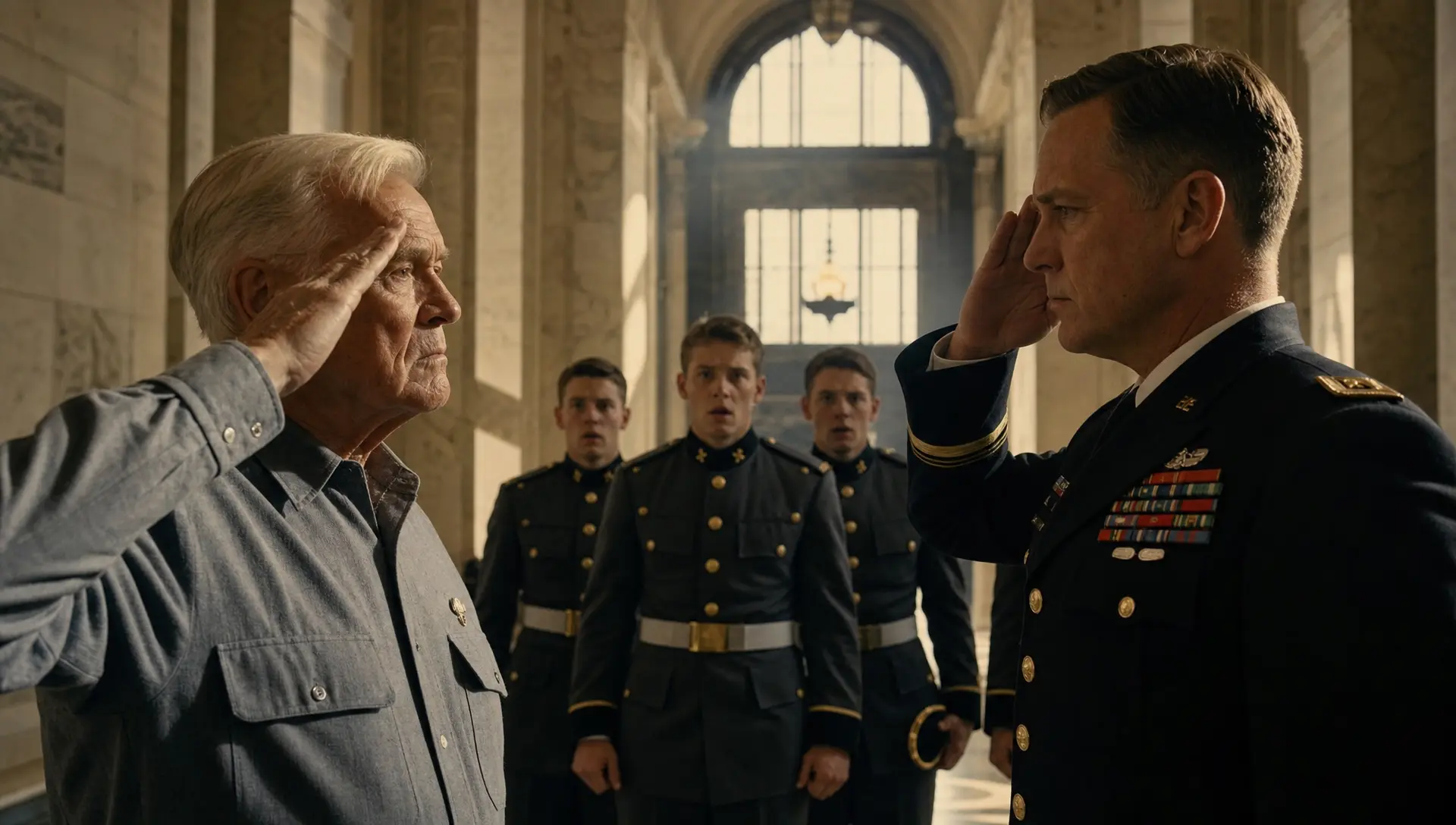
“Airborne.”
It wasn’t a shout. It was a physical percussion that hit the stone walls and bounced back through the limestone arches.
The stoop left Wayne’s shoulders with a dull, wet pop of shifting bone.
His heels—warped by age and old jungle rot—struck together with a resonance that matched Thorne’s cadence exactly. The broom handle slipped from his palms and clattered against the marble, but he didn’t watch it fall. His chin came up. His right hand snapped to his brow—fingers flat, wrist locked in a textbook plane that hadn’t been modified by fifty years of regulatory shifts.
“All the way, sir.”
The voice that came out of Wayne Jenkins did not belong to a janitor. It was the iron rasp of Hill 937. A command voice that had held an infantry perimeter through mortar fire for seventy-two hours.
Thorne brought his hand up. The salute was slow, deliberate, a heavy mechanical arch that stayed locked for three full seconds.
The silence in the rotunda grew dense enough to taste.
When Thorne’s arm came down, his visor turned toward Peterson. The cadet’s skin had gone the color of damp paste. His gaze moved from the Colonel’s ribbons down to the tiny hand-soldered silver star on Wayne’s pocket.
“Do you know what that pin is, Cadet?” Thorne’s voice had gone quiet—low and vertical, more dangerous than the initial command.
“Sir, it’s… a non-regulation emblem, sir. We were identifying a uniform violation—”
“That pin,” Thorne said, reaching into his tunic for the yellowed, split-spine notebook, “was struck from the scrap metal of an exploded command track. By the village elders of Da Nang province. In 1969.”
He held the notebook open. His thumb pointed to a yellowed page where a single line had been crossed out with dry adhesive tape that had begun to lift at the edges. Underneath the old glue, the name JENKINS, W. was typed in faded purple ribbon ink.
“It is the only physical record remaining of the Second Platoon, Charlie Company,” Thorne said, his voice climbing until it filled the dome, “because your grandfather’s administrative staff erased the unit’s morning reports from the West Point annex to cover up their own withdrawal failure.”
Peterson’s knuckle grazed the crease of his trousers, searching for something to hold onto.
“You are standing in the presence of Sergeant Major Wayne Jenkins,” Thorne announced. “Recipient of the Distinguished Service Cross. Three Silver Stars. Five Purple Hearts. The man who dragged your father’s operational commander out of a burning bunker while his own boots were on fire.”
The two cadets behind Peterson had gone gray around the jawline. Their shoulders had collapsed inward until their uniforms looked two sizes too large.
“He refused a battlefield commission four times,” Thorne continued. “He told the Department of the Army he didn’t want to wear a shirt that required other men to clean up his mistakes.”
The corridor was absolutely still.
Peterson’s mouth opened.
Nothing came out.
Thorne didn’t wait for it to. “The academy omitted the entire third-day command transition. They turned a seventy-two-hour defensive hold into an orderly withdrawal on paper—to protect the tactical reputation of your grandfather’s early command staff. The man your grandfather took credit for relieving from the field? He was already dead. He’d been dead for eighteen hours. Sergeant Major Jenkins knew it. The enlisted men knew it. The records were cleaned while they were still in-country.”
He stepped closer to Peterson. Close enough that the cadet’s chin dropped automatically into a position of subordinate attention he couldn’t have stopped if he’d tried.
“Your grandfather built his Senate career on a hill he never climbed,” Thorne said softly. “And this man—this man right here—spent fifty years sweeping floors in the building where that career was managed. And he never said a word about it.”
The blond cadet had gone absolutely still. His phone was at his side, screen dark.
Peterson’s mouth finally closed.
Thorne gave him three seconds of that silence—the full, heavy weight of it—before he stepped back.
“Tomorrow morning. Zero-six-hundred. You will be outside my office in full winter dress. You will spend your next six months turning the pages of the 106th Infantry’s casualty logs until you can recite the home address of every man who didn’t get to come back and sweep these floors.” He paused. “If your father has a comment on that schedule, tell him he can file it directly with my court-martial board.”
“Sir—” Peterson started.
“That wasn’t a discussion, Cadet.”
He turned his back on the cadets. Completely. Dismissed.
He looked at Wayne.
The old man hadn’t dropped his posture. But his eyes had softened, watching the three cadets slowly backing toward the elevators, their boots dragging through the gray dust on the floor.
The blond cadet glanced back once. Not with defiance. With something closer to the expression a person gets when they’ve realized they almost stepped off a ledge in the dark.
“They’re just kids, Marcus,” Wayne said, his hand dropping from his brow with a faint tremor. “They don’t know the difference between the uniform and the man inside it yet.”
Thorne reached down. His fingers wrapped around the hickory handle of the broom. He picked it up and held it out—his palms touching the worn wood where Wayne’s skin had left its polish.
“They’re about to learn, Sergeant Major.”
Wayne took the handle back. His fingers slid into the familiar grooves.
As he adjusted his grip, the pale light from the rotunda caught the underside of the silver star’s latch—revealing a microscopic series of notched letters scratched into the base metal with a bayonet point.
Names.
Names that had never appeared in any official West Point ledger.
Three months after the rotunda, Sarah got a letter.
It was on VFW stationery, printed in a slightly off-center typeface that suggested the machine was older than the men who used it. It thanked her by first name—just Sarah, no last name—for a phone call she had never officially documented and was therefore unable to put on her performance review.
At the bottom, below the secretary’s signature, someone had added two lines in a small, dense cursive that she needed to tilt the page toward the window to read.
Forty-seven names restored to the official registry. One of them is named for a woman from Topeka who made a call nobody asked her to make. You’ll know her if you meet her.
Sarah had read the note four times before she realized her grandfather had signed it.
She put it in the inside pocket of her blazer and wore it to work every day for the rest of the year.
Twelve months after the corridor, a shadow crossed the marble floor.
It didn’t come the way Peterson’s boot had come—fast, aggressive, with the hollow arrogance of someone who hadn’t yet paid for anything. It came slowly, with the weight of an earned understanding measured out in every step.
Wayne kept his stroke rhythmic. He followed the broom to the edge of the wall, then stood up and let the handle rest against his hip.
He didn’t turn around right away.
He’d learned, in seventy-eight years, that there was no rush in recognizing something when it finally arrived.
A young second lieutenant stood three paces away.
The uniform was different now—no longer the stiff twill of a first-year cadet, but deep wool-blend dress blues. A single gold bar on his shoulder straps, immaculate, catching the amber afternoon light without casting a glare. The shoes were polished, but not the kind of polished that was performed for an audience. The kind that came from habit.
It was Peterson.
The jaw was the same. But it was set level now. The muscles along his cheeks were tighter, cured by six months in the archives reading after-action reports by lamplight while Colonel Thorne stood behind him without saying a word. He had spent his winter counting the names of dead men until those numbers became faces that lived behind his own eyes.
He had sat in the depository basement until four in the morning on November 11th—Veteran’s Day—alone with a lamp and the Third Battalion’s casualty logs, writing out addresses in longhand until his pen ran dry. He’d had to borrow a second one from the overnight security guard, a retired Navy NCO who hadn’t asked what he was doing, just set a fresh coffee next to him and gone back to his station.
That had been the night Peterson understood the difference between a lesson and a reckoning.
He looked down at the pile of dust at Wayne’s feet.
Then his gaze moved slowly up to the gray work shirt.
The silver star pin was still there—same frayed thread, same pocket. But the latch had been cleaned. The tarnish was gone. The microscopic names etched into the base metal were now visible: the names of the Second Platoon, restored to the military academy’s official master registry three months ago after an anonymous operational review cleared the old records.
Peterson took a slow, deep breath.
He brought his heels together. A muted click—no bravado, no theater. His spine straightened into a position of attention that was no longer rigid or brittle. It was fluid, anchored by the weight of a legacy he had finally learned to carry.
His right arm came up. Hand flat. Wrist locked. The brim of his officer’s cap aligned exactly.
It wasn’t a salute required by regulation or commanded by a superior. It was a silent testament from a boy who had been broken down to a man who had learned what it cost.
Wayne looked at him for a long moment.
The silence between them wasn’t the suffocating stillness of a confrontation. It was the warm, quiet peace of a shared burden finding its proper place.
Wayne didn’t drop his broom. He kept his left hand on the smooth wood. But his chin came up, and he gave Peterson a single small nod—a barely perceptible motion that closed the ledger between them for good.
“Lieutenant,” Wayne said softly.
“Sergeant Major,” Peterson whispered. His arm lowered slowly. His fingers rested flat against his seam. He didn’t offer a speech or an apology. He stood in the amber light with his face reflecting the quiet grace of a lesson that had sandblasted away pride to leave something solid underneath.
He turned and walked toward the elevators.
Wayne watched him until the brass doors slid shut with a soft mechanical sigh.
Then he looked down at the floor. There was still a small patch of dust near the column that needed attention before the night shift ended.
A man’s worth wasn’t in the salute he received, or the archives that finally carried his name. It was in the job he did, and doing it right until the floor was clean.
He hooked his thumbs loose over the wood.
The afternoon light through the upper arches laid a long, amber rectangle across the marble—the same marble, the same dust, the same corridor it had always been. But the air in it felt different. Not lighter. Just cleaner. The way a room feels after a window has been open long enough.
Wayne Jenkins began to sweep.
He swept the small patch of dust near the column. He swept the thin gray line along the baseboard that the morning crew had missed. He swept slowly, patiently, the way a man does when he is not waiting for anything, because what he has been carrying has finally found the right set of hands.
He swept until the floor was clean.
And then he started on the next section, because the building was long, and there was still a lot of floor left, and a man’s worth was not in the moment when his name was finally spoken out loud.
It was in what he did in every quiet hour before and after.
Original fictional stories. AI-assisted creative content.