The church was full.
Four hundred people. White peonies on every pew. My father’s favorite hymn playing softly from the organ.
James was already at the altar when I started walking.
He was smiling.
He looked like everything I had chosen and everything I had trusted for three years.
I almost made it.
I was twelve steps from the altar when I heard it.
Small footsteps on the stone floor.
I stopped.
Everyone stopped.
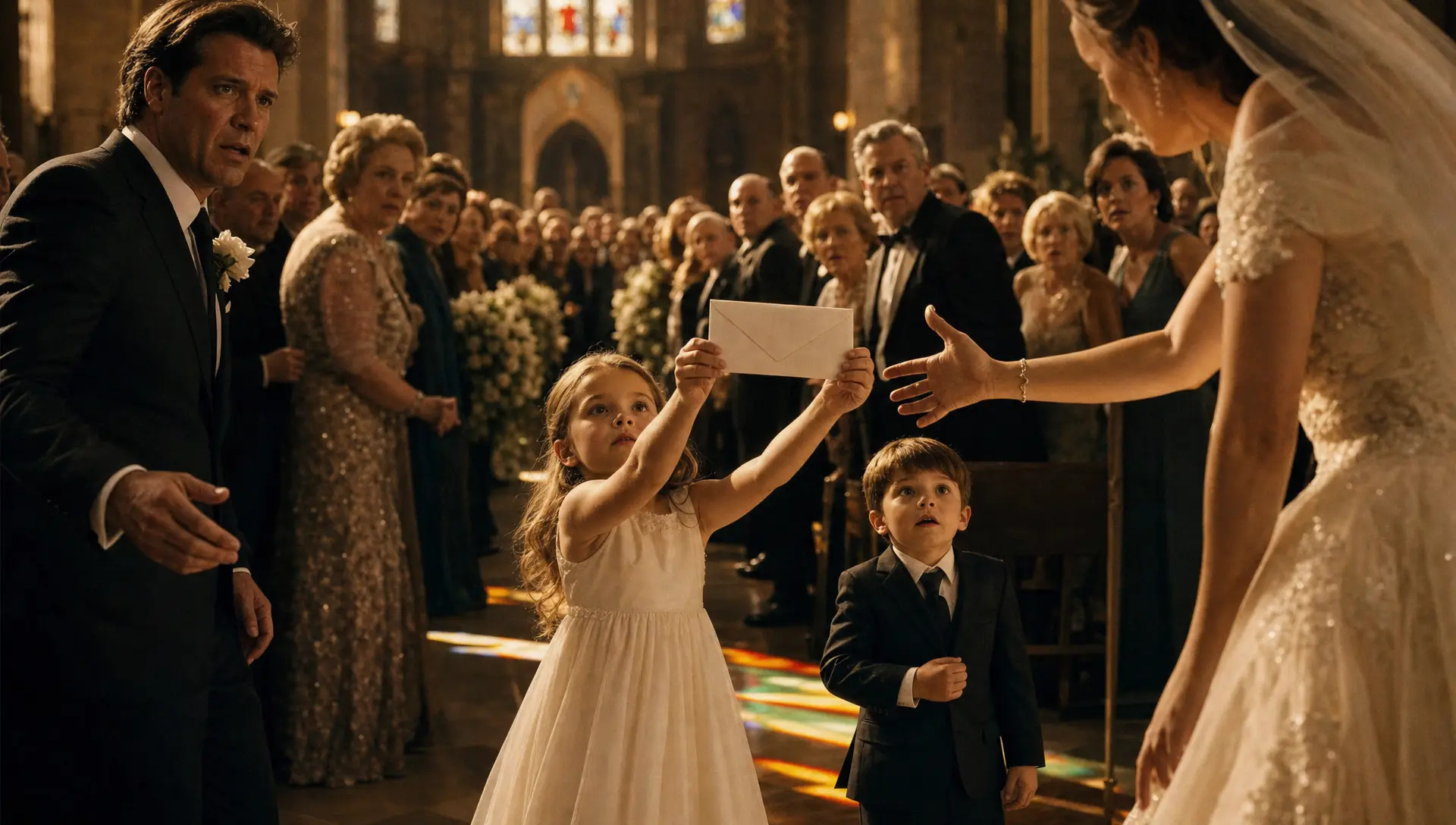
A little girl was walking down the aisle.
She was maybe seven. White dress. Brown pigtails. Backpack over one shoulder like she had just come from school.
Beside her, a boy who couldn’t have been older than five. One hand clutching hers. The other pressed against his jacket pocket.
The little girl walked all the way to the altar and looked directly at my groom.
“Are you James Miller?”
James went perfectly still.
He dropped my hand.
I noticed that before anything else.
He just — let go.
“Who brought you here?” he said. His voice came out flat.
She held up an envelope. “Our mommy said you needed to read this before you got married.”
A whisper moved through the pews like wind through grass.
I looked at James.
“Do you know these children?”
“No.” He said it too fast. The word came out like he had rehearsed it.
The little boy frowned up at him. “Yes, you do.”
James’s mother, Patricia, was on her feet before anyone else moved. She came down the side aisle in her ivory suit, heels clicking against the stone.
“Someone needs to remove these children immediately.”
The girl stepped back. Her grip on her brother’s hand tightened.
“No. Mommy said not to trust his mother.”
My stomach dropped.
I reached for the envelope before James could.
His hand shot out. “Claire. Don’t open that here.”
“Why not?”
“It’s obviously some kind of stunt.”
The girl shook her head slowly. “Our mommy is in the hospital.”
I looked at her.
Then I opened the letter.
The first sentence made my hands start shaking.
James Miller has two children. Their names are Sophie and Noah. I have the birth certificates. He signed both.
James reached for it.
I stepped back. “You told me you’d never been married.”
“I haven’t been.”
“That’s not what she’s saying.”
His parents exchanged a look. The kind that meant they already knew.
“Claire.” James lowered his voice to a register I recognized — the one he used when he wanted me to trust him without explaining anything. “I can explain everything. Not here. Please.”
I kept reading.
The letter said James had disappeared six years ago. He’d told a woman named Rebecca he was leaving Nashville for a work transfer. He’d changed his number. His apartment was gone. His employer said he’d relocated.
Then his mother had shown up at Rebecca’s door.
Alone.
With an envelope containing ten thousand dollars.
Rebecca had refused it.
Patricia had told her: James is beginning a new life. If you follow him, you will ruin him.
I lowered the letter.
I looked at Patricia.
She met my eyes without flinching. “That woman is unstable.”
“You visited her?”
“Years ago. It was a private matter.”
“A private matter.” I repeated the words slowly. “You helped your son disappear from his child’s life and you’re calling it a private matter.”
“Sophie is seven,” James said quietly. “This is complicated.”
Something about the way he said her name — without hesitating, without correcting himself — told me everything.
“You know her name.”
He closed his eyes.
“You said you didn’t know them.”
He said nothing.
The boy, Noah, finally spoke. He was still staring at his shoes. “He knows our names. He knows our birthdays too.” A pause. “He came at Christmas.”
Every head in the church turned toward James.
“Christmas,” I said.
“Claire—”
“You left our Christmas dinner. You said it was a work emergency.”
James rubbed both hands over his face. “I can explain.”
“Explain what? That you have a five-year-old son and you disappeared from his life after getting his mother pregnant again?”
Patricia’s voice cut through the silence. “This is not the place for this conversation.”
I turned toward her. “You lost the right to tell me what this place is for.”
She went quiet.
My maid of honor, Rachel, was suddenly beside me. She had moved without me noticing. She put one hand on my arm and positioned herself slightly between me and Patricia.
“I’m not going anywhere,” Rachel said quietly. It wasn’t directed at me.
Patricia looked at her. “You should stay out of this.”
“No,” Rachel said. Just that.
I turned back to the letter.
The second envelope — the one addressed only to me, CLAIRE HARPER, in shaky handwriting — was worse.
If James tells you he went back to Rebecca once and it meant nothing, he is lying.
He came back. Again and again. Sometimes at night. Sometimes when his mother sent him. Sometimes when he needed her to stay quiet.
I read that paragraph twice.
Then I looked at Noah. Five years old. Born three years after James had supposedly disappeared from Rebecca’s life forever.
“You went back to her,” I said.
James didn’t answer.
“You abandoned her, changed your number, let your mother offer her money to go away — and then you went back.”
“It was once.”
“It was enough to have another child.”
He said nothing.
My mother had been sitting in the front row, silent, one hand pressed over her mouth. Now she stood up.
Her voice was very controlled. “James. Look at me.”
He looked.
“Did you know about Noah before you proposed to my daughter?”
James’s jaw worked. “Yes.”
My mother sat back down. Slowly. Like something had gone out of her legs.
I returned to the letter.
Rebecca’s words had shifted in the second half.
She wasn’t explaining anymore.
She was warning me.
They are not marrying you because James loves you.
They need access to your company.
I stopped moving.
I read the sentence again.
Harper Development.
My father’s company. Everything he spent thirty years building.
The partnership agreement.
The one I had already agreed to sign the Monday after our honeymoon.
Eighteen million dollars of shared projects. A joint venture James had called a wedding gift. A new beginning for both families.
My father’s attorney, Daniel Marsh, had flagged the terms six weeks earlier.
He’d told me the asset-sharing clause was unusually broad. He’d asked me to wait.
James had been furious. He’d called it an insult. He’d used the word trust four times in one sentence.
Patricia had cried.
Charles had said the deal was a matter of family loyalty.
I had agreed to move forward.
I lowered the letter and looked at James’s father.
Charles was standing beside the first pew, jaw clenched, one hand gripping the back of the seat.
“Miller Construction is in debt,” I said.
Charles said nothing.
“How much?”
James answered quietly. “It’s manageable.”
“That’s not an answer.”
“The partnership would have solved it.”
“The partnership using my father’s company.“
“Claire, it was going to be good for both of us.”
“Was it?” I looked at the letter. “Because Rebecca seems to think the only thing keeping Miller Construction from collapse is that signed agreement. And she seems to know a great deal about your family’s finances.” I paused. “How does she know that, James?”
He didn’t answer.
“You told her.” I felt the words land as I said them. “You went back to her. You used her to keep a secret. And you talked.”
“I trusted her.”
“You trusted her.” The sentence came out almost calm. “But not me.”
He reached for my hand. “That is not what I meant.”
I stepped back. “Don’t.”
Sophie had been watching me steadily this whole time. She was too young to understand most of what was happening, but something in her face said she understood enough.
“Is she okay?” Sophie asked quietly.
I looked at her.
“Our mommy. Is she going to be okay?”
I crouched down.
My dress was worth three thousand dollars and I didn’t care.
“What happened to your mom?”
“There was a car accident this morning.” Sophie’s voice didn’t waver, but her eyes did. “She was driving us to Aunt Lisa’s. Then she got hurt and the ambulance came.” She swallowed. “She made us memorize what to say before she went in the ambulance. She made us promise.”
Noah spoke up. “She said give the letters to Claire. Not him.”
I looked up at James.
Something moved across his face. Not guilt exactly. More like a calculation that had suddenly failed.
“Someone hit her car,” I said slowly. “This morning.”
“Claire—”
“The morning of our wedding. After two nights ago, when you went to beg her to stay quiet.” I stood up. “And the car left the scene.”
“I don’t know anything about an accident.”
“Where were you this morning?”
“I was getting ready—”
“Charles.” My voice cut to his father. “Where was James this morning?”
Charles swallowed. “At the hotel.”
“Alone?”
A pause that lasted one second too long. “Yes.”
Rachel spoke from behind me. “He wasn’t at the hotel at seven. I called the hotel. The front desk confirmed James checked out at six forty-five.”
James turned toward Rachel. “You called—”
“I’m her maid of honor.” Rachel’s voice was flat. “I had a bad feeling.”
The church had gone from whispers to total silence.
I looked at Patricia.
She was very still.
“Two nights before the wedding,” I said, “you went to Rebecca’s apartment and offered her fifty thousand dollars to take her children and leave Tennessee.”
Patricia said nothing.
“Sophie.” I looked at the little girl. “Did a woman come to your house two nights ago?”
Sophie nodded. “The same lady from before. The one who brings envelopes.”
“And then your daddy came.”
“Yes. They argued outside. Mommy cried.”
I straightened up.
“Patricia. Did you arrange for someone to follow Rebecca this morning?”
“That’s an outrageous—”
“Did you know she was going to come here?”
“I knew she was unstable and I knew she would try to ruin—”
“Did you know about the accident?”
“No.”
“Then why,” I said, “when I told you someone hit her car and left the scene, did you look at Charles before you answered?”
The silence after that lasted a long time.
Charles looked at the floor.
Patricia looked at the window.
James looked at nothing.
I took one step toward the altar.
Then I stopped.
I set both envelopes on the altar step.
I looked at the pastor. He had the expression of a man who deeply regretted the past twenty minutes of his career.
“I need you to call 911,” I said. “And I need someone to get these children water and somewhere to sit.”
Rachel already had her phone out.
My mother crossed the aisle to Sophie and Noah. She crouched the same way I had. Her voice was very gentle. “Are you hungry?”
Noah nodded.
“I have a granola bar in my purse,” she said. “Is that okay?”
He nodded again.
My mother took his hand.
I turned back to James.
He was watching me. He still looked like James. Same face I had loved for three years. Same shoulders I had leaned on. Same hands that had held mine when my father died.
“I would have forgiven a lot,” I said.
He started to speak.
“I’m not finished.” I kept my voice level. “I would have forgiven a mistake. Even a serious one. I would have forgiven a child you had before me, if you had told me the truth. I would have argued with you and been hurt and I would have worked through it.” I paused. “What I can’t forgive is that you looked at me for three years and made a decision every single day to keep lying.” I glanced at Patricia. “Both of you.”
Charles made a sound.
I looked at him.
“Don’t,” I said. “You watched it happen.”
James’s voice was quiet. “Claire. I love you.”
“I know you think that’s true.”
“It is true.”
“You also think two children in a hospital waiting room are a problem you needed to manage.” I picked up my bouquet from where I had set it on the altar step. “You can’t love me and think that.”
I walked past him.
Rachel fell in beside me.
My mother followed, one hand resting lightly on Sophie’s shoulder, the other holding Noah’s small hand.
We walked back down the aisle.
Four hundred people watched us go.
Nobody stopped us.
The police arrived at the church before we made it to the parking lot.
They spoke to Patricia first.
Then Charles.
Then James.
I sat in a pew near the entrance with Sophie on one side and Noah on the other. Noah had eaten half the granola bar and was holding the other half very carefully, like he was saving it.
A detective crouched in front of me. “Ms. Harper. We need to ask you a few questions about the vehicle accident involving Rebecca Navarro this morning.”
“Of course.”
“Did you have any prior knowledge of—”
“No. I found out through her letter.” I nodded toward the altar, where a uniformed officer was photographing the envelopes. “She wrote everything down. She was very thorough.”
Sophie looked up at me. “Is Mommy in trouble?”
“No,” I said. “She’s not in trouble at all.”
“Is Daddy?”
I looked at the detective. He held my gaze.
“I don’t know yet,” I said honestly.
Sophie thought about this. Then she leaned sideways until her head rested against my arm.
“Mommy said you were going to be okay,” she said quietly.
I looked down at her.
“She said you were going to be sad but you were going to be okay.”
My eyes burned.
“She was right,” I said.
Rebecca Navarro spent eleven days at St. Thomas Midtown Hospital.
Broken collarbone. Two fractured ribs. Severe concussion.
She was released on a Thursday afternoon.
I was in her hospital room when she woke up the first morning — not the day of the wedding, but three days later, when the concussion had cleared enough for her to have visitors.
She looked at me for a long time without speaking.
Then she said, “You didn’t sign the papers.”
“No.”
“Good.” She closed her eyes again briefly. “How are Sophie and Noah?”
“With your sister. They’re okay.”
“Did Sophie—” She stopped. “Did she do what I asked?”
“She did everything exactly right.” I paused. “She’s remarkable.”
Rebecca’s eyes opened. They were dark and tired and very direct. “I know.”
“I’m sorry,” I said. “For all of it.”
She was quiet for a moment.
“You didn’t do anything to me.”
“No. But you were in this because of choices I didn’t question.”
She looked at the ceiling. “I knew about you. Two years ago, I saw his phone. Your name was in it.” A pause. “I didn’t warn you then.”
“Why?”
“Because I wanted him to choose.” Her voice was flat, not bitter. Just honest. “I wanted him to decide to come back, or to leave, or to tell you himself. I kept thinking he would do one real thing.” She looked at me. “He never did.”
“What changed?”
“The fifty thousand dollars.” She said it simply. “Patricia coming back. With a number. Like that was the conversation we were having.” A pause. “And then James at my door two nights before your wedding, telling me the partnership had to close or the company would collapse. He said it like it was my problem to solve. Like I was still supposed to protect him.” Her voice went quiet. “I’m done protecting him.”
I nodded.
“The letters were already written,” she said. “I had them for a month. I just kept deciding not to send them.”
“What made you decide?”
“Sophie asked me why Daddy’s name wasn’t on her school forms.” Rebecca’s voice didn’t break, but something in it went careful. “She’s seven. She’s starting to ask questions. I realized I had been protecting her from something she was going to find out anyway. And I decided I’d rather she grew up knowing her mother told the truth than knowing her mother stayed quiet for money.”
I left the hospital that afternoon and sat in my car for a long time.
Then I called Daniel Marsh.
“I need to know everything about the partnership agreement,” I said. “And I need to know it before James’s lawyers do anything.”
Daniel was quiet for a moment.
“I have notes,” he said carefully. “From when I flagged it originally.”
“Good.”
“Claire—”
“I know you warned me.”
“I wasn’t going to say that.”
“I know.” I exhaled. “Pull everything. We need to move fast.”
The investigation took four months.
The driver who hit Rebecca’s car was identified through traffic camera footage from a gas station two blocks from the accident scene. His name was Marcus Webb. He had been employed by Miller Construction for eleven years.
He was arrested on a Tuesday.
He told police that Patricia Miller had called him at six AM the morning of the wedding and told him Rebecca Navarro was driving a blue Honda Civic and needed to be “slowed down.”
Patricia was arrested the following Thursday.
Charles cooperated with investigators.
James hired three lawyers.
It didn’t help.
The court documents revealed that Miller Construction had accumulated nearly eleven million dollars in debt over four years. James had personally guaranteed several of the loans. The partnership agreement with Harper Development had contained a clause allowing Miller Construction to access Harper’s line of credit immediately upon signing.
Eighteen million dollars of my father’s company, used as collateral for debts James had never disclosed.
Daniel Marsh called it the cleanest fraud case he had seen in twenty years of corporate law.
“Clean how?” I asked.
“Documented,” he said. “James kept records. Very precise ones. He thought it was an asset. In case anything went wrong with the partnership, he had documentation that could protect him.”
“It became evidence.”
“Yes.”
I sat with that for a moment. “What about the trust? The family trust Charles set up?”
Daniel paused. “That’s an interesting development.”
“Tell me.”
“The trust required James to have legally acknowledged children before age thirty-five. He turns thirty-five in October.”
“He signed Sophie’s and Noah’s birth certificates.”
“He did.” A pause. “Rebecca’s attorney has filed a motion to compel recognition and establish a support order. If that succeeds — and it will — James will have legally acknowledged children on the record before October.”
“Which means—”
“Which means the trust transfers. To James.” Another pause. “Rebecca’s attorney has also filed a motion to attach that transfer as a child support asset.”
I sat quietly for a moment.
“Rebecca will get the trust money.”
“A substantial portion of it. Yes.”
“The money Patricia offered her to disappear.”
“Considerably more than that.”
I thought about a seven-year-old girl memorizing a message in the back of a car. I thought about a little boy holding half a granola bar like it was something precious.
“Good,” I said.
James pled guilty to securities fraud and breach of fiduciary duty in a deal that avoided trial.
He received three years of supervised probation, repayment of legal fees, and a formal bar from any directorial role in companies involving Harper Development assets for fifteen years.
Patricia was charged with conspiracy and reckless endangerment.
She was convicted.
She received two years, suspended to eighteen months with good behavior.
Charles settled with Harper Development separately. The settlement was sealed. My attorneys were satisfied.
I did not attend any of the hearings.
Rachel attended the sentencing for Patricia and texted me afterward: She looked at the judge the whole time like she expected him to apologize.
I believed it.
Six months after the wedding, I was sitting at my desk when my phone rang.
Sophie’s name was in the contact list. I had added it at Rebecca’s request.
“Hi,” Sophie said.
“Hi.”
“I made you something.” A pause. “Mommy said I had to ask before I mailed it.”
“You can mail it.”
“It’s a drawing.” A pause. “Of the church. But nicer.”
I almost laughed. “What does it look like?”
“I made the flowers bigger. And I took out your ex-fiancé.”
This time I did laugh.
“That sounds like an improvement,” I said.
“I thought so.” A pause. “Noah wants to say something.”
A shuffling sound. Then Noah’s voice, very serious. “The tooth fairy owes me ten dollars.”
“Why ten?”
“Inflation.”
I bit back a smile. “Tell her to get a lawyer.”
A short silence.
“Okay,” Noah said. He seemed satisfied with this answer.
Sophie came back on. “We’re coming to dinner Sunday.”
“I know.”
“Mommy made you lemon cake.”
“She didn’t have to do that.”
“She wanted to.” A pause. “She says you’re good people.”
I looked out the window at the Nashville skyline.
“So is she,” I said.
The drawing arrived two days later.
It was crayon on printer paper, folded four times.
The church had large pink flowers on every pew. The stained glass windows were purple and orange. There were two small stick figures at the front — one in a white dress, one in pigtails.
On the back, Sophie had written:
Claire,
Mom says letters can change lives.
I think she is right.
Thank you for reading ours.
Love, Sophie and Noah
I framed it.
It went on my desk beside a photograph of my father.
Two reminders. One of where I came from. One of why truth mattered.
That evening I sat on my back porch as the sun dropped behind the trees. The Nashville lights came on one by one.
I had not gone quietly into any of it — not the investigation, not the depositions, not the long months of untangling a lie that had been built carefully for three years.
But I had gone forward.
Every day I woke up and chose the life I was actually living over the one I had been sold.
It turned out the life I was actually living was better.
Not easier.
Better.
My phone buzzed.
Rebecca: Sunday still on? Sophie has been asking since Tuesday.
Me: Absolutely.
I set my phone down.
The bravest thing I said on my wedding day wasn’t yes.
It was no.
No to a man who saw my father’s company when he looked at me.
No to a family that had been running the same play for decades.
No to confusing loyalty with surrender.
And somewhere across Nashville, two children who had once walked down a church aisle carrying their mother’s warning were safe, and known, and no longer anyone’s secret.
That was enough.
That was more than enough.
Original fictional stories. AI-assisted creative content.