Ray “Hammer” Dawson was the kind of man crowds moved aside for without knowing why.
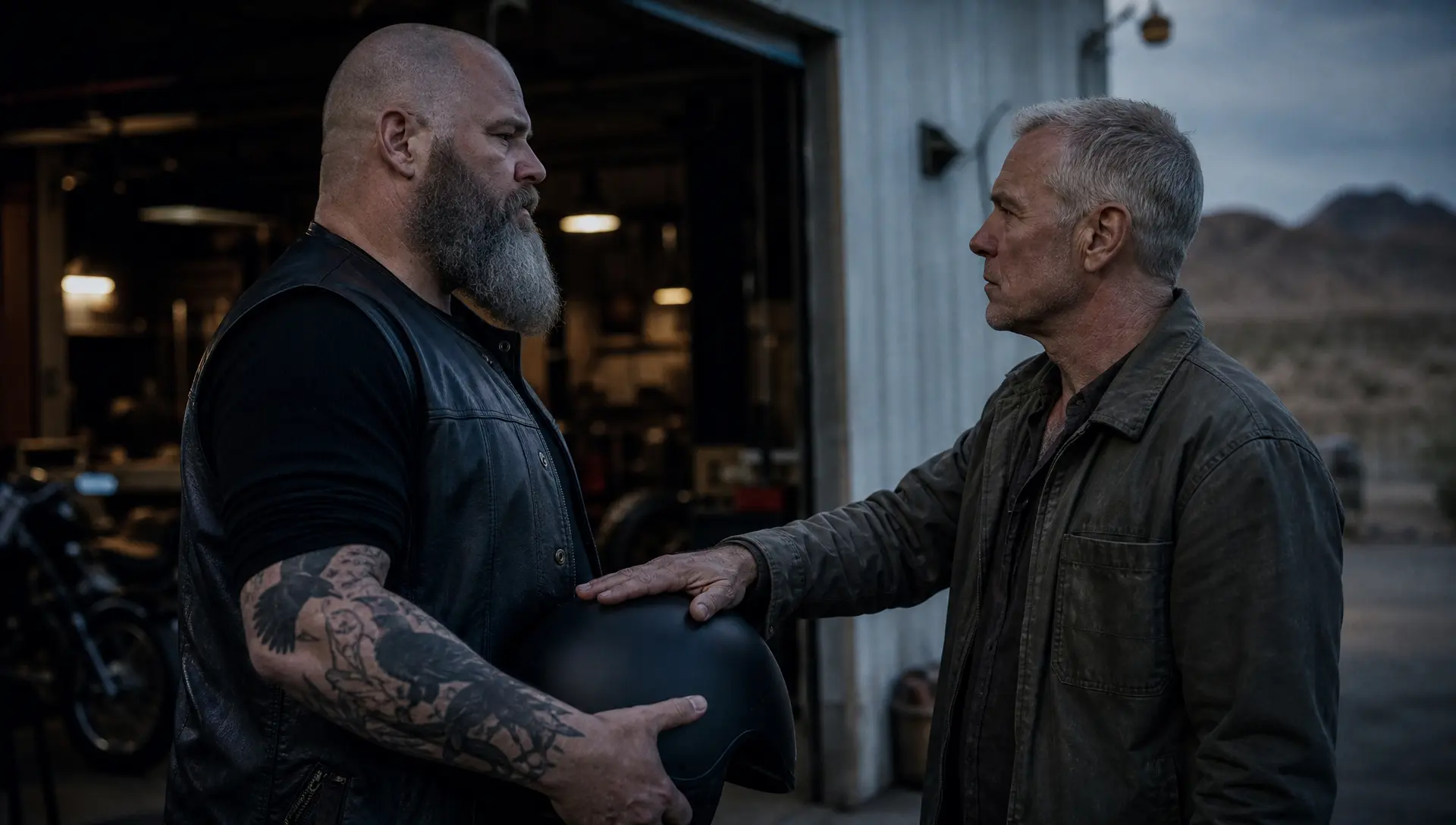
Six-foot-four, 285 pounds, ravens tattooed from his wrists to his collar, and a black leather cut worn soft from twenty years of Arizona highway. He’d been running Dawson Cycle Repair in Flagstaff for over a decade. He’d buried his brother. He’d never closed his shop for anything.
That morning, he was about to climb onto his Road Glide.
A thin man in a dirty army coat came running from the bus shelter before Hammer reached the chin strap.
“Don’t put that on.”
Hammer looked at him once. Then reached for the strap anyway.
The man lunged.
He ripped the helmet from Hammer’s hands and swung it hard against the curb. The black shell tore near the temple. A woman screamed. Two club brothers — Boone and Preacher — had the man face-down on the pavement in seconds.
“What the hell is wrong with you?” Boone shouted.
The man didn’t fight. He just stared at the broken helmet.
That was the only thing that slowed Hammer down.
“You got three seconds,” Hammer said.
The man raised his head from the concrete. No blood. Calm eyes.
“Pull the shell back. Above the right temple. Look at the liner.”
Nobody moved.
“Do it.”
Mara Velez — Dawson’s shop manager, the woman holding two coffees and a phone argument twenty feet away — walked over and knelt beside the wreckage.
She pressed the foam.
The liner opened along a hairline split that ran crown to temple. Two sections moved independently under her thumb.
“That happened when he hit it,” Boone said.
The man shook his head. “My strike opened the shell. That crush line was already inside. See the white powder? The flattened cell wall? That damage was old.”
Hammer crouched. His scarred fingers stopped an inch from the fracture.
“It was dropped,” Mara said quietly.
She remembered it now. The teenager, Cody, carrying helmets from a customer truck the afternoon before. A crash from the storage room. The kid calling out that everything was fine.
She’d never checked.
The man spoke again, still flat on the ground.
“If he rode at highway speed with that liner, the helmet could have opened where his skull needed it most.”
The crowd had stopped shouting.
Phones were still raised. But no one seemed sure anymore who the dangerous man was.
Hammer ordered Preacher to release him.
The stranger stood, collected his canvas tool pouch, and walked away without asking for money, an apology, or even a thank-you.
Hammer watched him disappear toward the railroad underpass.
Then he looked at the two pieces of his brother’s helmet in his hands.
Tommy had painted that red line along the back. Wrong paint — it had peeled the first week. Hammer had never fixed it and never replaced it.
He didn’t start his Harley.
The next morning, Dawson Cycle was closed for the first time in eleven years.
Hammer stood at the center workbench turning the broken liner over in his hands. Tommy’s old photograph had come out of the toolbox drawer.
Mara arrived at 6:40 and found the chain across the entrance.
“Where are we going?” she asked.
“Find him.”
“You know his name?”
“No.”
“Where he sleeps?”
“No.”
“Then how?”
“Man carries an inspector’s pencil.”
His name was Samuel Reed. The barista at the coffee shop knew him as Sam. The city bus driver gave her the last name. A few more questions and the picture started filling in.
Sam had been chief safety inspector for an aerospace supplier, then a fall-arrest equipment company. His certifications had expired. His license had been suspended.
His son, Lucas, had died at twenty-seven.
A lanyard had torn. A copper mine. A conveyor platform.
Sam had signed off on the batch of lanyards three months before. He’d done a visual inspection, run a pull test, cleared them. He hadn’t done destructive sampling because the company hadn’t wanted to sacrifice saleable units.
When the fibers failed, he was the first person to reach the scene.
He’d seen the chemical embrittlement under magnification. The damage had been invisible to the eye.
North Rim paid a settlement. Sam’s license was suspended for documentation violations. He could have gotten recertified.
He never applied.
Eleven months after Lucas died, his wife Ellen died too. He stopped paying the mortgage. Stopped opening mail. Truck eventually got repossessed.
He’d been on the street for four years.
They found him under the railroad underpass, kneeling beside a shopping cart, winding safety wire through the cracked wheel of a child’s stroller.
He saw the truck and stopped.
“If you came about the helmet, I’m sorry about the paint.”
Hammer held up the evidence bag. “You saved my head.”
“I damaged your property.”
“You saved my head.”
Sam looked at the stroller. “Both can be true.”
He agreed to inspect the garage for one day.
Twenty-five dollars an hour. No certification claims. One day.
His first act was to wash his hands.
His second was to ask for red tags.
Within two hours: three extension cords, a mushroomed chisel, two scratched face shields, a leaking hydraulic jack, an overdue torque wrench, and the aluminum ladder they’d trusted for seven years.
Boone — forty-nine, wide through the shoulders, proud of having fixed motorcycles since he was fifteen — tore the red tag off the ladder.
Sam attached another.
Boone tore that one off.
Sam attached a third.
“Do that all day?” Boone asked.
“If required.”
Boone stepped close enough their shirts nearly touched. Sam was five-nine, maybe 145 pounds. Standing next to Boone, he looked like the wrong shadow was being cast.
He didn’t move.
“I’ve been wrong before,” Sam said. “When I am, the cost is embarrassment. When damaged equipment is wrong, the cost belongs to whoever trusted us.”
Hammer stopped at that word.
Trusted.
He called a shop meeting. Locked every lift. Told twelve waiting customers they’d need to reschedule.
“Nothing moves until Reed clears it.”
“Man ain’t certified,” Boone said.
“Neither was his eyeball yesterday.”
“That supposed to make him boss?”
“Makes him right once.”
“Once ain’t enough.”
Hammer looked at Sam. “Then earn twice.”
At Lift Three, Sam stopped.
A school principal’s touring Harley was suspended three feet off the floor. Boone had installed tires and planned to finish the brakes that afternoon.
Sam crouched near the left column.
“Lower it.”
“Lock is engaged.”
“Lower it now.”
“What do you see?”
Sam didn’t blink. “Nothing yet.”
Boone laughed.
Hammer did not.
They lowered the Harley and rolled it clear. Sam pulled the steel cable cover. Behind it, one strand had broken near the upper pulley. Grease had hidden the frayed ends.
“Out of service,” Sam said, and attached a red tag.
Boone ripped it off.
This time Hammer grabbed his wrist.
The leather of his vest creaked. His voice stayed low.
“Tag stays, brother.”
Boone looked around at the club. Pride turned his face hard.
“You taking his word over mine?”
“Taking the broken wire over both.”
Boone dropped his shop key on the workbench and walked out.
Three other Iron Lanterns followed.
Their exhausts hit the metal doors like accusations.
Sam watched through the window until the last bike disappeared onto Route 66.
Then he removed the red pencil from behind his ear.
His hand had started shaking.
He tried to leave at noon.
Hammer locked the cash drawer before Mara could open it.
“Job ain’t done.”
“Your crew walked out.”
“They know the road home.”
“What if they don’t come back?”
Hammer shrugged. “Still got a shop to inspect.”
Sam looked at the empty bays.
“You always this stubborn?”
“Only on breathing days.”
He stayed.
At 12:17 a.m., while Hammer and Mara were in the office ordering cable, a metallic snap struck the garage floor.
Lift Three dropped six inches.
The secondary lock caught it.
No motorcycle was on the platform. No mechanic stood underneath. The cable had kept unraveling until the remaining strands failed under the empty lift’s weight.
If the principal’s Harley had still been overhead, the sudden load might have twisted the platform away from the lock. Boone could have been bleeding underneath it.
Sam stared at the crooked lift.
He didn’t look vindicated.
He looked sick.
Hammer walked to the shop phone and called Boone.
Six words.
“The cable went. Reed saved you.”
Boone was back before sunrise.
He came through the side door without his vest, carrying two paper bags from an all-night diner. Sam was asleep upright in the office chair, army coat folded under his head.
Boone set a breakfast burrito beside him.
Then he picked up the shop key he’d left on the workbench — and placed it next to Sam’s inspector pencil.
When Sam woke, Boone was across the room drinking coffee.
“I put you on the pavement yesterday,” Boone said.
“You believed I was attacking your brother.”
“Still did it.”
“You released me when told.”
“That ain’t an apology.”
Boone waited. Sam took a bite.
“I’m sorry,” Boone finally said.
“Accepted.”
Hammer announced the new position that morning.
Safety and Equipment Inspector. Thirty hours a week to start, full-time after recertification. Health insurance after ninety days. Use of the employee shower. A room above the garage.
“You wrote this before asking if I wanted it,” Sam said.
“Would’ve wasted time otherwise.”
“Why me?”
“Because everybody else saw a scuff.”
Sam touched the inspector’s pencil. “I saw a scuff too.”
“No. You saw what it could hide.”
Sam slid the packet back.
“I can’t take responsibility for another man’s safety.”
Hammer picked up Tommy’s broken helmet. Removed the old comfort liner. Set the fractured foam beside it.
“You already did.”
“One time.”
“Twice. Lift cable.”
“I could miss the third.”
“So could Boone. So could me.” Hammer’s voice dropped. “You don’t get to make Lucas’s death mean you’re forbidden from preventing another.”
Sam flinched like he’d been struck.
He opened the packet.
Signed on the final page with the hard red pencil.
His first official act was to fire the broken helmet into the scrap bin.
Hammer retrieved it.
“Evidence,” he said.
“Unsafe equipment must be destroyed beyond reuse.”
“Ain’t reusing it.”
“Someone else might.”
Hammer stared at it. Then carried it to the band saw. He cut through the chin bar, the crown, and Tommy’s painted red line — slow passes, each one making his shoulders tighten.
When he finished, Sam swept the pieces into a box.
Neither man spoke.
Some things deserve silence.
Sam’s first month cost the garage $18,430.
He quarantined twelve customer helmets, replaced every unlabeled chemical bottle, rejected tie-downs they’d used for years, and found two fire extinguishers listed as serviced that had never been recharged.
Boone complained about every invoice.
Then helped install every replacement.
Cody, the teenage helper who’d concealed the helmet drop, expected to be fired. Hammer made him stand in front of the whole shop and explain what happened instead. The kid’s voice shook the entire time.
Sam didn’t humiliate him.
He taught him how to log dropped protective equipment, why a heavy object inside a helmet changes the impact physics, and when visual inspection isn’t enough. Then he handed the boy a new clipboard.
INCIDENTS.
No punishment hidden in the word.
“Bad news gets more expensive when it travels slowly,” Sam told him.
Cody never hid another mistake.
Sam’s certifications came back in the spring.
Before the Iron Lanterns’ next long ride, he inspected every rider’s helmet in the parking lot. Thirty-one motorcycles, dawn still gray over Route 66.
Some members made jokes. None skipped the line.
Red tags appeared on three helmets. Their owners complained. Then walked inside to borrow replacements.
Boone presented a hard case — gauges, mirrors, marking pencils, a tablet for records — purchased with money the club had collected.
A small brass plate sat on top.
SECOND EYES.
Sam ran his thumb across the letters.
“You fellows know I work here, right?”
“Rumor reached us,” Preacher said.
“You don’t need to give me equipment.”
“Wasn’t a gift,” Boone said. “We got tired of you borrowing ours.”
Sam looked at him.
Boone held his face straight for nearly three seconds.
Then both men laughed.
Hammer came out last.
He wore a new matte-black full-face helmet. No paint. No sentimental history. Nothing that would persuade him to keep it beyond its safe life.
Before he put it on, he handed Sam a small wooden box.
Inside was a section of Tommy’s old helmet shell, bearing half of the broken red line.
Sam had assumed every piece had been destroyed.
“I thought you destroyed it,” he said.
“Destroyed the helmet. Kept the paint.”
Sam lifted the fragment. “Why give it to me?”
“Ain’t giving it.”
Hammer nodded toward the inspection room.
“Put it on the wall.”
The room above the garage had a window now, a heater, and a lock.
Sam’s shopping cart stayed behind the garage.
Hammer asked why.
“Reminder,” Sam said.
“Of what?”
“That possession and permanence aren’t the same thing.”
Before the club rolled out that morning, Sam checked Hammer’s strap, tugged it once, and struck the top lightly with his palm.
“Serviceable.”
Hammer swung onto the Road Glide.
“You riding with us?”
Sam looked toward the spare touring motorcycle near the door. Boone had been restoring it for months without explaining why. A new helmet sat on its seat.
Sam’s breathing slowed.
“Not today.”
Hammer nodded. No disappointment. No pressure.
“Next ride, then.”
“Maybe.”
“Means yes.”
The Harleys started one by one, their V-twins turning the cold morning into something you felt through your shoes. Taillights became small red dots beneath the pale Arizona sky.
Sam stood outside the garage with a red pencil in one hand and Tommy’s broken strip of paint in the other.
He didn’t ride with them that morning.
But he was there when they returned.
And on the wall of the inspection room, beneath the helmet fragment and the failed lift cable and his first red tag, there was no photograph of the confrontation, no newspaper clipping, no dramatic account.
Only three damaged things.
People who entered understood soon enough.
Original fictional stories. AI-assisted creative content.