The morning rush was all noise and cold air.
Richard Coleman stepped out of his black SUV in front of the glass tower he owned and straightened his cuffs. Fifty-three floors of his name on the lease. He never got tired of looking at it.
That’s when he saw the man.
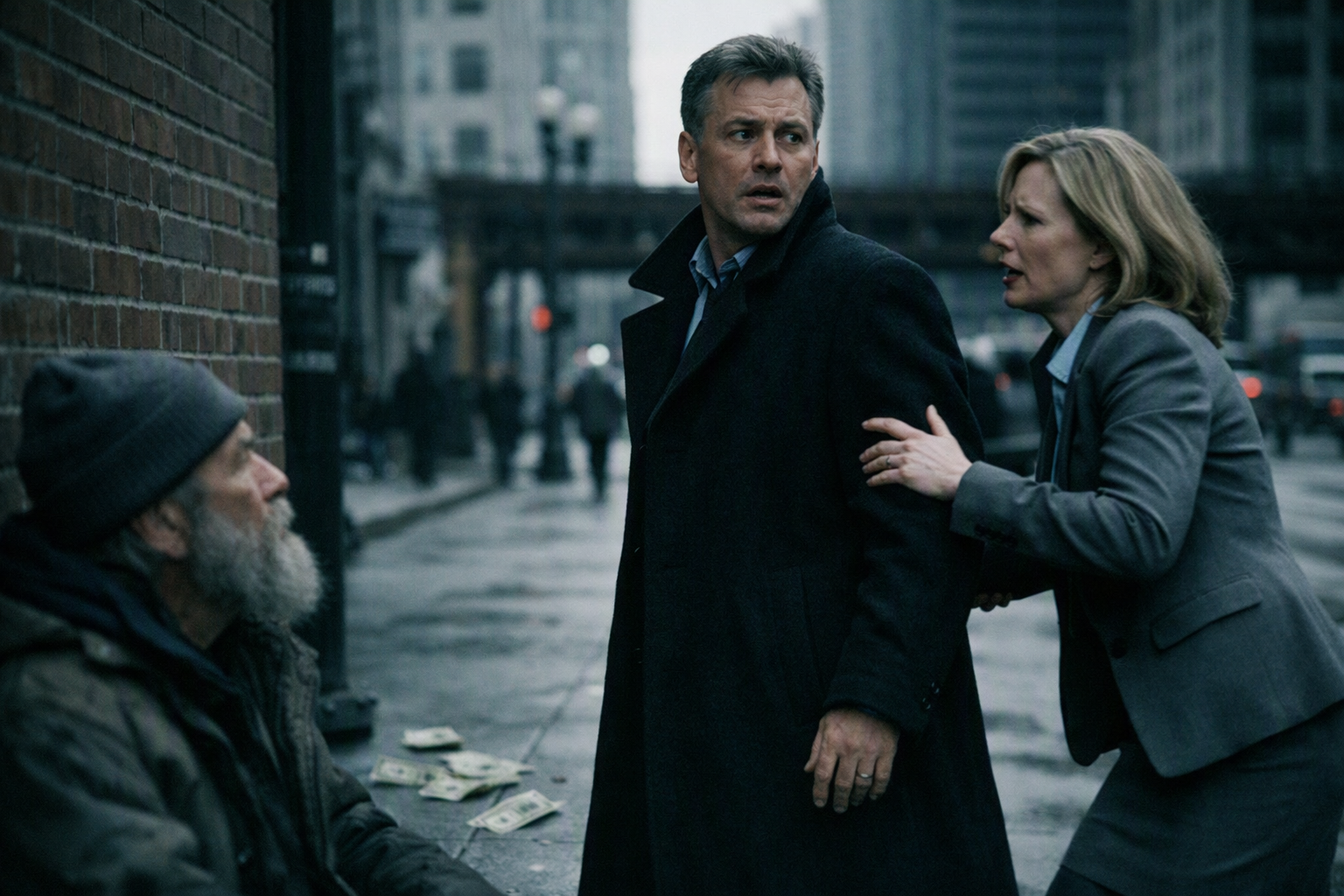
Sitting cross-legged on the corner, back against the brick, was a homeless man — older, weathered, coat held together by a single button. His face was deeply lined, his beard long and unkempt, his boots cracked at the toe. He could have been sixty. He could have been older. Beside him sat a small cardboard sign. It didn’t say “Hungry” or “God Bless” or “Anything Helps.”
It said: God sees every choice.
Richard stared at it. Then he laughed through his nose.
He pulled out his wallet, peeled off four twenties, and flicked them. They spun through the cold air and landed on the sidewalk near the man’s feet.
“There,” Richard said, loud enough for the people around him to hear. “Buy yourself some food.”
He waited. People nearby had slowed to watch.
The homeless man looked down at the bills on the pavement. Then he looked up at Richard. His eyes were calm — not grateful, not angry. Just calm.
“Keep it,” he said. His voice was low and even.
Richard raised an eyebrow. “Excuse me?”
“Take it back.” The man held his gaze. “You’ll need it soon.”
A few people exchanged glances. Someone stifled a laugh. Richard felt his face go warm.
“I own three factories,” he said flatly. “I have more money than you will see in your entire life.”
He leaned in slightly. “Worry about yourself.”
The man nodded once. Unhurried.
“I hope you’re right,” he said.
Richard straightened, adjusted his jacket, and turned toward his building — already reaching for his phone, already done with this.
He was still smiling when he heard the heels.
“Mr. Coleman!”
Melissa — his personal assistant — was running across the street toward him in her gray suit, which she never did. Her face, which was always composed, was not composed.
She reached him breathless and leaned in close.
“Factory One,” she whispered. “It’s on fire.”
Richard’s smile disappeared.
“What?”
“The fire department is already there. Several production lines have collapsed. News helicopters—” She swallowed. “It’s live on every channel right now.”
He grabbed his phone. The screen was a wall of notifications. His financial director. Operations. Insurance. Legal. Reporters. Fifty-three missed calls.
His knees went soft. He grabbed Melissa’s arm.
The people on the sidewalk had stopped moving. Someone was filming.
Richard turned slowly. The homeless man was still sitting exactly where he had been — back against the brick, hands in his lap, watching Richard with the same unhurried calm.
Richard stared at him.
The man said nothing.
Richard’s driver had pulled the SUV back around. Melissa was already on her phone, calling the operations team. The world was urgent and loud and pulling him forward.
He let himself be pulled. But he didn’t look away from the man until the door closed.
Factory One burned for six hours.
Every production line in the east wing collapsed. Eighty percent of the facility was destroyed. Somehow — impossibly — every worker got out. No one died. The fire chief called it a miracle of timing.
Richard didn’t call it anything. He stood at the edge of the police barricade and watched the smoke rise and thought about a cardboard sign that said God sees every choice.
The financial damage was catastrophic. Production halted. Three major contracts were suspended. Share price dropped fourteen points by close of market. Calls from investors he hadn’t spoken to in years, their voices careful and cold.
He went home that night to his enormous, empty house and did not sleep.
The next morning he went back to the corner.
The man was gone.
He asked at the coffee shop on that block. The owner said yes, the man came sometimes. No, she didn’t know where he stayed. No, she’d never seen anyone come for him.
Richard came back the next day. And the day after.
Weeks passed.
He found him on a rainy Thursday under a bus shelter on Wabash.
Richard walked over with a bag — sandwiches, a blanket, a thermos of hot soup. He felt slightly ridiculous. He did it anyway.
The man looked up and said nothing for a moment. Then: “Took you a while.”
Richard sat down beside him. Set the bag between them.
“I’ve been looking for you.”
The man accepted a sandwich. “Why?”
“I need to understand what happened.”
The man unwrapped the sandwich slowly. “What do you think happened?”
“You knew,” Richard said. “Before any alarm went off. Before anyone called. You knew.”
The man took a bite. Chewed. Said nothing.
“How?” Richard asked.
The man looked at the rain hitting the street.
“You threw those bills,” he said, “because you wanted people around you to see how generous you were.”
Richard opened his mouth.
“You weren’t helping me,” the man continued. Not unkind. Just level. “You were feeding your pride. There’s a difference.”
Richard closed his mouth.
“Real kindness doesn’t need an audience.”
The words landed somewhere Richard hadn’t expected. He sat with them.
“I’ve spent thirty years building a company,” he said finally. “I forgot there were people inside it.”
The man nodded. “Then maybe losing something helped you find something.”
Richard went back to work differently.
He didn’t lay off a single worker to cover the recovery costs. He reduced all executive compensation — his own first. He held a company-wide meeting, stood at the front without notes, and told twelve hundred employees that no one was losing their job over a fire.
The room was quiet for a moment. Then someone started clapping in the back.
He visited workers who had been treated for smoke inhalation. Sat in waiting rooms with their families. Set up an emergency fund for struggling households. Started walking the floors instead of taking the elevator.
Employees who had once avoided him started saying good morning.
The company recovered. Slowly, then faster.
Years passed.
Richard funded three homeless shelters on the South Side. He created a scholarship program for adults coming off the streets — job training, housing assistance, a real path out. Every Christmas Eve he served meals at the shelter on Michigan Avenue. No photographer. No press release. Just him and an apron.
When reporters asked what had changed him, he always gave the same answer.
“I met a man who told me the truth.”
They’d ask where.
He’d smile. “On a street corner.”
One December evening, five years after the fire, Richard walked back to the intersection on his own.
Snow on the sidewalks. City lights soft and close. He carried white flowers and set them against the brick wall where the man had once sat.
He stood there with his hands in his coat pockets.
“You knew him?”
He turned. An old janitor — lean, white-haired, push broom in hand — was watching him from a few feet away.
“Yes,” Richard said.
The man looked at him with something like surprise. “That’s strange.”
“What do you mean?”
“I’ve worked this block twenty-five years.” The janitor nodded toward the corner. “Seen thousands of people come through. Never saw any man sitting there.” He pointed up at the camera mounted on the building face. “City camera. Never cuts off. People have asked about this man before — a few of them, over the years.” He shook his head. “Camera never shows anyone sitting there.”
Richard went very still.
The janitor shrugged gently and went back to his sweeping.
Richard looked at the corner.
Then he saw it.
A single folded piece of paper resting against the base of the wall. He bent and picked it up. His hands weren’t steady.
Inside, in plain handwriting:
The richest people aren’t those who keep their money — but those who change before life forces them to.
No name. No date.
He looked up. The street was empty in both directions. Snow moved quietly across the pavement.
He folded the paper and put it in the inside pocket of his coat, close to his chest.
He had spent thirty years believing money was the measure of a man.
It had taken one cold morning, four twenty-dollar bills, and a stranger with nothing to his name to show him what the measure actually was.
He walked home. And for the first time in a very long time, he felt like a rich man.
Original fictional stories. AI-assisted creative content.