Captain Ryan Brooks drove his boot into the cafeteria table before Samuel Grant could say a word.
The steel legs shrieked across the tile. A coffee pot tumbled toward the edge.
Samuel reached for it. The handle caught his fingers. The pot hit the floor.
Brown coffee exploded across the linoleum—up chair legs, across polished boots, along the white baseboards.
Three ceramic mugs followed.
They shattered with sharp cracks that killed every conversation at the nearest tables.
For one suspended second, nobody moved.
Then Ryan looked around and smiled.
His smile gave the room permission to breathe again.
A few junior officers laughed nervously. Others stared hard at their breakfast trays.
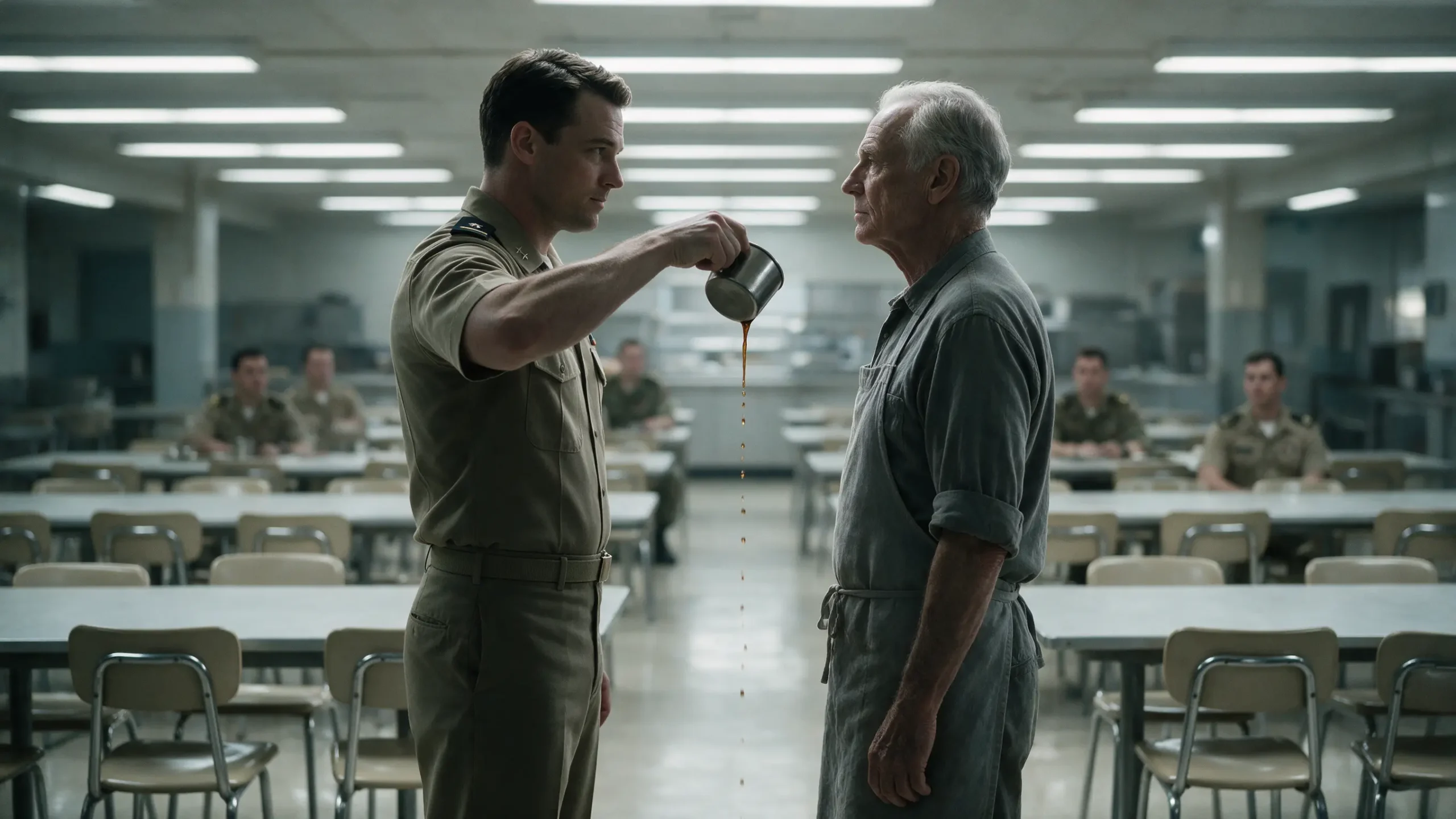
Ryan picked up his cup and tilted it. A thin ribbon of steam rose.
“Barely warm,” he said.
Samuel looked at the cup. Then at Ryan.
“I can bring a fresh pot, sir.”
Ryan tipped the cup slowly. Coffee poured onto the floor beside Samuel’s shoe.
“Should’ve done that the first time.”
More laughter. Louder this time.
Samuel’s face didn’t move. He crouched toward the broken mugs.
“Leave it,” said Ryan.
Samuel paused.
Ryan stepped forward until his boot toe touched a white ceramic shard.
“I said leave it.”
Samuel straightened.
He had worked that cafeteria for nine mornings. He arrived before sunrise. He tied the same faded gray apron. He moved slowly, listened more than he spoke, and kept his eyes low.
Most people stopped noticing him by day two.
Ryan had noticed him immediately.
Not because Samuel caused trouble. Ryan noticed anyone he believed stood beneath him. And in that cafeteria—apron, coffee pot, broken mugs—Samuel looked like the bottom of the entire chain.
Ryan was thirty-eight. Broad-shouldered. Decorated. Men competed for his approval.
His evaluations praised his tactical confidence. His subordinates praised his courage. The kitchen staff used different words when he couldn’t hear them.
Samuel had heard those words while wiping counters.
Arrogant. Cruel. Dangerous when embarrassed.
He’d heard something worse too: that several officers believed Ryan’s behavior was simply leadership.
Now Ryan stared at him across the spreading coffee.
“What are you waiting for?”
“Permission to clean the floor, sir.”
A few smiles disappeared. Ryan’s jaw shifted.
“Permission,” he repeated. He let the word sit there. “You need permission to do your job.”
“I needed permission to stop doing it, sir.”
The room went quiet in a different way than before.
Ryan’s eyes narrowed. He opened his mouth.
A door opened at the far end of the cafeteria.
Rear Admiral James Hale walked in.
Hale was the kind of man a room reorganized itself around. Straight posture. Sharp eyes that moved fast and missed nothing. He scanned the cafeteria the way officers scan a perimeter—one slow pass, cataloguing everything.
His gaze landed on the broken mugs.
On the spreading coffee.
On Samuel, standing still in the middle of it.
Then on Ryan, who straightened immediately and cleared his throat.
“Admiral Hale,” Ryan said, his voice reset to professional register. “Good morning, sir.”
Hale didn’t answer right away.
He walked across the cafeteria at a pace that forced the room to wait. Officers near the affected table shifted backward, creating a loose semicircle.
Hale stopped two feet from Samuel.
He looked at the broken mugs. He looked at the coffee stains on Samuel’s apron. He looked at Samuel’s hands—the knuckles, the way one was still curled from where the pot handle had struck.
Then he looked at Ryan.
“Captain Brooks,” Hale said quietly.
“Sir.”
“Did you cause this?”
Ryan blinked. “There was an incident with the coffee service, sir. The temperature wasn’t—”
“I didn’t ask about the temperature.”
Silence.
“Did you cause this?” Hale asked again.
Ryan’s chin lifted slightly. “The coffee wasn’t properly prepared, sir. I was—”
“Captain.”
“Sir.”
“Stop.”
Ryan stopped.
Hale turned back to Samuel.
“Are you injured?”
Samuel looked at his hand. “No, sir.”
“Your hand says otherwise.”
“It’s nothing, sir. I’ve had worse.”
Hale studied him for a moment. Something moved behind the admiral’s eyes—recognition, maybe. Or something older than recognition.
“What’s your name?”
“Samuel Grant, sir.”
“How long have you worked here, Samuel?”
“Nine mornings, sir.”
“And before that?”
A beat.
“Somewhere else, sir.”
It was technically true.
Hale let it pass.
He turned to the nearest junior officer—a lieutenant named Cho who hadn’t laughed, hadn’t looked away, hadn’t done anything except stand very still and watch.
“Lieutenant,” Hale said.
Cho straightened. “Sir.”
“Find a mop.”
“Sir?”
“A mop. For the floor. Find one.”
“Yes, sir.” Cho moved immediately.
Ryan stood very still. The officers around him were still too, in the specific way of men recalculating their positions in a hierarchy they thought they understood five minutes ago.
“Captain Brooks,” Hale said. “You’ll remain available this morning.”
Ryan’s eyes flicked sideways. “Sir, I have the morning brief at—”
“Reschedule it.”
“Sir—”
“That wasn’t a suggestion.”
Hale walked to the coffee station. He picked up a clean pot. He poured two cups.
He carried both back to Samuel.
He held one out.
Samuel didn’t move for a second. The gesture sat inside a larger silence—the room still processing what was happening, the admiral standing with a coffee cup extended toward a cafeteria worker while thirty officers watched.
Samuel took the cup.
“Hot enough?” Hale asked.
“Yes, sir.”
Hale raised his own cup. He drank.
Then he walked to a table near the window, sat down, and opened the briefing folder he’d carried in.
He didn’t look at Ryan again.
He didn’t need to.
Lieutenant Cho returned with a mop.
He handed it toward Samuel.
Samuel took it.
Then Cho bent down and started picking up ceramic shards with his bare hands.
“You don’t have to do that, Lieutenant,” Samuel said.
“I know,” said Cho.
He kept picking up pieces.
A second officer crouched down to help. Then a third. Ryan watched from ten feet away, jaw set, hands at his sides.
Nobody told him to leave.
Nobody invited him to stay.
He stood in the space between, which was its own kind of answer.
By nine o’clock, Hale had sent for Ryan privately.
The meeting lasted forty minutes.
Nobody knew exactly what was said. But the officers who saw Ryan in the hallway afterward noted that his posture was different. Not broken. Not destroyed. Just—altered. Like a man who had walked into a room expecting an echo and found silence instead.
He passed the cafeteria service window at 9:47.
Samuel was restocking napkins.
Ryan stopped.
He stood in the doorway for a moment.
“Mr. Grant,” he said.
Samuel turned.
“Sir.”
Ryan looked at his own boots. Then back up.
“The coffee this morning,” he started.
“Was adequately warm, sir,” Samuel said. “I checked the temperature before service.”
Ryan’s jaw worked.
“I know,” he said.
He left.
Samuel watched him go. Then he went back to the napkins.
Denise, one of the senior kitchen staff, leaned through the window.
“You know that man could still make your life difficult,” she said.
“He could try,” said Samuel.
“That doesn’t worry you?”
“Not particularly.”
Denise studied him.
“Who are you, really?” she asked.
Samuel straightened a stack of napkins.
“Someone who makes coffee,” he said.
The real answer came two days later, through channels Samuel hadn’t opened himself.
Hale had pulled his personnel file during the forty-minute meeting with Ryan.
What he found had taken him seventeen minutes to read and three minutes to sit very still afterward.
Rear Admiral Samuel Grant. Retired. Thirty-one years of service. Theater commands in three different decades. Two commendations for action under fire. A Distinguished Service Medal presented by a Secretary of Defense who had since died. A leadership record that Hale, reviewing it quietly in his office, recognized as one of the finest in the postwar institutional record.
Hale called his aide.
“Why is a retired rear admiral working the breakfast line at this installation?”
“Sir?”
“Samuel Grant. Working the cafeteria. Nine days. Why?”
The aide looked confused. “Sir, I don’t… I wasn’t aware—”
“Find out.”
The answer, when it came back, was simple: Samuel had requested it.
Not placement. Not a consulting role. Not an honorary post.
He had asked, through a former colleague who now ran the base’s civilian volunteer program, to work a regular shift in the cafeteria for two weeks.
No announcement. No escort. No insignia.
Just an old apron and a coffee pot.
Hale called Samuel into his office that afternoon.
He set the personnel file on the desk between them.
Samuel looked at it.
He didn’t look surprised.
“Why?” Hale asked.
“I spent thirty years giving orders,” Samuel said. “I wanted to know what the view looked like from the other direction.”
“And?”
“I learned some things.”
“Such as.”
Samuel looked toward the window.
“That a man in an apron becomes invisible very quickly to men who consider rank the only relevant fact. That invisible men hear the truth that visible men don’t. And that the difference between a cafeteria worker and an admiral is not character or intelligence. It’s context.”
Hale was quiet for a moment.
“Brooks,” he said.
“I have no complaint against Captain Brooks, sir.”
“He humiliated you in front of thirty officers.”
“He humiliated himself,” Samuel said. “I just happened to be nearby.”
Hale leaned back.
“You realize I have to do something with this.”
“I realize you think you do, sir.”
“He crossed a line.”
“Men cross that line every morning in cafeterias, mess halls, maintenance bays, and loading docks across this service,” Samuel said. “The only unusual thing about this morning was that a flag officer happened to be there.”
Hale didn’t answer right away.
“What would you want me to do?” he asked.
It was a real question. The kind that officers rarely asked each other, and almost never asked retired admirals working the breakfast line.
Samuel considered it.
“Make it impossible to do again,” he said. “Not to me. To the next one.”
What happened next moved more slowly than a single dramatic reversal—which is how real change tends to move.
Hale convened a review of command conduct across the installation. He did it quietly, without announcement, under the umbrella of a routine climate assessment.
The results were not surprising to anyone who worked in a support role at the base. They were very surprising to several of the officers being assessed.
Ryan Brooks was formally counseled. His next evaluation contained language that would follow him. Not a career-ending notation—but a serious one. The kind that told every subsequent reviewing officer that this man required attention.
He was reassigned within the quarter.
Not dishonorably. Not dramatically. Just—moved. To an operational posting with less visibility and less access to the kind of subordinate deference he had mistaken for respect.
He went without protest.
Samuel heard about it from Denise, who heard about it from Cho, who had been in the outer office when the reassignment orders were cut.
“Does that satisfy you?” Denise asked.
Samuel thought about it.
“No,” he said. “But it’s a start.”
The review process surfaced other names too.
A logistics officer who routinely berated supply clerks. A senior NCO whose entire section had developed an elaborate system for warning each other when he was approaching. A civilian facilities manager who had held the same position for eleven years specifically because no one below her felt safe filing a complaint.
Each case moved differently. Some resulted in formal action. Some in transferred supervision. Some in mandatory training that nobody believed would change anything but that at least created a paper record of institutional awareness.
Samuel attended three of the review sessions. Not as a witness. Not as an official. As a civilian observer, which was technically all he was.
He sat in the back and listened.
He did not offer opinions unless asked.
When asked, he said the same thing in different words.
The goal is not punishment. The goal is making silence unnecessary.
There was a young petty officer named Caleb who had been used.
He was twenty-two and he had been Ryan’s instrument in the cafeteria—laughing when Ryan laughed, stepping forward when Ryan stepped forward, his participation less cruelty than fear of the alternative.
Caleb knew the difference. He had known it at the time.
After the review process began, he requested to speak with the investigating officer.
He gave a full account. He included details that incriminated himself. He did not minimize his own participation.
The investigator asked why.
“Because pretending I wasn’t there doesn’t make it true,” Caleb said. “And because someone once told me that invisible men hear the truth.”
He didn’t know where the phrase had come from. It had passed through several hands before reaching him. But it had arrived, and it had done something to him that he was still working out.
His participation in the review reduced his formal exposure but did not eliminate it. He received a letter of caution. He accepted it.
He also submitted a formal request to be assigned to base support operations for a rotation.
The request came with a note: I want to learn the view from the other direction.
The base CO approved it.
Samuel heard about Caleb through Hale, who described it in a brief message: The young officer who laughed has requested service assignment to support operations. He cited, indirectly, something you apparently said. Thought you’d want to know.
Samuel read the message twice.
He was home in Norfolk by then, back to his regular life, which was quiet and organized and filled with books he kept meaning to reread.
He wrote back: He’ll learn more in six weeks than in six months of classwork. Watch him.
Hale did.
Three months into his rotation, Caleb stayed until midnight during a freezer failure, moving perishable inventory into temporary storage without being ordered to.
A kitchen worker named Miguel noticed.
The next morning, Miguel handed Caleb a coffee.
“Hot enough?” Miguel asked.
Caleb winced at the phrase.
Then he laughed, a small, genuine sound.
“More than enough,” he said.
It wasn’t forgiveness.
It was the beginning of a possibility.
Ryan Brooks wrote to Samuel six months after the reassignment.
The envelope carried no official seal.
Samuel opened it at his kitchen table, rain moving across the window, coffee going warm in his hand.
Ryan offered no justifications. He did not ask for reinstatement. He described his current posting—maintenance oversight, low visibility, routine—and said that nobody there cared about his operational record.
He wrote about a mechanic named Arthur. A delayed repair. His own first instinct, which had been the familiar one: confrontation, public correction, the assertion of rank through humiliation.
He had stopped.
He had asked what caused the delay.
The answer: his own office had ordered the wrong part.
He had apologized publicly to Arthur in front of the full maintenance crew.
Arthur had not forgiven him.
Ryan wrote that Arthur’s caution was deserved.
The letter ended with one question.
Does stopping once mean anything?
Samuel read that line twice.
He set the letter down. He watched the rain.
Then he picked up a pen.
It means you stopped once, he wrote. Do it again tomorrow.
He signed only his name.
No rank. No title.
Just Samuel.
He returned to Coronado eight months later.
A new leadership development program. Hale had asked him to speak—not as a consultant, not as a visiting dignitary. As a practitioner.
Come tell them what you learned from the other direction, Hale had written.
Samuel entered through the service gate. The guard recognized him from the cafeteria rotation and snapped to attention.
Samuel returned the salute.
Then he asked the sailor’s name.
Inside, the cafeteria looked the same. Same layout. Same service counter. Same windows facing the courtyard.
The repaired table stood in its original place.
Denise spotted him first.
She crossed the room and hugged him before protocol could interfere.
“You look like yourself again,” she said.
“I looked like myself before,” Samuel said.
“You know what I mean.”
He did.
Miguel brought three cups of coffee.
One for Samuel. One for Hale, who had just arrived. The third for Caleb, who stood near the service counter in his work rotation uniform.
Caleb approached.
“Sir. Captain Brooks wrote me.”
“What did he say?”
“He apologized for using me.”
“And you?”
“I told him he did.” Caleb lowered his eyes. “I also told him I volunteered.”
“That was honest.”
“He asked if we could speak sometime.”
“What did you say?”
“I said not yet.”
“That was honest too.”
Caleb looked relieved—the specific relief of a man who had expected to be told he should have said yes, that forgiveness was a moral requirement, that the past was finished.
Samuel said none of that.
Boundaries were their own form of dignity. Caleb would find his timeline.
A few minutes later, a young officer moved quickly past their table.
His elbow caught a coffee cup.
The cup tilted. Coffee spread across the polished surface.
The officer froze.
Everyone in the vicinity turned.
For a fraction of a second, the old scene reassembled itself in the air—the spill, the stillness, the waiting to see who would move and in what direction.
Samuel reached for a towel.
The officer reached first.
“I have it, sir.”
He wiped the table quickly and precisely.
Then he turned to Denise.
“I’m sorry about the mess.”
“It’s a table,” Denise said.
No one laughed. No one shouted. No one used the accident to prove anything about anyone.
The spill remained only a spill.
Samuel watched the coffee disappear into the cloth.
He thought about what nine mornings of carrying a coffee pot had taught him.
That the room always takes its cues from someone. That the someone is not always the one with the most stars. That a man in an apron, standing still among broken mugs, can anchor an entire room’s moral compass if he holds the line.
Hale joined him near the counter.
“You forgot your insignia,” Hale said quietly.
Samuel reached into his pocket. The retired admiral’s stars lay in his palm, cool and small and heavier than they looked.
“I didn’t forget them,” Samuel said.
He looked at the stars.
“I remembered where they belonged.”
He closed his fingers around the metal and put it back in his pocket.
Near the service station, a new cafeteria worker was wrestling with a full coffee pot—the same heavy stainless model, the same awkward center of gravity.
Samuel walked over.
He took one side.
“Thank you, Admiral,” the worker said.
Samuel shook his head.
“Samuel.”
Together, they carried the pot to the counter.
Nobody saluted.
Nobody needed to.
Near the repaired table, a faint mark remained in the tile where the mugs had broken nine months ago. A slight discoloration, easy to miss unless you were looking.
Samuel hoped they never polished it away.
Some marks should remain. Not as monuments to humiliation. As evidence that power always leaves a trace—and that the trace can be read by anyone willing to get close enough to the floor.
The new worker poured two cups.
He handed one to Samuel.
Samuel drank.
Outside, boots crossed the courtyard in measured formation.
Inside, nobody was invisible.
The coffee was exactly the right temperature.
Original fictional stories. AI-assisted creative content.