The storm hit faster than anyone predicted.
By mid-afternoon, the sky over northern Montana had turned a heavy, bruised gray. Wind drove snow sideways across the fields until the barn vanished, then the fence line, then the road itself.
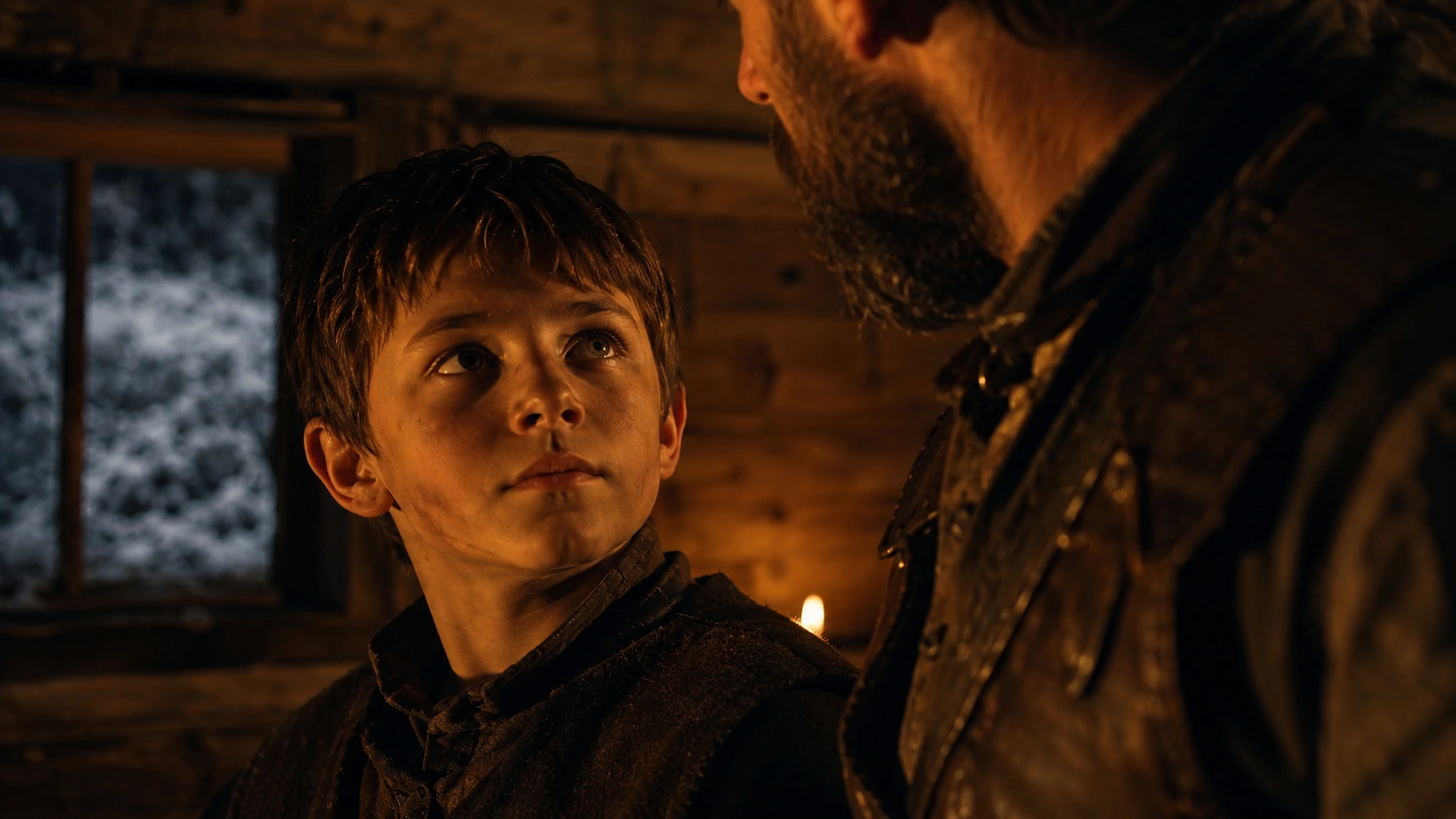
Twelve-year-old Caleb Rainer stood at the living room window, watching the world disappear one landmark at a time.
It was too quiet.
His mother, Olivia, was a nurse at North Valley Medical Center. Storms like this didn’t send her home — they pulled her in deeper.
“They need me tonight, Caleb,” she’d said on the phone, voice tight with worry. “Roads are getting bad.”
“I’ll be fine, Mom.”
A pause. “Lock every door. Don’t open it for anyone. No matter what.”
“I will.”
He meant it. For a while.
THE POWER DIES
The lights flickered twice, then died completely. The silence after was heavier than the wind outside.
Caleb found a flashlight and went down to the basement, where his father’s old generator sat in the corner. His dad had been gone two years, but his voice still lived in small things — labeled toolboxes, a coiled extension cord, a generator he used to start every fall “just in case.”
One pull. Nothing.
Second pull. A cough.
Third pull — it roared to life.
Relief lasted two hours. Then the generator sputtered and went silent for good. The furnace died with it. Cold crept into the house like it had been waiting outside the door the whole time.
Caleb wrapped himself in blankets near the cold fireplace, his father’s old baseball bat across his lap. Not a weapon. Just something solid to hold.
“I’m okay,” he whispered to no one. “I’m okay.”
He wasn’t sure he believed it.
HEADLIGHTS IN THE SNOW
Around nine, lights appeared on the road — low, uneven, swaying. Not one vehicle. Several.
Motorcycles.
Through the whiteout, Caleb watched the line of bikes struggle against the wind. Then the lead bike slid sideways. Another went down behind it. Within seconds, riders were scattered across the icy road in nothing but leather and denim, no winter gear at all.
One man fell and didn’t get up right away.
His mother’s warning rang in his head: Don’t open the door.
But so did something else his father used to say: Help people when you can.
Caleb grabbed the brightest flashlight in the house, unlocked the front door, and stepped into the wind.
“Over here!” he shouted, the storm swallowing half the sound.
The shapes on the road turned toward the light. Then they started walking toward him.
TWENTY STRANGERS ON THE PORCH
Up close, the first man was enormous — broad-shouldered, beard streaked with gray, a patch on his vest marking him as part of a motorcycle club. Snow caked his jacket.
He studied Caleb for a long moment.
“Kid. You sure about this?”
Caleb’s hands shook, but he held his ground. “You’re freezing. Come in.”
The man glanced back at the nearly twenty riders behind him. “You know who we are?”
Caleb shook his head.
“We’re not exactly who people usually invite inside.”
Caleb hesitated, then said quietly, “My mom says you don’t let people freeze.”
Something shifted in the big man’s face. After a beat, he nodded. “Alright. We come in, we respect your house.”
Boots came off at the door. Voices stayed low. Twenty strangers moved through Caleb’s home like they understood exactly how much trust the moment cost him.
The big man stuck out his hand. “Wade Lawson.”
“Caleb.”
The grip was firm. Careful.
PUTTING THE HOUSE BACK TOGETHER
They didn’t just sit and wait out the storm. One man checked the chimney for a blockage. Another split wood on the back porch. A mechanic named Daryl crouched next to Caleb by the dead generator.
“You got anything else with juice? Batteries, tools?”
Caleb remembered his dad’s marine batteries in the garage.
An hour later, under flashlight beams and still-blowing snow, Daryl walked him through every step without rushing him once.
“Won’t be pretty,” Daryl said, “but it’ll hold.”
When the furnace kicked back on and warm air finally pushed through the vents, the whole room erupted. Caleb blinked hard, fighting back tears he didn’t expect.
“You saved us,” Wade said.
“You saved me too,” Caleb answered.
They heated canned soup over the stove, passed around what little food there was, and talked like old friends instead of strangers who’d met two hours earlier. The house, which had felt unbearably empty that morning, suddenly didn’t.
A NOISE AT THE BACK DOOR
Miles down the dark county road, a van sat parked with its lights off.
The men inside had spent the blackout hunting for houses that looked alone and unguarded. A widow’s place. A house with no truck in the driveway. Caleb’s house, with its one small light burning through the storm, had looked like exactly that kind of target.
They didn’t know the house wasn’t empty anymore.
At two in the morning, the back door handle shifted slightly.
Wade was already awake. So were three others.
“Someone’s here,” one of them breathed.
Footsteps crossed the kitchen tile. A voice, barely audible, said, “Check the rooms.”
The lights snapped on.
The two men in the kitchen froze. They’d expected a sleeping boy. Instead they found a room full of calm, silent men who hadn’t moved from where they stood — no shouting, no scramble, just stillness that said everything.
Wade stepped forward. “You picked the wrong house tonight.”
It ended in under a minute. No one was hurt. The message didn’t need repeating.
MORNING
By sunrise, the wind had finally let go of the valley. A sheriff’s truck rolled up the snow-packed driveway, and Sheriff Marcus Hale stepped out to a scene that clearly hadn’t happened the way these things usually do — a dozen motorcycles in the yard, a dozen calm strangers on the porch, and one boy standing in the middle of it like he belonged there.
“Well,” Hale muttered. “This is something.”
After hearing the full night laid out — the generator, the strangers, the men in the kitchen — he shook his head slowly.
“You did good, kid.”
Caleb glanced at Wade. “I wasn’t alone.”
Olivia’s car came up the road an hour later. She was out before it fully stopped, running straight to her son.
“Are you okay?”
“I’m okay, Mom.”
Her eyes moved past him to the riders still gathered in the yard, wary at first. Wade stepped forward, hands open, voice respectful.
“Ma’am — your son took care of us last night.”
As the story came out in pieces, her guard slowly came down. She looked at Caleb like she was seeing something new.
“You let all of them in?”
He gave a small shrug. “They needed help.”
“And we needed someone like him,” Wade added.
WEEKS LATER
When the snow melted and the fields turned green again, the sound of engines came back down the road. This time it wasn’t an emergency. It was a visit — tools, parts, a brand-new security system for the house, and a handshake that turned into a hug.
Wade pressed a small card into Caleb’s hand. “Anytime you need us. You call.”
“You’re part of this now,” he said.
As the bikes pulled away under a clear spring sky, Olivia stood beside her son and understood something she hadn’t expected to learn that winter.
The people who look the toughest are sometimes the ones who protect the most — and the courage to open a door in the middle of a storm can change more than just one night. It can build the kind of family you never planned on, made of the people who showed up when it mattered.
Original fictional stories. AI-assisted creative content.