Rain hit the window of Midnight Harbor Café in long silver lines.
Noah Bennett wiped down table six with a gray rag, his apron damp at the hem.
The espresso machine screamed behind the counter.
“Two lattes, table nine!” the barista yelled.
Noah grabbed the tray without looking up.
Sixteen years old. Navy polo. Tired eyes that didn’t match his face.
He needed this job. His mother cleaned offices at night. His sister needed her inhaler refilled by Friday. The rent was already late.
So he smiled at every customer, even the ones who snapped their fingers at him like he was furniture.
Through the glass doors, something moved on the sidewalk.
A man stumbled. Then dropped.
Noah froze, rag still in his hand.
“Hey — someone’s down out there!” he called.
Nobody moved.
A woman at table four glanced up, then back at her phone.
“Not our problem,” she muttered.
Mr. Keller, the manager, didn’t even look. “Tables don’t bus themselves, Noah.”
Noah looked at the man on the wet pavement. Gray hoodie. Unmoving.
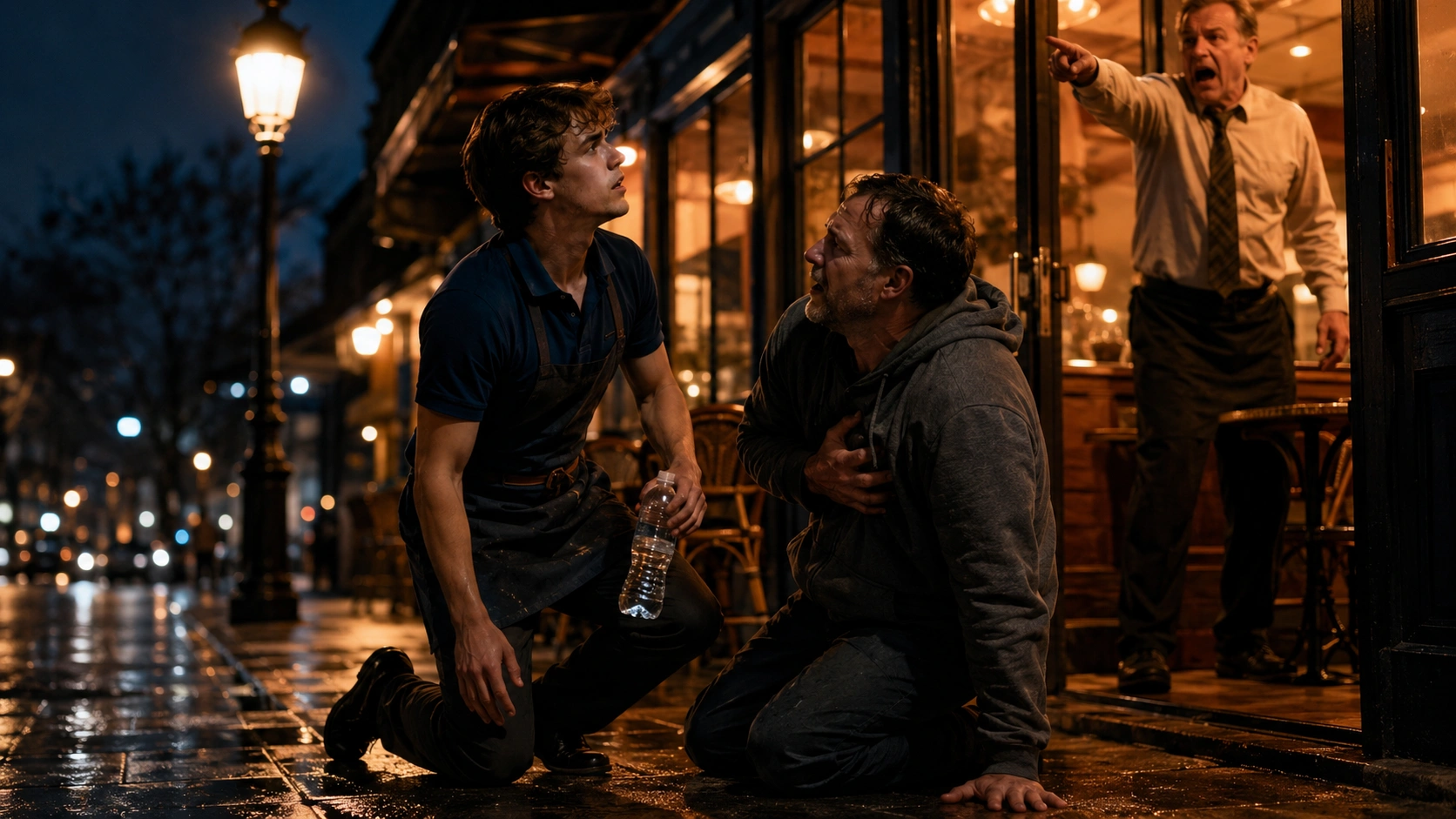
He grabbed a bottle of water off the counter and walked out the door.
Cold rain hit his face immediately.
He knelt beside the man. “Sir? Can you hear me?”
The man’s eyes fluttered. Gray stubble. Expensive watch hidden under a torn sleeve.
“Water,” the man rasped.
Noah tipped the bottle to his lips carefully. “I called 911. Stay with me.”
“Why… are you helping me?” the man whispered.
Noah shrugged. “Because nobody else would.”
Sirens grew louder down the block.
Behind him, the café door swung open. Mr. Keller stood in the frame, arms crossed.
“Get back inside. Now.”
“He’s hurt,” Noah said. “I’m not leaving him.”
“You’re on the clock, Noah.”
“Then take it out of my check.”
Mr. Keller’s jaw tightened. “Watch your tone.”
Paramedics arrived and lifted the man onto a stretcher.
The man’s hand caught Noah’s wrist before they pulled him away.
“What’s your name, kid?”
“Noah. Noah Bennett.”
“I won’t forget this,” the man said, voice fading as they wheeled him toward the ambulance.
Noah walked back inside, soaked to the bone.
Mr. Keller was waiting, badge gleaming under the fluorescent lights.
“You abandoned your station during a rush.”
“There was a man dying on the sidewalk.”
“That’s not your job.”
“Being a decent person isn’t a job,” Noah said. “It’s just what you do.”
Mr. Keller’s face went red. “Clock out. You’re done here.”
The café went silent.
A customer near the counter spoke up. “You’re firing him for helping someone?”
“This doesn’t concern you,” Keller snapped.
Noah untied his apron with shaking hands and set it on the counter.
“Three years,” he said quietly. “Three years I never missed a shift.”
Keller didn’t answer.
Noah walked out into the rain without his jacket.
At home, the apartment smelled like reheated soup and old carpet.
His mother, Denise, sat at the kitchen table sorting bills into piles labeled “due” and “overdue.”
“You’re early,” she said, not looking up.
Noah sat across from her. “I got fired.”
Her pen stopped moving. “What happened?”
He told her everything. The man on the sidewalk. The water bottle. Keller’s face turning red.
Denise was quiet for a long moment.
“You did the right thing,” she finally said.
“Doesn’t pay the rent.”
“No,” she agreed. “But it’s still the right thing.”
His little sister, Mia, shuffled in holding her inhaler. “Are we gonna be okay?”
Noah forced a smile. “We’re always okay.”
He didn’t believe it. But she needed to.
That night he applied to six jobs online. Two replied with rejections. The rest said nothing.
Three days later, a black car pulled up outside their apartment building.
Noah was taking out the trash when the door opened.
A man in a tailored gray suit stepped out. Clean-shaven now. No hoodie. No stubble.
Noah blinked. “You’re… the guy from the sidewalk?”
“Elias Maddox,” the man said, extending a hand. “I believe you saved my life.”
Noah shook it slowly. “You don’t look like you were dying.”
“Heart arrhythmia. Stress-induced. I’d skipped my medication for two days running a deal into the ground.” Maddox glanced at the building behind Noah. “May I come in?”
“It’s small,” Noah warned.
“So was the sidewalk.”
Inside, Denise nearly dropped a dish towel when she saw the suit standing in her kitchen.
“Mr. Maddox,” she stammered. “Can I get you anything?”
“Actually,” Maddox said, “I’m here to ask Noah something.”
Noah crossed his arms. “I’m listening.”
“I own Maddox Group. Logistics, real estate, three restaurant chains across the East Coast.” He paused. “Including, as of last year, Midnight Harbor Café’s parent holding company.”
Noah’s stomach dropped. “You own the café?”
“Through about four shell layers, yes. I rarely pay attention to it.” Maddox’s eyes sharpened. “Until I heard a manager fired the boy who saved my life.”
“How did you hear that?”
“I have people for that.”
Denise sat down slowly. “What are you saying?”
“I’m saying,” Maddox said, “that I’d like to offer Noah a position. Paid, real, with benefits. Not as charity. As respect.”
Noah shook his head immediately. “I don’t want a handout.”
“It’s not a handout. It’s a debt.” Maddox’s voice hardened slightly. “I don’t forget debts.”
“What kind of position?”
“Start in operations. Learn the business from the ground floor. If you’re as sharp as you were honest on that sidewalk, you’ll go far.”
Noah glanced at his mother. Her eyes were wet.
“Can I think about it?”
“Take the night,” Maddox said. “But Noah—”
He turned at the door.
“That manager. Keller. He’ll be dealt with separately. That’s not charity either. That’s accountability.”
The next morning, Noah walked into Maddox Group’s downtown office tower.
Glass elevators. Marble floors. A receptionist who actually smiled at him.
Maddox met him personally at the door of his office on the thirty-first floor.
“Sit,” Maddox said, gesturing to a leather chair.
Noah sat stiffly.
“I looked into the café,” Maddox said. “Keller’s been skimming inventory for two years. Falsifying waste reports. Pocketing the difference.”
Noah’s eyebrows rose. “You’re firing him for that?”
“I’m firing him for that. I’m exposing him for what he did to you.”
“What did he do to me besides fire me?”
Maddox leaned forward. “He let a man die on a sidewalk to protect a shift schedule. Then punished the only person with a conscience in the building.” He tapped the desk. “That’s not a manager. That’s a liability.”
A knock interrupted them. An assistant peeked in.
“Mr. Maddox, the café staff are asking about the announcement.”
“Send them my regards,” Maddox said. “And send Keller in. Now.”
Keller arrived twenty minutes later, sweating through his beige shirt.
“Mr. Maddox, sir, I didn’t realize you—”
“Sit down, Gerald.”
Keller sat.
Maddox slid a folder across the desk. “Inventory discrepancies. Eighteen months. Want to explain those?”
Keller’s face drained of color. “There must be some mistake.”
“There’s no mistake. There’s a pattern.” Maddox’s voice stayed calm, almost gentle, which made it worse. “But that’s not actually why you’re here.”
“Then why—”
“You fired a sixteen-year-old boy for helping a dying man. In front of customers. While I was on a stretcher fifteen feet away.”
Keller’s mouth opened. Nothing came out.
“Do you know who I am, Gerald?”
“You’re… you own the parent company.”
“I’m also the man you let bleed out on a sidewalk while you worried about table service.”
Keller’s hands trembled in his lap.
“I’m not angry that you didn’t help me,” Maddox continued. “Cowardice is common. I’m angry that you punished the one person who did.”
“Sir, please, I have a family—”
“So does Noah,” Maddox said. “He worked three years to keep his afloat. You fired him in under a minute.”
Noah, standing by the window, said nothing. He didn’t need to.
“You’re terminated,” Maddox said. “Effective immediately. Severance will be withheld pending the embezzlement investigation.”
Keller stood, knees unsteady. “This isn’t fair.”
“Fair,” Maddox repeated, “would have been an ambulance call and a coffee on the house. You gave neither.”
Keller walked out without another word.
Word spread fast.
By the following week, local news picked up the story: BILLIONAIRE’S RESCUER FIRED FOR SAVING HIS LIFE.
Reporters camped outside the café.
Customers who’d watched Keller fire Noah and said nothing now avoided eye contact with cameras.
The woman from table four, the one who’d said “not our problem,” gave an interview claiming she’d “always known something was off about management.”
Noah watched it on his phone in Maddox’s office, shaking his head. “Everyone’s rewriting history.”
“People do that,” Maddox said. “What matters is what you did when no one was rewriting anything yet.”
Three months passed.
Noah learned the business from the warehouse floor up — inventory systems, logistics routing, vendor negotiations. He stayed late without being asked. He asked questions nobody else bothered to ask.
Maddox noticed.
“You ask why,” Maddox told him one evening, reviewing a shipping report Noah had flagged for errors. “Most people just follow instructions.”
“My mom always asked why,” Noah said. “Bills don’t pay themselves with blind obedience.”
Maddox almost smiled. Then caught himself, because that wasn’t the ending yet.
“There’s an investigation starting,” Maddox said, changing the subject. “Bigger than Keller. Bigger than the café.”
“What kind?”
“The embezzlement trail leads further than inventory skimming. Shell accounts. Falsified vendor invoices across four properties. Federal auditors are already involved.”
“Does it touch us?”
“It touches everyone who looked away,” Maddox said. “Including people far above Keller’s pay grade.”
The investigation widened over the following weeks.
Two regional directors were named in court filings.
A vendor company turned out to be a shell used to launder skimmed inventory funds.
Noah’s name appeared in exactly one sentence of one report — the employee who reported irregular waste logs three years prior, logs that had been ignored.
“You reported this before?” Maddox asked, reading the same line twice.
“I told Keller the numbers looked off once,” Noah said. “Back when I first started. He told me to mind my own register.”
“And you let it go?”
“I was fourteen. He was the only manager I had.”
Maddox closed the folder slowly. “If anyone had listened to you three years ago, this wouldn’t have grown as large as it did.”
“Nobody listens to sixteen-year-olds,” Noah said. “Or fourteen-year-olds.”
“I’m listening now.”
The case eventually expanded into a federal investigation touching distributors across three states.
Arrests followed. Convictions followed those.
Reporters wanted Maddox’s comment on camera, again and again.
He gave the same answer every time.
“It began when a sixteen-year-old boy decided a stranger’s life mattered more than his shift.”
On a clear afternoon, Maddox invited Noah back to Midnight Harbor Café.
The staff had been told to expect a “company visit.” They had not been told what kind.
Cameras waited near the entrance. Customers filled the tables, curious.
Noah stepped inside, confused. “What is this?”
Maddox smiled. “Something I should have done the day I met you.”
He walked to the center of the café. No microphone. No notes.
“Three months ago, a young man worked behind that counter,” Maddox said, voice carrying easily through the quiet room. “He watched a stranger collapse outside this window. Most people in this room that night looked away.”
A few customers shifted uncomfortably.
“One person didn’t.”
He turned toward Noah.
“This young man knelt in the rain with a bottle of water because nobody else would. He lost his job for it. I want every person in this room to understand exactly what that cost him — and exactly what it earned him.”
He placed a hand on Noah’s shoulder.
“On behalf of Maddox Group, and on behalf of myself personally — thank you.”
The room erupted into applause, hesitant at first, then full.
Near the back, a familiar figure stepped forward through the crowd.
Keller. Older-looking. Thinner. Out of the beige shirt and gray tie, dressed in something plain and unremarkable.
“I’ve rehearsed this about a hundred times,” he said, voice unsteady. “Every version sounded fake.”
He stopped in front of Noah.
“So I’ll just say it straight. I was wrong. I judged you for your age. I cared more about a schedule than a man’s life. And I forgot what the job was supposed to mean.”
He extended his hand. “I’m sorry, Noah.”
Noah studied him for a long moment.
Then shook it. “I forgive you.”
The café went quiet again. Forgiveness, it turned out, was louder than anger ever was.
As the small crowd began filtering out, a shout rang from across the street.
“Someone’s down by the bus stop!”
Every head turned.
An elderly man had collapsed near the curb.
For one heartbeat, the café held its breath, the memory of that rainy night hanging over every face in the room.
Then chaos broke — but the right kind.
A barista grabbed bottled water and ran out the door.
A customer dialed 911 before the door even swung shut.
A college student stripped off his jacket and folded it under the man’s head.
A nurse drinking coffee at table two knelt and checked his pulse without being asked twice.
Within seconds, nearly twenty strangers surrounded him.
Nobody filmed it.
Nobody said “not my problem.”
Noah watched from the doorway, something easing in his chest.
“Looks like they learned,” he said quietly.
Maddox stood beside him, watching the same scene through the glass.
“No,” he said. “They remembered.”
The ambulance arrived minutes later. The man would recover — exhaustion and low blood sugar, nothing worse.
As the crowd dispersed and the street noise returned — taxis, chatter, the ordinary hum of the city — Maddox and Noah remained on the sidewalk where it had all started.
The exact spot where a frightened sixteen-year-old had once knelt beside a stranger with nothing but a water bottle and a decision to make.
“I used to think the world changed because of powerful people,” Maddox said, looking down at the wet pavement, dry now under the afternoon sun. “I was wrong.”
“So what changes it?” Noah asked.
Maddox looked at him, then out at the street, full of people who no longer looked away.
“One ordinary person,” he said, “who refuses to walk past.”
Years later, people would remember the headlines. The arrests. The court dates.
Noah remembered something smaller.
Rain on a window. A stranger on the ground. A bottle of water.
And the moment he chose not to look away.
Because the biggest changes rarely start with money.
They start with someone deciding a stranger’s life is worth more than convenience.
Original fictional stories. AI-assisted creative content.