The Eastside Diner was half-empty on a Tuesday night. Fluorescent hum, bad coffee, the smell of bacon grease soaked into forty years of linoleum.
Ray Decker was in booth seven. Same booth every night. Vietnam vet, Korea-era boots, a mug of decaf he never finished. He was reading a paperback when the bell above the door rang.
He didn’t look up right away. He never did. Forty years of habit told him to clock the room first with his ears before his eyes — footsteps, breathing, the particular rhythm of someone who belonged versus someone who didn’t.
This one didn’t belong.
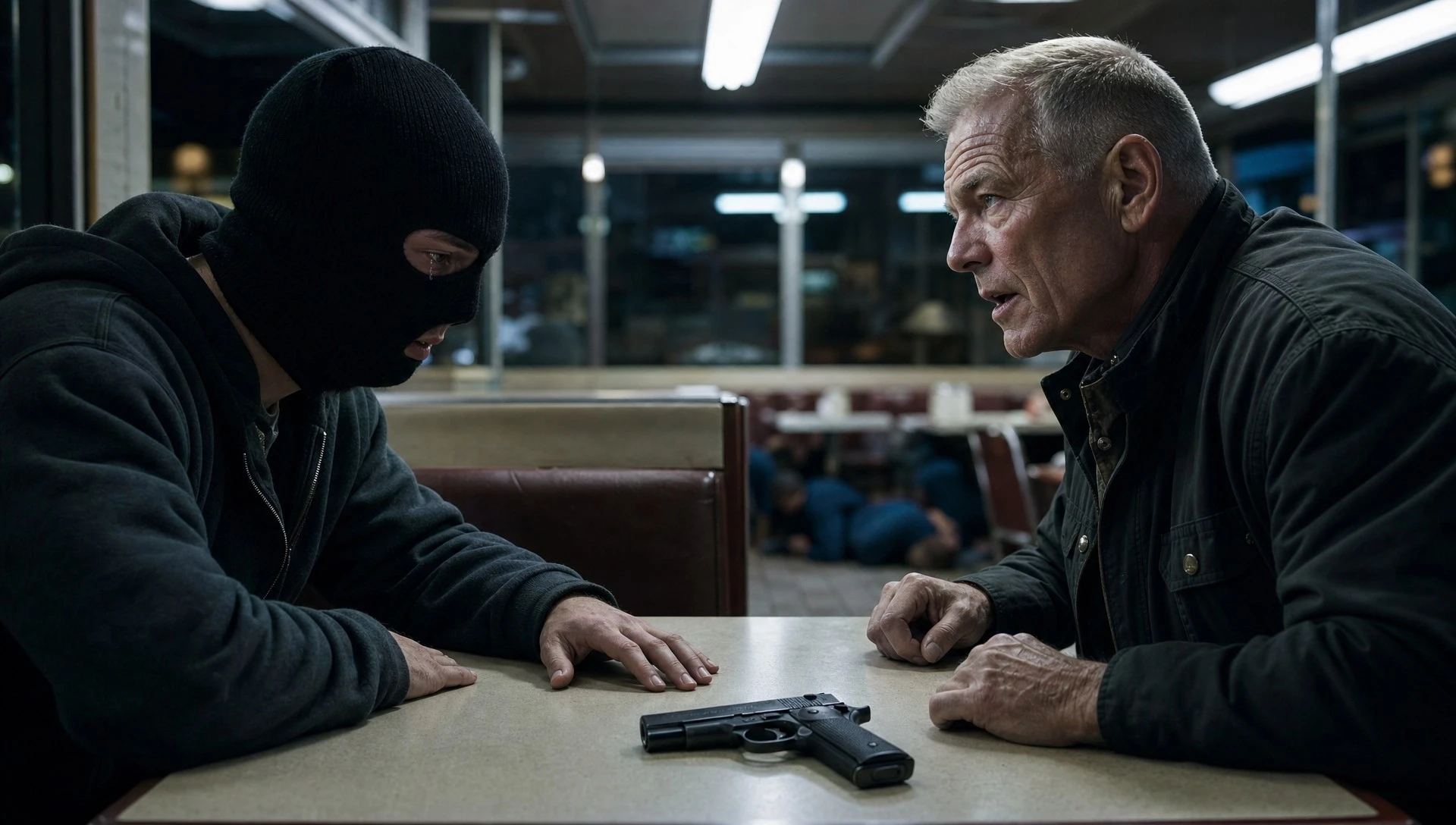
The man who walked in wore a black ski mask and a denim jacket two sizes too big. He pulled a 9mm from his waistband and pointed it at the teenager behind the counter.
“Register. Now. Everybody on the floor.”
Chairs scraped. A woman yelped. People dropped.
Ray didn’t move.
He set his paperback face-down on the table. Picked up his mug. Took a slow sip.
The gunman swung the weapon toward him. “You. I said floor. You deaf, old man?”
Ray looked at him for the first time. His eyes were flat and quiet, the kind of quiet that doesn’t come from peace.
“Son,” Ray said, “I’ve had guns pointed at me in three countries. You’re going to need to try harder than that.”
The diner went completely still.
The robber stepped closer. His hand was shaking. “You think this is a joke?”
“No,” Ray said. “I think you’re twenty-two years old and you made a bad decision tonight.” He set the mug down carefully. “I’m going to give you one chance to walk out that door. The people in this room deserve to go home.”
“Shut up—”
“I’m not done.”
The young man’s finger tightened on the trigger guard, then loosened. He took another step, and now the gun was close enough that Ray could see the barrel shaking in rhythm with the kid’s pulse.
“You don’t know anything about me,” the kid said. His voice cracked in the middle of the sentence, the way a teenager’s does, not a grown man’s. “You don’t know what I owe. You don’t know who’s waiting on this money.”
“You’re right,” Ray said. “I don’t. So tell me.”
The question landed wrong. The kid blinked behind the mask, like nobody had asked him that in longer than he could remember — like every conversation he’d had in the last six months had been about what he owed, never about why.
“That’s not—” He stopped. Started again. “Just put your hands where I can see them.”
Ray didn’t move them. They stayed folded on the table, steady, the hands of a man who had held far worse things than a coffee mug and not trembled.
Behind the counter, the teenager — her name tag read MARISA — had her own hands raised halfway, eyes darting between the gunman and the old man in the corner like she was trying to figure out which one of them was about to get her killed.
“Sir,” she whispered, barely audible, “please, just—”
“I’m not going anywhere, Marisa,” Ray said, without turning his head. “Neither is anybody else who doesn’t want to be.”
The kid’s eyes snapped back to him. “How do you know her name?”
“I come in here four nights a week. I know everybody’s name.” Ray’s voice hadn’t risen above a calm, even register the entire time. “I know yours too, in a way. I just don’t know which version of you is standing in front of me right now.”
“What’s that supposed to mean?”
“It means there’s a version of you that walks out of here in the next sixty seconds and goes home. And there’s a version that doesn’t.” Ray’s eyes didn’t blink. “I’ve buried men who picked wrong on nights exactly like this one. I’d rather not add you to that number.”
Something flickered across the kid’s face — not quite recognition, not quite fear, something closer to the look of a man hearing a sentence get read out loud for the first time and realizing it applies to him.
“You think you scare me,” the kid said, but the words came out thinner than he wanted them to.
“No,” Ray said. “I think you’re scared already, and I’m the first person in a long time who’s said it out loud instead of pretending not to notice.”
The gun dipped an inch. The kid caught himself and brought it back up, overcorrecting, the barrel swinging wide before he steadied it again. His breathing had gone ragged, audible even over the hum of the refrigerated case behind the counter.
“There’s a guy,” the kid said suddenly, like the words had been building pressure behind his teeth for weeks and finally cracked through. “Guy I owe. It’s not — it’s not small money. He said if I didn’t have it by Friday—” He stopped himself, jaw working, like he’d said more than he meant to.
“By Friday, what?” Ray asked.
The kid didn’t answer. He didn’t have to. The silence did it for him.
“Son,” Ray said quietly, “robbing a diner with forty dollars in the register isn’t going to fix a problem that size. You know that. You knew that before you walked in here. That’s why your hand’s been shaking since the door.”
“Shut your mouth, old man.” But there was no heat behind it. It came out closer to a plea than a threat.
“I’ve seen a hundred men talk themselves into bad math because the alternative felt worse,” Ray said. “Survived two wars worth of bad math myself. You want to hear how that usually ends?”
“I don’t want a story.”
“You’re going to get one anyway, because right now it’s the only thing standing between you and a decision you can’t take back.”
The kid’s arm wavered again. Marisa had gone completely silent behind the counter, frozen mid-breath. Somewhere near the back booths, a man’s phone buzzed in his pocket and nobody dared reach for it.
“There’s a verse,” Ray said slowly, “I used to read to my men before bad nights. ‘The Lord is my shepherd. I shall not want.’ You know the one.” He folded his hands on the table. “I’m not your shepherd, son. But I am the last man in this room you want to test.”
Twelve seconds of silence.
The gunman’s arm dropped two inches.
“You don’t know what’s waiting for me outside if I leave with nothing,” the kid said, and now his voice had lost all its edge. It was just a young man’s voice, tired and scared underneath the mask.
“Maybe not exactly,” Ray said. “But I know what’s waiting for you in here if you don’t put that down — and it’s worse than whatever’s outside, because in here, it’s permanent.”
The kid’s chest rose and fell, fast and shallow. His eyes — the only part of his face visible — flicked toward the door, toward the counter, toward Ray, and back to the door again, like a man running calculations he didn’t have the math for.
“You don’t get it,” the kid said. “You don’t get what it’s like to owe somebody something you can’t pay.”
“I spent two tours owing men my life and never having a way to pay it back except staying alive long enough to mean something with it,” Ray said. “So don’t tell me what I don’t understand about debt.”
That landed. The kid’s shoulders dropped half an inch, like a string had been cut somewhere inside him.
“Put the gun down,” Ray said. Still calm. Still even. “Not because I’m telling you to. Because some part of you walked in here already knowing you didn’t want to pull that trigger, or you’d have done it the second the door closed. You’re not a killer, son. You’re a kid who got in over his head and ran out of better ideas.”
The barrel sank another two inches.
“If I walk out with nothing,” the kid said, voice barely above a whisper now, “he’s going to—”
“Then we figure out the next part after you put the gun down,” Ray said. “Not before. You don’t get to solve tomorrow’s problem with today’s mistake.”
The silence stretched long enough that the hum of the diner’s old refrigeration unit became audible again, a low mechanical drone underneath everything.
Then the kid’s arm dropped all the way. The gun pointed at the floor.
“That’s it,” Ray said, voice softening for the first time. “That’s the version of you I was talking about.”
The kid took a step back. Then another. His shoulders had caved inward, the swagger completely gone, replaced by something closer to a boy standing in front of a principal’s desk, waiting for a sentence he already knew was coming.
“I don’t know what to do,” the kid said. The words cracked.
“I know,” Ray said. “That’s usually where the actual deciding starts.”
He backed toward the door, weapon still low, eyes fixed on Ray — not on the register, not on the exits. On the old man in the booth who hadn’t moved an inch the entire time.
The bell above the door rang again as he stepped out into the night.
For a moment, nobody in the diner breathed.
Then Marisa’s hands came down from the counter, shaking so hard she had to grip the edge to steady herself. “Sir,” she said, voice unsteady, “are you — how did you just—”
“Call it in,” Ray said gently. “Tell them which direction he went. Tell them he was scared, not dangerous. Make sure whoever responds knows the difference — it matters for what happens to that kid next.”
She nodded, already reaching for the phone with trembling fingers.
Around the diner, people slowly began rising from where they’d dropped to the floor — a trucker by the window, a young couple near the register, an elderly woman two booths down who’d gone pale as paper. Nobody spoke above a whisper. Somebody let out a shaky laugh that wasn’t really a laugh at all.
Ray picked up his paperback. Found his page.
A man from the back booth approached, hands still trembling slightly. “How’d you do that? Just — talk him down like that?”
Ray looked up, considered the question like it deserved a real answer instead of a quick one.
“You don’t talk a scared man down by being louder than his fear,” Ray said. “You talk him down by being calmer than it. Most men with guns in their hands aren’t dangerous because they’re strong. They’re dangerous because they’re terrified and don’t know what else to do with it. Give them a way out that doesn’t cost them their pride, and most of them will take it.”
“Most of them,” the man repeated.
“Most,” Ray agreed. “Not all. But the odds are better than people think, if you’re willing to sit still long enough to find out.”
Outside, distant sirens began to rise, faint at first, then closer.
Marisa set the phone down and looked at Ray with something between gratitude and disbelief. “You didn’t even seem scared.”
“I was plenty scared,” Ray said. “Forty years of practice just means it doesn’t show on my face anymore. Fear and panic aren’t the same thing. Fear keeps you alive. Panic gets you killed. I learned a long time ago which one to listen to.”
The sirens grew louder, then cut off abruptly somewhere outside. Red and blue light swept briefly across the diner’s front windows.
Two officers entered, scanning the room, hands near their belts out of habit rather than necessity. Marisa pointed toward the door, already explaining in a rush of words — the mask, the gun, the direction he’d run, the fact that nobody got hurt.
One of the officers, older, with gray at his temples, walked over to Ray’s booth.
“You the one who talked him out?”
“Didn’t talk him out of anything,” Ray said. “Just gave him room to talk himself out of it. There’s a difference.”
The officer studied him a moment, something like recognition passing behind his eyes. “Military?”
“Long time ago.”
“Figured.” He nodded once, the kind of nod passed between men who’d both spent time in places they didn’t talk about at dinner tables. “We’ll need a statement. Won’t take long.”
“Take your time,” Ray said. “I’m not in a hurry. Never have been.”
Twenty minutes later, after the statement, after the diner had mostly returned to its quiet Tuesday-night hum, after Marisa had refilled coffees with hands that had finally stopped shaking, Ray sat back down in booth seven.
His paperback was still open to the same page. His mug sat where he’d left it, decaf gone cold.
Marisa appeared at his table, coffee pot in hand, eyes red-rimmed but steady now.
“On the house,” she said. “Tonight and — honestly, forever, if you want.”
“Just the coffee’s fine,” Ray said. “Warm, if you don’t mind.”
She refilled the mug, lingering a moment. “What you said to him — about the version of him that walks out and the version that doesn’t. Did you mean that?”
“Every word,” Ray said. “Seen both versions of plenty of men. Difference between them usually comes down to whether somebody gives them a reason to choose the better one before it’s too late to choose anything at all.”
She nodded slowly, like she was filing the words away somewhere she wouldn’t forget.
Outside, the police cruiser’s lights had gone dark. The street had returned to its ordinary stillness — a gas station glowing across the intersection, a stoplight cycling through its colors for no one.
Ray picked up his paperback again.
Found his page.
Began to read.
The bell above the door rang one more time as a new customer walked in, oblivious, asking for a booth by the window. Marisa showed them to their seat, voice steady, professional, like the last half hour hadn’t happened at all.
Ray didn’t look up from his book. He’d learned that lesson decades ago, in places far from this diner — that life doesn’t pause to let you catch your breath. It keeps moving, and the only thing you control is whether you move with steady hands or shaking ones.
Tonight, his hadn’t shaken once.
He turned the page, and the diner settled back into the ordinary hum of a Tuesday night that had, for a few minutes, almost become something else entirely — and didn’t, because one man in a corner booth had decided it wouldn’t.
Original fictional stories. AI-assisted creative content.