The 34th floor smelled like money.
Fresh coffee, imported cologne, the faint metallic bite of ambition. The boardroom of Global Enterprise sat high above the city, glass walls turning the skyline into wallpaper. Below, traffic moved like blood through veins. Up here, Ignacio Ferrer owned everything he could see.
“Two minutes,” his assistant murmured, sliding a pen onto the glass table.
Ignacio didn’t look up. He was already reading the contract — not because he needed to, but because he liked the way the pages felt. Heavy. Final. His.
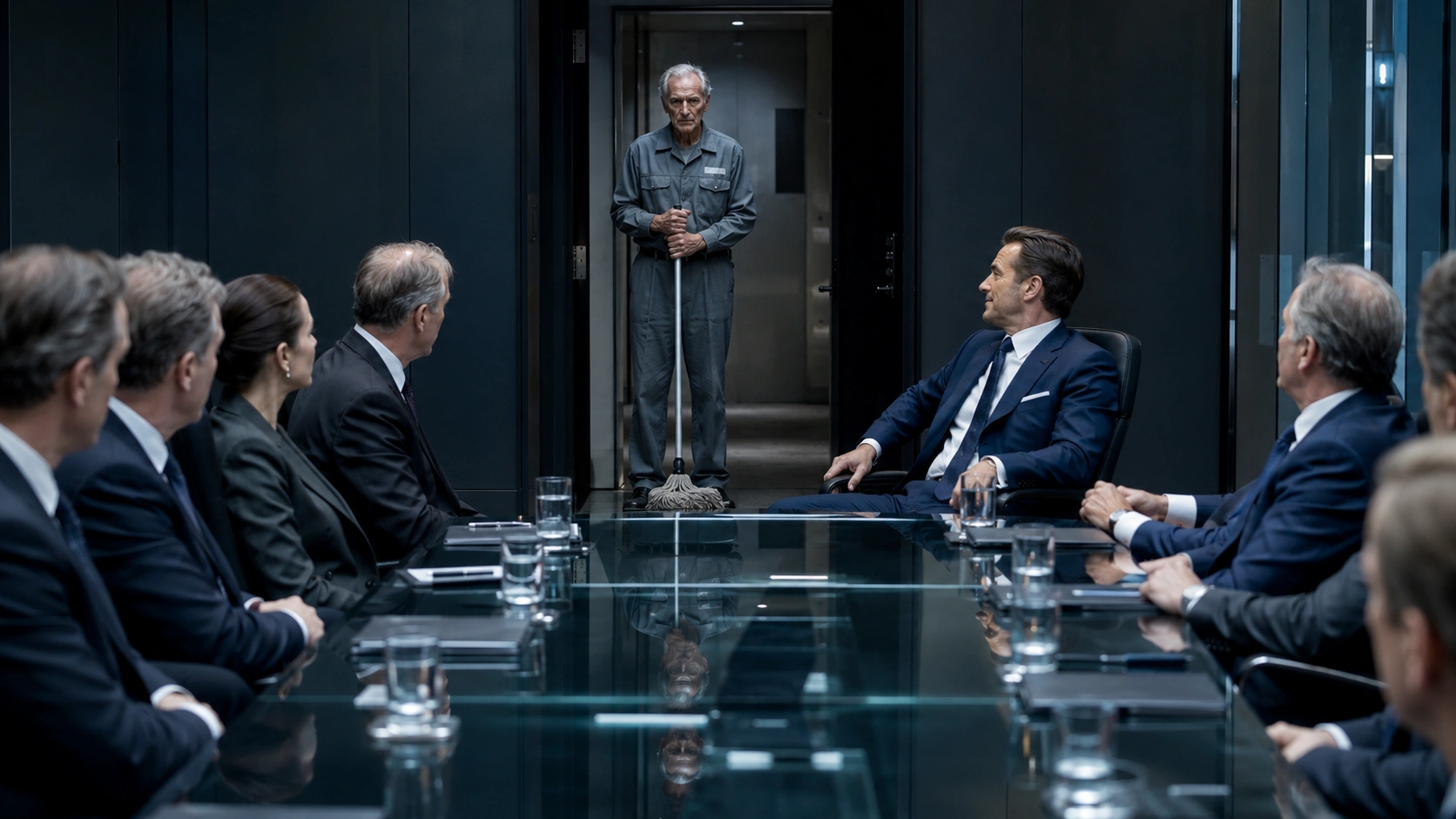
The investors sat along both sides of the table: ten men and women in charcoal and navy, each worth more than a small nation, each here because Ignacio had made it worth their while. Crystal glasses waited beside untouched water. Nobody drank. Celebration came after the signature.
“Global Enterprise represents the largest single acquisition in North American infrastructure this decade,” said the lead investor, Marcus Webb, sliding his reading glasses down his nose. “Once you sign, Ignacio, we move within seventy-two hours.”
“I know what it represents, Marcus.” Ignacio picked up the pen. “I wrote the deck.”
Polite laughter rippled down the table.
Outside, beyond the floor-to-ceiling glass, clouds drifted past skyscrapers. The world was small from up here. Ignacio liked it small.
He uncapped the pen.
That was when the doors opened.
Not a knock. Not an announcement from the front desk. Just the slow, hydraulic exhale of the heavy glass doors swinging wide, and a figure stepping through.
The man was old. Seventy, maybe older. He wore a grey janitorial uniform — chest patch, worn sleeves, the fabric faded at the shoulders from years of washing. He held a mop handle at his side the way a soldier holds a rifle at rest: not a prop, not an apology. Just a thing he carried.
Two security guards posted near the elevator moved immediately.
“Sir — this floor is restricted—”
The man didn’t stop. He walked at the same pace he would walk a corridor — unhurried, certain, as if the room had been expecting him.
Every head at the table turned.
One of the junior analysts near the door actually laughed — a short, involuntary sound, quickly swallowed. A woman across from him pressed her lips together. Marcus Webb set down his water glass.
The guard caught up and planted a hand on the old man’s arm.
“Sir. You cannot be in this meeting.”
“I need two minutes with Mr. Ferrer,” the old man said.
His voice was calm. Not loud, not aggressive. Just certain, the way a fact is certain.
Ignacio looked up from the contract.
He looked at the janitor the way a man looks at something that has wandered in from outside — not threatened, not frightened. Faintly amused. He leaned back in his leather chair, one arm draped over the armrest, and let his eyes travel from the grey uniform to the mop handle to the old man’s face.
The face was deeply lined. The eyes were steady.
Ignacio held his gaze for a moment. Then he smiled — slowly, deliberately, making sure the whole table could see it.
“Two minutes,” Ignacio said. “Let’s hear it.”
A few executives exchanged glances. Someone at the far end of the table shifted in their seat.
The old man crossed the room without rushing. He stopped at the corner nearest the door — he didn’t approach the table, didn’t reach for a chair. He stood with the mop handle beside him and looked at Ignacio directly.
“Before it was called Global Enterprise,” he said, “this company had another name.”
Silence settled over the room in a different way. The polite kind was gone. This was the silence of people recalibrating.
Ignacio’s smile didn’t move. He recognized this game — the grievance, the conspiracy, the man who believes he is owed something. He’d handled versions of this before. The trick was to humiliate them quickly, in front of witnesses, and let the room do the rest.
He looked at the janitor. Then he let out a short laugh — head tilting back, teeth showing, a laugh that invited the whole table to join him.
Some did. Nervous smiles, carefully calibrated.
“Is that right?” Ignacio said, leaning forward now, looking directly at the old man. His voice carried easily across the room. “And who are you, exactly? Because I don’t see your name on the agenda.”
“My name is Tomás Villalba,” the old man said. “I was your father’s partner for eleven years. I built this company with him from a two-desk office in Newark. I held forty-three percent of the founding shares.” He paused. “And I never sold them.”
A sound went out of the room. Not a gasp. More like the soft collective exhale of people who had just recalculated something.
Marcus Webb removed his glasses.
Diana Reeves, private equity out of Boston, put her phone face-down on the table.
Ignacio stared at the old man for a long moment. Something moved behind his eyes — small, quick, like a door closing. Then he straightened in his chair, spread his hands on the armrests, and looked at Tomás with the flat patience of a man who has already decided the outcome.
“You are a janitor,” Ignacio said. Quietly. Evenly. The whole room heard it. “You walked in here off a service elevator, and you are standing in front of a nine-billion-dollar transaction with a mop and a story.” He paused. “Call whoever you want. You’re just the janitor.”
A beat.
Three seconds. Four.
Tomás Villalba looked at him. He did not flinch. He did not look at the table, or the investors, or the door. He looked only at Ignacio.
Then, slowly, he reached into the breast pocket of his grey uniform and pulled out a phone.
He dialed a number from memory.
One ring. Two.
“It’s time,” Tomás said. Then he hung up and stood where he was.
“Who did you call?” Ignacio said.
Tomás said nothing.
The room waited.
Ignacio ordered the guards to remove him. Tomás didn’t resist — he simply said, quietly, that what was coming would come regardless, and that it would be better for everyone if he was still in the room when it arrived. The guards looked at Ignacio. Ignacio, after a moment, waved them back.
He told himself it was nothing.
But Villalba & Ferrer Infrastructure Partners.
He hadn’t heard that name in years. His father had told him the original partner had died. A highway collision in Pennsylvania, 1998. The partner had been declared dead. The company restructured. The name changed. It was all handled before Ignacio had finished business school. He had never asked too many questions. The money was already there.
He stood at the head of the table, arms folded, jaw tight, watching the old man in the grey uniform stand at the edge of the room with his mop handle and his silence.
Fifteen minutes passed.
The elevator opened.
A man in a dark suit walked in carrying a slim black briefcase. Around fifty, silver-haired, the bearing of someone who spent his life in rooms where nothing was decided without witnesses.
“That’s Richard Holt,” Marcus Webb said quietly. “He’s the city’s chief notary.”
Holt set his briefcase on the table and opened it without ceremony.
He laid the documents out. They were old — paper yellowed at the edges, text typed on a machine, seals embossed in red wax that had dried to brick. The contrast against the glass table, the sleek laptops, the crystal water glasses, was almost violent.
Holt read the names of the founders. The share distribution. The clauses governing dissolution, merger, and sale.
And then Article Fourteen.
No sale, merger, or dissolution of the company may be executed without the written and witnessed consent of all founding shareholders holding five percent or more. Irrevocable. Surviving all subsequent restructuring.
Ignacio’s face didn’t change.
“Mr. Villalba was never bought out,” Holt said. “A death certificate was filed in 1999 but never ratified by a court. No probate was opened. The certificate is legally void.” He looked at Ignacio over the rim of his glasses. “Mr. Villalba is alive. He has always been alive. And he never stopped owning forty-three percent of this company.”
The room came apart quietly.
Phones appeared. Attorneys were called. Two investors picked up their folders and left without speaking. Marcus Webb was typing so hard his rings clicked against the screen. Diana Reeves paced the hallway, her attorney on speaker, her voice low and flat.
Ignacio sat at the head of the table.
The pen was still uncapped in front of him.
He looked at it. Then he looked at Tomás Villalba, still standing at the edge of the room in his grey uniform, still holding the mop handle, still watching him with those steady, unhurried eyes.
“What do you want?” Ignacio said. “Money? A board seat? Tell me a number.”
“I don’t want money,” Tomás said.
Ignacio waited.
“I came because of what you were about to sign,” Tomás said. “That conglomerate — I know their model. They restructure. They eliminate redundancies. Fourteen hundred people, by my count, based on their last three acquisitions. People with mortgages. Children in school. Medical bills.”
He paused.
“Your father and I started this company to build things for people who needed them. Low-income housing infrastructure. Rural water systems. School construction in counties that couldn’t afford contractors. We had a mission. It wasn’t glamorous, but it was real.”
Ignacio said nothing.
“Somewhere in the last twenty years,” Tomás continued, “the mission became the portfolio. The portfolio became the empire. And the empire became this room.”
He looked around — the glass walls, the retreating investors, the frozen contract.
“I don’t want your money, Ignacio. I want what we built to do what it was built for.”
The room was nearly empty now. A few attorneys on the periphery, taking notes. Holt packing his briefcase. Two investors still watching from across the table.
Ignacio looked at the old man for a long time.
“You came here in a uniform,” he said. “You work here.”
“Third floor,” Tomás said. “Night shift, mostly. I’ve been in this building for four years.”
“You knew who I was.”
“Since the first week.”
A silence neither of them filled.
“Why didn’t you come sooner?” Ignacio said finally.
“I wanted to give you the chance to walk away on your own.”
Something in the old man’s eyes — patient, tired, not unkind — made Ignacio feel, for the first time in a long time, genuinely seen. Not as a CEO. Not as a brand. As a man who had made decisions, and would have to answer for them.
He looked at the unsigned contract.
Then he picked up the pen.
He drew a single line through the signature block. Clean. Deliberate.
He set the pen down and pushed the contract toward Holt.
“Void it,” he said.
Holt took it without expression, initialed it, and placed it in his briefcase.
Ignacio stood up and walked to the window. After a moment, Tomás followed. They stood side by side, looking at the city below. Neither spoke for a while.
“I didn’t know about the death certificate,” Ignacio said.
“I know,” Tomás said. “Your father handled it. I don’t blame you for what you didn’t choose.”
“I chose the sale.”
“You did.”
Another silence.
“I want to understand what you and my father built,” Ignacio said. “Before I took over.”
Tomás glanced at him.
“There are files. I kept everything. The original blueprints. The impact reports. The communities.”
“Bring them.”
“Tomorrow,” Tomás said. “Nine o’clock.”
Ignacio nodded.
Behind them, the acquisition screens went dark one by one as the tech team killed the feeds. The last investors filed out. The room was just a room again — glass and steel and chairs, the city glittering at its feet.
Holt paused at the door.
“Mr. Ferrer. The court will need formal documentation of your decision by close of business Friday.”
“You’ll have it,” Ignacio said.
The doors closed.
Tomás picked up his mop from where it leaned against the wall. He settled it over his shoulder and walked toward the service elevator at the back of the room — the one he always used, the one that opened onto the maintenance corridor, the one no one at the boardroom table had ever thought about.
“Tomás,” Ignacio said.
The old man stopped.
“Tomorrow. Nine o’clock.”
Tomás looked back at him. Something moved in his face — not quite a smile. Something older than that.
“Don’t be late,” he said.
The service elevator opened. He stepped in. The doors closed.
Ignacio turned back to the window. The city stretched out below him, indifferent and enormous. He stood there a long time.
He had laughed at a janitor this morning.
The janitor had owned him for four years.
He wasn’t sure yet what to do with that. But for the first time in a long time, he found he was willing to find out.
Original fictional stories. AI-assisted creative content.