
The social worker’s car pulled up to the curb, its engine idling rough in the gray Ohio cold.
Marlene Voss turned to the passenger seat and tried to force a reassuring smile. “This is it, Tessa. Placement number five.”
Eleven-year-old Tessa Quinn didn’t move, her small hands clutching a faded stuffed rabbit with a crooked ear. “Do they have rules about how loud I can breathe?”
“No, sweetheart,” Marlene sighed, a heavy weight pressing on her chest. “They’re good people on paper.”
Tessa looked out the window at the peeling paint of the house at the end of Mill Street. “Paper doesn’t have to live with them.”
They walked up the porch steps together, their boots crunching on the frost.
The front door swung open before Marlene could even reach for the brass knocker.
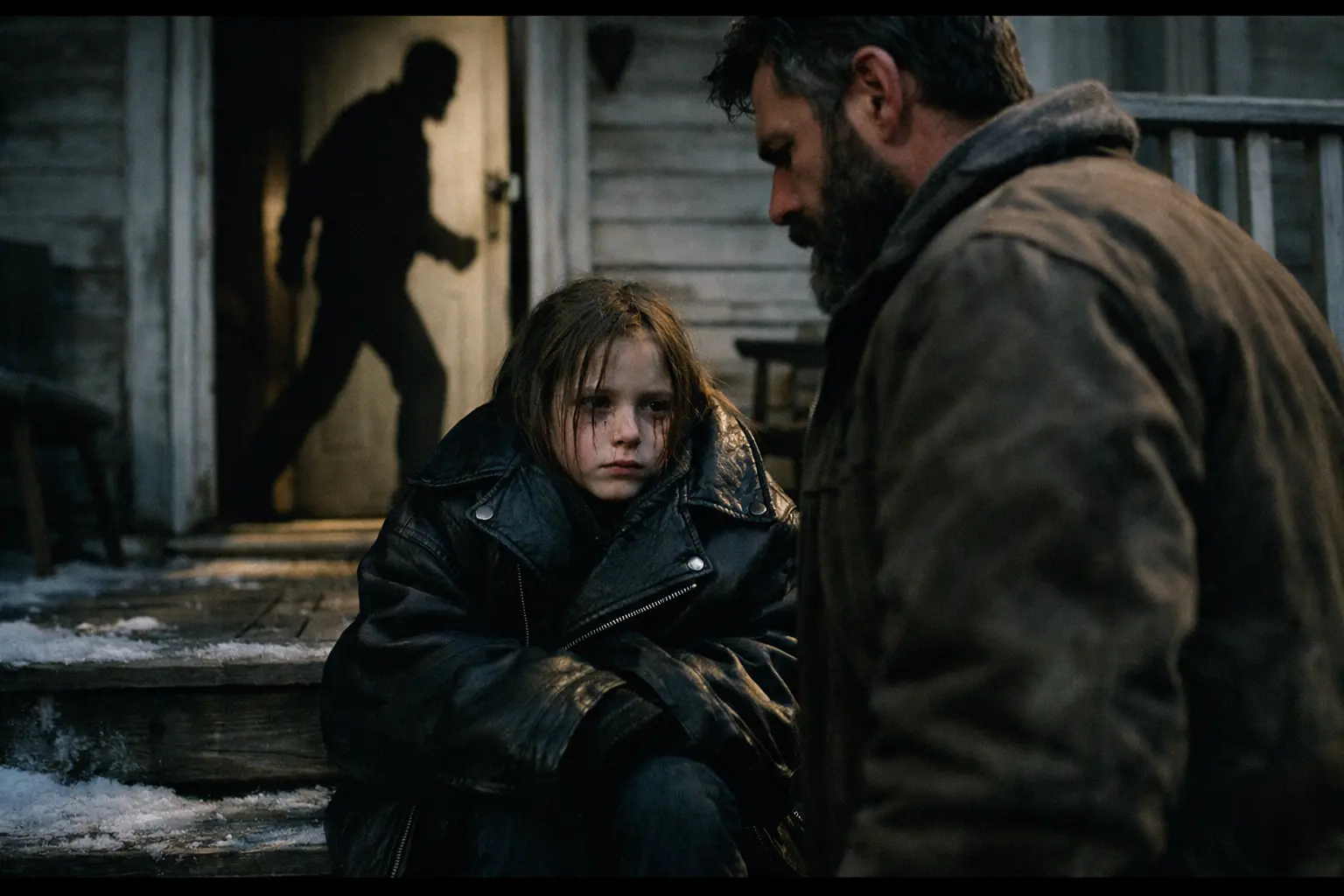
Ron Whitaker stood in the doorway, his thick shoulders blocking the warmth from inside, his face already hardened into a scowl. “This her?”
“This is Tessa,” Marlene said, keeping her voice deliberately bright. “Tessa, say hello to Mr. Whitaker.”
Tessa shrank slightly behind Marlene’s coat. “Hello.”
Ron looked her up and down like a bad grocery order. “She looks small. Can she even carry a laundry basket?”
“She’s eleven, Ron,” Marlene replied, her tone sharpening. “She’s a child, not a laborer.”
A woman stepped up behind him, her pale hair pulled back into a tight, merciless bun. Sheila Whitaker offered a smile that didn’t reach her cold eyes. “Come inside, Tessa. Let’s get you settled.”
The house smelled of old grease, stale cigarettes, and something chemical.
In the living room, their teenage son Eli didn’t look up from his phone, while his sister Mara leaned against the wall, chewing gum.
“Your room is in the back,” Sheila said, pointing down a dark, narrow hallway.
The room was tiny, containing nothing but a bare mattress, a single unshaded lightbulb, and a window without curtains.
Tessa set her stuffed rabbit on the stained mattress and sat down beside it, her knees pulled to her chest.
From the hallway, Ron’s voice carried clearly through the thin drywall. “How much is the state state-funding check for this one?”
“Enough,” Sheila replied flatly. “As long as she learns to be useful around here.”
Tessa closed her eyes tightly and hugged her knees. “Don’t cry,” she whispered to the rabbit. “If you cry, they know where to hit.”
The routine of the Whitaker house established itself by the very next morning.
Tessa was shaken awake before the sun even cleared the horizon.
“Get up,” Sheila snapped, tossing a heavy plastic bucket at the floor. “The kitchen floors need scrubbing before breakfast.”
Tessa dragged herself out of bed, her fingers stiff from the cold room. “Can I have a glass of water first?”
“You can have water when the work is done,” Sheila said, walking away.
For two hours, Tessa scrubbed the linoleum, wiped down the baseboards, and carried trash bags that weighed almost as much as she did.
When the family sat down to breakfast, the smell of sizzling bacon filled the kitchen.
Tessa stood quietly by the refrigerator, her stomach growling loudly.
Mara looked up from her plate, smirking. “Mom, the stray is making noises again.”
Tessa saw a half-eaten piece of toast left on Eli’s plate and reached out a trembling hand for it.
Smack!
Sheila’s hand struck the air right above Tessa’s fingers, forcing her back. “You eat when I tell you to eat, and not a second before.”
“I’m just really hungry,” Tessa whispered, her voice cracking.
“Then you should have scrubbed the corners harder,” Ron barked from the head of the table. “Nobody owes you a free ride here.”
That night, Tessa crept to the kitchen while the house was dead silent.
She found a crushed half of a turkey sandwich wrapped in a napkin near the bottom of the trash can.
She took it back to her dark room, sitting on the floor to eat it in tiny, desperate bites. “We just have to survive winter,” she whispered to her rabbit. “Just until spring.”
But the cruelty didn’t stop with small rations; it escalated with the dropping temperature.
By December, Ron was assigning her tasks that belonged to an adult man.
“Get outside and clear the gutters,” Ron ordered one afternoon, handing her a rusted, shaking aluminum ladder.
Tessa looked up at the ice-slicked roof. “It’s freezing, Mr. Whitaker. The ladder is slipping.”
“Then hold onto the house,” Ron sneered, crossing his arms. “You think you’re special? You think someone out there is looking for you?”
Tessa swallowed the lump in her throat. “My mom loved me.”
“Your mom is gone, kid,” Ron said, stepping closer until he towered over her. “Nobody is coming. You’re just a file nobody wanted to keep.”
The children followed their parents’ lead with terrifying accuracy.
Later that week, Eli cornered Tessa in the hallway, snatching the stuffed rabbit right out of her hands. “What’s this garbage?”
“Please give him back,” Tessa begged, reaching up frantically. “It’s the last thing I have from my mom.”
Mara laughed from the living room couch. “Look at her, she’s gonna cry over a dirty toy.”
Eli smirked and ripped the rabbit’s ear further along the seam. “Oops. Looks like he’s broken, just like you.”
He tossed the toy down the basement stairs into the dark.
Tessa scrambled down the wooden steps, retrieving the rabbit and holding it against her chest.
That night, using a needle and thread she had secretly stolen from Sheila’s sewing basket, she carefully repaired the torn ear. “I’m sorry,” she wept into the faded fabric. “I’ll keep you safe. I promise.”
School was her only refuge, specifically Room 214.
Mrs. Laurel Bennett, the art teacher, noticed the silent girl who always sat in the back row.
Tessa didn’t talk, but her sketchbook spoke for her.
She drew heavy storm clouds, iron cages, and rows of glowing headlights cutting through darkness.
Mrs. Bennett knelt beside her desk one afternoon, looking at a drawing of a small girl surrounded by large, protective figures. “This is incredible work, Tessa. You have a beautiful mind.”
Tessa tensed, waiting for a hidden catch. “Thank you.”
“Are things okay at home, honey?” Mrs. Bennett asked gently, her eyes scanning the faint yellow bruise on Tessa’s wrist.
Tessa immediately closed the sketchbook. “Yes. Everything is fine.”
Mrs. Bennett didn’t push, but she opened the bottom drawer of her desk. “Well, I always have extra snacks in here. Granola bars, sandwiches. If you ever feel hungry during lunch, Room 214 is always unlocked.”
Tessa looked at the drawer, then back at the teacher. “Thank you, ma’am.”
From that day on, a brown paper bag with a fresh turkey sandwich appeared in that drawer every single morning.
Across the street from the Whitaker house, another pair of eyes was watching.
June Mercer, a seventy-one-year-old widow, spent her mornings looking out her front window.
She saw Tessa sweeping the porch in a thin sweater while the snow fell around her.
June called the child abuse hotline that very afternoon. “The child is out there freezing. They aren’t feeding her.”
A state worker visited the house two days later.
The Whitakers put on a masterclass in deception, smiling and presenting a clean kitchen.
Tessa, terrified of what Ron would do if she spoke up, whispered that everything was fine.
The worker left, closing the file.
But June Mercer didn’t stop; she bought a small spiral notebook and began documenting everything.
December 12th: Tessa outside at 5:00 AM hauling firewood. Temp: 22 degrees. December 14th: Left on the porch for two hours without a coat.
The tipping point came a week before Christmas.
Sheila caught Tessa with an extra apple she had taken from the school cafeteria.
“Thief!” Sheila screamed, grabbing Tessa by the arm and dragging her toward the back utility shed.
“Please, Mrs. Whitaker, I was just hungry!” Tessa cried out.
Sheila shoved her into the dark, unheated shed and slammed the heavy wooden door. “You can stay in there until you learn some gratitude.”
The padlock clicked into place.
The temperature dropped to fifteen degrees that night.
June Mercer watched from her kitchen window, tears of absolute fury rolling down her wrinkled cheeks.
She knew calling the hotline again wouldn’t work fast enough.
She picked up her phone and dialed a different number. “Gabriel. It’s your Aunt June. I need you.”
Gabriel Soto, a former Marine and senior member of a major motorcycle club, answered with a gravelly voice. “What’s wrong, Aunt June?”
“They’ve locked the little foster girl in the shed,” June said, her voice shaking. “It’s freezing outside. The system isn’t doing anything.”
Gabriel’s voice turned to pure ice. “Give me the address. Don’t go over there yourself. I’m calling the President.”
Two hours later, Gabriel sat in a smoky roadside diner with Bishop, the imposing president of the regional biker chapter.
Bishop read through June’s spiral notebook, his jaw clenching tightly with every page he turned. “An eleven-year-old girl?”
“Eleven,” Gabriel confirmed. “The cops said their hands are tied without immediate proof of danger because the parents are licensed foster providers.”
Bishop closed the notebook with a heavy thud. “Then we give them proof they can’t ignore. Alert the chapters. Ohio, Indiana, Kentucky. All of them.”
“What’s the play, boss?” Gabriel asked.
“We ride,” Bishop said simply. “We stand between that child and the monsters.”
The trap was set, coordinated quietly with Sheriff Nolan Price, a man who had been itching for a legal reason to dismantle the Whitaker home.
The explosive catalyst happened on a bitter Tuesday morning in January.
Ron discovered twenty dollars missing from his wallet on the kitchen counter.
He marched straight into the living room, tearing Tessa’s stuffed rabbit away and throwing it into the roaring fireplace. “You stole from me!”
“No! I didn’t take it! Please, the rabbit!” Tessa screamed, watching the fabric catch fire.
Ron grabbed her by the collar of her thin shirt, dragged her to the front door, and threw her out onto the icy porch. “You stay out there until you confess!”
The heavy oak door slammed shut.
The lock turned with a definitive, final click.
Tessa sat on the frozen wood in her socks, her toes turning blue within minutes, her body shaking violently as she wept for her mother’s rabbit.
Across the street, June Mercer called Gabriel. “It’s happening right now. She’s on the porch. She has no shoes.”
“We’re already turning onto Mill Street,” Gabriel replied.
Tessa curled into a ball on the porch, her vision starting to blur from the extreme hypothermia.
Then, the ground began to vibrate.
At first, it sounded like a low, distant thunderstorm rolling over the Ohio hills.
But the sound grew louder, transforming into a deafening, mechanical roar that made the windowpane beside her head rattle.
Down the narrow street, a massive wall of chrome, leather, and bright headlights appeared.
Dozens of motorcycles turned the corner, followed by dozens more, filling the entire road from curb to curb.
Neighbors opened their front doors in shock.
The riders pulled up directly in front of the Whitaker house, cutting their thunderous engines in perfect unison.
An absolute, heavy silence fell over the entire block.
Bishop got off his massive black motorcycle, his heavy boots thudding against the asphalt as he walked up the walkway.
He climbed the porch steps and knelt down right in front of Tessa. “Are you Tessa Quinn?”
Tessa nodded weakly, her teeth chattering uncontrollably.
Bishop unzipped his heavy leather jacket, which was thick, warm, and smelled of the open road, and wrapped it completely around her small shoulders. “I’m Bishop. You’re safe now. Nobody is ever going to hurt you again.”
The front door flew open with a violent bang.
Ron stormed out, his face red with fury. “What the hell is this? Get off my property!”
Bishop stood up slowly, turning around to face him. He didn’t raise his voice, but the sheer authority in his tone froze Ron completely. “This is where it stops.”
Sheila ran out behind her husband, her phone pressed to her ear. “I’m calling the police on all of you! You’re trespassing!”
“Go ahead,” Bishop said calmly. “We already called them. In fact, look behind you.”
Two sheriff’s cruisers roared around the corner, their red and blue lights flashing against the snow, followed immediately by an ambulance.
Sheriff Nolan Price stepped out of the lead vehicle, his hand resting firmly on his service weapon.
From across the street, June Mercer walked over, holding her small spiral notebook high in the air. “I have it all right here, Sheriff! Every single date, every single abuse!”
“This is ridiculous!” Sheila shrieked, her voice cracking with sudden panic. “We are licensed foster parents!”
“Not anymore,” Sheriff Price said, marching up the steps. “Ron and Sheila Whitaker, you are under arrest for felony child abuse, criminal endangerment, and willful neglect.”
Click. Click.
The sound of metal handcuffs locking around Ron and Sheila’s wrists echoed across the silent street.
The neighbors watched, some of them recording on their phones, as the proud foster parents were pushed into the back of the police cruisers.
The paramedics rushed up the steps, immediately wrapping Tessa in a heated thermal blanket.
As they lifted her onto the gurney, Tessa looked back at the crowd of riders.
Every single one of them stood tall, forming an unbreakable human wall between her and the house of horrors.
Bishop gave her a firm, reassuring nod. “We’ve got your back, kiddo. Always.”
At the hospital, the medical reports provided the undeniable proof the legal system needed.
Severe hypothermia, malnutrition, and untreated fractures from older chores.
But this time, the system didn’t look away.
Dana Reeves, a district supervisor from child services, sat by Tessa’s bed the next morning. “We failed you, Tessa. I am so incredibly sorry. But I promise you, we will get it right this time.”
A few weeks later, Tessa was introduced to Aaron and Celia Brooks.
They lived on a quiet farmhouse outside Springfield, where the pantry was never locked and the rooms were filled with sunlight.
On her first night there, Tessa found a beautifully wrapped box on her new bed.
Inside was a brand-new watercolor paint set, a fresh sketchbook, and a brand-new stuffed rabbit with a perfectly stitched crooked ear.
Tessa looked up at Celia, her eyes filling with tears. “Is this really mine?”
Celia knelt down, wrapping her in a warm, gentle hug. “It’s yours, sweetheart. And you are staying here for good.”
The legal resolution was absolute and swift.
Six months later, Ron and Sheila Whitaker were convicted on all counts, receiving maximum prison sentences without the possibility of parole.
Their foster license was permanently revoked, and the house on Mill Street was seized and sold.
Years passed, and the nightmares slowly faded, replaced by the steady rhythm of a loving home.
Tessa grew up to become a celebrated artist, her paintings capturing the journey from deep darkness into bright, triumphant light.
She never forgot the sound of the thunder that saved her.
And whenever a frightened child needed a voice, Tessa was always the first one to answer the call.
The people who tried to break her didn’t get the final word.
The people who showed up did.
Original fictional stories. AI-assisted creative content.