The rain had been threatening since noon.
Maple Creek Grill sat just off the highway outside Cookeville, Tennessee. Sixteen motorcycles lined the gravel lot out front.
Inside, the lunch crowd moved the way it always did on a Saturday.
Waitresses balanced plates. Truck drivers argued about football. Families split fries across sticky tables.
In the back corner sat the Steel Guardians. Sixteen men. Leather vests. Quiet eyes.
People noticed them the second they walked in.
Not because they caused trouble. Because they looked like men who’d survived things nobody wanted to ask about.
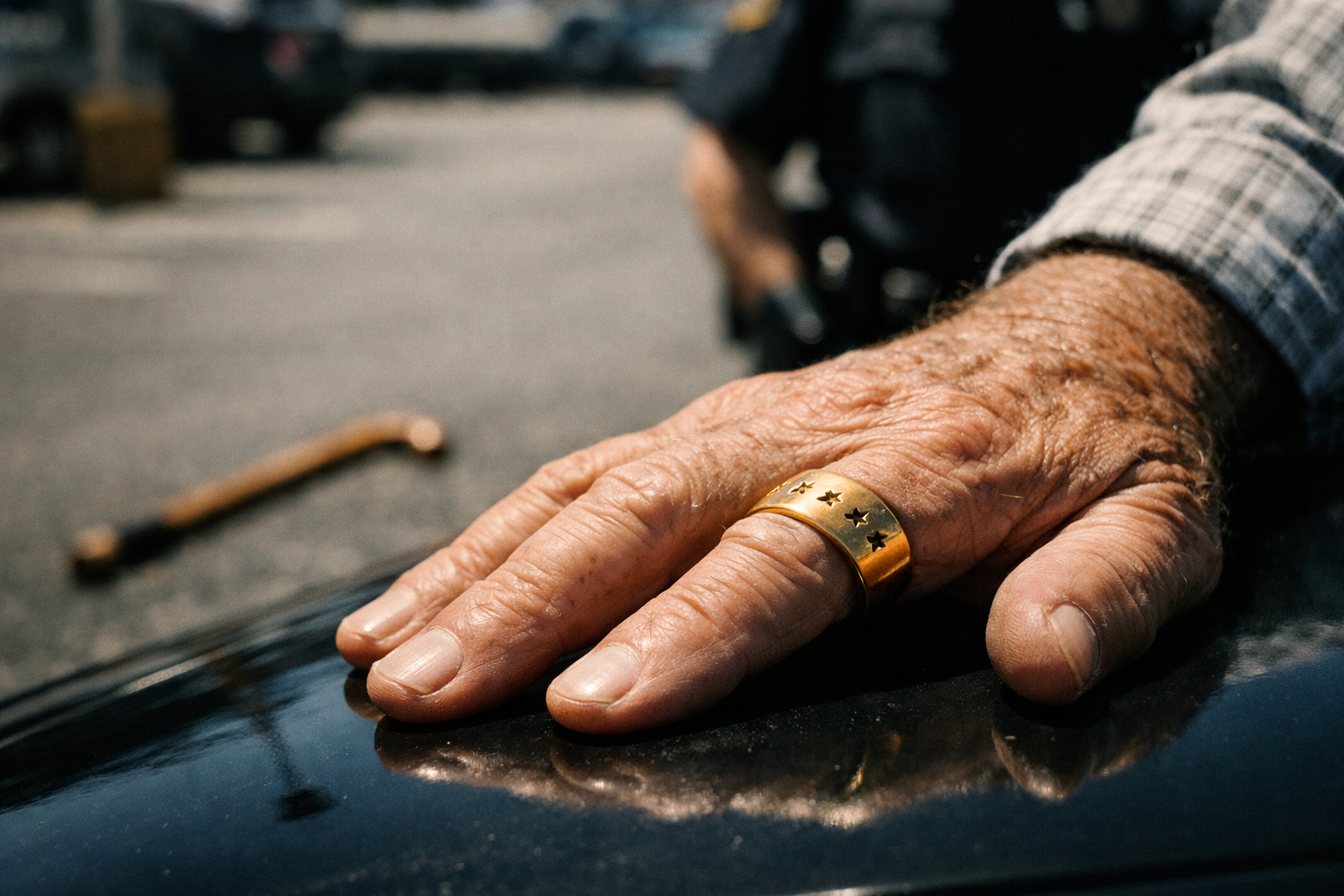
At the head of the table sat Everett Boone. Sixty-three. Army veteran. Silver hair, broad shoulders, a face that didn’t give much away.
He was halfway through his coffee when the boy appeared.
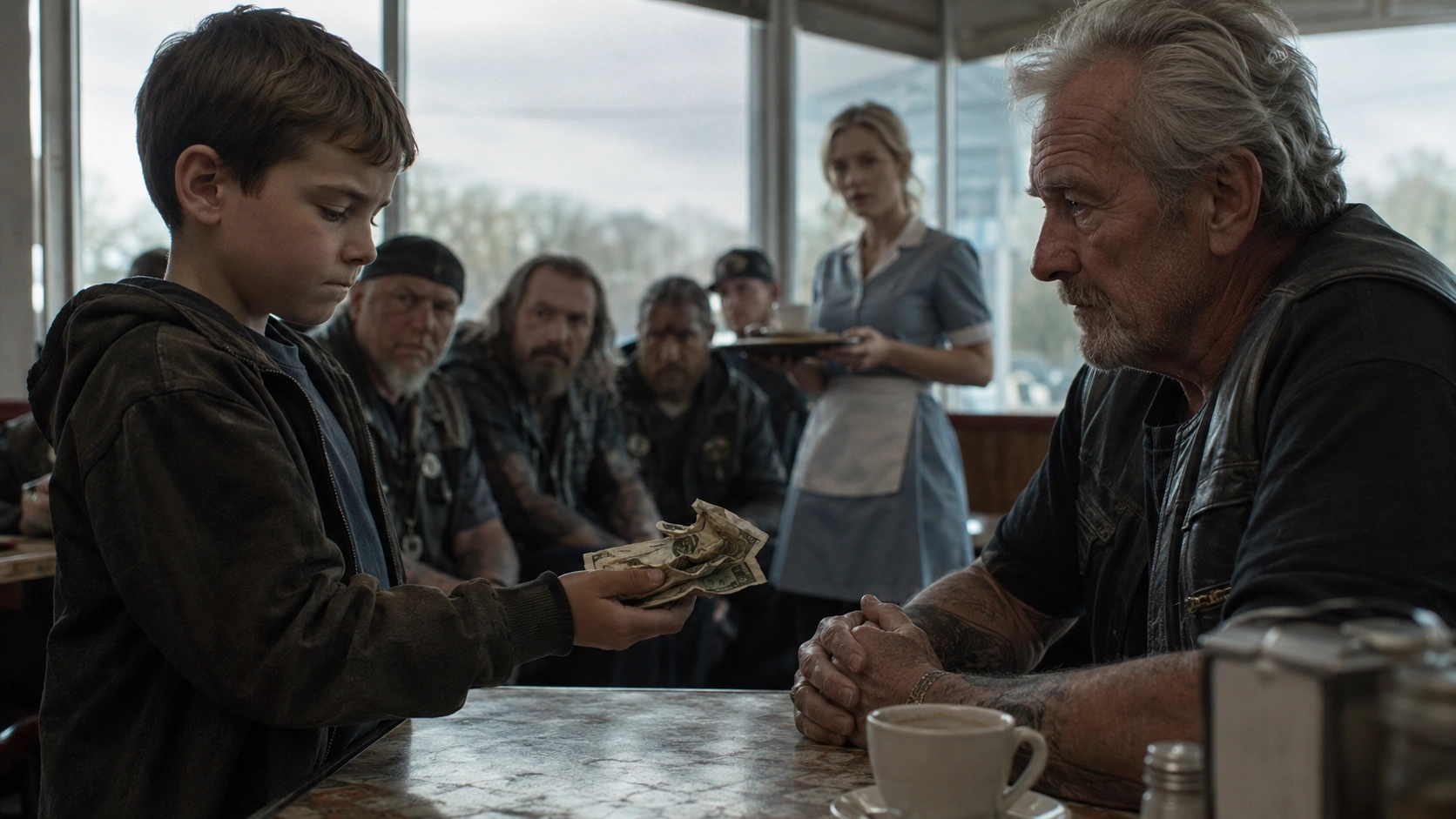
Maybe eight years old. Blond hair, uncombed. Sneakers worn through at the toe. A T-shirt two sizes too big.
In one small hand: a fistful of crumpled bills and loose change.
He walked straight past every other table in the diner. Straight to the bikers.
Conversations died around him.
A waitress froze mid-step, tray in hand.
The boy stopped beside Everett and set the money on the table.
“Can you help my mom?”
Four words. But something in his voice made every man at that table put his coffee down.
Everett studied him for a second before answering.
“What’s your name, son?”
“Mason.”
“And what kind of help does your mom need?”
Mason’s hands were shaking. He didn’t look up.
“She says everything’s okay. It isn’t.”
Nobody at the table moved.
“My stepdad gets angry a lot.”
He stared at his shoes.
“Mom cries when she thinks I’m asleep.”
Everett felt something cold settle in his stomach. Twenty years in the Army teaches a man to recognize fear in another person’s eyes. He was looking right at it.
“Does your mother know you’re talking to us?”
Mason shook his head. “She’s in the bathroom.”
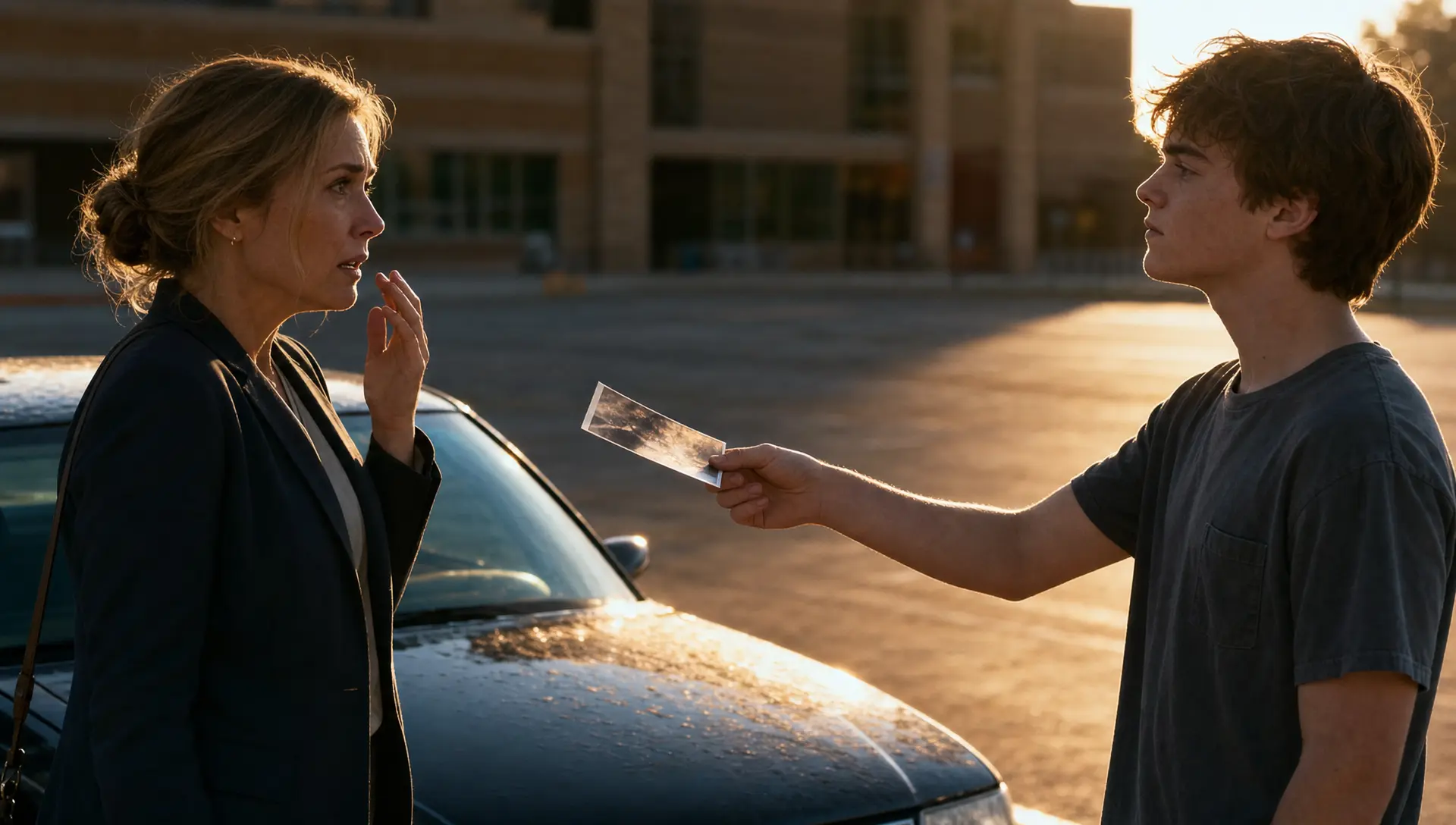
Before Everett could say another word, a woman came around the corner from the hallway. Her face went white.
“Mason!”
She rushed over, grabbing his shoulder.
“I’m so sorry — he’s bothering you. Come here, sweetheart.”
Then she saw the money on the table. And the faces looking back at her.
Something in her cracked open right there. Embarrassment. Exhaustion. The look of someone who’d been carrying too much for too long and just got caught.
Everett stood up slowly. She stepped back on instinct.
His voice stayed level. “Ma’am, why don’t you sit down a minute. We’re not looking for trouble.”
“We’re fine. Really.”
“How about lunch. Our treat.”
She looked at her son. Mason looked back at her with something close to hope.
She sat.
A waitress brought sandwiches and milkshakes nobody had ordered. Mason wrapped his arms around his mother, and Everett caught the way she flinched. Small. Almost nothing. But enough.
“What’s your name?” Everett asked quietly.
“Rachel.”
“Are you and Mason safe at home, Rachel?”
The question sat there in the air for a long moment.
Her eyes filled. She tried to answer and couldn’t.
“Not always,” she finally said.
Sixteen men went still. Nobody interrupted.
She told them about Trent. Married almost four years. Charming at first. Helpful. Then slowly, the walls closed in — where she could go, who she could talk to, how the money got spent. His temper getting worse by the month.
She’d wanted to leave. More than once. But there was nowhere to go. No family close by. No savings. No safety net.
Just Mason.
The boy sat quietly through all of it. Clearly not the first time he’d heard this conversation.
Everett felt his jaw tighten. No kid should carry weight that belongs to the adults around him.
“Where’s Trent now?”
“Home. Sleeping. He’d been drinking again this morning.”
Mason looked straight at Everett.
“Can you help us?”
Not dramatic. Just honest. A question from a kid who’d run out of people to ask.
Everett looked around the table. Sixteen men who’d spent their lives understanding loyalty, responsibility, and what it costs to look away.
He nodded.
“Yes, son. We’re going to help.”
For the first time all day, Mason smiled. Small. But real.
That was enough.
Thirty minutes later, sixteen motorcycles moved through the hills outside Cookeville, surrounding Rachel’s old sedan like a moving wall.
Mason sat in the passenger seat, watching the bikes flank them on every side. For the first time in months, he wasn’t checking the mirrors for what might be waiting at home.
Because this time, he wasn’t going home alone.
Everett rode point. He’d learned a long time ago that fear grows in silence — and courage grows the moment people stand together.
The house came into view exactly as Rachel described it. Faded siding. Grass that hadn’t been cut in weeks. A porch that looked one storm away from giving out.
Rachel’s knuckles went white on the wheel.
“Maybe this is a mistake,” she whispered.
Everett walked up to her window.
“No, ma’am. The mistake would be leaving things how they are.”
She broke down right there. Nobody had spoken to her like that in years.
Within the hour, deputies arrived, taking down statements and documentation Rachel had never felt safe sharing before. For the first time, she said it all out loud. For the first time, someone listened.
The Steel Guardians spent the evening helping her gather what mattered. Photos. Papers. Mason’s dinosaur books. His baseball glove. A blanket he’d had since he was three.
At one point Mason stood frozen in his room, staring at a shelf.
“What’s wrong, buddy?” Everett asked.
“I don’t know if we have room for all my stuff.”
Everett crouched down to his level.
“Son, we’ll make room.”
Mason grinned like that was the best news he’d ever gotten.
Years later, Rachel would say that was the exact moment her son started believing things could actually be different.
The years after weren’t easy.
Rachel worked two jobs while grinding through nursing school. Studied past midnight, up before sunrise. There were nights she doubted she could pull it off.
Every time she felt like she was drowning, her phone rang. Sometimes Everett. Sometimes another Guardian.
They checked in constantly.
When Mason played Little League, sixteen bikers showed up in the bleachers. When he won a school award, they showed up again. When Rachel walked at her nursing school graduation, the loudest cheers in the room came from a row of grown men in leather vests.
People stared at first. Some judged.
Then they heard the story.
By then everyone understood — the Steel Guardians weren’t just a motorcycle club anymore. They were family.
On Mason’s tenth birthday, Everett handed him a small box.
Inside: a faded American flag pin. One that had ridden with Everett through deployments overseas, decades back.
“Are you sure?” Mason asked.
“A flag doesn’t mean much sitting in a drawer,” Everett said. “It belongs with someone brave enough to carry it.”
Mason pinned it to his jacket that day and never took it off. Not for school. Not for graduations. Not for baseball games. Not for family photos.
It became a reminder — that courage isn’t the absence of fear. It’s asking for help while you’re afraid.
Years passed. Mason grew taller, stronger, sharper. He did well in school, did well in sports. But what stuck with Everett wasn’t the success.
It was the character. Mason volunteered at shelters. Tutored younger kids. Worked summer jobs without complaint. Never forgot where he came from.
The night before graduation, he sat beside Everett outside the diner where it had all started. The Tennessee sky was going orange behind the tree line.
“I made a decision,” Mason said.
Everett looked over. “What’s that.”
“I’m joining the Army.”
Everett went quiet for a long moment, then smiled.
“Why?”
Mason glanced down at the flag pin on his jacket.
“Because somebody protected me when I couldn’t protect myself. Now I want to do that for somebody else.”
Everett had to look away before the kid could see his throat working.
A few months later, Mason left for training. The years that followed brought deployments, hard lessons, long stretches apart. But every photo Rachel got from her son showed the same thing.
The faded flag pin. Over his heart. Exactly where it belonged.
Fifteen years later.
The afternoon felt strangely familiar. Rain clouds drifting over the hills. Motorcycles lined up outside Maple Creek Grill.
Everett sat in his usual booth. Seventy-eight now. Beard gone fully white, knees complaining every morning. Still showed up every Saturday. Some things you don’t let go of.
The lunch crowd filled the diner the way it always had. Coffee cups clinking. Life moving on.
A black SUV pulled into the lot.
Everett barely glanced up — until something made him look twice.
A tall man stepped out. Army Ranger dress uniform. Shoulders set, posture sharp. And pinned above his heart, a faded American flag.
Then Everett saw the tears in the man’s eyes.
The diner door opened. The room went quiet without anyone asking it to.
The Ranger walked straight to Everett’s table. Neither man said anything for a moment.
Then the soldier smiled.
“You probably don’t remember me.”
Everett stared. Something about the eyes. The smile.
“Fifteen years ago,” the man said, voice cracking, “you helped my mom and me. My name’s Mason.”
Everett went still. Stared for a long moment. Then stood up, and they embraced like family — because that’s exactly what they were, and half the diner watching didn’t matter at all.
When they stepped apart, Mason waved toward the door. A young woman walked in holding the hand of a little girl with blond curls. Rachel followed behind — healthy, confident, smiling. Nothing like the woman who’d once walked out of that bathroom fifteen years earlier.
Mason knelt next to his daughter.
“Sweetheart, this is Mr. Everett.”
The girl smiled shyly. Mason lifted her gently into Everett’s arms.
Everett looked confused — until Mason’s eyes filled again.
“This little girl exists because of what you did for us that night.”
The table went silent. A few bikers wiped their eyes without trying to hide it.
“You didn’t just help a scared kid,” Mason said. “You gave him a future.”
He pulled a small velvet box from his pocket and handed it over.
Inside: a brand-new American flag pin. Engraved underneath, six words.
THANK YOU FOR GIVING ME A FUTURE
Everett stared at it, hands trembling. For the first time in years, he had nothing to say.
Rachel stepped forward.
“You saved more than one life that day. You saved all of ours.”
The whole diner had gone quiet by then. Waitresses, truck drivers, customers — everyone watching. Not because of the bikes. Not because of the uniform.
Because they were watching something rare: kindness that had survived fifteen years and turned into a family.
Everett looked at Mason. Then Rachel. Then the little girl settled comfortably in his lap.
A family. A future. A life rebuilt — exactly what one frightened kid had hoped for the day he walked across a diner floor with a handful of crumpled dollar bills.
Everett smiled through tears.
“Best investment I ever made.”
The diner laughed. Then applauded.
Outside, thunder rolled soft across the hills, and an old biker sat holding a little girl in his arms, finally understanding something simple.
Sometimes a small act of kindness doesn’t change a day.
Sometimes it changes generations.
Original fictional stories. AI-assisted creative content.