Blackridge Correctional Facility had a king, and his name was Rex.
For twenty years, no one had challenged him. He came in at nineteen for aggravated assault. By twenty-five, he ran the north wing. By thirty, he ran the whole block.
Rex didn’t need to be the biggest man in the room, though he was close. He didn’t need to be the smartest, though he was sharp enough. What made Rex dangerous was simpler than that. He genuinely enjoyed hurting people.
New inmates learned the rules fast. You paid tribute. You looked away when Rex’s crew went to work. You gave up your commissary, your phone time, your bunk if he wanted it. And if you didn’t—if you were stupid enough to think you had rights inside these walls—you ended up in the infirmary. Or worse.
The guards knew. The warden knew. But Rex kept the block quiet in his own way. Fewer riots. Fewer complaints. As long as the bodies didn’t pile up too fast, everyone looked the other way.
Three months before Harold arrived, a young inmate named Nathan Cole made the mistake of refusing to hand over the letters from his mother. Rex’s crew held him down in the shower for six minutes. Nathan never walked right again. He stopped talking altogether. Two weeks later, he hanged himself in his cell.
The block held a moment of silence. Rex laughed.
That was the world Harold Reed walked into on a gray Tuesday morning in October.
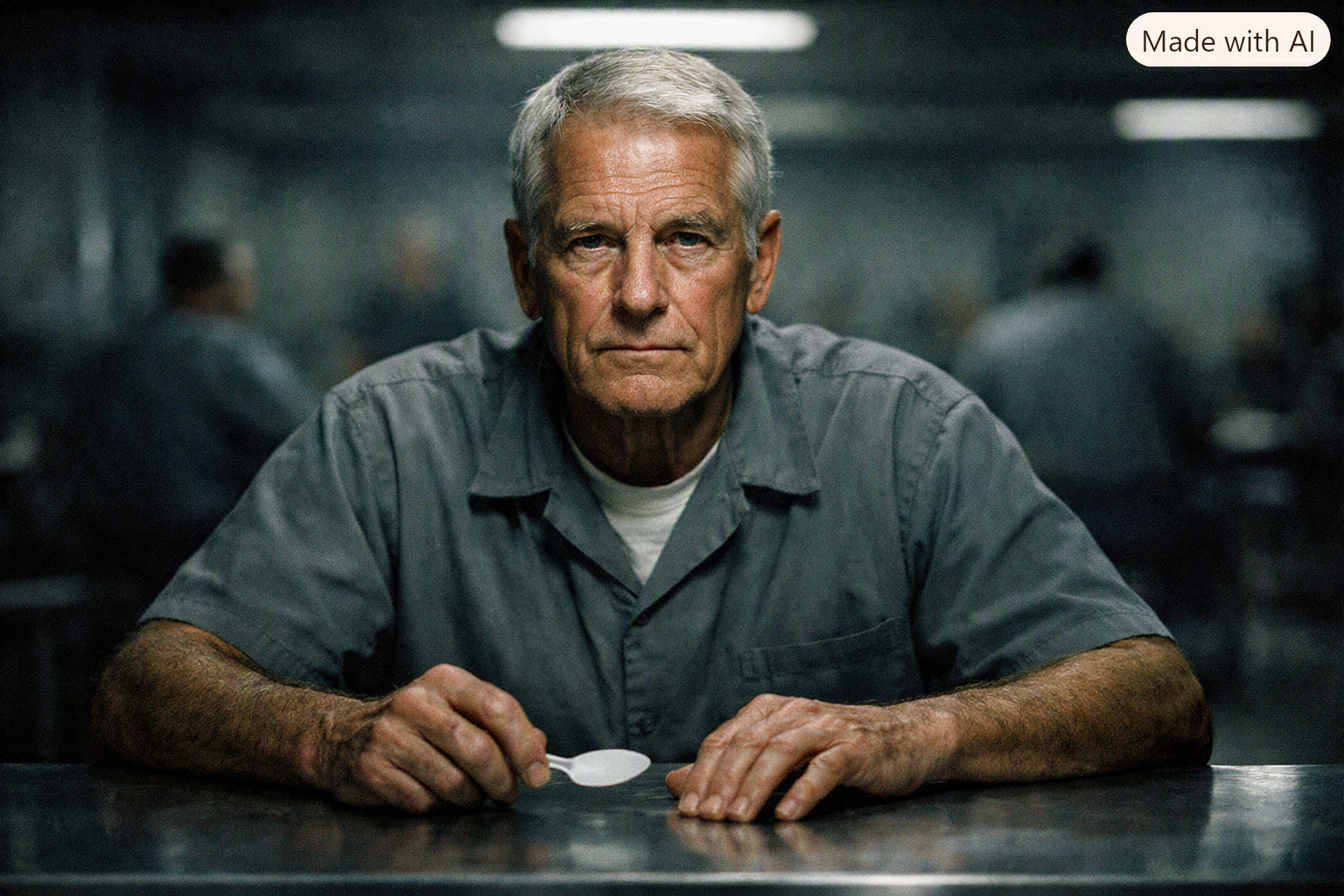
He arrived on the transfer bus with seven other men. Six of them looked terrified—young, thin, wide-eyed. The seventh was Harold. Seventy-two years old. Silver hair cut short. Faded blue eyes. A body that looked like it had been carved down to bone and wire by decades of something.
He didn’t look scared. He didn’t look angry. He looked like a man arriving at a hotel he’d stayed in a hundred times before.
The intake guard, Danvers, had seen thousands of inmates come through those doors. But when Harold set his small canvas bag down on the counter, something about him made Danvers pause. It wasn’t the age. It wasn’t the calm. It was the eyes. They didn’t focus on Danvers. They mapped him. Cataloged him. Filed him away.
“First time in the system?” Danvers asked, already knowing the answer.
Harold almost smiled. “No.”
His paperwork came back marked with three red flags Danvers had never seen before. Sealed jacket. Restricted history. Warden’s eyes only.
Danvers made a note in his logbook that night: New arrival, cell 214. Something wrong with this one.
Harold sat alone in the prison cafeteria on his third day, eating his bland dinner in silence. He was seventy-two, thin, with silver hair and calm eyes that never seemed to blink.
The other inmates already had a name for him. “The ghost.” He never spoke unless spoken to. Never fought. Never caused trouble. He moved through the block like he wasn’t quite there—present but somehow separate, like a man watching a play he’d already seen the ending of.
Rex didn’t like ghosts.
Rex had been watching Harold since intake. Something about the old man bothered him in a way he couldn’t name. New inmates were supposed to be afraid. They were supposed to keep their heads down, avoid eye contact, look for allies. Harold did none of that. He ate when he wanted. He read in the yard. He nodded at Rex’s crew the same way he nodded at everyone else—polite, empty, unreadable.
By day three, Rex had decided. This ghost needed to learn who owned this block. And the whole cafeteria needed to see the lesson.
That’s when Rex walked over to Harold’s table.
“Hey, old man,” Rex barked across the cafeteria. “You’re in my spot.”
Harold looked up slowly. “There are other tables.”
Rex’s face darkened. He walked over and kicked Harold’s tray. Food splattered across the floor.
“Now there’s no reason to sit here at all.”
The cafeteria went silent. Everyone waited for Harold to cower, to apologize, to run.
Instead, the old man simply looked at Rex. His eyes didn’t widen. His expression didn’t change. But something in that gaze made Rex’s skin crawl.
It wasn’t anger. It wasn’t fear. It was recognition—like a surgeon studying exactly where to cut.
Rex laughed it off. “What’re you gonna do, grandpa? Bore me to death?”
Harold said nothing. He stood, walked to get a mop, and cleaned up the mess himself.
But that night, Rex couldn’t sleep. Those eyes haunted him.
The next morning, Rex’s lieutenant, Jake, pulled him aside. “Boss, we got a problem.”
“What problem?”
“The old man. I’ve been asking around.” Jake’s voice dropped to a whisper. “He’s been in and out of prisons for thirty years. Short sentences. Different facilities.”
“So? He’s a career criminal.”
“No, boss. Every time he shows up, someone disappears. Transfers. Suicides. One guy went completely insane, started eating his own hair.”
Rex scoffed. “That’s prison legend garbage.”
“A guard told me Harold’s not even his real name. Nobody knows what he’s in for. His file’s sealed. The warden won’t talk about him.”
A chill crept down Rex’s spine. “What are you saying?”
“I’m saying maybe he’s not just an old man.”
Rex spent the next week watching Harold. The old man’s routine never changed. Wake up. Exercise. Read. Eat. Every single day, he received one letter. Always the same plain envelope.
Harold would read it, smile faintly, then tuck it into his shirt pocket.
That letter. It had to mean something.
Rex decided to find out. He waited until shower time, then broke into Harold’s cell. He tore through the thin mattress, the books, the small box of belongings.
Finally, he found it. The letter.
His hands shook as he unfolded it. Inside was a child’s crayon drawing of a house with stick figures. At the bottom, in careful handwriting: “I love you Grandpa. Come home soon. – Lily.”
That’s it? A kid’s drawing?
“Looking for something?”
Rex spun around. Harold stood in the doorway, perfectly calm.
“Old man,” Rex growled, clutching the drawing. “What kind of game are you playing?”
Harold stepped inside and sat on the bunk. “Sit down.”
“I don’t take orders from—”
“Sit. Down.”
Something in those words made Rex obey.
Harold gestured to the drawing. “My granddaughter Lily. She’s eight. Her parents were killed by men like you—men who thought they were untouchable.”
Rex’s throat tightened.
“I’m not a criminal, Rex. I’m a consequence.” Harold’s voice was soft but absolute. “I’ve spent my life finding men who hurt innocents. Men the system couldn’t touch. And I make them disappear.”
“You’re bluffing.”
“Am I?” Harold leaned forward. “Your lieutenant, Mike. He disappeared three years ago from Stateville. You remember him?”
Rex’s blood ran cold. Mike had worked for him before he got transferred here.
“He liked hurting women,” Harold continued. “Bragged about it. Six months after I arrived, he requested a transfer. Nobody’s seen him since.”
“You… you killed him?”
“I don’t kill, Rex. I dismantle. I make men like you lose everything without lifting a finger. Your reputation. Your power. Your sanity. And when you’re finally broken, the system finishes the job.”
Harold stood. “I’ve been watching you. The way you terrorize the weak. The inmates you’ve sent to the hospital. You’re exactly the kind of man I came here for.”
Rex’s hands trembled. “What do you want?”
“I want you to understand something.” Harold took the drawing back, folding it carefully. “You have a choice. Stop being what you are, or I’ll make sure you lose everything. Not today. Not tomorrow. But slowly, piece by piece, until there’s nothing left of Rex but a shell.”
He moved toward the door, then paused. “Or you can walk away right now. Leave the weak alone. Serve your time quietly. And when you get out, maybe you’ll be someone Lily wouldn’t have to fear.”
Harold left without another word.
Rex sat frozen. For the first time in twenty years, he felt genuine terror.
Over the next months, Rex changed. He stopped the shakedowns. Stopped the beatings. His crew scattered when they saw their leader wouldn’t fight back anymore.
The cell block noticed. The ghost had won without throwing a single punch.
One day, Harold was released. At the prison gates, a little girl in a yellow dress ran into his arms.
“Grandpa!”
Harold hugged Lily tight, the drawing still in his pocket.
From his cell window, Rex watched them leave. He finally understood: some men don’t fight with fists. They fight with inevitability.
And true power isn’t about fear—it’s about knowing exactly when to show mercy, and when to become someone’s worst nightmare.
Original fictional stories. AI-assisted creative content.