The metal tag hit the rim of the trash can with a sharp ping, spun once, and disappeared under a pile of paper cups.
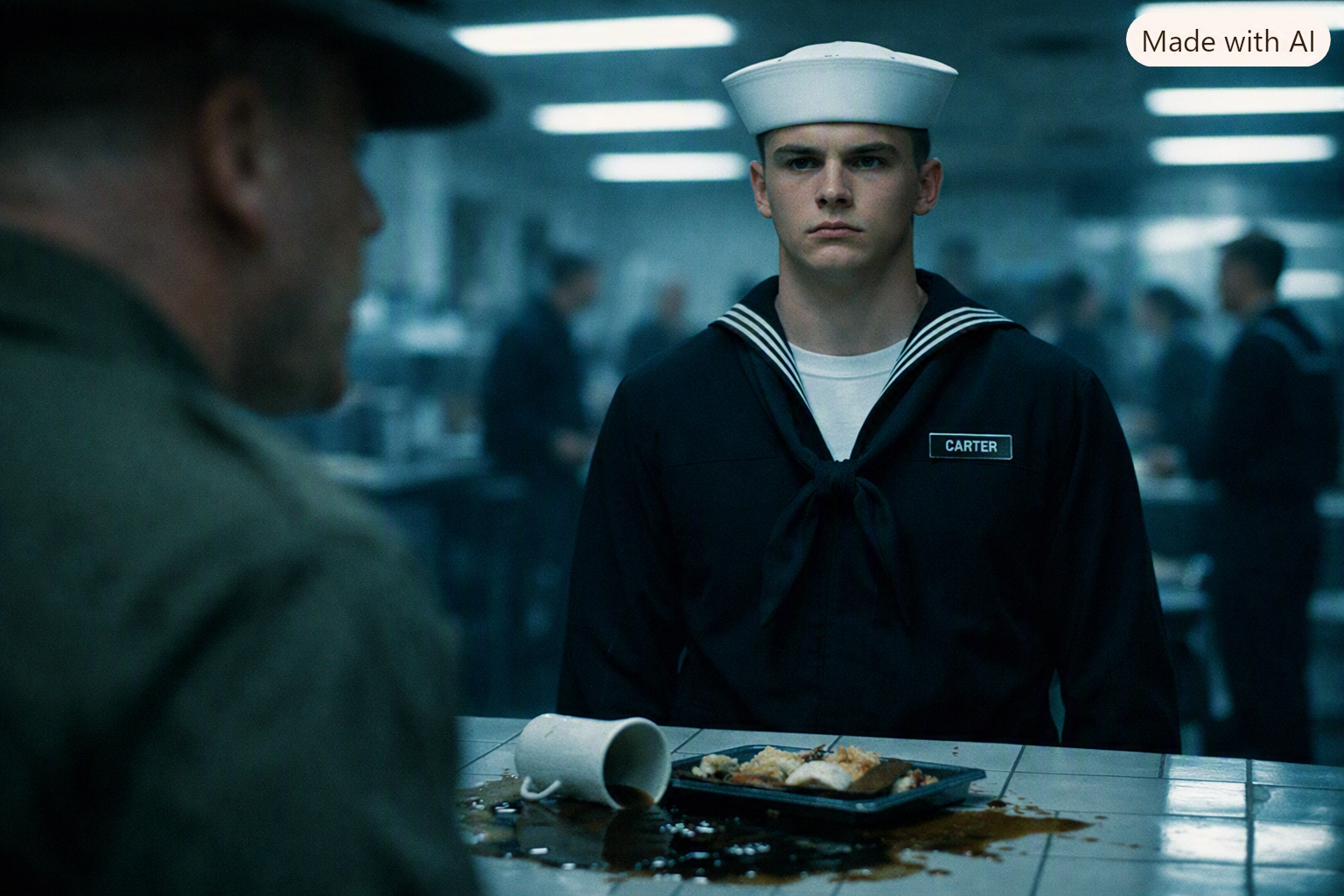
Noah Carter stood at attention and did not move.
The cafeteria at Naval Amphibious Base Coronado kept moving around him. Trays clattered. Coffee steamed. Somewhere down the line, a recruit dropped a fork and did not pick it up.
Sergeant Tyler Reed watched the nineteen-year-old’s face.
He seemed almost disappointed.
“Nothing to say, Carter?”
“No, Sergeant.”
“Good.” Tyler stepped closer until the toes of his boots touched Noah’s. “Because nothing is exactly what you’ve earned.”
A few recruits laughed. Others went quiet, which was smarter.
Noah’s eyes stayed level, tracking just above Tyler’s left shoulder — not defiant, not vacant. Controlled. Like he was absorbing information he would need later.
Tyler didn’t like that look.
He slapped the edge of Noah’s breakfast tray.
The plastic cracked against the tile. Eggs, toast, and a paper cup of orange juice scattered between two tables. Coffee splashed across Noah’s boots and striped the legs of the recruits standing nearest to him.
“Daniel Carter earned that name,” Tyler said. He pointed at the mess like it was evidence. “You’re borrowing his reputation and hoping nobody notices the difference.”
Noah crouched slowly to retrieve the tray.
Tyler kicked it away.
It skidded under a table and clipped a recruit’s heel.
“Leave it,” Tyler said.
Noah stood back up.
He looked at Tyler for exactly one second — not a challenge, not submission — and then looked straight ahead again.
“That composure doesn’t impress me,” Tyler said. “Your father had composure. Your father also had the actual ability to back it up. You? You’re a liability with a famous last name.”
“Yes, Sergeant.”
“You think this is a performance?”
“No, Sergeant.”
Tyler leaned in until his voice was only for Noah. “Sixteen men watched your father die in a burning helicopter because he froze at the wrong moment. That’s what you’re carrying. That’s the only thing you’re carrying.”
Noah said nothing.
“Look at me when I’m talking to you.”
Noah looked at him.
Tyler searched his face for something that would satisfy him. A crack. A flinch. Something that would confirm that the boy had heard what he’d said about his father.
He found nothing useful.
“Dismissed. Clean up your mess first.”
Noah collected the scattered tray, bent down for the paper cup, picked up the fork that had slid under the next table. Every movement deliberate. Not angry. Not wounded.
Tyler watched him walk away.
He told himself it was insolence.
The next morning, Noah arrived at the obstacle course twelve minutes before the first whistle.
He ran every station clean except the rope wall, where his left hand slipped on the wet fibers and he dropped six feet, landing hard on both heels.
He got up.
He ran the wall again.
Petty Officer Marcus Webb jogged alongside him on the mile cooldown. They’d been bunkmates for six weeks. Marcus had the kind of easy smile that made people forget he’d grown up harder than most of them.
“You going to tell me what happened with Reed yesterday?”
“Nothing happened.”
“Half the cafeteria watched it.”
“Then they already know.”
Marcus glanced sideways at him. “You know what people are saying.”
“I know.”
“They’re saying Reed has it out for you specifically.”
“He has opinions about my last name,” Noah said. “That’s his problem.”
“Except it keeps becoming your problem.”
“Yeah.” Noah kept his pace steady. “It does.”
Marcus was quiet for a few strides. “He said your dad froze.”
“I heard him.”
“Is any of that true?”
“I don’t know,” Noah said. “I was three years old.”
Marcus looked at him. “That doesn’t bother you?”
“Of course it bothers me.” Noah’s breath evened out at the top of the hill. “But I’m not going to lose my focus over it.”
Tyler ran Thursday morning inspection like he ran everything — with the kind of precision that made newer recruits mistake control for competence.
He walked the line slowly, pausing at each bunk, picking up a boot here, pressing a seam there, saying almost nothing.
When he reached Noah’s bunk, he stopped.
He reached out and straightened the name tag on Noah’s chest with two fingers.
“CARTER,” he said.
“Yes, Sergeant.”
“Your father served under Commander Holloway’s unit.”
“I know.”
“Holloway transferred to base administration last year.” Tyler’s voice was perfectly level. “He doesn’t run training cycles anymore.”
“I know that too.”
“Good.” Tyler released the tag. “I want you to understand something. Holloway’s presence on this base does not change the standard I hold you to. It does not change my evaluation of your performance. It does not change anything.”
Noah said nothing.
“Do you understand?”
“Yes, Sergeant.”
Tyler moved down the line.
Noah stood at parade rest and thought about the way Tyler had said Holloway’s name — casually, like it didn’t matter — and how that was the first time Tyler had mentioned anyone outside this training cycle.
He filed it carefully.
He found Marcus in the equipment bay that afternoon.
“Holloway,” Noah said. “What do you know about him?”
Marcus looked up from the gear he was stowing. “Commander Ellison Holloway? He ran SEAL Team operations for years before he came here. Now he handles base oversight and some kind of internal review board.” He paused. “Why?”
“Reed brought him up.”
“Reed mentioned Holloway to you directly?”
“In a way.” Noah leaned against the rack. “It felt like a warning.”
“Or a test,” Marcus said. “Reed likes to see what you’ll do with information.”
“Maybe.”
“Or maybe,” Marcus said slowly, “Reed knows Holloway could answer some questions about your dad that Reed doesn’t want answered.”
Noah looked at him.
“Think about it,” Marcus said. “Your dad died in Reed’s unit. Reed’s been on you since day one. That’s not random instructor aggression. That’s something personal.”
“He said my dad froze.”
“Reed said that.” Marcus set down the harness. “Which means Reed was there. Which means Reed knows exactly what happened.”
The bay was quiet except for the wind off the bay rattling the ventilation screens.
“I need to talk to Holloway,” Noah said.
“Yeah.” Marcus didn’t argue. “You probably do.”
Commander Ellison Holloway had an office in the administration building that looked like it belonged to someone who didn’t want to be found in it. No photographs. No plaques. A single window facing the training yard.
He looked up when Noah appeared in the doorway.
“Recruit Carter.” His voice was even. “I wondered how long it would take.”
Noah stepped inside. “You know who I am.”
“I knew your father.” Holloway gestured toward the chair across his desk. “Sit down.”
Noah sat.
Holloway studied him for a moment — same build, same eyes, something in the posture that made the years collapse.
“You want to know about the helicopter,” Holloway said.
“I want to know what actually happened.”
“What has Sergeant Reed told you?”
“That my father froze.”
Holloway’s expression didn’t shift, but something behind his eyes moved. “That’s what he said.”
“Is it true?”
Holloway was quiet for a moment. He opened a desk drawer, slid it shut again without taking anything out. “What I tell you in this room is not official. You understand that?”
“Yes, sir.”
“There’s a formal process for correcting mission records. I’ve been considering initiating it for some time.” He looked at Noah steadily. “Your appearance may accelerate that.”
“What happened?”
Holloway placed his hands flat on the desk. “The helicopter went down in a canal during an extraction. Rotor damage. Partial submersion. Your father got clear of the aircraft.”
Noah held very still.
“He was on the bank,” Holloway continued. “Thirty feet clear. Two teammates were already pulling him back from the edge.”
“And then?”
“And then Tyler Reed was still inside.” Holloway’s voice stayed level, but the words cost him something. “Harness malfunction. He couldn’t get free.”
The room went quiet.
“My father went back.”
“Yes.”
“No one ordered him.”
“No.”
“He was already clear.”
“Yes.”
Noah absorbed this slowly, the way you absorb cold water — feeling the surface first, then the depth.
“Reed told you he froze,” Holloway said. “That’s not what happened. Your father made a choice. He went back into a burning fuselage for a man who was trapped, and the fire overtook them before he could get clear again.”
“Reed survived.”
“Reed survived,” Holloway confirmed.
“Because of my father.”
“Because of your father.”
Noah looked at the window. The training yard outside moved with small figures in the morning heat.
“Why didn’t Reed ever—”
“Because acknowledging what your father did means acknowledging what he owes.” Holloway’s voice was quiet. “Some debts are too heavy to admit to. It’s easier to diminish the man who saved you than to live with what that rescue cost.”
“He’s been doing it for sixteen years.”
“He has.”
“And you’ve known this entire time.”
Holloway met his gaze without flinching. “I failed your family. I will not pretend otherwise. I delayed the review because Reed was still active duty and the official record was closed and —” He stopped. “None of that is an adequate explanation.”
“No,” Noah said. “It isn’t.”
“I know.”
They sat with that for a moment.
“What happens now?” Noah asked.
“Now I formally request a mission record review.” Holloway opened his desk again and this time removed a folder. “I’ve had this prepared for three months.” He set it down. “I was waiting for a reason that felt sufficient.”
“My father dying wasn’t sufficient?”
“Your father dying was the reason I prepared it.” Holloway looked at him steadily. “But I needed to understand whether you wanted the truth or wanted ammunition.”
“Those aren’t the same thing.”
“No,” Holloway said. “They’re not. And the fact that you understand that tells me everything I needed to know.”
Noah found Tyler Reed in the equipment yard that afternoon.
He didn’t go looking for a confrontation. He went to return a borrowed field kit to the storage rack near bay four, and Reed was standing at the far end, alone, cleaning a radio piece with practiced movements.
Tyler looked up.
He recognized something in Noah’s posture immediately. Not aggression. Something worse.
“Carter.”
“Sergeant.”
Tyler set down the radio. “You went to Holloway.”
It wasn’t a question.
“Yes.”
“And he told you his version.”
“He told me what happened,” Noah said. “Which is different from a version.”
Tyler’s jaw moved slightly. “You think it’s that simple.”
“I think my father got out of that helicopter,” Noah said. “I think he was thirty feet clear. And I think he went back in for you.”
Something crossed Tyler’s face — not guilt exactly, but the particular exhaustion of a man who has been outrunning a specific truth for a very long time.
“You don’t know what that day was,” Tyler said. “You don’t know what it looked like from inside. The noise, the water, the fire—”
“I’m not asking you to defend yourself.”
“Then what are you asking?”
“Nothing,” Noah said. “I don’t need anything from you.”
Tyler looked at him. “Then why are you standing here?”
“Because you threw my father’s name in a trash can,” Noah said. “And I wanted you to see me pick it back up.”
Tyler went very still.
“You spent sixteen years telling yourself he froze,” Noah said. “You told it to enough people that it probably started feeling true. You said it to me.” He looked at Tyler directly. “But you know what you owe. You’ve always known.”
“Carter—”
“I don’t want an apology,” Noah said. “I don’t want anything from you. But Holloway’s filing the review. The record is getting corrected. And when it is, you’re going to have to live with your name next to the truth of what happened.”
He turned and walked back toward the bunk block.
Tyler watched him go and did not call after him.
Three days after his conversation with Holloway, Noah found a printout folded under his bunk mattress.
It was a single page — a photocopy of a training evaluation form with his name at the top and Tyler’s signature at the bottom. The ratings were marginal across every category. Not failing, but barely passing — the kind of record that could justify removal from a training cohort at the next review.
Noah read it twice.
He folded it back exactly as he’d found it and put it in his pocket.
He found Marcus in the laundry bay. “When do training evaluations get submitted to the review board?”
“End of week four,” Marcus said. “Why?”
“I need to know whether a preliminary evaluation can be submitted earlier.”
Marcus stopped folding. “Reed gave you something?”
“He left something for me to find.”
“That’s not submission. That’s a draft.”
“I know.” Noah looked at the folded paper in his hand. “Which means it’s not official yet. Which means he made a mistake.”
“What kind of mistake?”
“He put it in writing before he talked to anyone else.” Noah looked at him. “That means I can show Holloway before Reed submits it. Reed assumed I’d either panic or do nothing.”
Marcus stared at him. “You’re not going to panic.”
“No.”
“And you’re clearly not going to do nothing.”
“No.”
Marcus was quiet for a moment. “How are you this calm?”
“I’m not calm,” Noah said. “I’m organized.”
Holloway received the photocopy without expression.
He held it for a long moment. Read it once. Set it face-down on his desk.
“He left this under your mattress.”
“Yes, sir.”
“Not in your file. Not submitted through any official channel.”
“No, sir.”
“So he wanted you to find it.”
“I think he wanted me to understand what was possible,” Noah said. “What he could do if he decided to.”
Holloway nodded slowly. “And your response to that is to bring it to me.”
“My response to that is to make sure it’s documented before he uses it.”
Holloway studied him. “You understand that going on record about Reed’s conduct could complicate your training cycle. Some evaluators will wonder if you’re a recruit who causes friction.”
“Yes, sir.”
“That doesn’t concern you.”
“It concerns me,” Noah said. “But I’m not going to let it stop me.”
Holloway picked up the evaluation. “This form was never submitted. It can’t be entered into your official record without the standard review process.” He met Noah’s eyes. “But I can document its existence. And I can document the circumstances under which you found it.”
“That’s why I brought it.”
Holloway picked up a pen. “Your father had this same quality,” he said. He didn’t look up from the form. “The ability to make the right move in a situation where the right move was also the harder one.”
Noah said nothing.
“That’s not a compliment designed to make you feel good,” Holloway continued. “It’s an observation. Knowing what he did cost him doesn’t change the value of the action.” He looked up. “I want you to understand that before this review is finished.”
“I think I do,” Noah said.
“You think,” Holloway said. “By the end of this, you’ll know.”
The conduct interview was conducted the following Tuesday in a small room off the administration corridor.
Pierce ran it. Two other officers Noah didn’t recognize flanked her at the table.
She asked clean, direct questions. Noah gave clean, direct answers.
What had Tyler said about his father? When and where? Who else had been present? Was there a pattern of behavior or isolated incidents?
Noah described each incident without embellishment.
The tray in the cafeteria. The name tag in the trash. The comments about his father freezing. The planted evaluation form.
He didn’t characterize any of it. He described it.
Pierce made notes. The other officers made notes.
When it was over, Pierce set down her pen and looked at him directly.
“One question off the record,” she said.
“Okay.”
“What do you want out of this?”
Noah looked at her. “My father’s record corrected. That’s it.”
“Not Reed’s career.”
“His career is yours to decide,” Noah said. “I’m not interested in running it.”
Pierce held his gaze for a moment. “You know, most people in your position want both. And they dress the second one up to look like the first.”
“I know,” Noah said. “I’ve thought about that a lot.”
“And?”
“And wanting Reed punished is legitimate,” Noah said. “He did wrong things. Consequences are appropriate.” He paused. “But if that’s all that comes out of this — if my father’s record stays incomplete and Reed just gets a reprimand — then I’ve gotten nothing that actually matters.”
Pierce wrote something down.
“What are you writing?” he asked.
“That you’re either the most disciplined nineteen-year-old I’ve ever interviewed,” she said, “or you’re a very good liar.”
“I’m not lying.”
“I know,” she said. “That’s the interesting part.”
That evening, Marcus brought two cups of bad cafeteria coffee to the bunk room and sat on the footlocker across from Noah’s bed.
“How’d it go?”
“Fine.”
“Fine fine, or fine like you want to put your fist through something but you’re not going to?”
Noah almost smiled. “Second one.”
Marcus handed him the coffee. “You know Reed’s been talking.”
“To who?”
“Other instructors. Guys he trusts.” Marcus wrapped both hands around his cup. “Not anything that can be documented. Just positioning. Getting ahead of the narrative.”
“What’s the narrative?”
“That you have a personal grievance and you’re weaponizing the review process.” Marcus looked at him steadily. “That you’re using your father’s death to go after someone who was just doing his job.”
“And what are people saying back?”
Marcus was quiet for a moment. “Some of them believe it.”
“Some.”
“Not most.” He looked into his coffee. “But enough to make the atmosphere uncomfortable.”
Noah held his cup without drinking. “My father went back into a burning helicopter for Tyler Reed,” he said. “And Tyler Reed has spent sixteen years calling that man a coward.” He looked at Marcus. “I’m not interested in the atmosphere.”
“No,” Marcus said. “I didn’t think you were.”
They drank their coffee in the quiet of the bunk room while the base settled into night watch.
“My dad used to say something,” Noah said after a while. “My mom told me.” He looked at the name tag on the shelf. “He used to say the hardest thing isn’t doing the right thing when it’s easy. It’s doing it when doing it costs you something.”
Marcus looked at him.
“She told me that when I was thirteen,” Noah said. “I didn’t really understand it then.”
“And now?”
“Now I understand it in a way I wish I didn’t,” Noah said.
Marcus raised his coffee in a small, quiet toast.
Noah touched his cup to it.
The formal review took eleven days.
Investigator Dana Pierce handled most of the documentation alongside Holloway. She was a compact, exact woman in her forties who spoke like she’d spent twenty years translating things that were deliberately obscured.
She met with Noah twice — once to record his account of Tyler’s conduct, once to inform him of the review’s scope.
“We’re looking at two separate issues,” she said during the second meeting. “Your father’s mission record, and Sergeant Reed’s conduct during your training cycle. They’re related but they’re not the same case.”
“I understand.”
“The mission record review can proceed on its own merits. The training conduct report requires your statement.” She looked at him over her notes. “You’ve already given one. I’m asking if there’s anything you want to add or revise.”
“No.”
“Reed’s behavior — the name tag, the tray, the comments about your father — those are documented and corroborated by multiple witnesses.” She paused. “He will likely be removed from training duty. He may face formal discipline depending on how the conduct board interprets the pattern.”
“Okay.”
“You don’t look satisfied,” Pierce said.
“I’m not looking for satisfaction,” Noah said. “I want my father’s record to be accurate. That’s what matters.”
Pierce studied him. “Most people in your position want both.”
“Most people haven’t thought about what punishment actually fixes,” he said.
She made a note. “You’re either very disciplined or very controlled.”
“My mother would say there’s a difference.”
Pierce almost smiled. “Smart woman.”
On the morning the preliminary findings were released, Marcus knocked on the frame of Noah’s bunk at 0530.
“It’s done,” he said.
Noah sat up.
“Holloway sent me. The mission record amendment is confirmed. It’ll go through formal channels over the next few weeks but the findings are final.” Marcus leaned against the frame. “Your dad’s citation is being rewritten.”
Noah sat quietly for a moment.
“And Reed?”
“Relieved of training duty pending the conduct review.” Marcus looked at him carefully. “How are you doing?”
“I don’t know yet.”
“That’s honest.”
“I thought it would feel different,” Noah said. “Like — resolved. Finished.”
“Does it?”
“No.” Noah looked at the name tag on the shelf above his bunk. “It feels like the truth finally caught up. But the years don’t come back.”
“No,” Marcus said. “They don’t.”
They sat with that for a moment in the quiet before morning formation.
“Your dad went back into a burning aircraft for a man who spent sixteen years trying to erase him,” Marcus said finally. “And the thing that survived is the name on your chest.” He paused. “That’s not nothing.”
Noah picked up the name tag.
It still had coffee dried into the engraved letters from the morning Tyler threw it away. He’d never cleaned it out.
“No,” he said. “It’s not nothing.”
Tyler Reed was in the administration building when Noah passed through it with Holloway and Pierce.
He was seated outside the conduct review office. No instructor badge. Civilian jacket. He looked like a man who’d been waiting in that chair long enough to understand what the chair meant.
He saw Noah.
He stood up.
“Carter.”
Noah stopped. Holloway and Pierce kept walking ahead a few steps, then stilled.
Tyler looked at him — older somehow than he’d looked three weeks ago, or maybe just stripped of the authority that had been filling in around the edges.
“I know this doesn’t—” He stopped. “I know it doesn’t fix anything.”
“It doesn’t,” Noah agreed.
“I told myself I was protecting unit cohesion. The official story. That it wasn’t personal.” Tyler’s voice stayed steady but only barely. “I’ve been lying about that for a long time.”
“Yes.”
“I’m going to correct it. Every account I gave. Every version I repeated.” He looked at Noah’s name tag. “All of it.”
“I know,” Noah said. “Holloway told me.”
“That’s not why I’m saying it.”
“I know that too.”
Tyler was quiet for a moment. “I don’t expect anything from you.”
“Good,” Noah said. “Because I don’t have anything for you.”
“That’s fair.”
“It is.” Noah looked at him steadily. “My father made a choice. He chose to go back in. I’m not going to pretend that doesn’t matter, or that what he did wasn’t real, just because you spent sixteen years covering it up.” He paused. “But I’m also not going to spend my life being defined by what you did to his memory. That’s not what he went back in there for.”
Tyler’s eyes went wet.
He didn’t look away.
“No,” he said quietly. “It wasn’t.”
Noah turned and joined Holloway and Pierce down the corridor.
He did not look back.
That afternoon, Holloway drove Noah to Phoenix with Pierce.
Rachel Carter opened the front door before they reached the porch.
She took in Noah’s face, the restored name tag, and the sealed folder under Holloway’s arm all at once — the way mothers read the summary before the report.
“What happened?”
“A lot,” Noah said. “Can we come in?”
Inside, at the kitchen table, Holloway opened the folder with the careful movements of someone who had rehearsed this conversation and still wasn’t sure he had it right.
“Mrs. Carter,” he said. “The official account of your husband’s death was incomplete. What I’m about to tell you has been formally confirmed and will be reflected in his amended citation.”
Rachel’s hands were flat on the table. “Tell me without military language.”
“Your husband escaped the helicopter.”
Her breath caught. One sharp intake.
“He was clear of the aircraft. On the bank. He’d been pulled to safety.”
“Then—” She stopped. “Then how did he die?”
Holloway looked toward Noah once before he answered.
“Tyler Reed was still inside. His harness had jammed. He couldn’t get free.” Holloway’s voice was measured, but he’d stopped protecting himself with the phrasing. “Daniel went back in.”
Rachel did not move for a long moment.
“He chose that,” she said. It wasn’t a question.
“Yes.”
“No one ordered him.”
“No one ordered him.”
“He was already safe.”
“He was already safe.”
She pressed both hands over her mouth.
The sound that came out was brief and total — the sound of sixteen years of the wrong version of a story leaving a body all at once.
Noah moved to the chair beside her.
She gripped his hand with both of hers.
“He always went back,” she said, when she could speak again. She said it quietly, almost to herself. “Stranded drivers. Lost dogs. Neighbors calling at two in the morning.” She shook her head. “He could never walk past someone in trouble.”
“No,” Noah said.
“He should have come home.” Her voice cracked on the last word.
“Yes.”
“He should have chosen us.”
“I know.”
“I am so proud of him.” She looked at Noah with wet eyes. “And I am so furious with him.”
“So am I,” Noah said.
Pierce slid the folder gently toward Rachel and gave her time to read the preliminary findings.
Tyler’s original statement was inside — the account that had attributed Daniel’s reentry to the aircraft to classified equipment retrieval.
Rachel read it once, then again.
“He knew exactly what he wrote.”
“Yes,” Pierce said.
“He let this family carry a different story for sixteen years.”
“Yes.”
Rachel put the paper down carefully. Then she looked at Noah. “The name tag.”
Noah unclipped it and set it on the table.
She touched the dark coffee inside the engraved letters — the stain from the morning Tyler had thrown it away.
“Don’t clean this,” she said.
Noah looked at her.
“So you remember what someone tried to do to his name.”
She pressed it back into his palm.
“And so you remember that you picked it up yourself.”
The formal correction ceremony was small and deliberately spare.
Rachel had made clear to Holloway that she wanted no cameras positioned for drama, no music cueing the emotional moments, no speeches written to generate footage.
She wanted Daniel’s corrected record read aloud, accurately, in front of people who had known him.
It was seventeen minutes long.
Tyler attended. He stood at the back, in the last row, without his rank insignia.
Afterward, as people moved out of the small assembly room, he crossed toward Rachel and Noah.
He did not put his hand out.
“I’m sorry,” he said.
Rachel studied him. Not with performance. Just looking at him the way you look at something you need to understand correctly before you decide what to do with it.
“I don’t forgive you,” she said.
Tyler lowered his head. “I know.”
“No,” Rachel said. “You probably don’t understand what that means yet.” She held Daniel’s amended citation against her chest. “Daniel spent his life going back. He went back for you. That’s not a debt you can repay, and it’s not something I can absolve.” She paused. “But you will use the life he gave you. You will correct every account you gave. And you will not spend whatever time you have left pretending it was anything other than what it was.”
“I’ve already started,” Tyler said.
“That’s not forgiveness,” Rachel said. “But it’s somewhere to be.”
She walked out.
Noah remained.
Tyler looked at the name tag on Noah’s chest.
“You’re better than I gave you credit for,” Tyler said.
“Your opinion of me never mattered,” Noah said. “But you’re going to correct every false account you gave. Not because I’m asking. Because you owe it.”
“I know.”
“And you’re going to stop calling it a version.” Noah looked at him directly. “It wasn’t a version. It was a lie. Calling it a version is still protecting yourself.”
Tyler absorbed that. “You’re right.”
“I know.”
Noah left.
Outside, the late sun covered the Coronado courtyard in the flat warm light of early evening. Sailors moved between buildings on ordinary business — carrying coffee, checking phones, having conversations that had nothing to do with any of this.
Rachel was waiting at the edge of the courtyard.
She looked smaller outside, the way people sometimes do after they’ve been carrying something large for a long time and have just set it down.
Noah stood beside her.
“Does it fix it?” he asked.
“No.”
“Does it help?”
“Yes.” She touched his arm. “The lie doesn’t own the ending anymore.”
They stood in the evening light together.
After a while, Rachel reached into her bag and held out a watch — metal-banded, worn, with a small mark on the crystal where it had hit something hard once and survived.
“His,” she said.
Noah took it.
“I’ve been waiting for the right time,” she said. “I don’t think there is one. So.”
He fastened it to his wrist.
The clasp closed with the smallest click.
Weeks later, Noah completed the hardest phase of training.
He was not the best in his class. He was not the fastest. There were two recruits with better raw scores on the water obstacles and one who consistently finished the long runs a full minute ahead.
But when a recruit named Garza dropped under the weight of a loaded boat on a hill carry, Noah shifted under the frame and lifted.
He did not think about his father.
He thought: I am not leaving someone alone under this.
That was the only thought.
During a weekend pass, he drove to Phoenix.
His mother made coffee. They sat on the porch as rain moved slowly across the street.
He set Daniel’s watch and the stained name tag on the porch table side by side.
Rachel looked at them.
“The coffee never really dried out,” Noah said.
“No.”
“I could clean it.”
“Do you want to?”
He looked at the dark mark inside the letters of CARTER.
“No,” he said.
Rachel picked up the watch and turned it over. The back had a date scratched into it in his father’s handwriting — the year Daniel had enlisted.
She set it down again.
“He threw it away,” she said, looking at the tag.
“I picked it up.”
“And then?”
Noah lifted the name tag and clipped it above his heart.
The clasp closed.
One quiet click.
“I put it back.”
Original fictional stories. AI-assisted creative content.