The showroom smelled like leather and cold air conditioning.
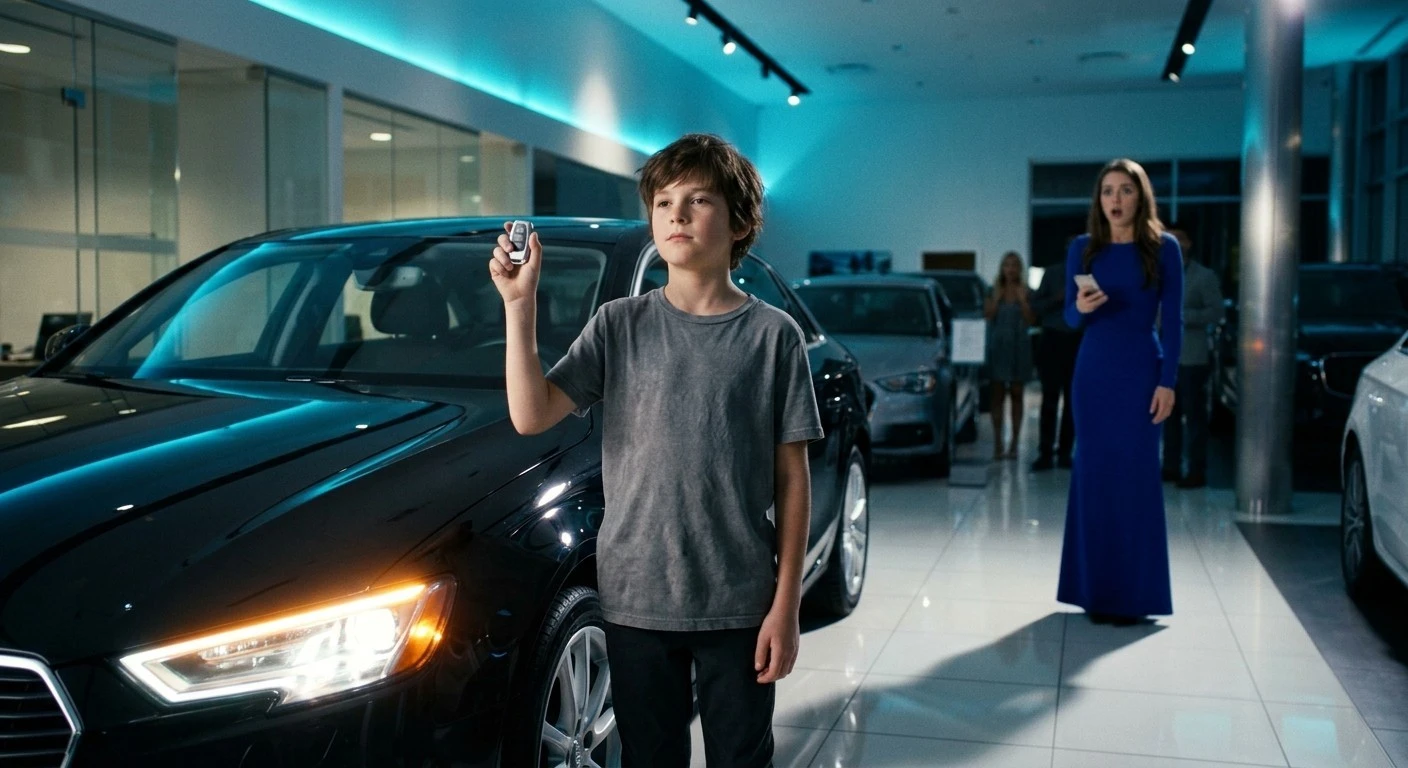
Marcus Reed stood near the black sedan on its raised platform, sneakers cracked at the edges, T-shirt torn at the shoulder. He wasn’t supposed to be interesting. He was eleven.
He reached out and touched the hood.
“Look at this,” Madison Clarke whispered, already filming.
She was twenty, in a cobalt gown, fresh from a charity luncheon down the street. Her friends leaned in behind her, laughing before they even knew what they were laughing at.
“Is he even supposed to be in here?” one of them said.
“Probably wandered in off the street,” Madison said.
“Maybe he’s trying to steal something.”
Marcus didn’t hear them yet. He was studying his reflection in the paint, thinking about his father’s hands on this exact design eighteen months ago.
Madison walked closer, phone raised.
“Hey,” she said. “Don’t touch that.”
Marcus turned. “I’m sorry?”
“That car costs more than your entire family’s worth.”
Her friends laughed harder now. A salesman near the desk looked over but didn’t move.
“I was just checking it out,” Marcus said.
“Checking it out.” Madison tilted the phone to keep them both in frame. “You mean leaving fingerprints on it.”
“I didn’t mean to.”
“People like you shouldn’t be touching cars like this.”
The showroom went quiet. A couple near a sports car stopped to watch.
“What do you mean by people like me?” Marcus asked.
Madison’s eyes flicked to his shirt, his shoes. “You know exactly what I mean.”
“Madison,” one of her friends muttered. “Maybe let it go.”
She didn’t.
“You probably came here to take pictures and pretend you can afford something.”
“I didn’t come here for pictures.”
“Then why are you here?”
“My dad has a meeting.”
Madison laughed. “Your dad? Let me guess — he cleans the offices.”
A few customers exchanged uneasy looks. Marcus’s face didn’t twist with fear. It sank with something closer to disappointment.
“My father doesn’t clean the offices,” he said quietly.
“Security, then?”
“No.”
“Valet?”
“No.”
“Can you please stop recording me?” Marcus asked.
“Why? Are you embarrassed?”
“No.”
“You should be.”
A salesman named Trevor finally crossed the floor. He recognized Madison — her father leased cars here. He recognized the boy too, or should have. The manager had mentioned a name that morning. Trevor had been too busy to clock it.
“Is everything all right?” he asked.
“This kid was touching the black car,” Madison said.
Trevor looked at the silver key in Marcus’s hand. His posture changed instantly. Only two of those keys existed.
“He should be asked to leave,” Madison pressed, before Trevor could speak.
“My dad said I could wait here,” Marcus said.
“You believe him?” Madison snapped at Trevor.
“Miss Clarke, perhaps the manager should—”
“Why do you need the manager?”
“Because this vehicle isn’t part of the public inventory.”
“That’s exactly my point.” She turned the phone back on Marcus. “He shouldn’t be near it.”
Marcus took a breath. He’d been here before — not this exact room, but this exact feeling. His mother’s voice came back to him: some people will decide your story before you open your mouth.
“I didn’t do anything to you,” he said.
“I’m protecting the car.”
“It doesn’t need protection from me.”
“You couldn’t afford the mirror.”
That was when Marcus pressed the button on the key.
The headlights flashed. The mirrors unfolded. A soft electronic tone rang through the showroom.
Everyone went still.
“Where did you get that?” Madison asked, her smile faltering.
“My dad gave it to me.”
“You found it.”
“No.”
“You stole it?”
“Miss Clarke, that is enough,” Trevor said sharply.
“Excuse me?”
“You cannot accuse a child of theft without evidence.”
Madison felt the room’s attention shift and did what people like her always do when they feel control slipping — she laughed, louder than necessary.
“You expect me to believe this car belongs to him?”
“It does,” Marcus said.
Her friends burst out laughing. A few customers smiled, assuming it was a joke.
“What’s next?” Madison said. “Do you own the whole dealership too?”
“No,” Marcus said. “My father owns part of the company that designed the car.”
The laughter died on the spot.
That’s when Jonathan Hayes, the general manager, appeared at the top of the staircase with two executives — and Daniel Reed, in a plain charcoal jacket that cost less than Madison’s shoes.
“Marcus,” Jonathan said, descending fast, “are you all right?”
“Yes, sir.”
“You know him?” Madison asked, color draining.
Jonathan turned to Marcus and inclined his head. “Sir, your father has finished the meeting.”
Sir.
The word landed like a verdict. Madison’s friends stopped smiling. Daniel crossed the floor and studied his son’s face — the face of a boy hiding something to protect someone else.
“What happened?” Daniel asked.
“Nothing important,” Marcus said.
“No problem at all,” Madison cut in, voice suddenly soft. “I was just making sure your son didn’t damage the car.”
“You were protecting the car,” Daniel said. “From my son?”
“I didn’t know who he was.”
“That seems to be the problem.”
Silence dropped over the showroom like a sheet.
“What did she say to you?” Daniel asked Marcus directly.
Marcus hesitated, then told the truth. “She said people like me could never drive something like this.”
Daniel didn’t raise his voice. That was worse.
“My son’s value would not change if this car belonged to someone else,” he said. “He would not deserve less respect if I were a mechanic, or a security guard, or the person cleaning these floors.” He looked at the sedan, then back at Madison. “This is metal, glass, and technology. It is expensive. It is not important.”
“I’m sorry,” Madison said.
“You’re sorry because you discovered who he is.”
Nobody argued. Nobody could.
Daniel unlocked the car for his son. Marcus paused at the open door, and for one long second, everyone braced for him to say something cruel. He’d earned the right.
Instead, he looked at Madison’s phone.
“You should delete the video,” he said. “Not because my father is rich. Because filming people to humiliate them is wrong.”
Then he got in the car, and it rolled out into traffic, and Madison stood alone on the empty platform while her friends drifted three feet away like she’d become contagious.
She looked at the video. Her thumb hovered over delete.
Too late. Someone had already uploaded it.
By nine that night, Madison’s name was trending.
She watched the numbers climb from the back seat of a friend’s car. 612,000. 629,000. A caption had been added: She judged a child by his clothes. Then she found out who his father was.
“Ethan, did you post this?”
“No.”
“Someone did.”
“Jason sent it to his brother,” Chloe said.
“You idiot,” Madison snapped at Jason.
“You were the one humiliating a kid in public,” Jason said. “What did you think would happen?”
“You laughed too.”
“I know,” he said. “And you’re acting like this is all on me.”
The car dropped her at her gate. Reporters were already parked outside by morning.
Her mother was waiting in the kitchen, wine untouched.
“What did you do?” Laura asked.
“It was taken out of context.”
“What context makes those words acceptable?”
“I didn’t call him anything.”
“You didn’t have to say the word to mean it.”
Madison’s voice cracked. “You and Dad talk about people by their houses and their jobs and their clubs every single day. How is this different?”
“We never taught you to humiliate children.”
“No,” Madison said. “You taught me which people matter.”
The silence that followed was worse than any shouting.
“Go to your room,” Laura said.
“I’m twenty.”
“Then act like it.”
By morning, the video had crossed a million views. Madison’s university placed her on a call with the dean. A brand dropped her sponsorship. Her father canceled two business meetings that had suddenly gone cold.
“Two partners postponed,” Charles Clarke said, sliding printed emails across his desk. “Explain ‘people like you.'”
“I meant poor people.”
“Say that back to yourself.”
“That isn’t better.”
“You called an eleven-year-old a thief.”
“I was embarrassed.”
“So you tried to embarrass him more.”
He pushed a laptop toward her, paused on Marcus’s face mid-humiliation.
“Watch what happened to him,” Charles said. “Not what happened to you.”
She watched. This time she didn’t look at herself. She watched Marcus glance around the room for help that never came, watched him stay calm while adults did nothing, watched him look tired instead of triumphant even after the headlights flashed and proved her wrong.
“He looks scared,” she whispered.
“Because he remained calm?” her father asked.
She nodded, understanding for the first time that his silence hadn’t meant he felt nothing. It meant he was holding himself together in a room full of people who wouldn’t.
At the dealership, Jonathan gathered the staff before opening.
“A child was humiliated in this showroom yesterday,” he said. “Most of us watched. One of us stepped in — later than he should have.” He nodded at Trevor.
“I was worried about upsetting a client,” Trevor admitted.
“That’s the problem.”
Outside, a reporter cornered Trevor.
“Is the family worth billions?”
“That’s irrelevant,” Trevor said.
“It’s part of the story.”
“No,” Trevor said, looking straight into the lens. “It’s the part people are using to avoid the real story. The child deserved respect before anyone knew who his father was.”
That clip aired within the hour, and slowly, the conversation online began to shift.
At school, kids swarmed Marcus’s locker.
“Is that really your car?”
“Can I see the key?”
“Did the girl get arrested?”
“No one got arrested,” Marcus said, closing the locker.
At lunch, his friend Jordan sat across from him. “My mom made me watch it. She said you handled it better than my dad would’ve.”
“What’d your dad say?”
“That he would’ve yelled.”
“Sounds like your dad.”
Jordan opened his lunch. “You okay?”
“I wish people would stop looking at me.”
“Want me to throw mashed potatoes at someone? Offer stands.”
Marcus laughed for the first time all day.
That evening, Daniel and Marcus drafted a statement rejecting every interview and sponsorship offer. At the bottom, Marcus added a line in pencil:
Please do not be kind to people because they might secretly be important. Be kind because they already are.
It went out that afternoon. By nightfall it was everywhere — on school walls, in sermons, in a thousand arguments at a thousand dinner tables. People started using a phrase: they already are important.
Three days after the video, a letter arrived at Daniel’s office. No return address.
Mr. Reed,
I judged your son by his clothing and what I assumed about his family. I treated him like a threat because I thought wealth gave me authority over him. I only became polite once I learned who you were — which proves my apology in the showroom wasn’t real. I am sorry. Not because the video went viral, but because Marcus deserved dignity before I knew his name.
Madison Clarke
Marcus read it twice at the kitchen table.
“Do I have to forgive her?” he asked his father.
“No.”
“Do you think she means it?”
“I don’t know.”
He folded the letter and put it in his binder. Not the trash. Not on display. Just somewhere safe.
A week later, Marcus agreed to meet her. No cameras. No friends. Just a small consultation room at the back of the dealership, her phone sealed in an envelope on the table.
“I don’t want a speech,” Marcus said.
“I threw the speech away,” Madison said. “I want to tell you the truth. I saw your clothes before I saw you. I saw you looked poor, and decided that meant you didn’t belong near the car.”
“You weren’t sorry when the lights flashed,” Marcus said. “You were scared.”
“Yes.”
“Because you were wrong?”
“Because people saw me being wrong.”
“What would you have done if the key hadn’t worked?”
Madison’s prepared calm cracked completely. “I don’t know.”
“Would you have posted it?”
“I might have.”
“Would you have apologized?”
“No,” she said. “I would not have.”
Marcus sat with that. “My mom says apologies are words until they cost you something. What have you done about it?”
Madison told him about the youth center — mopping floors, sorting donated clothes, redirecting her old sponsorship money to a kid whose shoes had a strip of silver tape holding them together.
“I don’t want people to know about this meeting,” Marcus said.
“They won’t hear it from me.”
“I don’t hate you,” he said. “But I still hated what you did. I don’t know if I forgive you yet.”
“That’s fair,” Madison said.
He stood to leave. At the door he stopped. “Why didn’t you embarrass me back, when I had the chance?” she asked.
“My dad says power shows people who you already are,” Marcus said. “I didn’t want to become you.”
It hurt her. He could see that it landed. She nodded anyway. “I understand.”
Months passed. Madison kept showing up at the youth center — not for cameras, not for credit. She quietly funded an anonymous shoe exchange so kids like Nia never had to be laughed at for a strip of silver tape again. She told no one it was her.
Trevor left the dealership to run outreach for a new nonprofit Marcus and his mother built — the Silver Key Project — training businesses and schools on dignity before information. Jonathan made it mandatory training at Sterling Crown.
At the black sedan’s formal delivery, Madison showed up uninvited, carrying a box of pins the youth center kids had designed: DIGNITY NEEDS NO PROOF.
“I won’t stay,” she said, turning to leave.
“Wait,” Marcus said. “We need volunteers Saturday. Eight a.m.”
“I’ll be there.”
Before she reached the door, he added, “I think I forgive you. That doesn’t mean what happened was okay. And it doesn’t mean I trust you yet. It means I don’t want to keep being angry.”
She didn’t make it about herself. She just said, “Thank you,” and left.
A year later, at the ribbon-cutting for a real community technology center built on the site of an abandoned department store, Marcus stood at a microphone in front of three hundred people — the same crowd that once wanted a viral redemption story.
He gave them something else instead.
“If the key hadn’t worked that day, I still would have deserved respect,” he said. “If my father had been a janitor, I still would have deserved respect. This center isn’t here to prove any kid might secretly be rich. It’s here because talent is everywhere and opportunity isn’t. A key should open a door. It should never decide who belongs on the other side.”
That same week, a sales associate at a downtown electronics store told a ten-year-old boy named Isaiah to step back from a display laptop while two better-dressed kids nearby were left alone. Marcus was in the store. He didn’t invoke his father’s name this time — not until the very end, and even then, he corrected himself out loud, in front of everyone, for reaching for it at all.
The manager pulled the associate for retraining. Isaiah didn’t want an apology or a demonstration. He wanted to leave. Marcus walked out with him.
“You get scared?” Isaiah asked.
“All the time,” Marcus said. He took the silver key pin off his own shirt and handed it over. “You saw that I was scared in that video. That matters. This is yours now.”
That was the ending nobody could argue with — not a headline, not a lawsuit, not a viral clip. A grocery-store worker’s grandson standing under a store awning in the rain, wearing a two-word pin that used to belong to the boy who’d once needed a flashing headlight to be believed, and never would again.
The black sedan grew old. Its paint scratched, its tech went out of date, and eventually nobody looked twice at it in a parking lot. The silver key stayed in a drawer in Marcus’s desk, rarely used, because it had already done its only real job — not unlocking a car, but proving, once and for everyone watching, that the boy standing beside it had never needed unlocking at all.
Original fictional stories. AI-assisted creative content.