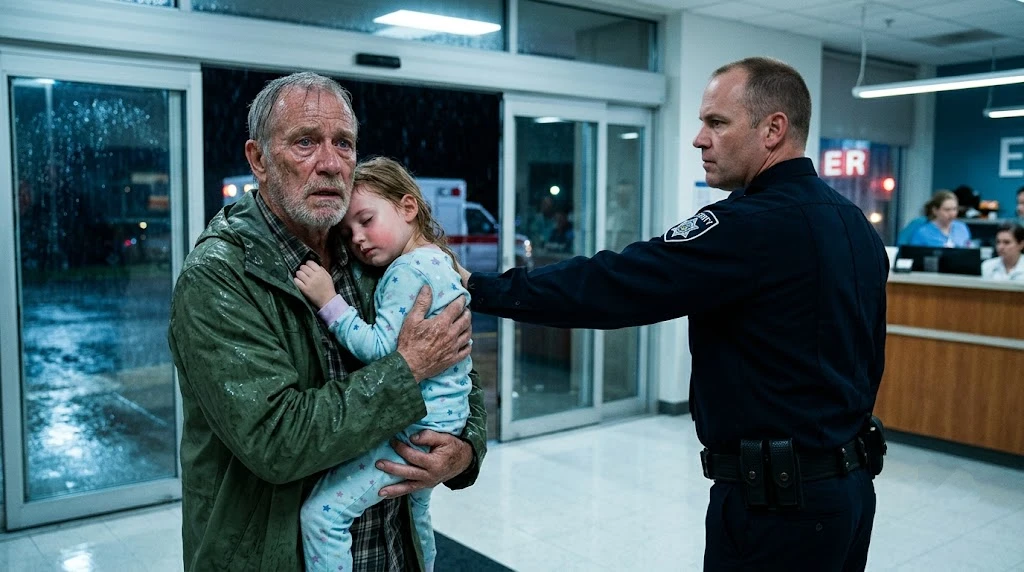
The automatic doors of St. Mary’s Emergency slid open and shut, open and shut, letting in bursts of cold rain and the wail of a siren three blocks out.
Walter Hayes stood just inside the threshold, soaked to the bone.
His moss-green coat dripped onto the polished floor.
In his arms, six-year-old Emma burned like a small furnace.
“Please,” Walter whispered against her hair. “Please, baby, hold on.”
Emma coughed. It was the kind of cough that rattled loose inside a chest, wet and deep.
She was too weak to lift her head.
A security guard in a black uniform stepped in front of him. Broad shoulders. Bored face. A radio clipped to his shirt.
“Sir. You need to check in at the desk.”
“She can’t breathe right,” Walter said. “Look at her. Look.”
“I see her. You still check in first.”
Walter shifted Emma higher on his shoulder. His arms were shaking. He hadn’t put her down for almost an hour.
“I walked here. From Route 9. The truck broke down.”
“That’s not my problem, sir.”
“She’s six years old.”
The guard sighed like a man who had heard it all before.
“Everybody’s kid is sick. Everybody walked. Rules are rules.”
A woman on the waiting bench looked up. Then looked down at her phone.
Nobody wanted to see it.
Walter reached into his pocket with one trembling hand and pulled out a folded wallet. He opened it in front of the guard.
Seventeen dollars.
A library card.
A picture of a boy he hadn’t seen in thirty-six years.
“That’s all I have,” he said. “I’ll pay the rest. I swear on my life I’ll pay the rest.”
“Sir, without insurance or a card on file, I can’t let you past this line. That’s the policy.”
“She’s dying.”
“Then call an ambulance.”
“I’m holding her right now.”
The guard’s jaw tightened.
“Step outside, sir. Please.”
Emma stirred. Her lips were cracked. Her cheeks were the color of raw meat.
“Grandpa,” she breathed.
“I’m here, sweetheart. I’m right here.”
“It hurts.”
“I know.”
“Grandpa, don’t leave me.”
Walter’s throat closed. He couldn’t answer.
The guard put a hand on his chest. Not hard. But firm.
“Outside. Now.”
Twenty feet down the corridor, Dr. Michael Hayes was pulling off his stethoscope.
Fourteen hours. Two codes. One pediatric intubation he wasn’t going to forget any time soon.
He was thirty-five and moved like a man twice that age at the end of a shift.
The break room was ten steps away.
He didn’t make it.
Because he heard the little girl’s voice.
“Grandpa, don’t leave me.”
Michael stopped in the middle of the hallway.
He had heard a thousand children cry in this building. This one landed different.
He turned toward the entrance.
The guard had one arm across an old man’s chest. The old man was holding a child. The child wasn’t moving much.
Michael’s shoes squeaked on the tile as he walked over.
“What’s going on here?”
The guard straightened.
“Doctor. Guy’s got no insurance, no ID, walked in off the street. I’m handling it.”
“Handling it how?”
“Sending him to the county clinic.”
“County clinic is closed at night. You know that.”
The guard didn’t answer.
Michael looked at the child.
One look.
That was all it took.
Her lips had a blue edge to them. Her breathing was shallow and fast. Retractions above the collarbone.
“Get her inside,” Michael said. “Now.”
“Doctor, he hasn’t registered—”
“Get her inside.”
“Policy says—”
Michael turned his head slowly toward the guard. He didn’t raise his voice.
“I said. Get her. Inside.”
The guard opened his mouth. Then he closed it.
A nurse was already running with a pediatric wheelchair. Another came behind her with an oxygen mask.
“Sats seventy-eight,” the nurse called out.
“Move,” Michael said. “Trauma two.”
Walter didn’t let go of Emma’s hand until they were inside the room.
Then he stood in the hallway.
Alone.
Dripping onto the floor.
Trying to breathe.
Michael worked fast.
Oxygen. Nebulizer. IV. Chest X-ray ordered on the fly.
“Pneumonia,” he said to his nurse. “Both lobes. Probably viral on top.”
“Sats coming up. Eighty-eight. Ninety.”
“Good girl,” Michael said, brushing hair off Emma’s forehead. “You keep breathing for me, okay?”
Emma’s eyes fluttered open.
She looked at him.
For a second, she didn’t look scared.
For a second, she looked like she recognized him.
Michael didn’t know why that thought crossed his mind.
He shook it off.
“Keep her on continuous pulse-ox. I want a repeat film in an hour.”
“Yes, Doctor.”
He stepped out.
The old man was still in the hallway.
Still standing.
Still dripping.
“She’s stable,” Michael said. “You got her here in time. Barely.”
Walter’s knees gave a little. He caught the wall.
“Thank you.”
“Sit down before you fall down.”
“Thank you, Doctor. Thank you.”
Michael guided him to a chair.
That was when the old man looked up at him.
Really looked.
And something changed in his face.
Walter’s eyes went to the name badge clipped to Michael’s coat.
Blue shirt. Red tie. White coat.
The badge read:
Dr. Michael Hayes, MD
Walter’s mouth opened.
No sound came out.
His eyes went up to the doctor’s face.
The jaw. The eyes. A small pale scar above the left eyebrow, thin as a thread.
Walter knew that scar.
He had carried the boy who got it home from a driveway thirty years ago, blood on his shirt, ice cream forgotten in the grass.
“Sir?” Michael said. “Are you okay? Do you need me to check your—”
“Michael?”
Michael stopped.
The old man’s voice had cracked on the word.
“I’m sorry?”
Walter stood up. His legs shook but he stood.
“Michael. Is your name Michael?”
“That’s what my badge says, sir.”
“No. Your name. Your real name. Before.”
“I don’t know what you—”
“Where did you grow up?”
Michael frowned.
“Foster care. Why?”
“Where before that?”
“I don’t remember before that. I was five.”
Walter’s hands went to his mouth.
“Oh, God.”
“Sir—”
“Oh, God. Oh, God.”
Michael took a step back. This wasn’t his lane. He should call psych. He should call a social worker.
He didn’t.
Because the old man was pulling something out of his wallet.
A photograph. Cracked at the corners. Faded to the color of weak tea.
A young couple. A little boy on a man’s shoulders.
Walter held it out with a trembling hand.
“Is this you?”
Michael took the picture.
He almost dropped it.
Because he knew it.
Not from remembering it. From dreaming it. For thirty years, on and off, he had dreamed of a fishing dock and a warm laugh and a pair of shoulders that lifted him higher than any tree.
He had assumed his brain made it up.
Everybody wants a father.
Everybody makes one up if they don’t have one.
“Where did you get this?” Michael whispered.
“I took it. Summer of eighty-nine. Cedar Lake.”
“That’s not possible.”
“You had a plastic dinosaur. Blue one. You wouldn’t go to sleep without it.”
Michael’s back hit the wall.
“Rex,” he said. “I called it Rex.”
The old man made a sound that wasn’t quite a sob.
“You called it Rex.”
They stood in the hallway for a long moment.
A nurse walked by. Slowed. Kept walking.
The security guard was still at the doors. Watching. Not moving.
“How?” Michael finally said. His voice was not steady. “How is this— how are you here?”
“The factory,” Walter said. “You remember the factory.”
“No.”
“The Redland chemical plant. Company housing. We lived in the row houses across the road.”
“I don’t remember any of that.”
“There was an explosion. October twelfth, nineteen ninety. You were five.”
Michael closed his eyes.
He didn’t remember an explosion.
He remembered waking up in a hospital bed with no name.
He remembered a social worker telling him his family was gone.
He remembered a nun named Sister Agnes who made him toast.
“They told me my parents were dead.”
“They told us you were.”
“Who told you that?”
“The fire marshal. The county. Everyone. They found part of the house. They found— they said they found remains.”
“They were wrong.”
“They were wrong.”
Walter’s voice broke.
“Your mother never believed them. Not for one day. Helen went to that lake every summer until she died. Sat on that dock and talked to you like you could hear her.”
Michael’s throat closed.
“She’s gone?”
“Twelve years ago. Cancer.”
“I never—”
“I know.”
“I never even—”
“I know, son.”
The word son landed like a hand on Michael’s chest.
He slid down the wall until he was sitting on the floor of his own emergency department.
A doctor. On the floor. In front of a patient’s grandfather.
Nobody said anything.
Nobody moved him.
The security guard finally stepped forward.
He cleared his throat.
“Doctor. Sir. Is everything— do you need—”
Michael looked up at him.
“You almost sent him back out into the rain.”
The guard swallowed.
“Sir, I was following—”
“You almost sent my father back out into the rain.”
The word came out of Michael’s mouth before he knew he was going to say it.
The guard’s face changed color.
“I didn’t— sir, I didn’t know—”
“You didn’t ask.”
“There’s a policy—”
“There’s a six-year-old girl in that room who almost died on your threshold. Because of a policy.”
“Doctor, I—”
“Get out of my sight.”
“Sir—”
“Off the floor. Tonight. I want you off this floor tonight, and I want a written report on my desk in the morning explaining why you refused entry to a symptomatic child.”
The guard opened his mouth.
Closed it.
Walked away.
Slowly.
Michael got up off the floor.
His legs weren’t quite his yet.
Walter was still holding the photograph.
“Can I keep it?” Michael asked.
“It’s yours. It was always yours.”
“I need to sit down again. In a chair.”
“Okay.”
“With you.”
“Okay, son.”
They went into the family waiting room and closed the door.
Michael put the picture on the table between them.
“Tell me everything,” he said. “Start at the beginning.”
“That’s a lot of years.”
“I’ve got the rest of my life.”
“Your mother’s name was Helen,” Walter said. “Helen Marie Hayes. She was a receptionist at the elementary school. Everybody’s kid loved her. She had this laugh— you could hear it from the parking lot.”
“What did she look like?”
Walter took a second photograph out of his wallet. Smaller. Even more faded.
A woman with dark hair pulled back, a wide smile, a summer dress.
“That was our anniversary. Nineteen eighty-eight. We drove up to the Cape.”
Michael touched the edge of the picture.
“She’s pretty.”
“She was pretty. She was also stubborn. Just like you, probably.”
“How would you know I’m stubborn?”
“You threw a security guard off the emergency department floor in front of six witnesses, son. Stubborn runs in the family.”
Michael let out a breath that was almost a laugh.
“Okay. Keep going.”
“We lived in a company house. Redland Chemical owned about forty of them across the road from the plant. Two bedrooms. Screened porch. A little yard where you buried your dinosaurs so nobody would find them.”
“I buried them?”
“You buried them. I dug up the yard three times looking for them. Never found them all.”
“They’re probably still there.”
“They probably are.”
“What happened the day of the explosion?”
Walter’s face went still.
“You want the truth or the short version?”
“Truth.”
“It was a Tuesday. I was at work. Second shift. Your mother had walked over to the school to pick up some papers. You were with the neighbor. Mrs. Kessler. She used to watch you two afternoons a week.”
“Okay.”
“Around three in the afternoon there was a valve failure in Tank Seven. Chlorine mixed with something it shouldn’t have mixed with. The explosion took out the eastern wall of the plant and half the row houses across the road, including ours and Mrs. Kessler’s.”
“Jesus.”
“Twelve people died on the block. Mrs. Kessler was one of them. They found her in what was left of her kitchen. They didn’t find you.”
“They didn’t find me.”
“They found a shoe. Your shoe. In the debris of her living room. And they found — they found — remains they thought were a child.”
Michael closed his eyes.
“But it wasn’t.”
“It wasn’t. The county coroner never actually completed an ID. He wrote ‘presumed’ on the report. Nobody read it carefully. Everybody was too busy burying twelve people at once.”
“How did I get out?”
“That’s the part I still don’t know completely. Best we can figure, you were playing in Mrs. Kessler’s backyard when the wave hit. The blast knocked you into the ravine behind the property. Somebody found you the next morning about a mile downstream. A volunteer from a church out of Danville. You had a head injury. You weren’t talking.”
“And nobody knew who I was.”
“Nobody knew who you were. Your face was so bruised even Helen might not have recognized you at first. And every kid on our block was on the missing list.”
“So they wrote me off.”
“They wrote you off.”
Walter looked down at his hands.
“I spent the first year in the hospital myself. Burns and lung damage from the chlorine. By the time I could walk again the files were closed. The county had moved on.”
“And Mom.”
“And your mother. She never accepted it. I told you that. Every August she sat on that dock at Cedar Lake and she said, He’s out there, Walt. He’s out there somewhere.“
“And you didn’t believe her.”
“I wanted to. I tried to. But after ten years, fifteen years, twenty— you can’t hold a candle in a hurricane forever. I let it burn down. She never did.”
Michael wiped his face with his sleeve.
“I’m sorry.”
“For what?”
“For not being findable.”
Walter reached across the table and took his son’s hand.
“Michael. Listen to me. That was not your job. You were five years old. You were a child. The system lost you. Not you.”
“Okay.”
“Say it back.”
“The system lost me. Not me.”
“Again.”
“The system lost me. Not me.”
“Good.”
Michael looked at the old man across the table.
“How are you this steady right now?”
“I’m not steady, son. I’m just old. Old men have more practice pretending.”
At the end, he said, “Emma.”
“Yeah?”
“You said Emma is your granddaughter.”
“Yeah.”
“Whose kid is she?”
Walter’s face changed.
“My daughter Sarah’s. Your— your sister.”
Michael’s hand went to his mouth.
“I have a sister?”
“Had. She passed two years ago. Car accident. Emma’s been with me since.”
Michael sat very still.
“I have a niece.”
“You have a niece.”
“And I never—”
“You never had a chance to know. Now you do.”
Michael went back to check on Emma at four in the morning.
She was sleeping. Sats ninety-six on two liters. Fever down two degrees.
He stood at the foot of her bed for a long time.
Her hair was the same color his had been at that age. He could see it in the old photograph.
The same slightly crooked front tooth his mother had had, according to a picture Walter had shown him twenty minutes earlier.
He pulled up a chair. Sat down. Watched her breathe.
At some point, Walter came in and sat on the other side.
Neither of them said anything for a while.
Then Walter said, “Are you going to be all right?”
“I don’t know yet.”
“That’s honest.”
“I’m mostly angry.”
“At who?”
“At the county. At the fire marshal. At whoever wrote the report that said my remains were in that house.”
“Me too. Been angry at them for thirty-six years.”
“How do you live with it?”
Walter thought about that.
“Badly. For a long time. Then Sarah had Emma. And I found something to be for again.”
Michael nodded slowly.
“I can help now.”
“You don’t have to—”
“I can help now. That’s not a question.”
“Okay.”
“Where are you staying?”
Walter hesitated.
“There’s a room. Above the hardware store on Fifth. Landlord’s been patient.”
“How patient?”
“Three months patient.”
Michael pulled out his phone.
“Not anymore.”
By sunrise, three things had happened.
One: Emma was upgraded from critical to stable and moved to the pediatric floor.
Two: The security guard’s shift supervisor was on the phone with the hospital administrator, explaining why a symptomatic pediatric patient had been denied entry at the door.
Three: Michael Hayes had signed a piece of paper putting Walter and Emma into the guest room of his condo, effective immediately, for as long as they needed it.
He also called his lawyer.
Then he called HR.
Then he called the state licensing board, because he wanted the record of the guard’s refusal on file somewhere permanent.
Then, finally, he called in sick for the first time in four years and sat next to Emma’s bed and held her hand while she slept.
Two days later, the hospital administrator came by the room personally.
Her name was Diane Park. She was sixty-two and did not smile easily.
“Dr. Hayes.”
“Ms. Park.”
“May I speak with you outside?”
They stepped into the hall.
“I’ve reviewed the incident from Monday night,” she said. “The guard has been terminated. The contract with the security company is being renegotiated. We are updating our triage policy to make it explicit that no symptomatic child can be turned away from the ED for financial reasons. Ever.”
“Good.”
“I owe you a personal apology.”
“You don’t owe me anything, Ms. Park. You owe him.”
He pointed through the glass at Walter, who was reading Emma a book about a rabbit.
Diane Park looked in.
“I understand he’s your father.”
“He is.”
“I’m sorry, Doctor. On behalf of this hospital. I am truly sorry.”
Michael looked at her.
“I accept your apology. On one condition.”
“Name it.”
“There’s a plaque going up. Somewhere visible. Somewhere the next guard on that door has to walk past every shift. And it’s going to say something like, No child in respiratory distress will ever again be turned away from these doors.“
“Consider it done.”
“And it’s going to have my mother’s name on it. Helen Hayes.”
Diane Park nodded once.
“Consider that done too, Doctor.”
She walked away.
Michael went back into the room.
Walter looked up from the book.
“Everything okay?”
“Everything’s okay.”
“You sure?”
“I’m sure.”
Emma opened her eyes.
She looked at Michael.
“Are you my uncle?”
“Yeah, sweetheart. I am.”
“Grandpa said.”
“Grandpa’s right.”
“Are you gonna stay?”
Michael sat down on the edge of the bed. He took her small hand in his.
“I’m gonna stay,” he said. “For the rest of my life, I’m gonna stay.”
She thought about that.
Then she nodded, satisfied, and closed her eyes again.
Walter looked at his son across the bed.
Thirty-six years of missing. Ended in a hospital hallway at two in the morning, because one doctor stopped walking when he heard a little girl cry.
He didn’t say any of that out loud.
He just reached across the blanket and put his hand over Michael’s.
And Michael let him.
The hearing for the security guard happened on a Thursday.
His name was Ray Doolan. Forty-eight years old. Nine years with the contract company that supplied guards to St. Mary’s.
He came in wearing a suit that didn’t fit him anymore.
Michael sat in the third row of the conference room, next to Walter.
He hadn’t planned to come. He had told himself all week that he wasn’t going to come.
Then that morning he had put on a tie and driven over anyway.
The hospital’s lawyer laid it out.
Symptomatic child. Denied entry. Physical contact used to block a guardian from crossing the threshold. Refusal to escalate to a physician despite visible respiratory distress. Prior written warnings on file.
Ray Doolan’s lawyer tried.
“My client was following the letter of the intake policy.”
“The policy explicitly exempts pediatric respiratory presentations from the financial-clearance requirement,” the hospital lawyer said. “There’s a laminated card at his post. It’s been there since 2018.”
“My client didn’t see the card.”
“For nine years?”
The room was quiet.
Ray Doolan looked down at his hands.
Then he looked up.
Not at the panel.
At Michael and Walter.
“Can I say something?”
The panel chair nodded.
“You can say something.”
Ray stood up.
He wasn’t a big man out of uniform. Just a middle-aged guy with a receding hairline and tired eyes.
“I’m not gonna stand here and pretend I read every card at that desk. I didn’t. Nobody does. You do the job long enough, you start seeing the same faces come through with the same stories, and you get tired, and you get lazy, and you start deciding who deserves what.”
Nobody moved.
“That night I decided that old man didn’t. I looked at his coat and his shoes and the seventeen dollars in his wallet and I made a call I wasn’t qualified to make. That little girl could have died in his arms while I was explaining the policy.”
He turned toward Walter.
“Sir. I don’t have the words. I just don’t.”
Walter did not answer.
Ray sat back down.
The panel deliberated for eleven minutes.
Termination confirmed. State security license flagged for review. A civil letter of finding placed on his professional record.
Ray Doolan walked out of the room without looking at anyone.
Michael watched him go.
Walter finally spoke.
“You wanted to say something to him.”
“I did.”
“Why didn’t you?”
“Because he already said it to you first. And you’re the one who mattered.”
Walter took his son’s arm as they stood up.
“Come on,” he said. “Emma’s waiting.”
That night, Emma was well enough to sit up in the hospital bed and eat applesauce.
Michael and Walter sat on either side of her.
“Uncle Michael,” she said between bites.
“Yeah?”
“Grandpa says you were lost.”
“That’s true.”
“For how long?”
“A long time.”
“Like how long?”
“Longer than you’ve been alive. Times six.”
Emma frowned. She was six. Math was a lot.
“That’s forever.”
“Almost.”
“Who found you?”
“Your grandpa did.”
“Where?”
“Right here in this hospital.”
She thought about that.
“So if I didn’t get sick, Grandpa wouldn’t have found you?”
Michael and Walter looked at each other.
“That’s about right,” Michael said.
“So I helped.”
“You helped a lot.”
“Am I in trouble for getting sick?”
“No, baby. You’re the opposite of in trouble.”
“Good. Because I didn’t do it on purpose.”
Walter laughed. It was the first real laugh Michael had ever heard him make.
“She takes after your mother,” Walter said. “Helen used to argue with the weather.”
“Yeah?”
“She’d stand on the porch in the rain and tell it to stop like it was gonna listen.”
“Did it ever listen?”
“Once or twice. Your mother had a way.”
Emma finished her applesauce and set the cup down carefully.
“Uncle Michael?”
“Yeah, kid.”
“Are you gonna be at breakfast tomorrow?”
“Yeah.”
“And the day after?”
“Yeah.”
“Every day?”
Michael looked at her.
“Every day I can be.”
“Okay,” she said. “Then I’m not scared.”
She lay back down and pulled the blanket up to her chin.
“Goodnight, Grandpa. Goodnight, Uncle.”
“Goodnight, sweetheart.”
“Goodnight, Emma.”
Within a minute she was asleep.
Michael and Walter sat in the dim room and listened to her breathe.
“You know what she just did?” Walter said quietly.
“What?”
“She just decided you’re family. Kids don’t take that back.”
“I don’t want her to take it back.”
“Then you’re fine, son. You’re fine.”
Emma was discharged on a Saturday morning.
Michael carried her out to the parking lot himself. She was wearing a pink sweatshirt two sizes too big for her and clutching a stuffed rabbit somebody on the pediatric floor had given her.
Walter walked next to them with a paper bag of discharge instructions and a pharmacy printout.
“You’re gonna feel tired for a couple weeks,” Michael told her. “That’s normal. Your body worked really hard.”
“Okay.”
“You’re gonna want to sleep a lot.”
“Okay.”
“And you can’t go back to school until next Wednesday. Doctor’s orders.”
“Are you the doctor?”
“I am.”
“Then I have to listen.”
“That’s the rule.”
She thought about that for a second.
“Uncle Michael?”
“Yeah?”
“Are we going to your house?”
“Yeah.”
“For how long?”
Michael stopped walking. He looked at Walter. Walter looked back.
“For as long as you want,” Michael said. “That’s the answer.”
“Grandpa too?”
“Grandpa too.”
She nodded and put her head down on his shoulder.
“Okay,” she said. “That’s a good answer.”
Michael’s condo had two bedrooms and a view of the river.
He had bought it four years ago because it was quiet and close to the hospital.
He had never had a guest sleep in the second bedroom. Not once. Not in four years.
Now there was a stuffed rabbit on the pillow and a bottle of children’s Tylenol on the nightstand and a pair of size-eleven work boots by the front door.
Michael stood in the living room the first night and looked around like he had walked into someone else’s apartment.
Walter came out of the guest room in a borrowed T-shirt.
“She’s out,” Walter said. “Down cold.”
“Good.”
“You okay?”
“I don’t know.”
“Say more.”
Michael sat down on the couch.
“Everything I thought I knew about my life is wrong. Not partly wrong. Wrong. I have a father. I had a mother. I had a sister. I have a niece. I’ve had all of them, this whole time, and I didn’t know.”
“That’s a lot.”
“It’s a lot.”
Walter sat down on the other end of the couch.
“You want the truth?”
“Always.”
“For thirty-six years I have been carrying a hole in my chest the size of a five-year-old boy. Every morning I woke up with it. Every night I went to sleep with it. I got used to it, the way you get used to a limp.”
“And now?”
“Now the hole is filled up. And I don’t know what to do with my chest.”
Michael let out a sound that was almost a laugh.
“Same.”
“We’re gonna have to figure it out as we go.”
“Yeah.”
They sat there for a while, not talking, watching the lights on the river.
Then Walter said, “Your mother would have liked you.”
Michael didn’t say anything.
He couldn’t.
Walter kept going, quietly.
“She was a big reader. You’re a reader?”
“I read at night.”
“She read at night. She used to fall asleep with the light on and I’d have to come turn it off.”
“I do that.”
“I know. I saw the stack on your nightstand.”
Michael wiped his eyes with the back of his hand.
“Tell me more.”
“About your mother?”
“About all of it.”
So Walter did.
For two hours.
Until Michael finally fell asleep on the couch with his tie still on.
Walter put a blanket over him and turned off the lamp.
Then he stood there in the doorway of the guest room and looked at Emma sleeping under a nightlight in a condo she had never been in before, and he understood that he was, for the first time in a very long time, exactly where he was supposed to be.
A month passed.
Then two.
Emma went back to school. She started calling Michael’s condo “our house.”
Walter got the truck fixed. He drove Emma to school in the mornings and picked her up in the afternoons and told her stories about the grandmother she had never met.
Michael cut his shifts to four days a week.
Nobody at the hospital complained.
Diane Park, the administrator, saw him in the cafeteria one afternoon and asked how he was doing.
“Better,” he said.
“Just better?”
“Better than I’ve ever been. I just didn’t want to sound dramatic.”
She smiled. He had never seen her smile before.
“Dr. Hayes. Come with me. I want to show you something.”
She walked him to the ED entrance.
Above the sliding doors, mounted flush against the wall, was a bronze plaque.
In memory of Helen Hayes. No child in respiratory distress will ever again be turned away from these doors. St. Mary’s Emergency Department.
Michael stood in front of it for a long time.
The new guard at the desk, a young woman named Priya, watched him respectfully from a distance.
“I read about it my first day,” Priya said when he finally turned around. “The whole story. It’s in our training now.”
“Is it.”
“Yes, sir.”
“Good.”
He walked out through the sliding doors, into a bright fall afternoon, and got in his car and drove home to his father and his niece.
The Christmas after all of it, Walter took a small framed photograph out of his coat pocket and set it on Michael’s mantel.
It was the picture from the wallet.
The young couple. The little boy on the man’s shoulders.
Cedar Lake. Summer of 1989.
“I’ve been carrying this in my pocket for thirty-six years,” Walter said. “It belongs on a shelf now.”
Michael looked at it.
Then he looked at his father.
Then he looked at Emma, who was sitting under the tree pulling ribbon off a package with the concentration of a surgeon.
“Yeah,” he said. “It does.”
He put his hand on Walter’s shoulder.
Walter put his hand over Michael’s.
And that was the end of thirty-six years of missing.
Not with a bang.
Not with a speech.
Just with a photograph on a mantel, and a little girl laughing under a tree, and two men standing in a warm living room, finally, at last, home.
Original fictional stories. AI-assisted creative content.