The morning rush was already thick when everything stopped.
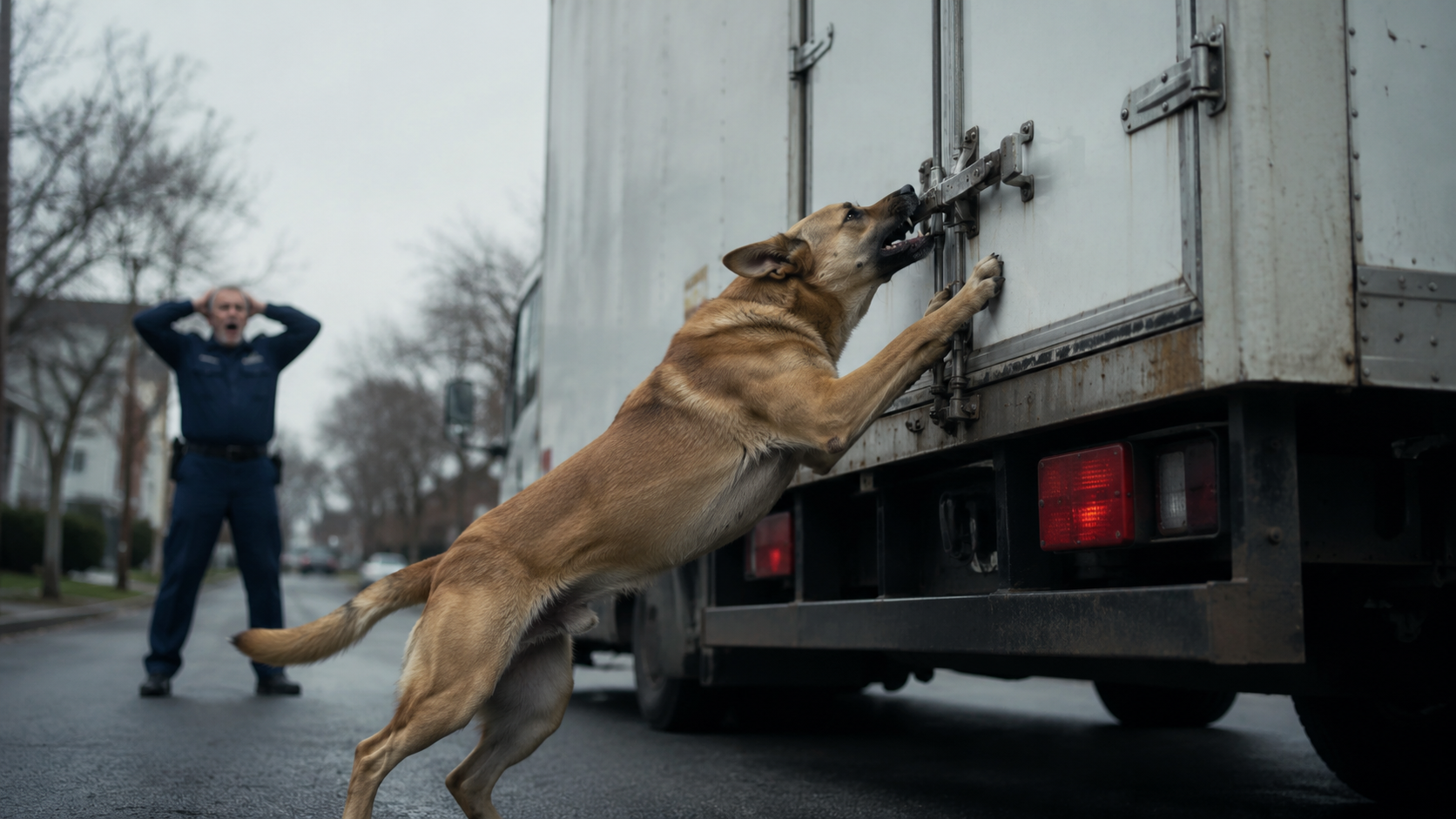
A large white freight truck sat frozen in the middle of the road. Behind it, cars stretched back as far as you could see. Horns. Confusion. People stepping out of their vehicles to see what was going on.
Then they saw the dog.
He was mid-sized, sandy-colored, and absolutely relentless. He stood on his hind legs against the truck’s rear doors, scratching at the metal with both front paws, then dropped back down and barked — sharp, urgent, almost human in its desperation. Then up again. Scratch. Down. Bark. Over and over.
“What is wrong with that animal?” a woman near the sidewalk muttered.
A man beside her shook his head. “Could be rabid.”
“No,” said another voice, quieter. “Look at him. He’s not angry. He’s scared.”
The truck driver — a man named Earl, sixty-three years old, white hair, blue work uniform — stood about ten feet back from his own vehicle, watching the scene with his arms loose at his sides. He’d stepped out to check the noise and hadn’t moved since.
A police cruiser had pulled up. Officer Haines got out first.
“Sir, is that your dog?”
Earl shook his head slowly. “Never seen him before in my life.”
“What are you hauling?”
“Parcels. Cardboard boxes. Household goods for a delivery over on Mercer Ave.” He paused. “Nothing that should be doing that to a dog.”
Haines moved closer. Ben — though no one knew his name yet — swung his head around and barked once, not in warning but in what looked almost like acknowledgment. You. Come here. Help me.
“Easy, buddy.” Haines crouched low, one hand out. “Easy.”
Ben let him approach, then immediately turned back to the doors and resumed his frantic scratching.
A woman in scrubs — she’d pulled over and walked up from three cars back — crouched near the dog and watched carefully. “He’s not in distress,” she said. “His breathing’s controlled. He’s not foaming, not aggressive. He just… wants in.”
“Well he’s not getting in,” Earl said. “Those are someone’s dishes and winter clothes.”
“Does he smell something?”
“Like what?”
No one had an answer.
By now there were maybe thirty people gathered. Phones were out. Someone was livestreaming. A kid on a bike had stopped at the edge of the crowd and was standing on his pedals to see over the adults.
Ben kept going.
Fifteen minutes passed.
Then twenty.
Haines had called in a second unit, mostly to manage the backed-up traffic. His partner, Officer Reyes, came around the side of the truck and stood beside him.
“Animal control?” Reyes asked quietly.
“Already called. Ten minutes out.” Haines watched the dog. “But I don’t think this is a welfare situation.”
“Then what is it?”
Haines didn’t answer, because at that moment, a dark blue sedan pulled up hard on the shoulder and a young man got out fast, almost running.
He was maybe twenty-four, twenty-five. Dark jacket, jeans, a look on his face that was equal parts confusion and something else — something that looked like recognition.
He stopped at the edge of the crowd.
He saw the dog.
His face changed completely.
“Ben?”
The dog froze.
The scratching stopped.
Ben turned around.
For one second, the two of them just looked at each other — the young man standing still, the dog’s entire body trembling with something that was almost too big to contain.
Then Ben ran.
He crossed the distance between them in about four seconds and hit the young man so hard the guy actually had to step back. The tail was going wild. Small, high sounds — not quite barks, not quite whines — came out of him in quick bursts. He pressed his whole body against the young man’s legs.
“Hey.” The young man dropped to his knees on the asphalt, and his voice broke on the word. “Hey, hey, hey. I’ve got you.”
Nobody spoke.
Even Earl, who’d been on the road for thirty years and thought he’d seen everything, didn’t move.
Officer Haines finally walked over. “Sir. Is this your dog?”
“Yeah.” The young man looked up. His eyes were red. “Yeah, he’s mine. I’m sorry. I didn’t even know he’d gotten out — I was at work, and my neighbor called me, she said she saw him on the news —”
“You’re not in trouble,” Haines said. He paused. “Can I ask — do you know why he was doing that? The doors?”
The young man — his name was Oliver — sat back on his heels and looked at the truck.
He was quiet for a long moment.
“What color is your truck?” he finally asked.
Earl blinked. “White.”
“Is it a freight delivery? Long haul?”
“Twenty years of it.”
Oliver nodded slowly. His jaw worked. He put one hand back on Ben’s head.
“My dad drove trucks his whole life,” he said. “He had one just like this. Same color, same style.” He paused. “Ben grew up riding with him. Every route, every stop. The minute my dad got home, Ben would run to the truck before the engine even shut off.”
Earl took a step closer.
“My dad died,” Oliver said. “Seven weeks ago. Sudden. No warning.” He kept his eyes on the truck. “Since then, Ben just — he waits by the front door. All day. Every time he hears a engine in the street, he goes to the window.”
He looked down at Ben.
“When he saw your truck… he must’ve thought—”
He stopped.
He didn’t finish the sentence. He didn’t need to.
The woman in the scrubs had both hands over her mouth.
The man who’d thought the dog might be rabid was staring at the pavement.
The kid on the bike had gotten off and was just standing there, holding the handlebars, completely still.
Earl, the truck driver, walked forward until he was standing a few feet from Oliver. He was a big man, weathered, the kind of person who didn’t emote easily. He looked at the dog for a long moment.
Then he got down on one knee.
Ben turned to look at him.
Earl held out his hand, palm up.
Ben stepped forward and put his nose against it.
“You’ve got a hell of a heart,” Earl said quietly. He wasn’t talking to the crowd. He wasn’t performing anything. He was just talking to the dog. “He must’ve been something, your guy.”
Ben’s tail moved slowly.
Earl looked up at Oliver. “What was his name?”
“Arthur.”
Earl was quiet for a moment. “I drove with a dog for eleven years. Lost him in 2019.” He glanced at the truck. “I still look for him when I open the door sometimes.”
Oliver’s throat moved.
“Listen.” Earl stood up. His voice was gruff, but steady. “I run this route every Tuesday and Thursday. I pass through this area — right around Clement and 5th, usually around nine in the morning.” He looked at Oliver directly. “If you want to bring Ben sometimes, he can ride up front with me. Not forever. Just… until he figures out that the truck isn’t where Arthur is anymore.”
Oliver stared at him.
“You don’t have to—”
“I know I don’t have to.” Earl’s voice was flat but not unkind. “I want to.”
Ben, sitting between them, looked from one face to the other.
His tail began to wag again — not the frantic, desperate motion from before, but something slower and steadier. Something that looked, if you were watching closely, like relief.
Officer Haines cleared his throat. “I’m going to need everyone to return to their vehicles so we can clear this road.” He said it without any urgency. He looked at Oliver one more time. “Take care of him.”
“I will,” Oliver said.
The crowd began to thin. Cars started moving. Earl climbed back into his cab, and as the truck rolled forward, he gave one short wave out the window.
Ben watched it go.
He didn’t scratch. He didn’t bark. He didn’t chase.
He just watched — tail still, ears up, eyes tracking the white truck until it rounded the corner and disappeared.
Then he turned and looked at Oliver.
Oliver looked back.
“Okay,” Oliver said softly. “Let’s go home.”
Three weeks later, on a Tuesday morning, Oliver parked near Clement and 5th at eight fifty-five. Ben sat in the passenger seat, alert, watching the street.
At nine-oh-two, a white freight truck slowed and pulled up alongside them.
Earl rolled down his window. “Right on time.”
Ben was already at the glass.
Oliver got out and opened the door, and Ben jumped down and went straight to Earl — no scratching, no panic, just his tail going and his nose working the familiar smell of diesel and worn leather seats.
Earl opened the cab door.
Ben jumped in.
He turned around twice, sniffed the seat, then sat down and looked out through the windshield.
Oliver stood on the sidewalk and watched.
For the first time in seven weeks, Ben looked like himself again.
“We’ll be back in forty-five minutes,” Earl called down.
“Take your time,” Oliver said.
The truck pulled away from the curb.
Oliver stood there until it turned the corner. Then he put his hands in his pockets and walked to the nearest bench and sat down.
He didn’t cry.
He just sat in the morning light, watching the empty street, and let himself breathe.
Because Ben had found his way back to the road. And somehow — for the first time since the call that had changed everything — so had he.
Original fictional stories. AI-assisted creative content.