Sophie Mitchell had been staring at the gym door for forty minutes.
She wasn’t crying. That was almost worse.
She just stood there in her pink princess dress, fingers curled around the fabric, watching. Every time the door swung open, her shoulders lifted—just barely—then dropped again.
Laura stood frozen at the edge of the room, watching her daughter disappear into herself.
Six months. That’s how long Eric had been gone. Six months since the knock on the door, the uniforms, the folded flag. Six months of trying to explain something that couldn’t be explained to a child who still drew pictures of her father coming home.
“Mom,” Sophie had said that morning, smoothing her dress in the mirror. “Do you think Heaven lets people visit? Like, just for one night?”
Laura had looked at her own reflection. Steady. Steady.
“He’ll always be with you, baby,” she said. “Always.”
She’d brought Sophie here because of that belief. Because you don’t take hope away from a seven-year-old, even when hope hurts.
Now she was starting to wonder if she’d made a terrible mistake.
She was halfway across the gym when she saw Karen Doyle moving toward Sophie.
PTA president. Event organizer. The woman who sent three emails about the dress code and personally arranged the balloon arches. Perfect posture. Pearls. A smile that looked more like a policy statement than a greeting.
Laura felt something cold run through her chest.
She started moving faster. The crowd slowed her down—parents chatting, kids crossing in front of her, a folding table someone had pushed out too far.
By the time she got close enough to hear, it had already started.
“Oh, sweetheart.” Karen’s voice was soft. Practiced. “You look a little out of place standing here all by yourself.”
Sophie’s fingers tightened on her dress.
“I’m waiting,” she said quietly. “My dad might come.”
Silence.
Then Karen laughed. Just a small sound. Just enough.
“Honey.” She tilted her head. “This is a father-daughter dance. It’s not really meant for… situations like yours.”
A few parents nearby glanced over.
No one moved.
“We all worked very hard to make tonight special,” Karen continued, her voice still sweet, still soft. “And when someone stands alone like this, it makes things… uncomfortable. Maybe it would be better—”
“Her father is Major Eric Mitchell.”
Laura hadn’t planned to say it that loud.
But her voice carried, and the small cluster of people nearby went still.
Karen turned. The smile didn’t fully disappear, but it shifted—defensive now, recalibrating.
“Laura, I wasn’t—”
“He was deployed twice. He died in service six months ago.” Laura stepped in front of her daughter. “She is exactly where she belongs.”
“I understand that, I just meant—”
“I know what you meant.”
Karen’s mouth opened. Nothing came out.
Sophie tugged on Laura’s sleeve.
“Mom.” Her voice was small. “It’s okay.”
It wasn’t. It was so far from okay that Laura could feel her hands shaking. But she looked down at her daughter’s face—still patient, still waiting, still somehow full of something that looked almost like faith—and she swallowed everything she wanted to say.
“We’re going to dance together,” Laura said firmly. “Just us. That’s enough.”
She took Sophie’s hand and started toward the floor.
Then the doors opened.
Not swung. Not pushed.
Slammed.
Both doors, simultaneously, hard enough to rattle the streamers hanging from the basketball hoops.
The music cut mid-note.
Laughter stopped.
Even the punch bowl seemed to stop rippling.
Boots on hardwood floor. Slow. Measured. Deliberate.
Every head in the gym turned.
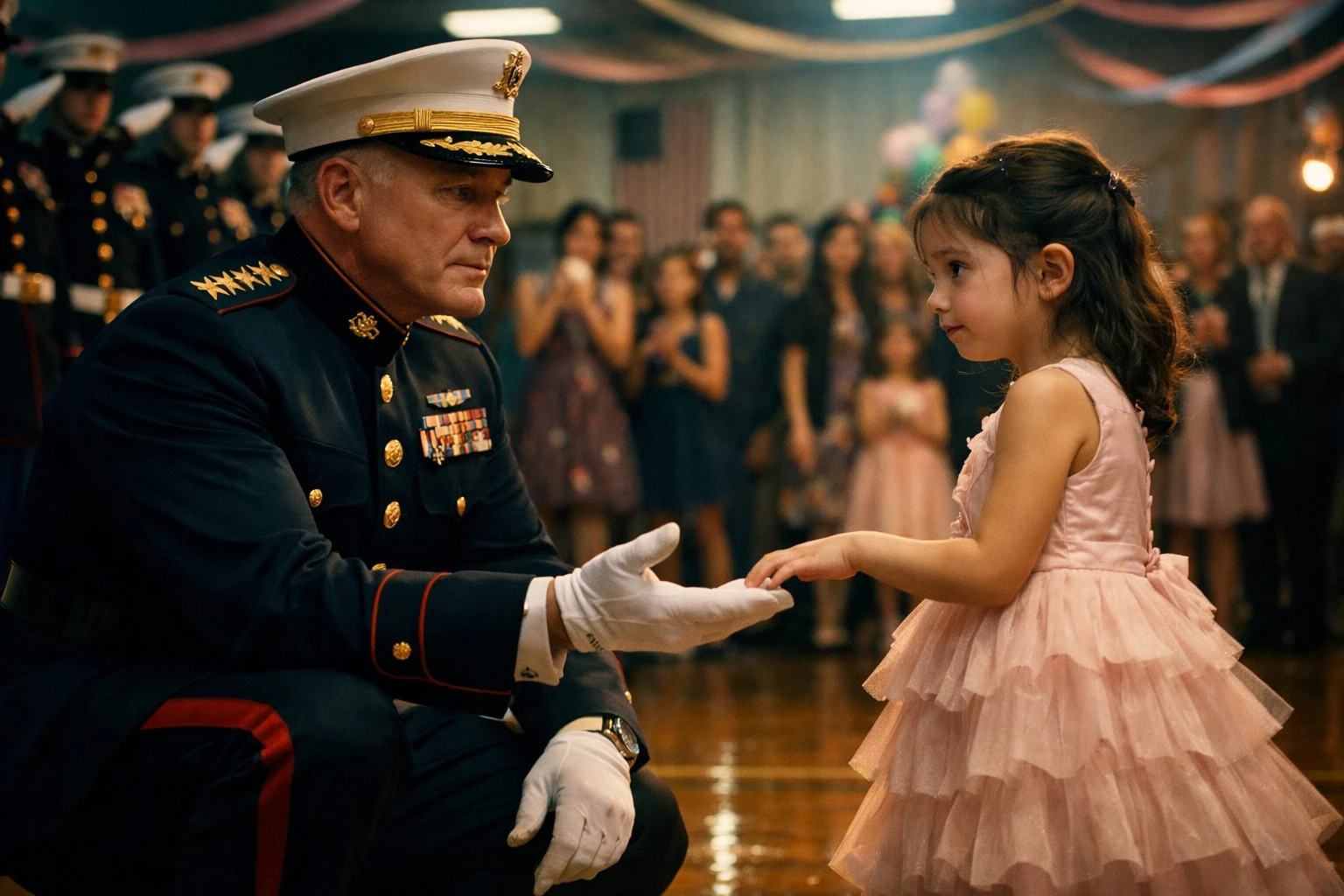
Twelve Marines in full dress uniforms moved through the entrance in two clean columns. Brass buttons. White gloves. Covers squared. Posture so perfect it looked architectural.
At the front, four stars on his shoulders.
General Marcus Donovan.
He didn’t look around the room. He didn’t acknowledge the crowd or the decorations or the stunned silence. He scanned once—precise—found what he was looking for, and walked directly toward it.
Directly toward Sophie.
Karen stepped back without meaning to.
The General stopped three feet in front of a seven-year-old girl in a pink dress.
And then—
He saluted.
Sharp. Crisp. The full formal military salute, right arm raised, hand flat, eyes level.
Every Marine behind him did the same.
Twelve simultaneous salutes, in a Brookside Elementary gymnasium, aimed at one small girl.
Sophie stared up at him.
Her mouth was slightly open.
The General held it for a long count—long enough that the room understood exactly what it meant—then lowered his hand slowly and came down to one knee.
“Sophie Mitchell,” he said. His voice was quiet. Like the room had gotten smaller.
She whispered, “You know my name?”
“I knew your father.”
Something moved across her face. Complicated. Fragile.
“He talked about you every chance he got,” the General said. “Showed us pictures. Told the whole unit you were the bravest person he’d ever met.” He paused. “I didn’t argue.”
Her lip trembled.
“He asked us to look out for you,” Donovan continued. “If there was ever a moment he couldn’t be there himself.”
He stood.
Then he turned, slowly, to face Karen Doyle.
The warmth was gone.
Not angry. Something quieter than anger. More final.
“I understand you spoke to this child tonight,” he said. “About belonging.”
Karen’s chin lifted. “General, I want you to know that I have enormous respect for—”
“Major Eric Mitchell completed two full deployments.” The General’s voice didn’t rise. It didn’t need to. “He was awarded the Bronze Star. He came home from the first tour with a piece of shrapnel in his shoulder that he never told his family about because he didn’t want them to worry.” A pause. “I know because I signed the medical report.”
The gym was completely silent.
“He died so that rooms like this one could exist. So that little girls like his daughter could grow up in a country where they were safe.” Donovan looked at Karen directly. “And you told her she didn’t belong in it.”
Karen’s mouth worked silently.
“I didn’t realize—”
“No,” he said. “You didn’t.”
He turned away from her. Completely. Like she had simply ceased to be relevant.
He looked at Sophie.
“Miss Mitchell.” He held out one white-gloved hand. “May I have this dance?”
Sophie looked at the hand.
Then up at his face.
Then back at the hand.
She put her palm in his.
Someone started the music again—something soft, something slow—and General Marcus Donovan walked Sophie Mitchell to the center of the floor with the same deliberate care he’d walked through those doors with.
She stepped onto his shoes.
He adjusted his pace.
They danced.
For about four seconds, no one moved.
Then one of the Marines began to clap. Slow and steady. The others joined. Then a dad near the back. Then three more. Then it spread—quiet and building, not a cheer, something more than that—until the entire gym was giving something back to a little girl who had been told she didn’t belong there.
Laura pressed her hand over her mouth.
She didn’t try to stop what was happening in her chest.
She let it happen.
Karen Doyle slipped out somewhere in the middle of all of it. Laura noticed, distantly, the way you notice a door closing in another room. No one else did.
No one looked for her.
The song ended.
Sophie looked up at the General with an expression Laura had never quite seen on her daughter’s face before. Something settled. Something resolved.
“He really talked about me?” Sophie asked.
“Constantly,” Donovan said. “We used to joke that if he could figure out how to get you deployed, he would.”
She laughed.
The sound hit Laura somewhere between her sternum and her throat.
She hadn’t heard that laugh in six months.
Outside, in the parking lot afterward, the General crouched in front of Sophie one more time and pressed a challenge coin into her hand. Worn smooth on one side. A Marine Corps emblem on the other.
“This belonged to your father,” he said. “He left it with me. Told me to give it to you when you needed it most.” He curled her fingers around it. “Whenever someone makes you feel like you don’t belong somewhere—you look at that. You remember tonight. And you walk straight in.”
Sophie nodded, very seriously, the way children nod when they’re memorizing something.
On the drive home, she fell asleep in the backseat before they reached the end of the school road. One hand tucked under her cheek. The other closed tight around the coin.
Laura watched her in the rearview mirror.
The pink dress. The coin. The soft even sound of her breathing.
She didn’t try to hold back what she felt.
She just let it come.
Grief doesn’t go away. But sometimes, when you’re not watching for it—when you’re too busy watching your daughter sleep—it shifts. Moves over just enough to make room for something else.
Something that feels, impossibly, like being held.
The school board received four formal complaints about Karen Doyle’s conduct within forty-eight hours—all from parents who had been standing nearby. She resigned her PTA position the following Tuesday. Sent a brief email. No one replied.
At the next school board meeting, the principal announced a new policy: no child at Brookside Elementary would ever be required to have a two-parent household to participate in any school event. Any child without a father could be paired with a volunteer—veteran, community member, family friend.
They named the program after Eric Mitchell.
Sophie found out at a school assembly two months later.
She didn’t cry.
She stood up very straight.
And she smiled like someone who understood exactly what her father had meant when he said she was the bravest person he’d ever known.
Original fictional stories. AI-assisted creative content.