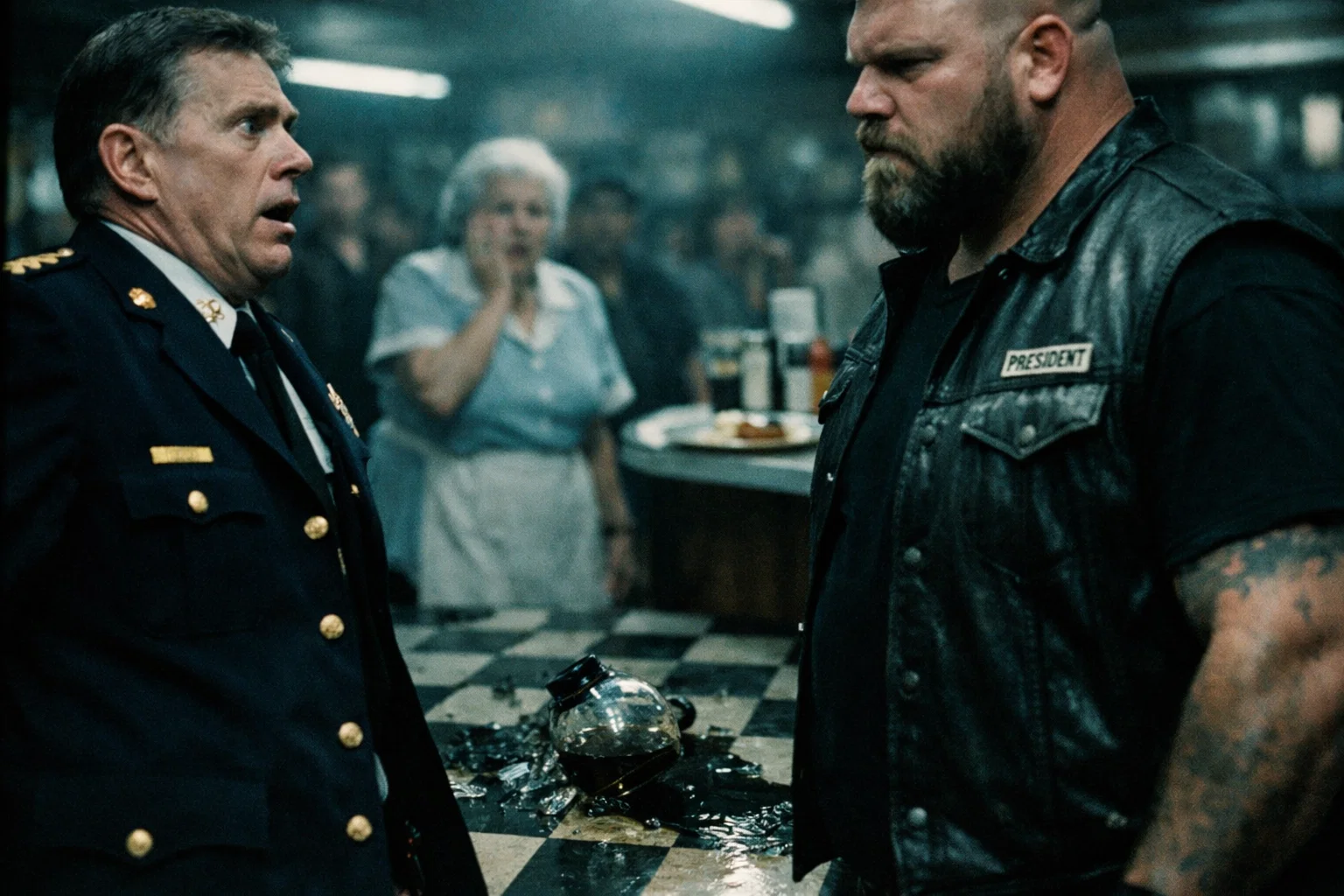

Steel Lantern sat on the edge of Highway 30 outside Lancaster, the kind of place people drove past without slowing down.
Inside, Griffin Hale sat alone near the back booth. Worn Army jacket. Hands that didn’t shake when he lifted his coffee. Eyes that tracked every movement in the room without ever seeming to look directly.
Twenty years since Afghanistan. Some things never left you.
The back door creaked open—just slightly.
A little girl slipped inside.
Maybe eight years old. Coat hanging wrong off her shoulders. Shoes that didn’t match. Hair like she’d been running.
Griffin’s gaze shifted.
She wasn’t crying. That’s what got his attention.
Kids who cry are scared. Kids who don’t cry have learned something worse.
Her eyes swept the room—corners, exits, shadows—like she was mapping tactical positions. Then they locked on Griffin for half a second.
Something passed between them.
Recognition, maybe. Not of faces. Of something else.
She moved toward the bar, small and silent.
Mason, the bartender, glanced at Griffin. Griffin gave one slow nod.
Mason put down a glass of water without asking questions.
The girl climbed onto the stool, hands trembling around the glass.
Griffin stood. Not fast. Just deliberate.
He walked to the bar and sat two stools away. Close enough. Not threatening.
“You hurt?” he asked quietly.
She shook her head.
“Hungry?”
A pause. Then a nod.
Mason slid a sandwich across the counter.
The girl ate like she hadn’t seen food in hours. Maybe she hadn’t.
Griffin waited. Silence was a language he understood.
After a while, she looked at him. “Are you a bad man?”
Griffin considered that. “Sometimes.”
Her eyes narrowed. “To kids?”
“No.”
She seemed to weigh that answer. Then: “He says men like you are dangerous.”
“Who’s ‘he’?”
“My mom’s boyfriend.”
Griffin’s jaw tightened, but his voice stayed level. “Some men are. Some aren’t.”
She nodded. “He’s different when she’s not around.”
Griffin didn’t interrupt.
“I don’t like being near him.”
Her hands clenched into small fists.
“You did the right thing,” Griffin said. “Coming here.”
“Here?” She looked around the bar, confused.
“Yeah. Here.”
Twenty minutes later, the door opened again.
A woman in her thirties stepped inside. Focused eyes. Calm but purposeful.
Lillian Brooks. Child services.
Griffin had called her from the pay phone in the back hallway. Old habits. He didn’t trust cell signals when things mattered.
Lillian crouched down to the girl’s level. “Hi. I’m Lillian. What’s your name?”
“…Avery.”
“That’s a beautiful name, Avery.”
Avery looked at Griffin, then back at Lillian.
And she started talking.
Not all at once. Not perfectly. But honestly.
Lillian listened without interrupting. Let every word land where it needed to.
When Avery finished, the silence felt heavier.
“What happens now?” Avery asked.
Lillian placed her hand gently over Avery’s. “Now we make sure you’re somewhere safe.”
“He won’t believe me.”
“That’s why I’m here,” Lillian said. “To listen carefully. And to make sure someone does believe you.”
It would have been easier if Darren hadn’t come back.
But some men don’t leave things unfinished.
The front door slammed open.
Darren. Mid-thirties. Eyes wild. Voice too loud.
“There you are.” He pointed at Avery. “Let’s go. Now.”
Avery went pale.
Lillian stood calmly. “She’s not leaving with you tonight.”
Darren’s face twisted. “And who the hell are you?”
“Lillian Brooks. Child Protective Services.”
That stopped him. For a second.
Then his voice rose. “You think you can just take her? She’s not even—”
“She’s not something to take,” Lillian said evenly.
Darren stepped forward.
And Griffin stood up.
Not fast.
Not aggressive.
Just… stood.
The entire room shifted.
Griffin didn’t move closer. Didn’t raise his voice. Didn’t need to.
He just placed himself between Darren and the table where Avery sat.
Solid. Unmoving.
His hands stayed relaxed at his sides, but something in his posture—something learned in places where hesitation meant lives lost—made it clear this wasn’t a discussion.
“You should stop,” Griffin said quietly.
Darren looked at him.
Really looked.
At the way Griffin stood. At the scars on his knuckles. At the absolute stillness in his eyes.
And something in Darren’s brain finally registered what his mouth hadn’t caught up to yet.
This wasn’t a bar regular. This was someone who’d stood in doorways where the wrong move meant death.
Darren took a step back.
“This isn’t over,” he muttered.
Griffin’s voice stayed low. “Yes. It is.”
Darren looked at Lillian, then at Avery, then at the door.
He chose the door.
When it closed behind him, the tension didn’t leave immediately. It hung in the air like smoke.
Griffin sat back down.
Mason poured him a fresh coffee.
Nobody said anything for a long time.
Three weeks later, Lillian came back to Steel Lantern.
She wasn’t alone.
Avery walked in beside her. Different coat. Shoes that fit. Hair brushed.
But more than that—she walked differently.
Not fearless. But not afraid.
She spotted Griffin at the same back booth.
She walked over and sat across from him.
“Hi,” she said.
“Hi.”
“I’m staying with my aunt now,” Avery said. “Lillian helped.”
Griffin nodded.
“She said you called her. That night.”
“Yeah.”
“Why?”
Griffin looked at her. “Because you needed someone who’d listen.”
Avery smiled slightly. “Thank you.”
Griffin lifted his coffee cup. “You’re tougher than you think.”
“My therapist says that too.”
“Smart therapist.”
Avery looked around the bar. “I knew this place was safe. I didn’t know why. But I knew.”
Griffin nodded slowly. “Sometimes you just know.”
She stood to leave, then paused.
“Lillian says some people protect others because they couldn’t protect someone else once.”
Griffin’s expression didn’t change, but something flickered behind his eyes.
“She might be right,” he said quietly.
Avery nodded. “I think she is.”
She walked toward the door, then turned back one more time.
“I’m glad you were here.”
“Me too, kid.”
The door closed.
Mason refilled Griffin’s cup without asking.
“You did good,” Mason said.
Griffin stared at his coffee.
“Just did what needed doing.”
Outside, the highway stretched into the distance. Cars passed without stopping. Most people never knew what happened inside places like Steel Lantern.
And that was fine.
Some things didn’t need to be loud to matter.
Sometimes the most important battles were fought quietly—in dimly lit bars, over sandwiches and water, with nothing but presence and the refusal to look away.
Griffin finished his coffee.
Then he stood, left a twenty on the counter, and walked out into the cold Pennsylvania night.
Behind him, the lights of Steel Lantern stayed on.
A place that meant something.
Not to everyone.
But to the ones who needed it most.
Original fictional stories. AI-assisted creative content.