I’ve lived on the same quiet Ohio farm my entire life. I thought I knew what danger looked like — a rattlesnake in the barn, a tractor sliding on ice. I had no idea.
I was fifteen. Walking home from the bus stop on Route 62, headphones in, staring at my boots.
Then the ground vibrated.
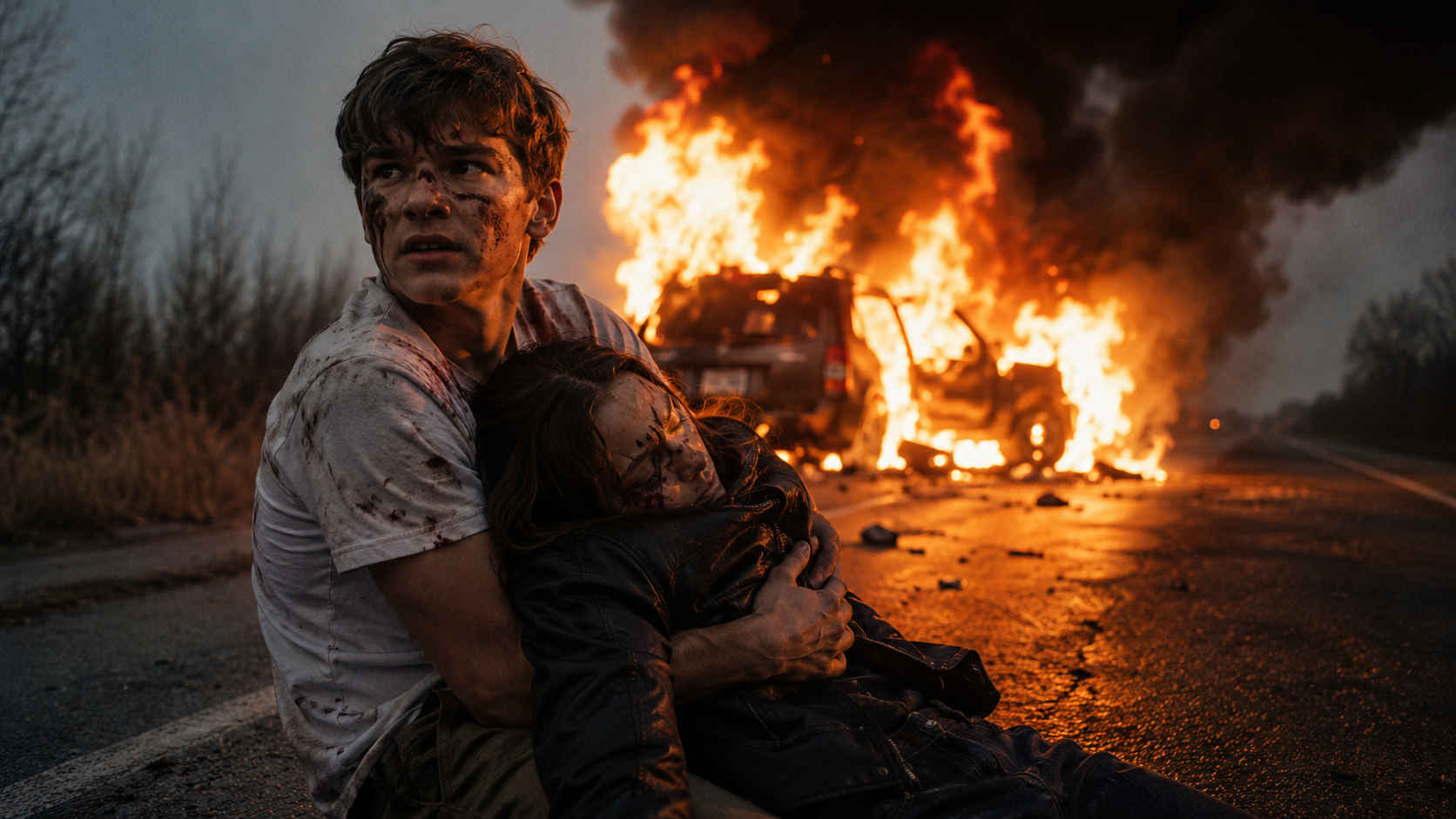
Before I even heard the sound, I felt it — a deep shudder through the soles of my feet. I ripped my headphones out just as the squeal of rubber tore across the air. Then the crunch. A massive black SUV left the road at highway speed, flipping end-over-end before smashing into the drainage ditch.
Silence.
Then smoke.
I dropped my backpack and ran.
The heat hit me before I even reached the wreck. The hood was already bubbling. I scrambled down into the muddy ditch and pressed my face against the shattered driver’s window.
A woman. Blonde hair matted with blood. Completely still.
“Hey!” I banged my fists against the glass. “Can you hear me?!”
The fire popped. An orange tongue licked up the windshield.
The door was fused shut. I ripped the side mirror off its wire, used the bracket to smash through the weakened glass, and reached inside. I grabbed her by the collar of her leather jacket, planted my boots against the car door, and pulled with everything I had.
She came free just as the fire breached the firewall.
We tumbled off the car and hit the frozen mud together. I dragged her up the embankment by her jacket collar, my knees slamming into rocks, my lungs burning. I didn’t stop until we were fifty feet from the car.
“Get down!” I threw my body over hers.
The explosion wasn’t what I expected. It was a massive, concussive thump — a shockwave of heat slamming into my back that sucked all the air from the world.
I rolled over. She was breathing. Barely.
“Call him,” she rasped, her hand finding my shirt. Her grip was shockingly strong. “Not the cops. My husband.”
That’s when I looked at the jacket I’d been dragging her by.
A skull with wings, stitched in red and gold. And beneath it: PROPERTY OF THE PRESIDENT.
Even at fifteen, I knew what that meant.
Her phone had one contact. Preach.
It rang twice. Then a click, and an engine rumbling in the background.
“Speak.”
A voice like broken glass and gravel.
“Her car crashed,” I stammered. “Route 62. Mile marker 14. She’s alive but she’s bleeding bad—”
“Are the cops there?” The panic was gone from his voice instantly, replaced by something colder.
“No, sir.”
“Good boy.” It didn’t sound like a compliment. “Don’t call them. Don’t flag anyone down. Ten minutes.”
The line went dead.
I pressed my bloody flannel shirt against her head wound and kept her talking. She faded in and out, her eyes going glassy. Every minute felt like it was eating me alive.
Then the ground vibrated again.
Thirty motorcycles crested the hill in a perfect formation, black leather and chrome filling the entire highway. They split perfectly, locking the road from both directions in seconds.
The lead rider was enormous. Six-five, at least. No helmet. Shaved head, gray beard, a jagged scar running from his eye to his jaw.
PRESIDENT.
He walked toward his wife without running — a heavy, deliberate stride. He dropped to one knee beside her, and for just a second, the terrifying outlaw disappeared. Raw, unfiltered agony crossed his face.
“Sarah,” he whispered.
“Told you the tires were bad,” she wheezed.
He let out a short, breathless sound that was half-laugh, half-sob, and snapped his fingers without looking up. “Doc! Now!”
Then he stood and looked directly at me.
I was backed against the guardrail, covered in his wife’s blood, shaking so hard I couldn’t stop.
He walked over. Stood over me. He reached into his leather vest, and I squeezed my eyes shut.
Cash landed on my chest. A thick stack of hundreds.
“You never saw us,” Preach said quietly. “You were never here. And if you ever say different — I will burn everything you love to the ground.”
He squeezed my shoulder once, hard. “You got guts, kid. More than most men.”
Then they were gone. Thirty seconds and the highway was empty again, like nothing had ever happened.
The next weeks were a psychological war I fought alone.
The money was hidden in the ceiling above our bathroom exhaust fan. I burned my bloody shirt in the incinerator barrel in the barn, watching every thread turn to ash. The police report called it an abandoned stolen car. No body. No driver. Case closed.
Preach made things disappear. He was good at it.
I started to breathe again.
That lasted until Saturday morning, when my dad took me into town for hardware store screws.
I walked out of the store and found a man leaning against my dad’s tailgate, smoking a cigarette. Two-fifty, easy. Heavy steel-toe boots. Eyes that went right through me.
He reached into his jacket. My feet stopped moving.
He pulled out my bloody flannel shirt. The same one I’d left in the dirt on Route 62.
He held it up for three seconds. Let me see the dark red stains. Smiled slowly.
Then he tucked it under my dad’s windshield wiper, turned into the alley, and disappeared. I heard a motorcycle engine snarl to life and fade away.
They knew where I lived. They knew what my dad drove.
I hid the shirt in the paper bag with the screws and stood there shaking while my dad came back from the bank, easy smile on his face, talking about fixing a fence.
“You okay, bud? You look pale.”
“Just a headache,” I said.
The Friday before Christmas, a blizzard buried the farm in eight inches of snow. My parents were asleep. I was at my window at midnight, staring at the white wall of static.
That’s when I saw it.
Not a headlight. The absence of light — a massive dark shape crawling up our driveway. No headlights. No engine sound.
A black pickup truck.
It stopped in front of the barn. The driver’s door opened. A figure stepped out into the knee-deep snow.
I recognized the shoulders before anything else. The purposeful, heavy stride.
Preach.
He stood in the blizzard, staring at the barn doors. Then he raised his right hand and tapped his knuckles against his chest. Once. Twice.
He knew exactly where I was.
I had two choices. Wake my dad — and watch him try to confront a man who killed people for a living. Or go outside alone.
I chose alone.
I crept downstairs, slipped past my dad’s recliner, and walked out into the storm.
The cold hit me like a wall. I kept my flashlight off, trudging through the drifts until I reached the barn. Preach was under the overhang, smoking, the orange cherry of his cigarette flaring in the dark.
“You look like hell, kid,” he rumbled.
“What do you want?” I managed. “I never told anyone. I swear.”
“I know. If you had, you wouldn’t be standing here.”
He flicked the cigarette into the snow. “Things got complicated. Heat in town is bad. We need somewhere to stash something. Off the grid. Somewhere nobody’s looking.”
He looked at my barn.
“No,” I gasped. “My dad comes out here every morning—”
He grabbed the front of my coat with one hand and lifted me off the ground like I weighed nothing.
“I am not asking your permission,” he whispered, inches from my face. “I’m calling in a marker. You hide it. You keep your old man away from it. Am I clear?”
He dropped me. I stumbled backward into the snow, gasping.
He snapped his fingers twice.
The tailgate of the truck dropped. Two enormous men stepped out carrying a heavy steel dog crate. It took both of them to haul it across the snow.
A sound came from inside — a deep, guttural vibration that rattled the metal bars. Not barking. A growl that sounded more like a lion than a dog.
“This is Brutus,” Preach said.
I shined my flashlight through the mesh.
Yellow eyes. A Cane Corso the size of a small bear — a hundred and fifty pounds, maybe more. Dark brindle coat matted with dried blood. A jagged laceration across the left shoulder, one ear partially torn off, sides heaving.
“He took a grazing bullet in a raid two hours ago,” Preach said, his voice tightening. “I take him to an emergency vet, cops are there in five minutes.”
He dropped a heavy duffel bag at my feet. “Antibiotics, bandages, painkillers, twenty pounds of raw meat. Old tack room. Broken padlock. Nobody goes in.”
“He’s trained to kill,” Preach warned. “He doesn’t like strangers. You reach into that cage without letting him smell the meat first, he’ll rip your arm off.”
“Then how am I supposed to help him?!”
For the first time, something shifted in Preach’s eyes. Not softness — but the closest thing to it he probably had.
“He knows Sarah’s scent,” he said quietly. “And right now, her blood is practically soaked into you. He’ll smell her on you. He’ll let you close.”
The men carried the crate into the barn and left without a word.
Preach stood by his truck, hand on the door.
“Three days,” he said. “Keep him quiet. Keep him alive.”
He didn’t finish the sentence. He didn’t have to.
The truck rolled silently back down the driveway and was swallowed by the blizzard.
I stood alone in the snow, holding a bag of medical supplies, listening to Brutus growl from the dark corner of my own barn.
What happened over the next three days changed something in me permanently.
The first night, I lay flat on the tack room floor for forty minutes, feeding strips of raw meat through the mesh, talking quietly until the growls turned to silence. When I finally opened the crate, Brutus didn’t attack. He pressed his bloody, cinderblock-sized head against my knee and let out a sound so low it was almost a moan.
He smelled her on me. He knew.
I cleaned the wound by flashlight, my hands steadier than they had any right to be. I wrapped the laceration, administered the antibiotics, and sat with him until he fell into a deep, exhausted sleep.
By day two, he was eating from my hand.
By day three, he got to his feet for the first time.
On the third night, Preach came back — this time without the blizzard, rolling in silent and dark just after midnight. He said nothing when he saw Brutus standing in the tack room doorway, coat clean, wounds dressed. He crouched down, and the dog pressed into him the way dogs press into the people they love.
Preach looked up at me from his crouch.
“The debt’s paid,” he said. “Both ways.”
He stood, and for just a second, he looked like a man instead of a legend.
“Get out of this life before it finds you again,” he said. “You’re too smart for this road.”
He loaded Brutus into the truck. Drove away. No threats. No envelope.
Just silence, and a barn that smelled like blood and antiseptic and the faintest trace of something that might have been trust.
I went back inside. I climbed the stairs. I reached into the ceiling and pulled out the stack of hundreds still wrapped in a grocery bag.
I drove to the nearest county social services office the next morning and left the cash in an envelope addressed to the family emergency fund. No name. No note.
The weight that lifted off my chest felt like a physical thing.
My quiet Ohio farm was still there. The road outside was still empty and straight.
But I had crossed something I could never uncross. I had looked into the dark and held it together.
That had to count for something.
Original fictional stories. AI-assisted creative content.