The Woman Who Wouldn’t Stay Buried
The funeral parlor had the kind of silence people trust too easily.
Beige walls. Black clothes. A white coffin resting above a polished floor.
Mourners stood close together, trying to look dignified enough to survive grief in public. Among them: Adrian Vale, the dead woman’s husband—rich, polished, destroyed in all the right ways.
I was there because the woman in that coffin was my sister.
Her name was Elena.
Then the maid screamed.
Not politely. Not hysterically. Like someone who had completely run out of time.
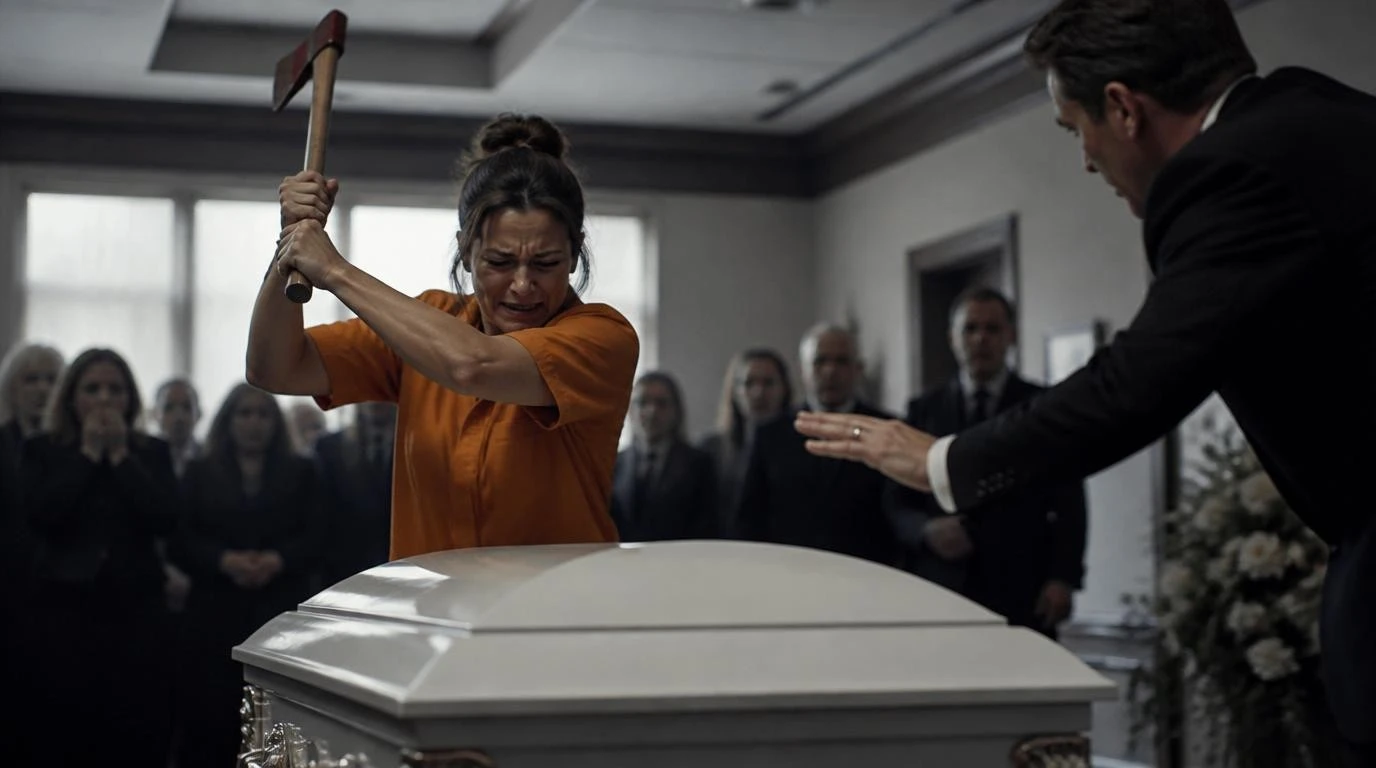
Rosa Alvarez had worked in Elena’s house for five years. She was small, maybe late forties, in an orange uniform that looked violent against all that funeral black. Adrian hadn’t invited the household staff to mourn. Rosa came anyway.
Before anyone could stop her, she swung the fire axe straight down into the coffin lid.
The crack split the room open. White wood exploded. Women screamed. A man stumbled backward into another mourner.
The axe stayed buried in the lid for one second.
Then Rosa yanked it free and shouted, “Stop! She’s not dead!”
No one moved.
The sentence was too impossible to understand all at once.
Adrian stepped forward first. His face twisted with horror. “What are you doing?”
Rosa pointed at the coffin. Her hands shook so hard it looked like the weapon might fall from them. “I heard her.”
No one believed her. Not yet.
That was why the second blow landed even harder.
The axe came down again. The lid split wider. Splinters flew.
Rosa dropped to her knees beside the broken wood and screamed, “She’s breathing!”
Adrian rushed forward to stop her. Then froze.
Because from inside the coffin came a sound.
Not loud. Not clear. Just enough.
A scrape. A trapped breath. Something alive where nothing alive should have been.
Rosa threw the axe aside and clawed at the broken lid. “Help me!”
Wood cracked again. And through the jagged opening—a hand inside twitched.
Then I saw it.
On that pale, trembling hand: a gold signet ring engraved with the Vale family crest. Adrian’s ring. The one he’d been wearing twenty minutes earlier while accepting condolences.
His right hand was bare now. The indentation still visible where the ring used to be.
I looked at his face. Not a husband whose wife had come back from death. A man whose locked door had just opened in front of witnesses.
I moved before I thought.
“Help us!” I shouted.
Rosa shoved both hands under the broken lid and lifted with a strength that looked impossible in a woman her size. I grabbed beside her. Wood split. Fabric tore. The lid finally gave.
Elena lay inside in a white dress Adrian had chosen. Her lips were blue. Her eyelashes trembled. A shallow breath dragged into her chest.
Rosa pressed her fingers to Elena’s throat. “She’s alive.”
The words moved through the room like fire.
The ambulance arrived within minutes. Paramedics pushed through the mourners, lifted my sister from the coffin, cut away the funeral dress, checked her pulse.
One of them looked at the broken coffin and the axe on the floor.
“Who found her breathing?”
Rosa raised her shaking hand.
The paramedic nodded. “You saved her life.”
I turned to Adrian. He stood near the wall, silent, one hand hidden in his jacket pocket.
“Where is your ring?” I asked.
His eyes met mine. For one brief second, all the grief disappeared. I saw the man behind it—cold, calculating, cornered.
Then Elena’s hand moved on the stretcher.
Her fingers opened weakly.
The gold ring slipped from her palm and clattered onto the polished floor.
Inside the band, something was folded. A tiny strip of paper.
Rosa saw it first. Adrian moved toward it.
I got there before both of them.
The paper was damp, tightly rolled, hidden beneath the signet face. With trembling fingers, I pulled it free.
Four words. Elena’s handwriting.
He poisoned my tea.
The police took Adrian aside before the ambulance even left. Not arrested. Not yet. Men like Adrian Vale do not get handcuffs immediately—they get questions in quiet rooms, respectful voices, and the benefit of every doubt money can purchase.
But Detective Mara Ellis arrived before his lawyers did.
She stepped into the funeral parlor, looked at the shattered coffin, the axe, the ring, the scrap of paper, and Adrian Vale standing too still beneath a painting of lilies.
“Nobody leaves,” she said.
In a side office, Rosa sat with a blanket over her shoulders, refusing to stop shaking. Detective Ellis closed the door and sat across from her.
“Mrs. Alvarez. Why did you believe Elena was alive?”
Rosa looked at me. I nodded.
“I heard her last night,” Rosa said. “At the house.”
She explained it slowly. Elena had been sick for three weeks—not flu-sick, but sleepy, confused, weak in ways that didn’t add up. Adrian called it stress. The private doctor said rest, herbal sedative, no visitors.
“Mr. Adrian told staff if Miss Elena’s sister called, say she was sleeping,” Rosa whispered.
I had called four times in three weeks. Elena was always “too tired for company.”
I’d believed it. Because grief makes you polite when you should be loud.
“Two nights ago,” Rosa continued, “Miss Elena came to the kitchen when Mr. Adrian was out. Barefoot. Very weak. She told me: if something happens, look inside the ring.”
“How did it end up in the coffin?” Detective Ellis asked.
Rosa’s eyes went somewhere haunted. “I think he put it there. He found the ring missing and searched everywhere. Then Dr. Harlan came. They closed the door. Later the ring was back on Mr. Adrian’s hand.” She paused. “Maybe he found it with her. Maybe he was afraid to open it. Maybe he thought no one would notice if he buried it with her.”
“Why did you come with an axe?” Ellis asked.
Rosa’s voice went very small. “Because the night before the funeral, I heard tapping from the cold room.”
The temperature in the office seemed to drop.
“From the wine cellar Adrian converted for storage,” Rosa said. “He told staff Miss Elena’s body had already been taken to the funeral home. But when I went downstairs for linens, I heard tapping from inside.” She twisted the strap of Elena’s black handbag. “I called her name. It stopped. Then three taps came back.”
“What did that mean?” Ellis asked.
“Miss Elena and I had a signal. When Mr. Adrian was angry, she tapped on the kitchen wall if she wanted me to stay nearby. Three taps meant help.” Her lips trembled. “My phone was gone. The house phones were locked. The gate guard said I was hysterical. By the time I got back, the cold room was empty and Mr. Adrian said if I spread lies, he would have me deported.”
Detective Ellis’s jaw tightened. “Are you undocumented?”
“No. But my husband is waiting for residency. Mr. Adrian always knew what people feared.”
Rosa reached into Elena’s handbag and pulled out a folded napkin.
“I found this in the kitchen trash after Miss Elena got sick.”
Inside: a faint brown stain. Crushed leaves. Tea. Or something that had been in tea.
“Miss Elena hated tea at night,” Rosa said. “Said it made her feel old. But Mr. Adrian made it for her every evening for three weeks.”
Detective Ellis stood. “I need Briar House sealed.”
By morning, every local outlet had the headline: WOMAN FOUND ALIVE DURING FUNERAL SERVICE.
By noon, Adrian’s publicist had released a statement calling it a “catastrophic medical error” and asking for privacy.
By three, his lawyer suggested Rosa was mentally unstable, traumatized by grief, possibly responsible for mishandling household medication.
By four, a rumor appeared online that Rosa had been seen stealing jewelry.
I found her in the hospital chapel, alone in the back row.
“I didn’t steal anything,” she said before I spoke.
“I know.”
“They are saying I wanted her jewelry.” Her voice broke. “I have worked since I was fourteen. I have cleaned rich people’s houses my whole life. They always know how to make dirt stick to the person holding the broom.”
I sat beside her. For a while, neither of us said anything.
Finally Rosa whispered, “He is going to win.”
“No.”
“Yes,” she said, turning to me with wet eyes. “You know these people. They smile and everything becomes their version.”
I wanted to deny it. But I had watched Adrian do it for years. When Elena stopped visiting, he said she was overwhelmed. When she left her job, he said she needed rest. When I asked if she was happy, Elena had smiled and said, “Adrian likes things peaceful.”
I hated myself for accepting that answer.
Detective Ellis found us near sunset. She looked tired in the way people look when the truth is getting larger instead of smaller.
“We searched Briar House,” she said. “The cold room was cleaned with bleach.”
Rosa closed her eyes.
“But not well enough.” Ellis let the hope settle before continuing. “Forensics found fibers matching the coffin lining in the drain. Traces of embalming fluid on the floor. Elena wasn’t fully embalmed—Adrian had requested sealed viewing and rushed cremation. But someone began preparation before they should have, then stopped.”
“Why did they stop?” I asked.
“Because she moved,” Rosa whispered.
Detective Ellis nodded. “That’s our working theory. She showed signs of life before the funeral. Someone panicked. Moved her. Then decided the fastest way to finish it was to proceed with the service and cremation.”
Cremation. If Rosa hadn’t broken that coffin, Elena would have been burned alive.
Ellis placed an evidence photograph on the pew between us—a porcelain teacup, white with a blue rim. Elena’s favorite.
“The lab found a sedative compound not currently prescribed to Elena,” she said. “Adrian’s attorneys will argue Dr. Harlan administered it.” She paused. “We’re looking for Harlan.”
“What do you mean looking?” Rosa asked.
“He’s gone. Office cleared. Computers missing. His assistant says he left for a conference in Zurich.”
Rosa gripped the pew. “The red notebook.”
Ellis turned sharply. “What notebook?”
“Miss Elena kept a small red notebook. She wrote things after she started forgetting—dates, tea times, what Mr. Adrian said. She kept it in my cleaning cart. Said the house had eyes.”
We drove to Briar House in silence. Fast enough to make every turn feel like an accusation.
Rosa led us to the service pantry. Her cleaning cart stood beside the mop sink exactly where she’d left it. Rags. Spray bottles. A caddy of brushes.
Then Rosa reached beneath the removable liner of the bottom shelf and pulled out a small red notebook wrapped in a plastic grocery bag.
Detective Ellis opened it with gloves.
The first pages were ordinary. Grocery notes. Medication reminders. Then Elena’s handwriting changed.
Became shaky. Uneven. Terrified.
March 3. Tea tasted bitter. Adrian watched me drink.
March 5. Woke up on bathroom floor. He said I fainted. I don’t remember standing.
March 9. Claire called. Adrian said I was sleeping. I was awake.
March 12. Harlan injected something. Said vitamins. I could not move for twenty minutes.
March 16. Adrian took my phone.
March 19. I heard him tell Victoria the transfer must happen before Claire gets suspicious.
“Victoria?” I whispered.
“You know a Victoria?” Ellis asked.
“Victoria Hale. Adrian’s financial advisor.”
Rosa crossed herself. “She comes on Thursdays.”
Ellis turned the page.
March 22. Victoria says the trust cannot move until I am declared dead.
March 24. Adrian told Harlan the funeral must be closed casket.
March 25. I hid his ring. If I cannot speak, the ring must.
The final entry was written so shakily it barely looked like Elena’s hand.
If I am found dead, do not let them burn me.
Rosa began to sob.
Then a sound came from the front hall. A door closing. Not accidental.
Detective Ellis grabbed her weapon. “Stay here.”
Rosa’s face went white. “She came back.”
“Who?”
“Victoria.”
Victoria Hale did not look like the kind of woman who ran from police. She looked like the kind who made police wait in reception.
Fifty years old. Silver-blonde hair. A cream coat that cost more than Rosa made in three months. She stood in the front hall with an officer’s flashlight on her face and the serene expression of a woman who expected to be trusted.
“Detective, I believe there’s been a misunderstanding.”
People who say that too calmly should always be searched first.
Detective Ellis did.
Inside Victoria’s coat pocket: a flash drive, two vials of clear liquid, a shredded document stolen from an evidence bag, and a burner phone with one outgoing message—drafted, not yet sent.
Adrian failed. Prepare the clinic.
Detective Ellis read it twice. “What clinic?”
Victoria said nothing.
Elena woke at 3:17 the next morning.
I know the exact time because I was staring at the clock, bargaining with every god I’d ignored for years, when her fingers moved against the bedsheet.
Her eyelids fluttered. Her mouth opened. No sound came out.
I stood so fast the chair hit the wall. “Elena?”
Her eyes moved slowly—unfocused, frightened—then they found me.
Tears slipped sideways into her hair.
I leaned over her. “I’m here. You’re in the hospital. You’re alive.”
Her lips moved.
“Rosa,” she breathed.
“She saved you.”
Elena closed her eyes. Another tear slid down.
The truth unraveled in pieces.
Elena had been gradually poisoned through tea and injections. Dr. Harlan monitored the dosage. Victoria designed the financial structure.
Our grandparents had left Elena controlling interest in Monroe House—a real estate and charitable trust worth nearly eighty million dollars. Adrian had the lifestyle, the estate, the social standing. But not control of the principal. If Elena divorced him, he got almost nothing. If she died without children, the trust transferred to the Vale-Marston Charitable Development Fund—administered by Adrian, structured by Victoria, audited by Harlan’s brother.
The funeral wasn’t just a burial. It was a transfer.
The cremation would erase the body before toxicology could challenge the cardiac arrest story. The closed coffin would hide any signs she’d been alive too recently. Dr. Harlan’s certificate would do the rest.
But Adrian made one mistake. He loved symbols—his ring, his crest, his need to control every detail while appearing devastated. When he discovered Elena had hidden the ring and its note, he panicked. He couldn’t destroy it without admitting he knew what it contained. He couldn’t keep wearing it if anyone asked. So he placed it in Elena’s hand before the service, assuming the coffin would stay closed and cremation would follow within hours.
He thought the dead kept secrets.
He forgot Elena was not dead.
And he underestimated the woman who cleaned his floors.
At trial, Adrian’s defense team attacked Rosa with everything they had.
They called her a thief. A liar. Unstable. Said she misunderstood English. Said she invented the tapping. Said she attacked a coffin in a grief-induced delusion.
They tried to make the jury see an orange uniform before they saw a human being.
Then Rosa testified.
She wore a navy dress borrowed from my mother, hands folded, looking terrified—until the prosecutor asked why she struck the coffin.
Rosa lifted her chin.
“Because I had heard Miss Elena ask for help before,” she said. “And one thing I know is this: rich houses have thick walls. If you wait for someone important to hear, women die.”
The courtroom went silent.
Adrian did not look at her. Victoria did—with hatred so controlled it almost looked like admiration.
The prosecution played security footage showing Adrian carrying Elena’s limp body toward the cold room. They showed texts between Adrian and Victoria discussing “asset release,” “cremation timing,” and “the maid problem.” They showed Harlan’s bank records, Victoria’s shell documents, and Elena’s red notebook with its final written warning.
Then they brought in the ring.
It sat under courtroom lights in a sealed evidence box. Small. Elegant. Damning.
The prosecutor asked Elena what she wrote on the paper hidden inside it.
Elena, still weak but steady, looked at Adrian for the first time since the funeral.
“He poisoned my tea.”
Adrian’s face did not change.
But his hand moved. Just once. Toward the finger where the ring used to be.
The jury noticed. Everyone did.
Victoria took a plea before closing arguments—she gave up the clinic, the accounts, the falsified medical records, and the contingency plan to move Elena to a private facility if she survived too long. Dr. Harlan was arrested at a private airport under another name. Adrian held out until the end.
He believed charm had legal value. For most of his life, it had.
The jury convicted him on attempted murder, conspiracy, medical fraud, false imprisonment, obstruction, and financial crimes tied to the trust transfer.
When the judge sentenced him, Adrian finally looked small.
Not sorry. Just reduced.
As deputies led him away, he turned toward Elena and said, “You would have been remembered beautifully.”
Elena answered softly.
“I’d rather be alive.”
Healing came slower than justice.
Elena spent weeks relearning how to trust sleep. She flinched when anyone brought tea into the room. She panicked when doors closed too quietly. She cried the first time she saw a white dress in a boutique window.
But she lived.
That became the sentence we returned to when everything else felt too complicated.
She lived.
Rosa stayed close. Hospital staff thought she was family because she sat like family—not at the edge of the room waiting to be dismissed. Beside the bed. Holding lotion. Arguing gently with nurses when Elena was too tired to argue for herself.
One morning, Elena woke to find Rosa sleeping upright in the chair beside her.
“She shouldn’t have to keep saving me,” Elena whispered.
I looked at my sister. “Maybe let her be loved for a while too.”
Elena did.
Briar House was sold after the trial. Part of the proceeds funded a legal support program for domestic workers and household staff threatened into silence by powerful employers.
Elena named it The Alvarez Fund.
Rosa cried when she found out, then immediately yelled at Elena for making her cry in public.
That was the first time I heard my sister laugh again.
A real laugh. Small, rusty, and entirely hers.
Years later, Elena placed Adrian’s gold signet ring on her kitchen windowsill.
The court had released it after all appeals ended. The lawyers asked whether she wanted it destroyed, sold, or stored.
She chose none of those.
She set it where sunlight could hit it.
Not as memory of him. As proof of what failed.
For years, that ring had meant Adrian Vale—power, control, a family name pressed into gold. Now it meant the opposite. It meant Elena had been awake enough to hide a warning. It meant Rosa had been brave enough to believe a sound no one else heard. It meant a coffin had cracked open before a lie could become ashes.
Sometimes visitors asked about it.
“That ring helped save my life,” Elena would say. Simply. Without drama.
One afternoon, Rosa’s youngest granddaughter visited and stared at the ring for a long time.
“Was it magic?” the little girl asked.
Elena smiled. “No.”
“Then why did it save you?”
Elena looked toward Rosa, who was standing by the stove pretending not to listen.
“Because someone poor touched something powerful,” Elena said, “and refused to be afraid of it.”
Rosa turned around with wet eyes. “You make everything sound fancy.”
“You made everything true.”
The little girl didn’t understand all of it.
But someday, maybe she would.
Every year on the anniversary, we gathered somewhere bright. Never a cemetery.
Elena wore colors. Rosa brought food. My mother cried every time Elena reached for another slice of bread. And in her kitchen, the gold ring still catches morning light on the windowsill—smaller than it ever looked in court, almost harmless now.
But none of us forget what it carried.
Four words. A warning. A voice. A woman refusing to vanish quietly.
And the maid who raised an axe a second time when the whole room called it madness—because from inside the coffin, my sister was still breathing, and Rosa was the only one brave enough to break the silence before it buried her.
Original fictional stories. AI-assisted creative content.