The bell above the door rang like a warning.
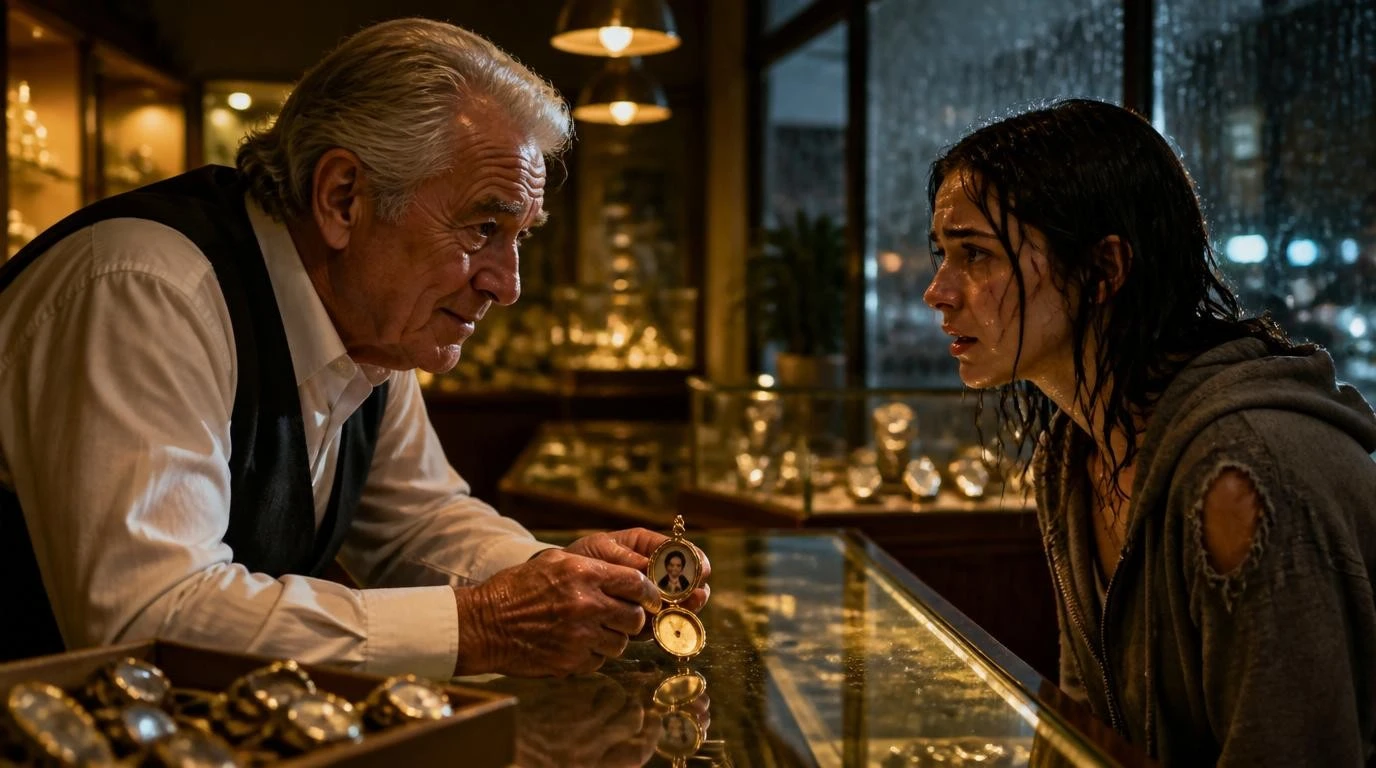
Clara stumbled inside, soaking wet, heart pounding. Her gray hoodie was torn at the shoulder. Rain poured behind her in silver sheets.
She slammed a gold necklace onto the counter. “How much will you give me for this?”
The old man behind the register looked up slowly. Silver hair, dark vest, steady eyes. He had run this store for forty years. He had seen desperate people before.
But something about her made him stop completely.
He reached for the necklace. Turned it over under the warm yellow light.
“Where did you get it?”
“It’s mine.”
Too fast. He noticed.
The pendant was old. Handmade. An oval locket with tiny vines engraved along the edge and a hinge almost invisible unless you knew where to look.
His thumb found the groove.
Click.
The locket opened.
Inside was a photograph—faded, small, protected behind glass. A little girl with soft curls and a missing front tooth, laughing beside a young man.
Mr. Whitmore recognized the man immediately.
Because it was himself.
His breath stopped.
“Where,” he said slowly, “did you get this?”
The girl stepped back. “I told you. It’s mine.”
“No.” His voice cracked open. “This necklace belonged to my daughter.”
She froze.
Not guilty. Not confused.
Recognized.
As if those seven words had unlocked something she had spent her whole life pressing down.
“What is your name?” he asked.
She stared at him. Her lips trembled.
“Clara,” she whispered.
Mr. Whitmore’s face collapsed.
He didn’t shout. Didn’t reach for her. Just stood very still while twenty years of grief shifted into something unrecognizable.
“My daughter,” he said. “My missing daughter.”
“That’s impossible.”
“Tell me that again after you look at this photograph.”
Clara looked.
The little girl with the missing tooth stared back at her.
She had seen that face her entire life—in mirrors, in glimpses, in the way her mother touched her face sometimes like she was memorizing it.
She had never seen it in a picture.
She had never seen it beside a father.
Her voice came out fractured. “My mother told me you were dead.”
“And everyone told me you were dead.”
The rain against the windows was the only sound.
Clara didn’t run. She sat.
Slowly, carefully, she told him what she could.
Her mother’s name was Evelyn. They had moved twelve times in fifteen years. Three states. Cheap apartments. Backpacks always packed. Shoes always on.
“She never explained why,” Clara said. “Just said dangerous men wanted something from her. She said going back would get us killed.”
Mr. Whitmore’s jaw tightened. “What men?”
“Men connected to this store.” She met his eyes. “She said someone wanted the property. The vault. Something in the old records.”
He didn’t look confused.
He looked like a man who had just been handed the last piece of a puzzle he had stopped believing would ever complete.
Twenty years ago, Whitmore & Sons had stored more than jewelry.
Old families trusted them with estate documents tucked inside heirloom pieces—watches, rings, lockets that held paperwork alongside photographs. The store was quiet. Respectable. Safe.
Except for one item.
The Ashford Blue.
A rare diamond connected to a trust fund worth millions. It disappeared the same night his wife and daughter vanished.
The police believed Evelyn took it.
Mr. Whitmore had spent years telling himself she hadn’t.
Then grief grew thorns.
He wondered.
He hated himself for wondering.
“Your mother,” he said carefully, “where is she now?”
Clara’s voice went flat. “A clinic outside the city. She needs surgery. They won’t proceed without a deposit—tonight.”
“How much?”
“Twenty thousand.”
He stared at her.
“And you were going to sell this for fifty dollars.”
Her eyes filled. “I tried everywhere else. One man offered me thirty. Another tried to take it from me.” Her voice broke on the last word. “I didn’t know where else to go.”
Outside, headlights moved slowly through the rain.
Clara turned toward the window.
Her face went white.
A black car sat across the street, engine running. Two men inside. Watching.
She was on her feet before the chair stopped scraping.
“They found me.”
Mr. Whitmore’s whole demeanor shifted.
The warmth didn’t leave him—but something harder settled underneath it.
“Sit down.”
“I have to go.”
“No. You have to stop running.”
“You don’t know them.”
“I knew men like them before you were born.”
He walked behind the counter and pressed a silent alarm beneath the register. Then he opened an old leather address book.
“What are you doing?” Clara demanded.
“Calling people who still owe me favors.”
“You don’t understand—”
“I understand my daughter is alive.”
She went still.
His voice trembled. His hands did not.
“I understand my wife may die tonight because I believed lies for twenty years. I understand men are sitting outside this store because they’re afraid of what you brought back.”
He held up the locket.
“And I understand this was never just jewelry.”
He turned the pendant over again. Beneath the engraved vines, near the base of the hinge, was a mark too small for a customer to notice.
Not decoration.
A number.
He took a jeweler’s tool from the drawer and pressed the hidden groove.
Click.
A second compartment opened beneath the photograph.
Inside: a thin strip of folded paper, sealed in wax gone dark with age.
Clara leaned forward. “What is that?”
Mr. Whitmore unfolded it carefully. His eyes scanned the words. Then he went absolutely still.
“What does it say?” she asked.
“It says Evelyn never stole the Ashford Blue.”
He looked toward the black car.
“It says who did.”
The bell above the door chimed again three minutes later.
Softer this time. The practiced kind.
Two men entered.
One was tall and broad in a dark coat. The other was older—thin, precise, leather gloves, calm eyes. He looked around the shop like he owned it.
He had tried to, once.
His eyes found Mr. Whitmore.
“Arthur.”
“Langford.”
Clara felt the name land in her chest like a stone dropped in cold water.
Langford pulled off one glove, finger by finger.
“I heard you had an interesting customer tonight.”
“Store’s closed.”
“So I see.” His gaze drifted to Clara. Slow. Assessing. “And there she is.”
Mr. Whitmore stepped in front of her.
Langford smiled. “Still sentimental after all these years.”
“You framed my wife.”
The smile thinned. “That’s a strong accusation.”
“I found the document.”
Now the room changed.
For the first time, Langford’s composure cracked. Only slightly. But enough.
“What document?”
“The one Evelyn hid in the locket. The one that names you.”
The tall man’s hand moved toward his coat.
Mr. Whitmore didn’t flinch.
Langford sighed like a man inconvenienced rather than cornered.
“You should have stayed quiet, Arthur. You were always good at grief.”
“You stole the diamond,” Mr. Whitmore said. “You used Evelyn’s access codes. Made it look like she fled with my daughter. Twenty years, Langford. You let me bury my family alive.”
“She was going to expose things she didn’t understand.”
“She was my wife.”
“She was inconvenient.”
The word hit Clara like a physical blow.
Inconvenient.
Twelve apartments. Five hundred nights with her shoes on. A mother coughing through fevers and still watching the door. A daughter who never once went to sleep without wondering why they were always running.
All because they were inconvenient.
“You ruined our lives,” Clara said.
Langford looked at her like she had just spoken out of turn.
“Your mother did that. When she refused to hand over the original trust certificate.” He tilted his head. “The locket only holds a copy. Did you know that? The real document is still out there. Without it, the diamond is just a stone. Without it, I get nothing.”
Clara’s mind went cold and clear.
Her mother’s voice.
Find the old street. Find the yellow lights. Trust the man behind the glass only if he opens it and cries.
She had thought fever was making her mother ramble.
She understood now.
Evelyn had never sent her here to sell the necklace.
She had sent her here to end this.
Langford extended his hand.
“Give me the locket, Arthur.”
“No.”
“I’m asking politely.”
“You’re begging quietly. There’s a difference.”
The tall man lunged.
And the windows exploded with red and blue.
Sirens filled the street.
Two police cruisers. Then a third.
Langford went completely still.
Mr. Whitmore looked at him with something close to pity.
“You always talked too long.”
The bell rang again.
Officers entered, not asking questions.
The tall man ran. He made it three steps.
Langford stood very still as they came for him. His eyes never left Mr. Whitmore.
“You have no idea what you’ve opened.”
Mr. Whitmore held up the locket.
“I opened my family. That was enough.”
The clinic smelled like bleach and stale coffee.
Clara ran down the hallway. Mr. Whitmore followed as fast as his old legs allowed.
Room 214.
She stopped outside the door.
For the first time since the jewelry store, she looked afraid again. Not of men. Not of being caught.
Of hope.
“What if she doesn’t want to see you?” she whispered.
Mr. Whitmore’s eyes filled with tears he didn’t bother hiding.
“Then I’ll thank her for keeping you alive and leave.”
Clara pushed open the door.
Evelyn lay under thin blankets—smaller than he remembered, paler than grief. Her hair had gone gray. Her hands were folded on the blanket like someone conserving warmth.
But her face.
Twenty years hadn’t taken her face.
She heard them enter and turned her head. She saw Clara first—then looked past her.
To him.
Her lips parted.
No sound came.
Mr. Whitmore crossed the room. Each step felt like walking through water.
“Evelyn.”
She began to cry before she found the word.
“Arthur.”
Clara stood between them trembling. Watching the two people who had loved each other, lost each other, and survived each other for twenty years try to remember how to be in the same room.
“I’m sorry,” Evelyn whispered. “I’m so sorry.”
He reached her bedside and took her hand.
The same hand from the church. The same hand he had convinced himself had betrayed him.
“You kept her alive,” he said.
“They said they would kill her if I came back.” She sobbed. “They said they’d kill you too. I had nothing. No proof. No money. No one who would believe me.”
“I would have believed you.”
She looked at him. Her eyes searched his face.
“Would you?”
He lowered his head.
Because twenty years ago, yes. Certainly.
But grief is patient and liars are persistent, and somewhere in the years between the search parties and the silence, the certainty had rotted.
“I should have found you,” he said.
“You searched.”
“Not long enough.”
“You searched until they convinced you I was the monster.” Her voice broke on the last word. “I watched from the news. I watched you stop believing in me. And I couldn’t come back because Clara was alive, and that was the only thing that mattered.”
Clara pressed both hands over her mouth.
Mr. Whitmore opened the locket and held it out.
Evelyn stared at the folded paper in the hidden compartment. Her face flooded with relief so deep it looked like pain.
“You found it,” she breathed.
“Clara brought it home.”
Evelyn looked at her daughter—full of pride and heartbreak in equal measure.
“I told you,” she whispered. “Trust him if he cries.”
Clara let out a broken laugh. “He did.”
“The police have Langford,” Mr. Whitmore said.
Evelyn’s hand tightened around his. “For how long?”
“Long enough. And you’re going to tell them where the original certificate is. Everything else you’ve kept hidden for twenty years.”
She closed her eyes. “There’s more than one name in those files, Arthur.”
“I know.”
“Men with money. Men with lawyers.”
“I have a lawyer now too.” He squeezed her hand. “A very annoyed one I just woke up at midnight.”
Evelyn laughed. It became a cough.
Clara rushed forward. Mr. Whitmore was already pressing the call button.
Within the hour, the surgical deposit was paid.
Not with the necklace. Never with the necklace.
With Mr. Whitmore’s card, no hesitation.
When the nurse confirmed the procedure was scheduled for morning, Clara sank into a hallway chair and pressed her face into her hands.
Mr. Whitmore sat beside her.
Neither spoke for a long time.
Then Clara said quietly, “I almost sold the only thing that could bring me back to you.”
He shook his head.
“You brought it exactly where it needed to be.”
The case didn’t explode all at once.
It unraveled—methodically, publicly, piece by piece.
Langford had connections that stretched far wider than a stolen diamond. Private estate auctions. Forged inheritance documents. Three cold cases no one had been brave enough to reopen.
The locket carried the first proof.
Evelyn knew where the rest was.
She had hidden evidence across twenty years—library books, church basement lockers, storage units in six different states. Not because she believed in revenge. Because she believed that one day, Clara would be safe enough to tell the truth.
Now she was.
The first time Clara called him Dad, it was an accident.
They were sorting through evidence boxes in the jewelry store after closing. She dropped a tray of old rings. Gold scattered across the polished floor.
“Dad, I’m sorry—”
They both froze.
Rain tapped the windows.
Softer than that first night.
Clara looked mortified. “I didn’t mean—”
“Yes,” he said quickly. Too quickly.
His voice cracked.
“I mean. Only if you want to.”
She looked at him—really looked at him. The old jeweler who had spent forty years behind a counter, who had outlasted storms and robberies and grief and lies, who had opened a locket and wept in front of a stranger.
“Okay,” she said.
That was all.
For Arthur Whitmore, it felt like the world had returned something no court could quantify.
Evelyn survived.
Not easily. Not without setbacks.
But she survived.
She came home to the apartment above the jewelry store—the same apartment that had once been a nursery, repainted now, the windows repaired, the old rocking chair restored.
Clara left one thing unchanged.
A small scratch on the wooden doorframe near the entrance.
Arthur had carved it the day she turned four—a quick mark measuring her height, the number written in pencil beside it: 4 years, 3 ft 2 in.
She touched it every morning.
Proof. She had been loved before she was lost.
The store changed.
People came for more than rings and watches now. They came because they had heard the story—the girl in the rain, the locket, the father who recognized his daughter in a photograph.
Some came to buy.
Some came to stare.
Some came to cry quietly near the display case where Arthur had placed a small sign beside the locket’s empty velvet stand:
Some treasures are not made of gold.
Clara stood behind the counter now, learning the trade. How to judge weight. How to hear the small lie in a customer’s voice. How to clean silver without scratching memory.
Arthur taught her slowly. Patiently. The way he wished he had been allowed to teach her all those missing years.
One evening, as rain tapped gently on the glass, Clara held up a pendant and studied the hinge.
“You know,” she said, “I still would’ve taken the fifty dollars that night.”
Arthur looked offended. “It was worth far more than fifty.”
“I know.”
“Then why say it?”
She smiled.
“Because fifty dollars brought me home.”
Arthur paused.
Then laughed—a real laugh, surprised out of him.
Evelyn, sitting near the back with a blanket over her knees, shook her head.
“You two are impossible.”
Clara walked over and kissed her forehead.
“You made me that way.”
Evelyn reached up and held her hand.
“No,” she said softly. “I kept you alive. But you walked through that door yourself.”
Clara looked at her father.
Then at the locket resting in its velvet box—the same locket she had nearly sold for fifty dollars on the worst night of her life.
She understood now why Evelyn had pressed it into her palm with trembling hands.
Not because it was valuable.
Because it was the last door home.
And on the night Clara had nothing left—no money, no sleep, no more roads to run—she had walked through that door.
Soaked. Terrified. Ready to trade her past for bus fare.
Instead, she found her name.
Her father.
Her truth.
And a family that had not been dead.
Only waiting.
Langford was sentenced to nineteen years.
Three other men from the original scheme pled out to avoid trial. Two of them were people Arthur Whitmore had known for decades—men he had trusted, eaten dinner with, mourned beside at funerals.
He sat through every day of the proceedings.
Not with anger.
With clarity.
On the last day, when the judge read the final verdict, Clara reached over and took his hand under the gallery table.
He didn’t say anything.
Neither did she.
They didn’t need to.
Outside the courthouse, rain was falling again.
Arthur turned up his collar.
Clara walked beside him.
“Still hate rain?” he asked.
“Getting better,” she said.
He nodded.
They walked home together through the wet city streets, back to the store with the yellow lights, back to the apartment where Evelyn was waiting, back to the velvet box and the old locket and the scratch on the doorframe.
Back to the beginning of everything.
Original fictional stories. AI-assisted creative content.