The sign outside said OPEN 24 HRS, but the neon H had been dead for weeks. It blinked O—PEN over and over, like a warning no one had bothered to read.
Inside, the booths were cracked vinyl and paper napkin holders. The smell of fryer grease had soaked into the walls so deep it was practically structural. A long counter ran the length of the place, lined with spinning stools that hadn’t spun properly since 2009.
It was a Tuesday. Half past seven. The dinner rush was winding down, which in a place like this meant four truckers, two couples, a lone man in a fishing vest, and a guy at the end of the counter nursing his third cup of coffee like it owed him money.
Nobody was looking at each other. That’s just how roadside diners work.
Then the tray clattered.
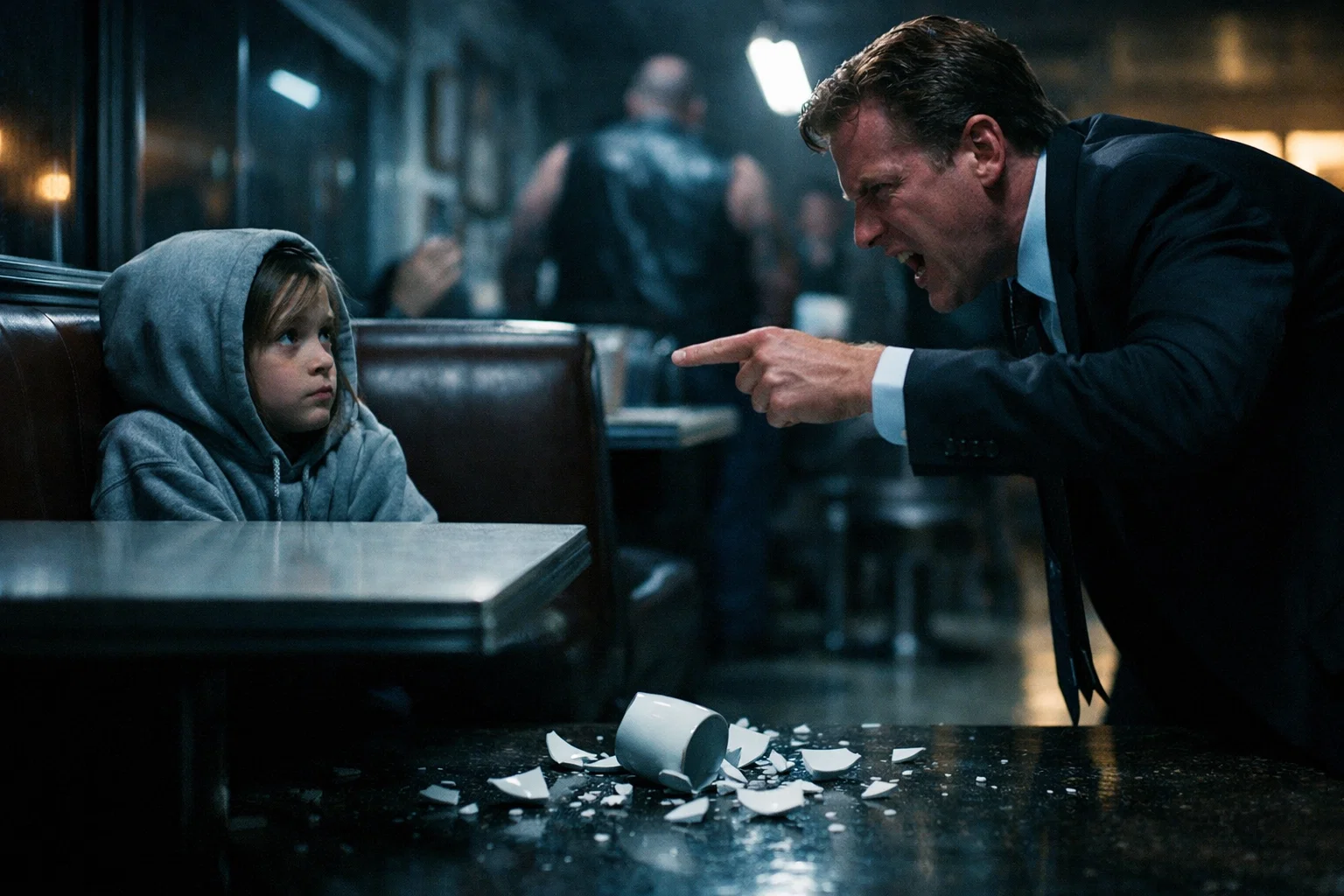
It hit the linoleum in three stages — first the edge, then the flat slap of the whole thing, then the secondary crash of two ceramic mugs spinning off in opposite directions. One broke clean in half. The other rolled under the counter and kept going.
The little girl stood there staring at it.
She was maybe seven. Maybe younger. Hard to tell. She was small for her age, whatever that age was — the kind of small that makes you stop and do a quiet calculation you don’t really want to finish. Her clothes were a size too big, washed so many times the color had given up. Her hair was pulled back in a ponytail that was half out, rubber band stretched and tired. She held her arms slightly out from her sides like she was still trying to balance the tray she no longer held.
For a second, nobody moved.
Then:
“Are you KIDDING me right now?”
The manager came through the kitchen door like he’d been launched. Heavy man, mid-fifties, wearing an apron that said GRILL MASTER in letters that had mostly peeled off. His face had gone a specific shade of red that only comes from a combination of heat, frustration, and a genuine belief that the world owed you compliance.
“That is the THIRD time this week, Maya!”
The girl — Maya — bent down immediately. Started picking up the pieces.
“I’m sorry,” she whispered. “I—I’m sorry, I’ll clean it up—”
“Sorry doesn’t clean the floor! Sorry doesn’t replace ceramic! Sorry doesn’t—” He stopped, exhaled hard through his nose. “Get the mop. Then the bus tub. And you’re working till close, you understand me? Till close. Both sections.”
Maya nodded. She was still crouched on the floor, a broken mug handle in each hand, not looking up.
“Yes, sir.”
It wasn’t the words. It was the way she said them. Practiced. Automatic. The voice of someone who had learned that agreement was the fastest way to make a thing stop.
Two of the truckers glanced over. One of them looked down at his coffee. The other looked at the window. The guy in the fishing vest adjusted his vest. The couple by the door went back to their menus. The man at the counter turned his cup slowly in its saucer, around and around, not drinking it.
Nobody said anything.
That’s how it usually goes.
He was in the booth by the far window.
He’d been there since six-thirty, long before the dinner crowd, nursing a plate of eggs he’d barely touched and a cup of coffee he kept letting go cold. He’d asked for a refill once, and Maya had been the one to bring it, gripping the pot with both hands the way kids do when they’re trying to seem careful, and he’d watched her work — table seven, table nine, the counter, the pass-through window, back to the counter — and he’d done the arithmetic.
She was the only floor staff.
Not the only young staff. The only floor staff, period.
He was broad through the shoulders, the kind of build that comes from actual work rather than a gym. His vest was leather, worn at the collar and cuffs to a pale gray, a small patch on the left chest that just said ROADS & MILES in block letters. His boots were real boots. He had the face of a man somewhere between forty-five and sixty who had stopped being too concerned about which.
He’d been watching.
Not staring. Just — watching. The way you watch when something is settling into you slowly, like water finding the cracks.
When the manager came through that door, he set down his coffee.
When Maya said “yes, sir” and started picking up broken ceramic with her bare hands, he put both palms flat on the table.
When the manager added, “And if this happens again we’re gonna have a very different conversation about your situation here” — the chair moved.
It was loud enough.
Every head in the diner turned.
The man stood up from the booth — slow, deliberate, no drama in it. He didn’t push the chair back or shove the table. He just rose to his full height and took three steps across the floor and stopped, and suddenly the manager was looking up at him instead of down at Maya.
“Hey.” His voice was level. “That’s enough.”
The manager blinked. “Excuse me?”
“I said that’s enough.”
The manager’s jaw set. “Sir, I don’t know who you think you are, but this is a private business and what happens between me and my employees is—”
“She’s picking up broken ceramic with her hands.”
Silence.
“She’s picking up broken—” The manager turned slightly. Maya was still crouched on the floor. He looked back. “She’s fine. She knows what she’s doing.”
“She’s seven years old.”
“She’s—” A pause. “That’s not your business.”
“It became my business.” He kept his voice exactly the same. Not louder. Not slower. Just the same. “The second you started yelling at a kid in a public room, it became everybody’s business.”
One of the truckers had put down his fork. The couple by the door had turned fully around in their seat. The man at the counter had stopped rotating his cup.
The manager’s face was doing something complicated. “She needs to learn how things work. You can’t just— you break things, there are consequences. That’s how the world—”
“She’s seven.”
“I know how old she is—”
“Then act like it.”
The words weren’t loud. They didn’t need to be. They sat in the room like something had been set down on a table — heavy, final, taking up space.
The manager opened his mouth and then closed it again.
The man turned. He crouched down, bringing himself to Maya’s level. She had gone very still, the broken pieces in her hands, watching him with an expression that hadn’t decided yet what it was.
“Hey,” he said. Quiet. “You okay?”
She nodded once, small and automatic.
He looked at her hands. “You got any cuts?”
She looked down at her palms like she hadn’t checked. Shook her head.
“Good.” He glanced up at the manager, then back at her. “Set those down. You don’t have to hold those.”
She set the broken ceramic on the floor, very carefully, like she was worried about making more noise.
He stood back up.
“Whatever she broke,” he said, reaching into the chest pocket of his vest, “I’m covering it.” He pulled out two folded bills and set them on the nearest table without looking at them. “Whatever it costs. That’s covered.”
The manager stared at the money. “That’s not the point—”
“I know it’s not the point.” He looked at him directly. “The point is you’ve got a child working your floor alone on a Tuesday night, and your response to a dropped tray is to yell at her in front of a room full of people. That’s the point.”
“She’s not—” The manager lowered his voice suddenly, aware of the room. “This is a family situation. It’s complicated. You don’t understand—”
“Then explain it.”
Silence.
“What’s complicated about a seven-year-old dropping a tray?”
No answer.
“She done for the night,” the man said. Not a question.
The manager’s face went through three different expressions. “You can’t just—”
“I just did.” He turned back to Maya. “You got a coat somewhere?”
Maya looked at him for a long moment. Something moved through her expression — the specific confusion of someone who is not accustomed to being asked about their coat, or their comfort, or their anything.
“In the back,” she said quietly.
“Go get it.”
She looked at the manager. Old reflex.
The manager said nothing.
She went.
It took her less than two minutes. She came back with a blue zip-up hoodie that was a size and a half too large, sleeves hanging past her wrists. She was wearing it already, hands tucked inside the cuffs.
The man was standing by the door. He’d left a ten on the counter for his coffee. The two bills he’d put down for the breakage were still on the table where he’d set them — nobody had touched them.
“You got somewhere you’re supposed to be tonight?” he asked her.
She shook her head.
He nodded like that was the answer he’d expected. “Alright. You’re coming with me for now. We’ll figure the rest out.”
She looked up at him. “Where?”
“Somewhere that’s not here.”
It was the simplest possible answer. It was also the right one.
Outside, the evening had gone a deep blue-orange, the sun mostly gone but the sky still holding the memory of it. The parking lot was half gravel, half cracked asphalt, and in the far corner sat three motorcycles — big ones, touring bikes with saddlebags — and two men standing beside them who had the same general energy as the man from the diner: quiet, unhurried, wearing the same road-worn leather.
One of them had a thermos. He looked up when they came out and took in the situation in about a second and a half, the way people do when they’ve learned to read a room quickly.
He held the door open. Didn’t say anything. Just nodded.
The man walked Maya to the nearest bike.
“You ever been on one of these?”
She shook her head.
“You scared of it?”
She looked at the motorcycle for a moment. Considered it seriously, the way kids do when they’re actually thinking about something instead of just reacting to it.
“A little,” she said.
“That’s fair.” He crouched down next to the bike. “You know what helps?”
“What?”
“Holding on.”
She almost smiled. It was a small one, barely there, but it was real. The first real expression she’d had since the tray hit the floor.
He went through the routine — where to hold, where to put her feet, don’t lean into the turns, just sit still and let it happen. She listened with complete attention, the way kids listen when they understand that the information matters.
Behind them, the diner door opened. The manager stepped out.
“You can’t just take her. That’s not—you don’t have the right—”
The man with the thermos turned around slowly. So did the third. They didn’t move toward the manager. They just turned around, and somehow that was enough.
The manager stopped at the edge of the parking lot.
“She’s got school tomorrow,” he said, but his voice had changed. Smaller now. “I’m just saying.”
“We know,” the man from the diner said. He didn’t look up from adjusting the seat. “She’ll be at school tomorrow.”
A pause.
“There’s a social services number,” said the man with the thermos. Conversational, like he was mentioning the weather. “For situations like this. Thought you might want to have it.”
He held out a card.
The manager looked at it. Didn’t take it. But he looked at it.
“In case you want to get ahead of things,” the man with the thermos added. Still conversational. “Before someone else makes that call for you.”
The manager stood there for another moment. Then he went back inside.
The door swung shut behind him.
They didn’t go far. There was a motel six miles up the highway, the kind with exterior corridors and a vending machine that actually worked, and the woman at the front desk — mid-sixties, reading glasses pushed up on her head, a paperback open face-down on the counter — took one look at the situation and didn’t ask a single unnecessary question.
She gave them two adjoining rooms and two keys and said “there’s a continental breakfast starting at six” with the tone of someone who has seen more complicated things than this and found that most of them resolved better with a hot meal and a good night.
Maya sat on the edge of the bed in her room — which had a real comforter and a TV and a lamp and a small desk, none of which she commented on, though her eyes moved across each one carefully — and the man sat in the chair by the window.
“You want to tell me how long this has been going on?” he asked.
She picked at a loose thread on the comforter. “A while.”
“How long is a while?”
She looked up. Looked down. “Since March.”
It was October.
“Where’s your mom?”
A pause. “She got sick. She’s at a place.”
“Your dad?”
“He left when I was four.”
He nodded. Didn’t push. “So who put you at the diner?”
“My uncle.” She said it the way you say a word that used to mean something and now mostly just means a fact. “He said I had to help out. Pay for my keep.” She picked at the thread again. “I get dinner. At the end of the shift.”
He looked at her.
“One meal,” she added. Not complaining. Just completing the information.
He got up. He went next door and said three sentences to the other two men. One of them got back in his jacket and went to his bike. Twenty minutes later, he came back with two bags from the fast food place down the road — burgers, fries, a milkshake — and they ate in the room with the TV on low, and Maya ate all of it, methodically and without hurry, the way you eat when you’ve learned not to leave things on the plate.
She fell asleep before nine o’clock, still sitting up slightly, and the man with the thermos found a blanket in the closet and draped it over her, and they sat in the adjoining room with the door cracked and the TV off.
“Child services in the morning,” the man from the diner said.
“Already called.” The man with the thermos held up his phone. “Got a case number. Someone’s coming at nine.”
“The uncle?”
“We’ll let the caseworker handle the uncle.”
“And the diner?”
The third man — who hadn’t spoken once since the parking lot — said: “I sent the tip to the labor board about forty minutes ago. Anonymous. Included the date range she gave us.”
He went back to looking at his hands.
“Seven months,” the man from the diner said, quietly.
Nobody answered. There wasn’t anything to answer with.
At nine-fifteen the next morning, a caseworker named Diane arrived. She was thorough, unhurried, and took nine pages of notes. She had clearly heard a lot of things in her career, and she had the expression of someone who had learned to let those things sit in her without letting them knock her over.
She spoke to Maya for forty-five minutes alone in the room, then came out and spoke to the three men for twenty minutes more.
“She’ll come with me today,” Diane said. “We have a placement. Good one. Family’s been licensed for eight years, no issues.” She looked at the man from the diner. “She asked if she could say goodbye to you.”
He went in.
Maya was standing by the window, backpack on — small, blue, with one broken zipper pull replaced by a twist of wire. She’d found a hair tie somewhere and re-done her ponytail. She looked rested in a way she probably hadn’t looked in a while.
“They said I’m going to a new place,” she said.
“Yeah.”
“Is it okay?”
“Yeah.” He said it straight. Not reassuring-voice, not adult-softening-hard-things voice. Just the same level voice he’d used in the diner. “It’s a good place. Real family. You’ll have a room.”
She nodded. Looked down at her backpack straps.
“That lady, Diane,” Maya said. “She said my mom might get better.”
“She might.”
“But not soon.”
“Probably not soon.”
Another nod. She was processing. You could see her doing it — serious, methodical, the same way she’d listened to the motorcycle instructions.
“Thank you,” she said. “For last night.”
“Yeah.”
“You didn’t have to.”
“No,” he agreed. “I didn’t have to.”
She looked up at him.
“That’s kind of the point though,” she said. Not a question. She’d worked it out herself.
He looked at her for a moment.
“You’re going to be fine,” he said.
And he meant it the way you mean something when you’ve seen enough of the world to know the difference between fine and not fine, and you’re making a genuine prediction, not just filling silence.
She picked up her backpack, adjusted the strap, and walked to the door.
At the threshold she stopped.
“The motorcycle,” she said, without turning around. “When I’m older. Maybe I’ll try it again.”
“Door’s open,” he said.
She walked out.
Three weeks later, the diner on the highway closed temporarily — pending a labor investigation. The sign in the window said CLOSED FOR RENOVATIONS but everyone in town knew it wasn’t renovations.
The uncle was interviewed twice. Then a third time. By the second week of November, he was facing two separate complaints — one from child services, one from the labor board — and his lawyer had advised him to say very little about very much.
Maya’s mother was still in the facility, but her treatment was going well. The doctors were cautiously optimistic. The caseworker sent updates.
Maya herself was in the third week of school by then, in a new district, new classroom. Her teacher noted in an early report that she was extremely focused, caught on to things quickly, and had a habit of finishing her work and then quietly looking out the window — not daydreaming, exactly, but thinking. Working something out.
She’d told the foster family she liked motorcycles.
They’d written it down in the intake form, under hobbies. As though it was a thing she’d always known, instead of a thing she’d learned one Tuesday night at a roadside diner where the neon sign blinked O—PEN like a warning no one had bothered to read.
Except, in the end, someone had.The sign outside said OPEN 24 HRS, but the neon H had been dead for weeks. It blinked O—PEN over and over, like a warning no one had bothered to read.
Inside, the booths were cracked vinyl and paper napkin holders. The smell of fryer grease had soaked into the walls so deep it was practically structural. A long counter ran the length of the place, lined with spinning stools that hadn’t spun properly since 2009.
It was a Tuesday. Half past seven. The dinner rush was winding down, which in a place like this meant four truckers, two couples, a lone man in a fishing vest, and a guy at the end of the counter nursing his third cup of coffee like it owed him money.
Nobody was looking at each other. That’s just how roadside diners work.
Then the tray clattered.
It hit the linoleum in three stages — first the edge, then the flat slap of the whole thing, then the secondary crash of two ceramic mugs spinning off in opposite directions. One broke clean in half. The other rolled under the counter and kept going.
The little girl stood there staring at it.
She was maybe seven. Maybe younger. Hard to tell. She was small for her age, whatever that age was — the kind of small that makes you stop and do a quiet calculation you don’t really want to finish. Her clothes were a size too big, washed so many times the color had given up. Her hair was pulled back in a ponytail that was half out, rubber band stretched and tired. She held her arms slightly out from her sides like she was still trying to balance the tray she no longer held.
For a second, nobody moved.
Then:
“Are you KIDDING me right now?”
The manager came through the kitchen door like he’d been launched. Heavy man, mid-fifties, wearing an apron that said GRILL MASTER in letters that had mostly peeled off. His face had gone a specific shade of red that only comes from a combination of heat, frustration, and a genuine belief that the world owed you compliance.
“That is the THIRD time this week, Maya!”
The girl — Maya — bent down immediately. Started picking up the pieces.
“I’m sorry,” she whispered. “I—I’m sorry, I’ll clean it up—”
“Sorry doesn’t clean the floor! Sorry doesn’t replace ceramic! Sorry doesn’t—” He stopped, exhaled hard through his nose. “Get the mop. Then the bus tub. And you’re working till close, you understand me? Till close. Both sections.”
Maya nodded. She was still crouched on the floor, a broken mug handle in each hand, not looking up.
“Yes, sir.”
It wasn’t the words. It was the way she said them. Practiced. Automatic. The voice of someone who had learned that agreement was the fastest way to make a thing stop.
Two of the truckers glanced over. One of them looked down at his coffee. The other looked at the window. The guy in the fishing vest adjusted his vest. The couple by the door went back to their menus. The man at the counter turned his cup slowly in its saucer, around and around, not drinking it.
Nobody said anything.
That’s how it usually goes.
He was in the booth by the far window.
He’d been there since six-thirty, long before the dinner crowd, nursing a plate of eggs he’d barely touched and a cup of coffee he kept letting go cold. He’d asked for a refill once, and Maya had been the one to bring it, gripping the pot with both hands the way kids do when they’re trying to seem careful, and he’d watched her work — table seven, table nine, the counter, the pass-through window, back to the counter — and he’d done the arithmetic.
She was the only floor staff.
Not the only young staff. The only floor staff, period.
He was broad through the shoulders, the kind of build that comes from actual work rather than a gym. His vest was leather, worn at the collar and cuffs to a pale gray, a small patch on the left chest that just said ROADS & MILES in block letters. His boots were real boots. He had the face of a man somewhere between forty-five and sixty who had stopped being too concerned about which.
He’d been watching.
Not staring. Just — watching. The way you watch when something is settling into you slowly, like water finding the cracks.
When the manager came through that door, he set down his coffee.
When Maya said “yes, sir” and started picking up broken ceramic with her bare hands, he put both palms flat on the table.
When the manager added, “And if this happens again we’re gonna have a very different conversation about your situation here” — the chair moved.
It was loud enough.
Every head in the diner turned.
The man stood up from the booth — slow, deliberate, no drama in it. He didn’t push the chair back or shove the table. He just rose to his full height and took three steps across the floor and stopped, and suddenly the manager was looking up at him instead of down at Maya.
“Hey.” His voice was level. “That’s enough.”
The manager blinked. “Excuse me?”
“I said that’s enough.”
The manager’s jaw set. “Sir, I don’t know who you think you are, but this is a private business and what happens between me and my employees is—”
“She’s picking up broken ceramic with her hands.”
Silence.
“She’s picking up broken—” The manager turned slightly. Maya was still crouched on the floor. He looked back. “She’s fine. She knows what she’s doing.”
“She’s seven years old.”
“She’s—” A pause. “That’s not your business.”
“It became my business.” He kept his voice exactly the same. Not louder. Not slower. Just the same. “The second you started yelling at a kid in a public room, it became everybody’s business.”
One of the truckers had put down his fork. The couple by the door had turned fully around in their seat. The man at the counter had stopped rotating his cup.
The manager’s face was doing something complicated. “She needs to learn how things work. You can’t just— you break things, there are consequences. That’s how the world—”
“She’s seven.”
“I know how old she is—”
“Then act like it.”
The words weren’t loud. They didn’t need to be. They sat in the room like something had been set down on a table — heavy, final, taking up space.
The manager opened his mouth and then closed it again.
The man turned. He crouched down, bringing himself to Maya’s level. She had gone very still, the broken pieces in her hands, watching him with an expression that hadn’t decided yet what it was.
“Hey,” he said. Quiet. “You okay?”
She nodded once, small and automatic.
He looked at her hands. “You got any cuts?”
She looked down at her palms like she hadn’t checked. Shook her head.
“Good.” He glanced up at the manager, then back at her. “Set those down. You don’t have to hold those.”
She set the broken ceramic on the floor, very carefully, like she was worried about making more noise.
He stood back up.
“Whatever she broke,” he said, reaching into the chest pocket of his vest, “I’m covering it.” He pulled out two folded bills and set them on the nearest table without looking at them. “Whatever it costs. That’s covered.”
The manager stared at the money. “That’s not the point—”
“I know it’s not the point.” He looked at him directly. “The point is you’ve got a child working your floor alone on a Tuesday night, and your response to a dropped tray is to yell at her in front of a room full of people. That’s the point.”
“She’s not—” The manager lowered his voice suddenly, aware of the room. “This is a family situation. It’s complicated. You don’t understand—”
“Then explain it.”
Silence.
“What’s complicated about a seven-year-old dropping a tray?”
No answer.
“She done for the night,” the man said. Not a question.
The manager’s face went through three different expressions. “You can’t just—”
“I just did.” He turned back to Maya. “You got a coat somewhere?”
Maya looked at him for a long moment. Something moved through her expression — the specific confusion of someone who is not accustomed to being asked about their coat, or their comfort, or their anything.
“In the back,” she said quietly.
“Go get it.”
She looked at the manager. Old reflex.
The manager said nothing.
She went.
It took her less than two minutes. She came back with a blue zip-up hoodie that was a size and a half too large, sleeves hanging past her wrists. She was wearing it already, hands tucked inside the cuffs.
The man was standing by the door. He’d left a ten on the counter for his coffee. The two bills he’d put down for the breakage were still on the table where he’d set them — nobody had touched them.
“You got somewhere you’re supposed to be tonight?” he asked her.
She shook her head.
He nodded like that was the answer he’d expected. “Alright. You’re coming with me for now. We’ll figure the rest out.”
She looked up at him. “Where?”
“Somewhere that’s not here.”
It was the simplest possible answer. It was also the right one.
Outside, the evening had gone a deep blue-orange, the sun mostly gone but the sky still holding the memory of it. The parking lot was half gravel, half cracked asphalt, and in the far corner sat three motorcycles — big ones, touring bikes with saddlebags — and two men standing beside them who had the same general energy as the man from the diner: quiet, unhurried, wearing the same road-worn leather.
One of them had a thermos. He looked up when they came out and took in the situation in about a second and a half, the way people do when they’ve learned to read a room quickly.
He held the door open. Didn’t say anything. Just nodded.
The man walked Maya to the nearest bike.
“You ever been on one of these?”
She shook her head.
“You scared of it?”
She looked at the motorcycle for a moment. Considered it seriously, the way kids do when they’re actually thinking about something instead of just reacting to it.
“A little,” she said.
“That’s fair.” He crouched down next to the bike. “You know what helps?”
“What?”
“Holding on.”
She almost smiled. It was a small one, barely there, but it was real. The first real expression she’d had since the tray hit the floor.
He went through the routine — where to hold, where to put her feet, don’t lean into the turns, just sit still and let it happen. She listened with complete attention, the way kids listen when they understand that the information matters.
Behind them, the diner door opened. The manager stepped out.
“You can’t just take her. That’s not—you don’t have the right—”
The man with the thermos turned around slowly. So did the third. They didn’t move toward the manager. They just turned around, and somehow that was enough.
The manager stopped at the edge of the parking lot.
“She’s got school tomorrow,” he said, but his voice had changed. Smaller now. “I’m just saying.”
“We know,” the man from the diner said. He didn’t look up from adjusting the seat. “She’ll be at school tomorrow.”
A pause.
“There’s a social services number,” said the man with the thermos. Conversational, like he was mentioning the weather. “For situations like this. Thought you might want to have it.”
He held out a card.
The manager looked at it. Didn’t take it. But he looked at it.
“In case you want to get ahead of things,” the man with the thermos added. Still conversational. “Before someone else makes that call for you.”
The manager stood there for another moment. Then he went back inside.
The door swung shut behind him.
They didn’t go far. There was a motel six miles up the highway, the kind with exterior corridors and a vending machine that actually worked, and the woman at the front desk — mid-sixties, reading glasses pushed up on her head, a paperback open face-down on the counter — took one look at the situation and didn’t ask a single unnecessary question.
She gave them two adjoining rooms and two keys and said “there’s a continental breakfast starting at six” with the tone of someone who has seen more complicated things than this and found that most of them resolved better with a hot meal and a good night.
Maya sat on the edge of the bed in her room — which had a real comforter and a TV and a lamp and a small desk, none of which she commented on, though her eyes moved across each one carefully — and the man sat in the chair by the window.
“You want to tell me how long this has been going on?” he asked.
She picked at a loose thread on the comforter. “A while.”
“How long is a while?”
She looked up. Looked down. “Since March.”
It was October.
“Where’s your mom?”
A pause. “She got sick. She’s at a place.”
“Your dad?”
“He left when I was four.”
He nodded. Didn’t push. “So who put you at the diner?”
“My uncle.” She said it the way you say a word that used to mean something and now mostly just means a fact. “He said I had to help out. Pay for my keep.” She picked at the thread again. “I get dinner. At the end of the shift.”
He looked at her.
“One meal,” she added. Not complaining. Just completing the information.
He got up. He went next door and said three sentences to the other two men. One of them got back in his jacket and went to his bike. Twenty minutes later, he came back with two bags from the fast food place down the road — burgers, fries, a milkshake — and they ate in the room with the TV on low, and Maya ate all of it, methodically and without hurry, the way you eat when you’ve learned not to leave things on the plate.
She fell asleep before nine o’clock, still sitting up slightly, and the man with the thermos found a blanket in the closet and draped it over her, and they sat in the adjoining room with the door cracked and the TV off.
“Child services in the morning,” the man from the diner said.
“Already called.” The man with the thermos held up his phone. “Got a case number. Someone’s coming at nine.”
“The uncle?”
“We’ll let the caseworker handle the uncle.”
“And the diner?”
The third man — who hadn’t spoken once since the parking lot — said: “I sent the tip to the labor board about forty minutes ago. Anonymous. Included the date range she gave us.”
He went back to looking at his hands.
“Seven months,” the man from the diner said, quietly.
Nobody answered. There wasn’t anything to answer with.
At nine-fifteen the next morning, a caseworker named Diane arrived. She was thorough, unhurried, and took nine pages of notes. She had clearly heard a lot of things in her career, and she had the expression of someone who had learned to let those things sit in her without letting them knock her over.
She spoke to Maya for forty-five minutes alone in the room, then came out and spoke to the three men for twenty minutes more.
“She’ll come with me today,” Diane said. “We have a placement. Good one. Family’s been licensed for eight years, no issues.” She looked at the man from the diner. “She asked if she could say goodbye to you.”
He went in.
Maya was standing by the window, backpack on — small, blue, with one broken zipper pull replaced by a twist of wire. She’d found a hair tie somewhere and re-done her ponytail. She looked rested in a way she probably hadn’t looked in a while.
“They said I’m going to a new place,” she said.
“Yeah.”
“Is it okay?”
“Yeah.” He said it straight. Not reassuring-voice, not adult-softening-hard-things voice. Just the same level voice he’d used in the diner. “It’s a good place. Real family. You’ll have a room.”
She nodded. Looked down at her backpack straps.
“That lady, Diane,” Maya said. “She said my mom might get better.”
“She might.”
“But not soon.”
“Probably not soon.”
Another nod. She was processing. You could see her doing it — serious, methodical, the same way she’d listened to the motorcycle instructions.
“Thank you,” she said. “For last night.”
“Yeah.”
“You didn’t have to.”
“No,” he agreed. “I didn’t have to.”
She looked up at him.
“That’s kind of the point though,” she said. Not a question. She’d worked it out herself.
He looked at her for a moment.
“You’re going to be fine,” he said.
And he meant it the way you mean something when you’ve seen enough of the world to know the difference between fine and not fine, and you’re making a genuine prediction, not just filling silence.
She picked up her backpack, adjusted the strap, and walked to the door.
At the threshold she stopped.
“The motorcycle,” she said, without turning around. “When I’m older. Maybe I’ll try it again.”
“Door’s open,” he said.
She walked out.
Three weeks later, the diner on the highway closed temporarily — pending a labor investigation. The sign in the window said CLOSED FOR RENOVATIONS but everyone in town knew it wasn’t renovations.
The uncle was interviewed twice. Then a third time. By the second week of November, he was facing two separate complaints — one from child services, one from the labor board — and his lawyer had advised him to say very little about very much.
Maya’s mother was still in the facility, but her treatment was going well. The doctors were cautiously optimistic. The caseworker sent updates.
Maya herself was in the third week of school by then, in a new district, new classroom. Her teacher noted in an early report that she was extremely focused, caught on to things quickly, and had a habit of finishing her work and then quietly looking out the window — not daydreaming, exactly, but thinking. Working something out.
She’d told the foster family she liked motorcycles.
They’d written it down in the intake form, under hobbies. As though it was a thing she’d always known, instead of a thing she’d learned one Tuesday night at a roadside diner where the neon sign blinked O—PEN like a warning no one had bothered to read.
Except, in the end, someone had.
Original fictional stories. AI-assisted creative content.