The divorce papers were still warm when Daniel Harper leaned back and smiled.
His office on the third floor of Cedar Ridge Plaza had floor-to-ceiling windows, framed awards, and a desk polished like a mirror. He’d spent years making sure every detail said winner.
Today, it finally felt true.
“She signed?” he asked, not bothering to look up.
His lawyer, Marcus Webb, set a folder on the desk and nodded. “All of it. The house, the vehicles, the company shares, the joint accounts. She accepted the lump settlement.”
“Five thousand.”
“Five thousand,” Marcus confirmed. His voice was flat.
Daniel looked up then. “You sound bothered.”
“She helped you open the first location, Daniel.”
“She waited tables.” He picked up his pen. “Anyone could have done that.”
Marcus didn’t answer. He had been Daniel’s lawyer for nine years. He had learned when silence was the better argument.
Daniel signed the final line. The pen clicked shut like a period at the end of a sentence.
“She’ll be fine,” Daniel added, sliding the folder back. “Emily always lands somewhere.”
Outside, Cedar Ridge carried on. Traffic moved. Lunch crowds filed into Harper’s Grill. The town had no idea a chapter had just ended.
Emily didn’t cry on the courthouse steps.
She carried two bags and walked to the parking lot alone. The sky was wide and pale—the kind of sky that made the world feel very quiet. Her phone buzzed once.
Bank notification.
Transfer received: $5,000.00.
She stared at the screen for a long moment.
Ten years. Reduced to a number.
She exhaled slowly. She had expected worse. Daniel had already drained the joint account three weeks ago. The house was gone. The car she had driven for six years was now legally his. Even the set of cast-iron pans she had saved up for—itemized in the divorce settlement, awarded to him, never once used by him.
But she still had something he hadn’t thought to take.
She flagged a cab.
The motel on Route 9 cost forty-two dollars a night. The room smelled of laundry detergent and old carpet. The bed dipped toward the middle. Trucks roared past on the highway every few minutes like afterthoughts.
Emily sat on the bed and opened her notebook.
She had carried it for years. The cover was soft from handling. Inside were recipes, sketches of floor plans, ideas for seasonal menus, notes she had scribbled during slow shifts at Harper’s Grill—ideas she had pitched to Daniel that he’d never followed through on.
Sunday brunch service. Rotating chalkboard menu. Local supplier partnerships. A loyalty card.
He had always had a reason why the timing wasn’t right.
She flipped slowly until she found the page she was looking for.
A drawing. Small restaurant. Brick front. Big windows. Warm lights inside. A chalkboard menu leaning near the door. Underneath, in her own handwriting:
Simple food. Honest prices. Everyone welcome.
She had drawn it the year they opened the first Harper’s Grill—before the renovations, before the investors, before Daniel started calling her role “front-of-house support” at networking dinners.
Her hand rested on the page.
Her heart began to beat faster than she expected.
The next morning, she walked.
She walked past the polished downtown cafés and the trendy brunch spots with hour-long waits. She walked past boutiques and real estate offices with photos of houses she could no longer afford. She kept going until the sidewalks cracked and the storefronts thinned out.
She found it on the corner of Maple and Third.
The building sat low and wide, brick going gray at the edges. The sign above the door had lost most of its letters. The windows were filmed with dust. A paper notice curled at one corner of the glass, faded but legible:
FOR SALE — AS IS
Emily stepped closer and looked through the dirty glass.
Overturned chairs. A long counter. A kitchen swallowed by shadow. The whole place looked like it had been mid-sentence when somebody just… stopped.
Her pulse quickened.
She pressed her palm flat against the glass.
It wasn’t what she had imagined. It was smaller. Rougher. The ceiling tiles looked water-damaged and the floors were filmed with grime. But she could see it anyway—the lights on, coffee brewing, people at the counter, the sound of a busy kitchen.
She called the number on the sign.
The owner arrived forty minutes later. Carl Briggs was a heavyset man with a sunburned neck and a ring of keys he kept tossing between his palms.
“Been closed two years,” he said, unlocking the front door. “Roof leaks in three spots. Freezer’s dead. Plumbing does what it wants.”
Emily stepped inside. Dust rose with every footfall. The air was still and stale.
She walked the floor slowly. Ten tables. A long counter with eight stools. A compact kitchen behind a pass-through window. Small enough to manage. Small enough to know every corner of.
“How much?” she asked.
Carl scratched his jaw. “Town’s moved east. Nobody’s looked at this place in eight months.” He shrugged. “Five grand. Cash. You take it as-is, no complaints.”
Emily went still.
“All five thousand?”
“You got somewhere else to be?” He wasn’t unkind. Just tired.
She looked around the room one more time. The cracked counter. The missing tiles. The dead silence.
Then she looked at her notebook.
“I’ll take it,” she said.
Daniel heard about it three weeks later.
He was at Harper’s Grill, shaking hands with a pair of investors over the plans for a second location downtown. The dining room was full, servers moving with the easy efficiency that came from his training. He thrived in the noise.
Then his floor manager, Karen, leaned close. “Did you hear about Emily?”
He frowned. “Why would I?”
“She bought that abandoned diner on Maple. The old Briggs place.”
Daniel blinked—then laughed. “Emily bought a restaurant.”
“That’s what I heard. Fixing it herself.”
He shook his head and turned back to his investors. “That place has been condemned twice. She’ll burn through that money in a week.”
“Maybe,” Karen said.
But she didn’t laugh with him.
He drove past Maple Street that night. Just out of curiosity, he told himself.
Lights glowed inside the building.
He slowed.
Emily stood on a ladder, rolling white paint across a wall. Her hair was tied back. A streak of paint crossed her cheek. A small radio played quietly. The sign above the door had been taken down and leaned against the brick outside—freshly sanded, ready to be repainted.
She was alone.
No contractors. No hired hands. Just her, a roller, and a ladder that looked one rung short of trustworthy.
Daniel watched for a moment.
He smirked and drove away.
“She won’t last,” he said to no one.
Emily worked eighteen-hour days.
She scrubbed grease from the kitchen tiles with her hands raw and aching. She patched the roof with secondhand materials and a YouTube tutorial and a borrowed ladder. She repainted the walls, rewired two light fixtures, and sanded every table until the wood was smooth.
Money disappeared fast.
She bought used chairs from a diner closing in the next town. A secondhand espresso machine she found on a local buy-sell page. Discount plates that didn’t match in color but were solid and clean.
When the money thinned to almost nothing, she improvised.
She sewed curtains from fabric she found at the thrift store—pale yellow, practical, warm. She painted the menu board herself in careful block letters. She hauled a cast-iron pan from the thrift store’s back room that reminded her of the ones she’d lost.
The neighborhood began to notice.
An older mechanic named Roy fixed her grease trap for free. “Been watching this corner sit empty too long,” he said.
The bakery three blocks over dropped off day-old bread without being asked. A seventeen-year-old named Marcus offered to help with cleaning in exchange for two meals a day.
Piece by piece, the place came alive.
Opening day came on a Tuesday morning in early spring.
No grand announcement. No advertising budget. Just a hand-painted sign in the window:
OPEN — Home Cooking
The first customer was a truck driver who parked on Maple by accident looking for a shortcut.
He pushed the door open and looked around. “What’s good?”
Emily smiled from behind the counter. “Everything’s fresh.”
He ordered eggs, bacon, toast, and coffee. He ate slowly. He didn’t look at his phone once.
When he left, he said, “See you tomorrow.”
He came back the next morning. And the morning after that. Then he brought another driver.
Two construction workers stopped in the following week. Then a retired couple. Then a teacher from the elementary school down the block who said she was tired of driving downtown on her lunch break.
Word spread the way it does in small towns—quietly, then all at once.
The food was simple but made properly. Prices were honest. Emily remembered names. She asked about people’s days and actually listened to the answers. When the lunch rush hit, she moved fast but never looked harried.
Within a month, every table was full at breakfast.
Within two months, a line formed outside before she opened.
Daniel first noticed the numbers in March.
Morning traffic at Harper’s Grill was down eleven percent from the same month last year. He called Karen into his office.
“Where are people going?”
Karen took a breath. “Second Chance Café. On Maple.”
He stared at her. “That’s Emily’s place.”
“Yes.”
He leaned back. “Eleven percent. Over a diner with secondhand furniture.”
“Her eggs benedict is being shared all over the local Facebook group,” Karen said carefully. “And she does a lunch soup that people are—”
“That’s enough.” He waved her out.
He pulled up the café’s social pages that evening. No professional photography. No curated aesthetic. Just photos people had taken themselves—plates of food, the yellow curtains, the mismatched mugs. Hundreds of tags. Comments that said things like this place saved my Tuesday and Emily remembered my name after one visit.
He closed his laptop.
He walked in on a Thursday afternoon in April.
The bell above the door rang. The place was full—every table, every counter stool. The sound of conversation layered with plates and a coffee machine and something cooking in the back.
Emily looked up from the counter.
Their eyes met.
She went still for just a moment—then smiled with the practiced ease of someone who had moved past being surprised. “Table for one?”
Daniel glanced around. He recognized three faces from his own restaurant. Two of them looked away.
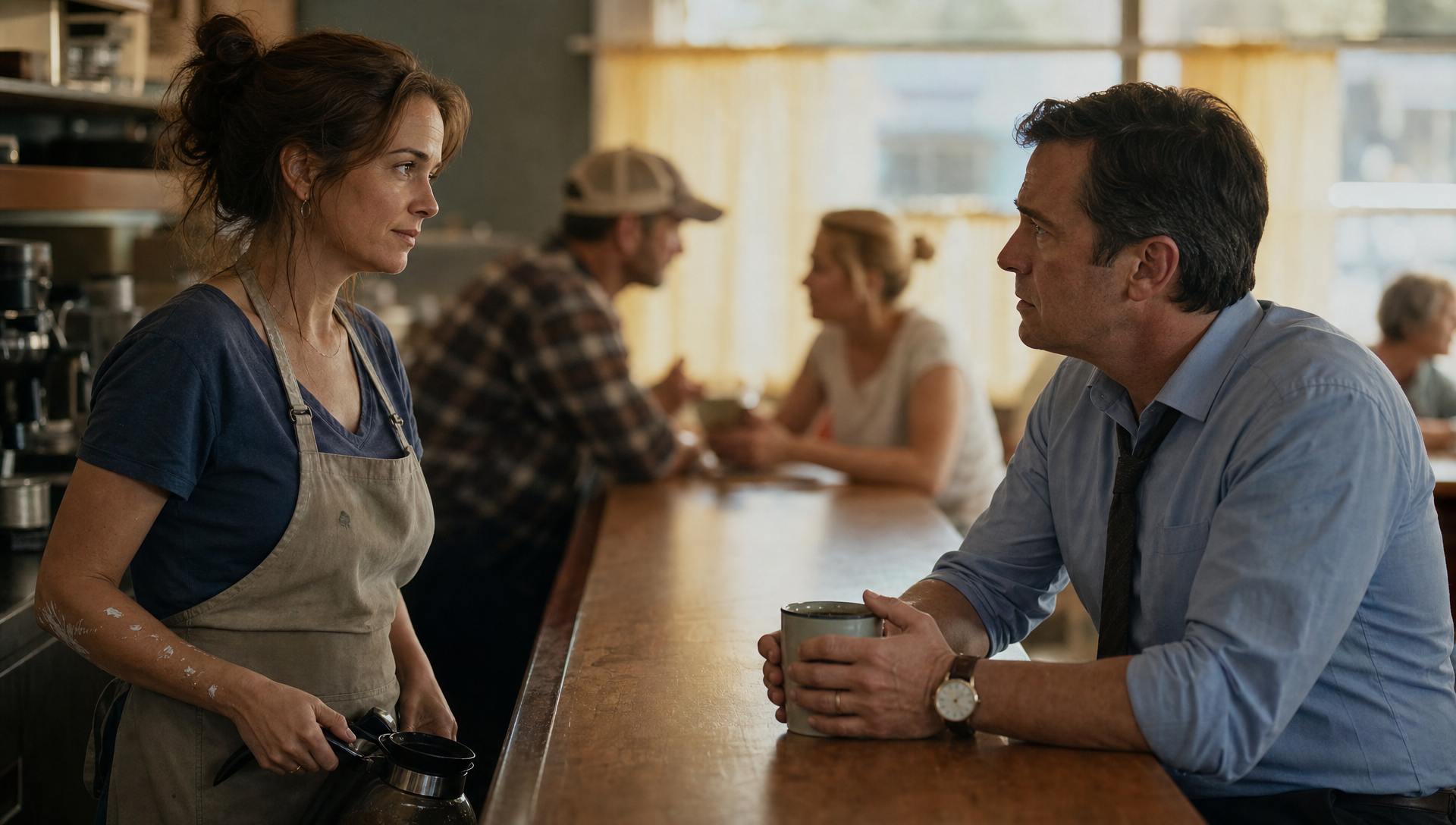
He sat at the counter.
“You did all this,” he said. It wasn’t quite a question.
“Mostly.” She poured his coffee without being asked—black, same as always.
He took a sip.
It was perfect.
“How?” he asked.
She tilted her head. “What do you mean?”
“The place was condemned. You had—” He stopped himself.
“Five thousand dollars?” She said it lightly. No edge in it.
He looked at the counter. “That’s not enough to do this.”
“Depends on what you spend it on.” She picked up a rag and wiped down the pass-through shelf. “I spent it on the building. Everything else, I figured out.”
He watched her move—efficient, unhurried, at ease. The woman who had stood beside him at Harper’s Grill looking tired and apologetic for taking up too much space. She looked like a different person.
She looked like herself, he realized. Maybe for the first time.
“You risked everything,” he said.
“I already had nothing,” she replied. She said it gently, like a fact and not an accusation.
The words landed heavier than he expected.
He left without finishing his coffee.
Six months passed.
Second Chance Café became the center of Maple Street. A barbershop opened two doors down. A small bookstore took the empty space on the corner. A yoga studio announced it was moving in next spring. Property values on the block ticked upward for the first time in a decade.
Emily hired staff.
A single father named Pete who needed morning shifts to be home by three. A college student named Jade working her way through school. A woman named Renata who had been rebuilding her life after a difficult few years and needed someone to take a chance on her.
Emily knew something about that.
Harper’s Grill still operated. Still made money. Daniel’s second location opened downtown in June with a ribbon-cutting ceremony and a photographer from the local paper.
But something felt different when he walked his own floor now.
Customers came and ate and left. It was efficient. Smooth. Profitable.
But no one lingered. No one came back the next day and asked about his kids by name. No one posted photos of the food with the caption this place feels like home.
He told himself it didn’t matter.
He was not convincing himself.
The storm hit Cedar Ridge on a Friday night in October.
Rain came in hard and fast. Power went out block by block starting downtown. Daniel closed Harper’s Grill at seven—the kitchen couldn’t run safely without proper ventilation and the backup generator only handled the register and emergency lights.
He drove home in the rain, frustrated.
On Maple Street, he slowed out of habit.
Second Chance Café glowed.
Emily ran on a small generator she had bought in August with her second month’s profit. Inside, people crowded every surface—neighbors who had lost power, a family with two kids in rain jackets, a handful of strangers passing through who had nowhere else to go. Candles supplemented the generator’s modest light. Emily moved through the room with a tray, ladling soup, refilling cups.
The place looked like a lighthouse.
Daniel parked across the street. He sat in his car in the rain and watched through the window for a long time.
He thought about the $5,000.
He thought about the signed papers.
He thought about how certain he had been, sitting in his office that morning, that he had won.
He finally understood.
He hadn’t left her with nothing.
He had left her with herself.
And that turned out to be more than he’d ever given her credit for.
A year after the divorce, Emily signed a lease for a second location.
Not downtown where the foot traffic was easy and the rent was high and success was already assumed. She chose another forgotten corner—a struggling neighborhood three miles east where a shuttered laundromat had been sitting empty for two years.
The opening was on a Saturday in November. She kept it simple: folding tables out front, a coffee urn, a plate of pastries, and a hand-painted banner over the door.
Daniel showed up.
He stood near the back of the small crowd, hands in his jacket pockets, watching. He almost left twice. But he stayed.
When the crowd thinned and Emily was moving between guests, she spotted him.
She walked over slowly, not sure what to expect.
“You didn’t have to come,” she said.
“I wanted to.” He looked around—the warm lights, the hum of conversation, the familiar energy she seemed to carry and set down in every room she built. “Congratulations.”
“Thank you.”
He searched for something to say that wasn’t too little and wasn’t too much.
“You built something real,” he said finally.
She smiled. “So did you. Just differently.”
“Yeah.” He exhaled. “Differently.”
A beat of quiet between them.
“Do you regret it?” he asked. “Any of it?”
She thought about the motel room. The notebook. The cracked tiles and the borrowed ladder and the nights she fell asleep sitting at the counter because she couldn’t make herself leave.
“No,” she said. “I needed to lose everything I had before I could use what I was.”
He nodded slowly.
He wanted to say something that would matter. But he understood, standing there, that there was nothing left to say that would change what he had done or earn back what he had dismissed.
He had taken her house. Her savings. Her security. Her cookware and her car and her ten years.
He had never owned her strength.
He had never even seen it.
When she spent her last dollar on a broken building nobody wanted, she hadn’t lost.
She had finally started.
And when Daniel Harper got back in his car and drove home through the quiet November streets, he understood something for the first time with complete clarity:
He thought he had left her with nothing.
What he had actually given her—without meaning to, without knowing, without understanding what she carried—was the one thing she had always needed.
A second chance.
Three months later, a regional food magazine ran a feature.
Cedar Ridge’s Most Beloved Restaurant Isn’t Downtown.
The photo on the cover showed Emily at the counter of Second Chance Café, laughing at something just outside the frame. The yellow curtains were in the background. A mismatched mug sat on the counter in front of her.
The article quoted seven longtime customers. A line from one of them ran as the pull quote:
“She made this block feel like it mattered again.”
Emily read the piece at the counter before opening, coffee cooling beside her.
She folded the magazine carefully and set it under the register.
Then she unlocked the front door, flipped the sign to OPEN, and started a fresh pot.
At 6:52 a.m., the truck driver was the first one through the door.
“Morning,” he said, taking his usual stool.
“Morning,” she said. “The usual?”
“Always.”
She smiled and started his order.
Behind her, the kitchen woke up.
Outside, Maple Street was already moving.
Original fictional stories. AI-assisted creative content.