Hannah Whitaker arrived at Morning Ember before the sun did.
She liked it that way. The quiet before the rush. The smell of fresh grounds and desert air leaking through the service door. The feeling that the day was still hers to shape.
She tied her apron, wiped down the counter, and told herself again what she told herself every morning: This is enough. This is good.
After a year of bad luck in Kansas City — a layoff, a broken lease, a relationship that dissolved like sugar in cold water — she had driven west with two bags and half a tank of gas. Arizona had felt like a reset. The sky was wider here. The silence had texture.
Route 17 outside Flagstaff wasn’t glamorous. Truckers. Road-trippers. Tired families stopping for bathroom breaks. But the regulars knew her name, and that mattered more than she’d expected.
“Medium dark, no sugar, two creams — that’s what I remember,” she’d told a long-haul driver named Roy on his third visit.
He’d looked at her like she’d handed him something valuable. “Nobody ever remembers.”
“I do.”
That was Hannah. Small things. Steady hands. The belief that it all added up to something, even when you couldn’t see the total yet.
She had no idea Tuesday morning was going to test that belief until it snapped.
The lunch crowd arrived early.
Hannah was four deep into a row of takeaway cups when she glanced through the glass doors and saw him.
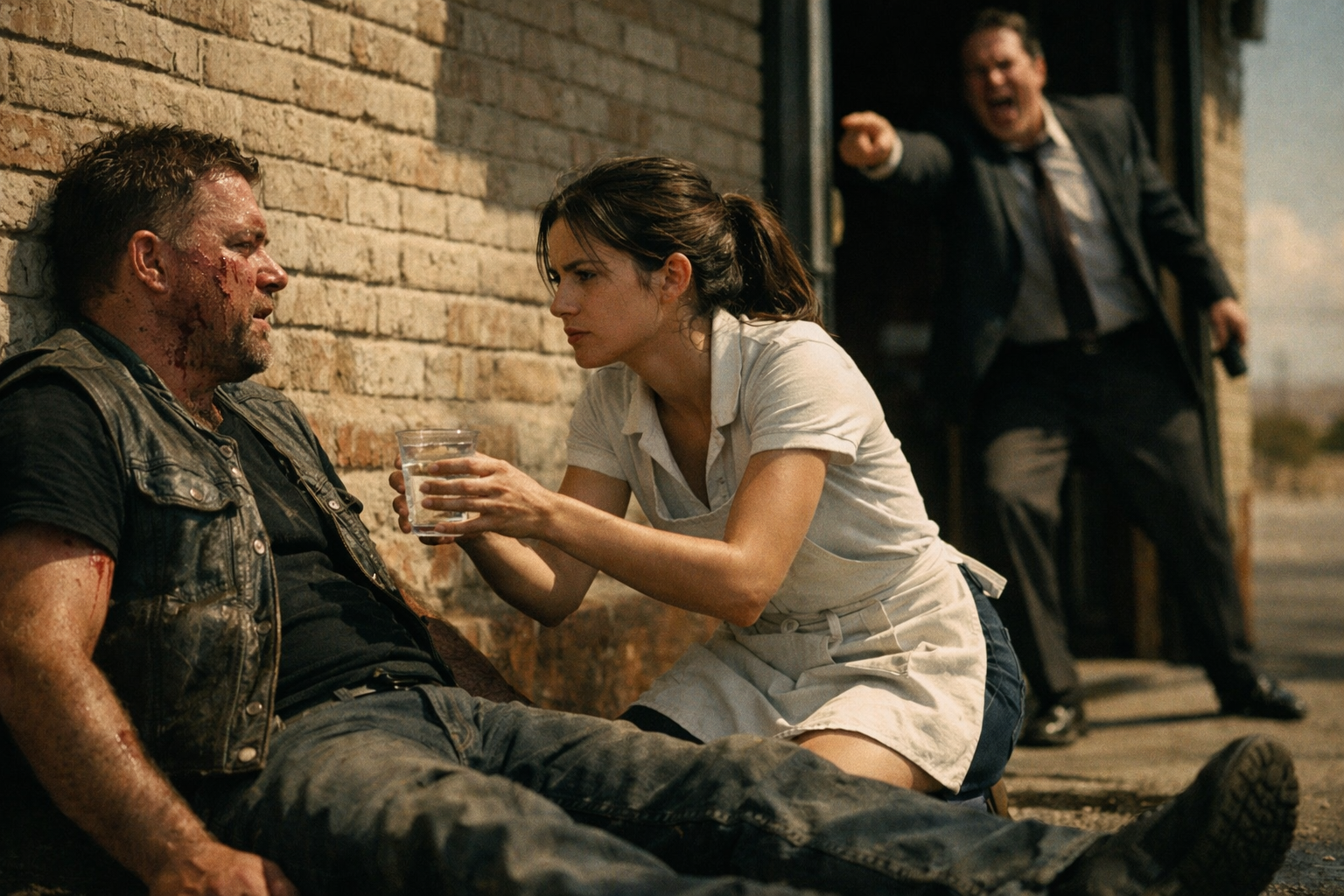
A man. Standing at the metal railing beside the entrance. Big, broad. A worn leather vest over a dark shirt. Faded tattoos climbing both forearms. A black motorcycle helmet resting at his boots like a fallen satellite.
She noticed him the way you notice something quietly wrong — not with alarm, but with the slow certainty that something is off.
He gripped the railing.
Swayed.
Gripped harder.
“Hey,” she said quietly, mostly to herself.
His knees buckled.
He went down slowly, heavily, like a building choosing its direction before it falls. He pressed his back against the brick wall and slid to the pavement.
Nobody moved.
A woman leaving the café glanced at him, recalculated something internal, and kept walking. A car honked at someone stalled in the pickup lane. Two guys near the window took a second look, then turned back to their food.
Hannah’s manager, Doug, appeared at her shoulder like he’d sensed trouble forming.
“Don’t,” he said.
She looked at him.
“Don’t go out there. He’s not our problem.”
“He just collapsed.”
“He’s a biker, Hannah. He’s probably drunk.”
“It’s nine-thirty in the morning, Doug.”
“I don’t care what time it is. We’re not a clinic. Get back on the line.”
She looked at the man again. His breathing — she could see it even through the glass — was too shallow. His shoulders moved in small, controlled arcs, the way someone breathes when they’re working very hard to appear fine.
She picked up a cup. Filled it with water.
“Hannah—”
She pushed through the door.
The desert heat hit her like opening an oven.
She crouched beside him. Close enough that she could see the tight line of his jaw, the way his eyes were slightly unfocused.
“Hey. Are you alright?”
He looked up slowly. His eyes were dark and sharp, the kind of eyes that didn’t miss much — but behind them, something was struggling.
“Just need a minute,” he said. His voice was calm, measured.
“You don’t look like you just need a minute.” She held out the cup. “Drink this. Please.”
He studied her for a moment. Then he accepted the cup and took a careful sip.
Neither of them spoke. Route 17 hummed with midday traffic. A crow called from somewhere in the scrub brush along the lot’s edge. The sun sat heavy above the mountains.
“Do you want me to call someone?” she asked.
“No.” Another sip. “I’ll be okay. Just got dizzy. Heat caught me.”
“Have you eaten today?”
He paused just a fraction too long. “I’m fine.”
“That’s not an answer.”
Something shifted in his expression — brief, almost amused. Like he hadn’t expected to be pushed.
He tried to stand. His legs disagreed.
Without thinking, Hannah reached out and grabbed his arm.
She heard the door bang open behind her.
“Hannah!”
Doug’s voice had that particular pitch — the one he used when he’d already decided something and just needed to perform the announcement.
She straightened but didn’t let go of the man’s arm.
“He was about to fall again,” she said.
Doug came to the edge of the curb, arms crossed. “You walked off the line during a rush.”
“I was gone two minutes.”
“You went out there to help—” He gestured at the man with the kind of vague contempt that didn’t need words to be clear.
The biker’s jaw tightened. He didn’t say anything. Just watched Doug with a stillness that somehow occupied more space than a loud reaction would have.
“Get back inside,” Doug said to her.
“Let me just make sure he’s okay.”
“He’s fine. He’s a grown man. Get inside, Hannah.”
The man tried to rise again. One knee wobbled. Hannah caught his elbow before she could stop herself.
Inside the café, three people had turned to watch through the window. Someone had already raised a phone.
Doug’s patience finished its last lap.
“That’s it,” he said flatly. “We’re done.”
She blinked. “What?”
“You’re fired. Go get your things.”
The words landed like something solid falling from a shelf.
“You’re firing me,” she said. Not a question. Just trying to feel the shape of it.
“You heard me.”
She looked at him — really looked at him — for a long moment. The parking lot felt very quiet suddenly, even with the highway noise and the engines and the distant crow.
“Because I gave someone water,” she said.
“Because you abandoned your post and made a scene in front of customers.”
“He could have been having a medical—”
“I don’t care.”
The biker had gotten himself to standing.
He moved slowly but stood straight now, and when he was upright, he was taller than Hannah had registered from the ground. He looked at Doug without hostility — just steady attention, the way a very patient person looks at something they’re choosing not to react to yet.
“She was only trying to help me,” he said.
His voice was quiet. Not soft — quiet. The difference being that soft things bend, and this voice didn’t.
Doug didn’t flinch. “That’s not her job.”
“I know.” A pause. “But it was the right thing.”
“We have policies—”
“I understand that.” He looked at Hannah. “You shouldn’t lose your job over this. I’m sorry.”
“Don’t be,” she said. She surprised herself saying it, but she meant it. “I’d do it again.”
Something passed over his face. Brief. Like a door opening and closing before you can see what’s inside.
Someone in the small gathering crowd whispered, call the police. Another voice said something about the vest, the tattoos. The whispers moved fast and shaped themselves into something ugly before anyone had established a single fact.
Doug pointed toward the exit. “I’m going to need you to leave the property as well, sir.”
The man raised both hands — slow, open. “I’ll leave.”
But he didn’t move yet. He looked at Hannah.
“Go get your bag.”
She shook her head. “I’m not just going to—”
“Hannah.” Something in his tone stilled her. “You’ve done more than enough today. Go get your bag.”
She went inside.
Her hands shook a little as she grabbed her jacket from the break room hook. Jessie, the other barista, watched her from the corner with an expression that said I’m sorry and I can’t afford to say that out loud at the same time.
“Jessie—”
“I know,” Jessie said quietly. “I saw.”
Hannah walked back out. The man was standing at the edge of the parking lot now. Doug had retreated to the door, arms still crossed, monitoring from a safe distance.
Two customers had their phones up. Recording.
She stood beside the biker, both of them in the sun, neither of them quite sure what the next move was.
He reached into his vest.
Three people nearby took a step back. One woman actually grabbed the arm of the person next to her.
He pulled out a phone.
Typed something. Then raised it to his ear.
“It’s me.” A pause. “I’m outside the Morning Ember on Route 17. I could use some company.”
Another pause.
“Yeah. I’m alright. Just come by when you can.”
He hung up.
Looked at Doug.
“You might want to hold off on making anything final just yet.”
Doug’s expression went flat. “Is that a threat?”
“No.” Simple as that. “It’s a suggestion.”
The police arrived eight minutes later.
Two cruisers. Four officers. They came carefully — hands ready, posture alert — reading the scene the way cops read scenes: tattoos, leather, crowd size, tension level.
One officer approached Doug first, which was the polite move toward the man who owned the space.
Doug launched in immediately. “This individual was causing a disturbance—”
“He was sitting on the pavement,” Hannah said. “I brought him water.”
The officer looked at her, then at the biker. “Sir, can you tell me what happened?”
“I got dizzy in the heat. This young woman came out to check on me. Her manager fired her for it and asked me to leave.”
The officer turned to Doug.
Doug doubled down. “She left her station. There are liability issues—”
“Has anyone been threatened? Anyone injured?”
“No, but—”
“Then why is this a police call?”
Someone in the crowd muttered something. The officer turned slowly and the muttering stopped.
Then the sound started.
One engine at first. Distant, like a road noise you file away without registering. Then another. Then the specific, unmistakable layering of multiple motorcycle engines approaching from the same direction.
Hannah heard it before she understood what it meant.
The biker heard it too. Something in his posture relaxed slightly, almost imperceptibly.
Motorcycles turned into the parking lot.
One. Three. Seven. More.
They came in an organized column and parked in a clean diagonal line at the far edge of the lot. Riders killed engines one by one. Removed helmets. Men and women both, wearing leather vests with the same patch on the back — a design Hannah couldn’t read from where she stood.
No one shouted. No one revved anything aggressively. They just stood there.
Twenty-three motorcycles. Counted later on the security footage.
The officer looked at the biker.
“Sir,” he said carefully, “who exactly are you?”
The man didn’t answer immediately. He reached into his vest pocket — slowly, making eye contact with the officer the whole time — and produced a small card.
The officer read it.
Read it again.
Looked up.
His posture changed. Not afraid — deferential.
“Yes, sir,” he said quietly. “I apologize. I didn’t realize.”
Doug, standing four feet away, had gone very still.
“What is that?” he asked. “What’s on that card?”
The officer glanced at him. “Sir, I’d recommend you step back for a moment.”
“I have a right to know who’s in my parking lot—”
“And you’ll know. Right now I’m asking you to step back.”
A woman from the group of bikers came forward.
She was in her fifties, short grey hair, vest identical to the others. She walked like someone who had been in charge of rooms for a long time and found it unremarkable.
“Officer,” she said, “we’re not here for any trouble.”
“I understand that, ma’am. Can you help me understand the situation?”
She turned toward Hannah.
“Someone did the right thing today when it would’ve been easier not to. We came to make sure it didn’t cost her anything she can’t get back.”
“That’s very considerate,” the officer said. “But I’m not sure what you’d like me to do about an employment matter.”
She smiled slightly. “Nothing. That part’s between her boss and his conscience.”
She looked at Doug.
Doug looked at the twenty-three motorcycles, then at the officer, then at the card the officer was still holding.
“I didn’t — I wasn’t—” He stopped. Tried again. “I didn’t know who he was.”
“I know,” she said.
“If I had known—”
“That’s the part that matters,” she said quietly. “You didn’t help him because you knew who he was. She did it because it was the right thing.”
The parking lot was absolutely silent.
Hannah felt something strange move through her — not triumph, exactly. Something quieter. Like a knot coming loose.
No charges were filed.
No one was arrested.
The crowd dispersed slowly, the way crowds do when the drama finishes without the explosion everyone was waiting for. People put their phones away with the vague dissatisfaction of having filmed something that didn’t end the way they’d shaped it in their heads.
Doug pulled Hannah aside as the last of the cruisers backed out.
“You can come back in,” he said. He was studying a spot on the pavement between them.
She waited.
“Starting tomorrow. If you want.”
“Why tomorrow?”
He didn’t answer.
“Because you need a day to figure out how to explain it to corporate?” she asked.
He rubbed the back of his neck. “I didn’t know who he was, Hannah.”
“I know you didn’t.” She looked at him steadily. “Doug. Listen to me. It shouldn’t have mattered. That’s the whole point. It shouldn’t have mattered who he was.”
He opened his mouth. Closed it.
She walked back toward the biker, who was standing beside his motorcycle at the end of the row, watching the last of his people pull onto the highway one by one.
“That was a lot of backup for a cup of water,” she said.
He looked at her sideways, and for the first time that morning, he almost smiled — and then the almost became the real thing, brief and real.
“We take care of the people who take care of us.”
“I didn’t do it for a reward.”
“I know.” He picked up his helmet. “That’s why you deserved one.”
She watched him settle onto the bike. “Are you actually okay? The dizzy spell—”
“Blood sugar. I didn’t eat. I’ve been told repeatedly that I’m stubborn about it.”
“You are,” she confirmed.
He laughed — a short sound, genuine. “Get back to work, Hannah.”
“You know my name?”
“Jessie told me when you went to get your bag.” He paused. “You did a good thing today.”
“I gave someone water.”
“In a world where everyone else walked past.” He fastened his helmet. “Don’t underestimate that.”
He pulled out of the lot.
She watched until the sound of his engine folded into the general noise of Route 17.
Then she walked back inside.
Jessie was waiting behind the counter with a fresh apron.
“You heard?” Hannah asked.
“The whole lot heard.”
Hannah took the apron. Tied it. Wiped the counter the same way she wiped it every morning.
Doug moved past her without speaking and disappeared into the office.
“You okay?” Jessie asked.
Hannah thought about the question.
“Yeah,” she said. “I think I actually am.”
The lunch rush hadn’t slowed. Orders still needed filling. Coffee still needed pouring.
She picked up the next cup and got to work.
Original fictional stories. AI-assisted creative content.