
Chapter One: What Came Back
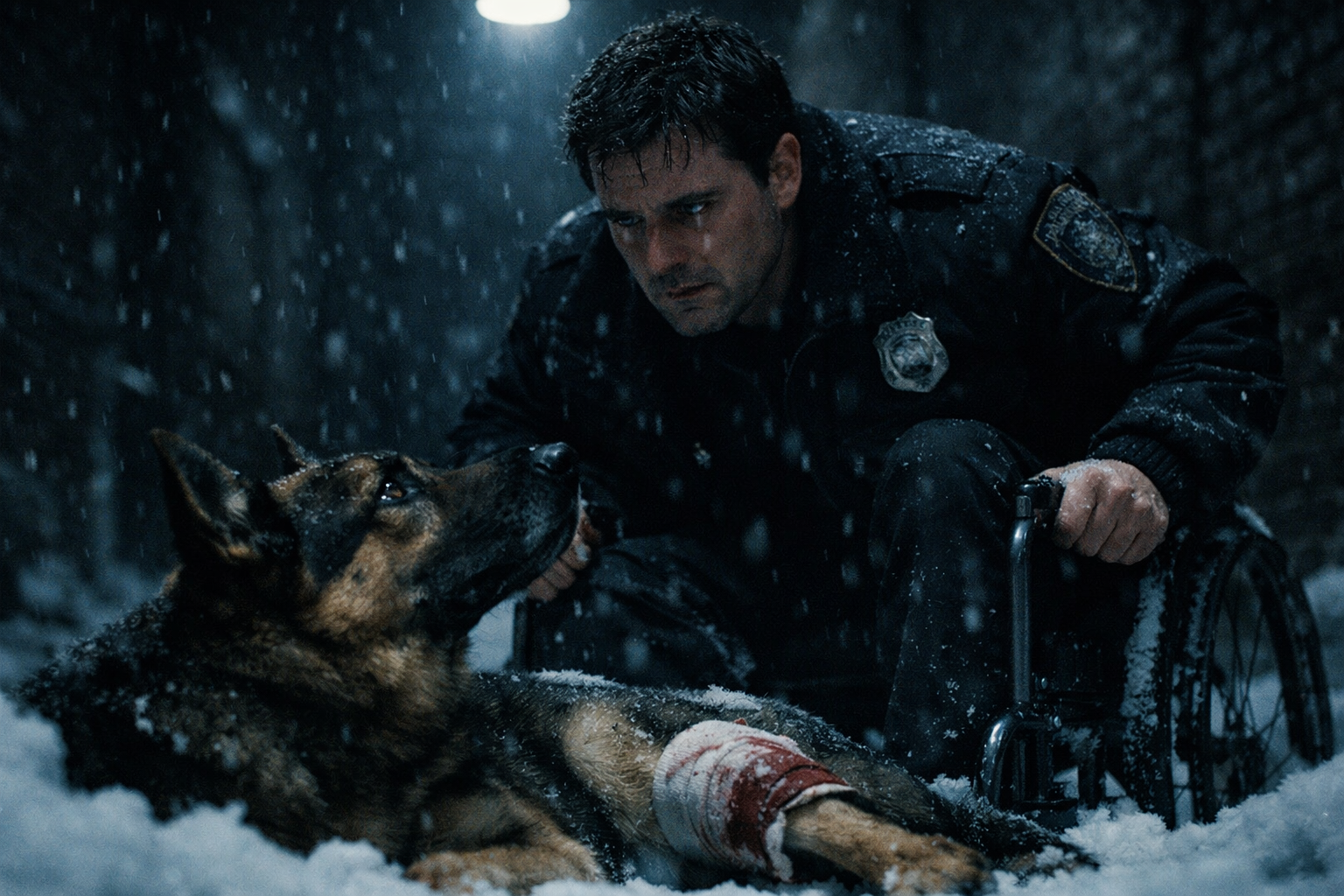
The snow had been falling for two hours when Mark Sullivan’s wheelchair left the grocery store.
He knew the route by now. Harbor and Third. Cut through the alley by the old print shop. Home in twelve minutes if the packed ice didn’t catch his rear wheels.
He did not expect to hear anything.
The sound came low, almost swallowed by wind. A whine. Not a stray’s complaint. Something older. Something that had used up everything else and was down to this one thin thread of sound.
Mark stopped his chair.
The grocery bag shifted. A can rolled against a bread loaf.
He heard it again.
He pushed forward.
Halfway down the alley, something dark moved against the white.
A dog. Large. German Shepherd. Lying on his side in the snow.
Mark’s mind refused the shape for one full second. It built a wall between recognition and hope because hope had become the most dangerous thing he owned. But the wall cracked when the dog lifted his head.
Amber eyes.
A notched left ear — training accident, three years ago, a fence cleared too fast.
A scar along the muzzle.
White fur below the chin.
The grocery bag slid from Mark’s lap. A can struck the pavement and rolled away.
“Duke.”
The name came out of him like a wound opening.
The dog’s tail moved once in the snow. Then he dragged himself another inch forward, and Mark saw what was clenched between his jaws. A canvas bag, torn and blood-stained and held.
Still held.
Mark shoved himself out of the wheelchair. No calculation. No careful technique. He went straight down onto his knees in the snow and crawled forward on gloved hands, useless legs dragging behind him, pain sparking through his hips and spine.
“I’ve got you,” he said. “I’ve got you. I’ve got you.”
Duke released the bag.
His tongue flicked weakly over Mark’s glove.
The canvas flap fell open.
Inside: a hard drive wrapped in plastic. A flash drive taped to it. A folded piece of paper stained along one edge with blood.
Duke had crawled three miles through a blizzard, bleeding, starving, broken — and he had brought the evidence home.
Mark pressed his hand against the dog’s neck. The pulse was there. Thin. Real.
He tore off his jacket and wrapped it around Duke’s body.
“You stupid, perfect dog,” he whispered. “You came back.”
He pulled out his phone and called the only number he trusted.
“Harbor Paws,” came Emily Carter’s voice.
“Emily.” His breath shook. “It’s Duke. I found Duke. He’s alive. He’s hurt bad.”
Silence.
Then her voice sharpened to a point.
“Where?”
“Alley behind the old print shop.”
“I’m coming. Don’t move him. Keep him warm. Talk to him.”
Mark almost laughed because he hadn’t stopped.
He ended the call and lowered his forehead to Duke’s.
“Stay with me. You don’t get to quit after crawling back here. You hear me? You don’t get to leave me twice.”
Duke’s breath rattled.
Snow covered Mark’s shoulders, his hair, the scattered groceries, the blood trail in the snow. Headlights turned at the alley mouth. Emily’s truck braked hard. She jumped out before the engine settled, red medical bag already in hand.
She came running through the dark.
When she saw Duke, her face did not break. It became something harder and more focused than grief.
“Oh, boy,” she said, dropping to her knees. “What did they do to you?”
Her hands moved fast over his body. “Hypothermia. Blood loss. Hind-leg fracture. Shoulder wound. He’s so thin.”
“He brought a bag. Evidence.”
Emily glanced at the canvas.
“Evidence later,” she said. “Life first.”
Together they slid Duke onto the stretcher. Mark braced on one arm in the slush, his legs trailing behind him, helping lift what was left of the partner he had mourned for six months. Duke cried out once. Mark nearly dropped him.
Emily’s voice cut through the storm.
“Steady. He needs you steady.”
So Mark became steady. Because Duke needed it. Because Duke had come back. Because whatever hell had held him had not broken the last thing inside him: the need to find his handler.
As Emily secured the stretcher, Duke opened his eyes and searched the darkness until he found Mark’s face.
“I’m right here.”
Duke’s paw twitched beneath the thermal blanket.
The snow kept falling, as if trying to cover the miracle before anyone else could witness it.
Chapter Two: Evidence and Gravity
The clinic exam table showed the truth in full light.
Matted coat. Deep bruising. A shoulder wound requiring stitches. A fractured hind leg. Raw rings around his neck and chest where restraints had cut through the skin. Fur missing in patches along his ribs.
Emily worked quickly, calling instruments without looking up. Carlos Vega, her young vet tech, moved beside her — warm saline, antibiotics, pain control, splinting material — his face pale with focus.
Mark sat at Duke’s head and talked.
“Remember the academy tunnel? You hated it. Acted like we were asking you to audit tax documents. Marcus dropped the bite sleeve laughing at you.”
Duke’s ear moved.
Carlos looked up. “He heard you.”
“He always hears me.”
The words nearly finished him.
Emily paused. Only a half-second. Then back to work.
When she had stabilized the wound and begun the splint, she looked at Mark directly.
“Will he live?” he asked before she could.
She didn’t answer fast. He respected her for that and hated her for it.
“If infection doesn’t set in and his temperature climbs, yes.” She met his eyes. “I think yes.”
Mark put his hand over Duke’s.
“Hear that?”
Duke’s breathing steadied.
An hour later, Mark opened the canvas bag on the counter.
Hard drive. Flash drive. A note, handwritten, partially blood-smeared: Pier 9. Tunnel. Voss. Blue Widow.
He photographed everything. Sent it to one number. Jacob Pierce, federal agent, Mariner’s Bluff field office — the only federal contact Mark still trusted after the department’s internal leak had cost him a partner and his legs.
Jacob called back in four minutes.
“Where did this come from?”
“Duke.”
Silence.
“Mark—”
“Duke escaped. He came to me. He brought evidence in his mouth across three miles of snow.”
A longer silence.
“I’ll be there in twenty minutes.”
“Jacob.” Mark’s voice dropped. “They’re still looking for him. The note says retrieve Sullivan dog. If they know he escaped—”
“I know.”
“Then how long do we have before they figure out where he went?”
Jacob was already moving. Mark could hear it.
“Not long enough,” Jacob said. “Keep the lights low. Lock the back.”
The clinic went quiet after that.
Mark sat beside Duke in the dim exam room, one hand resting on the dog’s chest, feeling the rise and fall. Outside, snow erased the world past the glass doors.
Duke slept.
Mark didn’t.
At 11 p.m., something moved in the alley.
Duke came awake instantly — head up, ears forward, growl low in his chest before any human in the room heard a thing.
Mark rolled to the window.
Emily killed the lights.
A figure stood at the alley door. Tried the handle. Moved the beam of a flashlight across the back window. Waited.
Stayed.
Then footsteps retreated. An engine turned over and faded.
Emily let out a slow breath.
“He heard them before any of us.”
Mark looked at his dog.
“He always did.”
Jacob arrived three minutes later, jaw set, body armor under his open coat.
“They’re testing response time,” he said. “They want to know how protected you are.”
“They know Duke’s here.”
“Yes.”
“And they know he brought evidence.”
“Probably.”
By dawn, Harbor Paws looked less like a clinic and more like a bunker that smelled of dog shampoo. Cameras covered both doors. Sensors covered the alley. An unmarked car sat at each end of the block. Carlos slept in the supply room with a blanket and one eye open.
Mark stayed beside Duke.
And waited for the rest of the truth to surface.
Chapter Three: What the Drive Contained
Jacob spread the printouts across the clinic counter like a case board.
“Strayhook wasn’t just drugs,” he said. “Weapons, cash, stolen vehicles — and dogs. Working dogs. K9s taken from raids, shelters, private handlers. They used them for security, transport intimidation, and as cover. They hid contraband inside animal crates.”
Emily’s voice went sharp. “They trafficked dogs.”
“Duke was taken because he was valuable. And because they believed you were permanently out of the game.”
Mark felt cold in a way no heater could reach.
“What did he bring back?”
“Names. Payments. Warehouse routes. Dirty dock workers. Law enforcement leaks. Coordinates to a storage site near the old cannery. Surveillance footage.” Jacob paused. “Duke was held at multiple locations. The last confirmed site is Pier Nine Storage. He escaped two nights ago during a transfer.”
Emily looked at Duke sleeping under the heat lamp.
“He didn’t just escape. He chose what to carry.”
“The last entry appears to have been captured deliberately,” Jacob confirmed. “He came back with everything we needed.”
Mark’s voice dropped.
“How far is Pier Nine from the alley?”
Jacob hesitated.
“Almost three miles.”
Carlos whispered something in Spanish that needed no translation.
Ruth Jennings arrived at 7 a.m. with cornbread and two terriers in matching sweaters, despite being told no visitors. She was sixty-seven, compact, silver-haired, a former bait-shop owner who inserted herself into crises the way some people insert themselves into photographs — naturally and without apology.
She looked past Mark at Duke.
Her hand went to her mouth.
Duke lifted his head.
Ruth stepped slowly forward. “May I?”
Duke sniffed her hand.
Then let his head fall back down.
She touched his ear with one finger and said nothing for a long moment.
“I knew you’d come home,” she finally whispered.
Mark looked away.
Emily pretended not to notice the room change.
Then Jacob found the video file on the second drive.
Duke in a concrete room, thinner than Mark had ever seen him. A man shouting commands. Duke in a harness loaded with drug packets, being ordered toward a young woman tied to a chair in the corner.
Duke refusing to move.
The man used a shock collar.
Duke collapsed.
Then rose.
And still refused.
Mark’s vision narrowed to a point.
Valerie Tran, Jacob’s cyber specialist, turned the monitor volume down. But Mark had already heard enough.
“Who’s the woman?” he asked.
Valerie typed fast. Froze.
“Emily Carter,” she said quietly.
Mark stared at her.
Valerie enlarged the frame.
The woman in the chair was younger. Hair shorter. Face bruised. But the shape of her jaw, the line of her shoulders — unmistakable.
Jacob’s voice came through the radio. “We have a hidden victim file. Emily Carter, volunteer EMT, witness to Pier Nine injuries two years ago. Briefly abducted. Released after threats. No police report.”
Mark barely heard the blood in his ears.
He grabbed the radio.
“Emily.”
Static.
“Emily.”
Her voice came from the tunnel. “I’m here.”
“You knew them.”
Silence.
“Not all of them.”
“Emily.”
“I’ll explain later.”
“Now.”
Her voice trembled for the first time.
“They killed my brother.”
The command van went completely still.
She continued. Each word fought through years of silence.
“My brother Aaron worked the docks. He found dog crates in a shipment and called me. We tried to report it. Men grabbed us near Pier Nine. I got out. He didn’t.” Her breathing came unsteady over the radio. “They told me if I spoke, they’d kill every animal I’d ever touched and every person near me.”
Mark closed his eyes.
She had been carrying the same case from another direction. Another wound in the same storm.
“Duke knew you,” he said.
“He saw me in that room. He refused to hurt me. Even when they shocked him.” A pause. “Even then.”
In the tunnel feed, Emily knelt beside a rescued Malinois, one hand shaking for only a second before she steadied it.
Duke had not only come home to Mark.
He had carried the truth for both of them.
Chapter Four: The Ice Plant
Duke began standing on the third day.
Barely. Badly. With fury.
Emily fitted him with a support brace and chest harness. She called it temporary. Duke called it offensive. He glared at her during the fitting and refused three treats in protest.
“You’re very dramatic,” she told him.
Duke sneezed.
Mark sat nearby, smiling for the first time in six months.
“Don’t encourage him,” Emily said without turning.
“I’m admiring his moral stance.”
“He has a fractured femur and a law-enforcement ego.”
“He earned both.”
They practiced twice a day. Three steps. Four. Rest. Water. Sleep. Repeat. Duke regained pieces of himself through stubbornness and food and Mark’s voice. Mark — watching him — returned to his own therapy with a ferocity that made his physical therapist ask who had replaced him.
“Duke started walking,” Mark said.
His therapist, Nina Walsh, ex-Army medic, snorted. “So now you remembered you have legs?”
“Something like that.”
Meanwhile, Jacob’s investigation hit a wall.
Strayhook’s leadership went dark. Phones died. Warehouses emptied before agents arrived. The information was moving faster than the warrants.
“Leak?” Mark asked.
“Maybe.” Jacob sat in the clinic office, exhaustion cutting deep lines around his mouth. “Or they’re spooked because Duke escaped.”
Jacob spread a map of Mariner’s Bluff across the table. His finger traced the northern cannery road. “Pier Nine was cleared before we arrived. Burned files. Wiped cameras. But tire tracks lead north.”
Duke had heard their voices. He walked from the treatment room on his brace, sniffed the map samples Jacob laid out — rope fiber, tarp scraps, soil from Pier Nine — and stopped cold.
He pawed the map.
Once. Twice.
His claw landed on a single building.
Braddock Ice Plant.
Closed nine years. Connected to the cannery by underground cold-storage tunnels.
Jacob stared.
“I didn’t even have that on the active list.”
Mark had. Old patrol memory. He and Duke had cleared the ice plant years ago after a squatter call. Duke had hated the tunnel beneath it. Refused to enter until Mark went first.
“He remembers it,” Mark said.
Emily sighed. “Of course he does.”
Jacob’s team entered before dawn.
They found the floor hatch on the main level. Below it: brick walls glazed with ice, old refrigeration pipes, shallow water reflecting flashlight beams. The tunnel stretched east toward the cannery.
Halfway through, they found the first crate.
Empty.
Then another.
Bloody blankets. Nylon restraints. Feeding bowls. Shock collars. A torn piece of K9 vest.
Then they found the room.
Seven dogs alive. Three dead. Shepherds, Malinois, a black Lab, two mixed breeds — starved, reactive, shut down, or snarling from fear.
Jacob’s voice went flat over comms.
“Veterinary team in. Now.”
Emily had been staged two blocks away. She arrived in under three minutes with Carlos and two animal-control officers.
She moved without drama. Hands first. Always hands first.
In the sealed back office, agents found the war room.
Documents. Cash. Weapons. Hard drives. A harbor-route map. Photos of Duke in captivity. And a whiteboard with one phrase circled three times:
RETRIEVE SULLIVAN DOG / DRIVE UNKNOWN.
They were still searching for him.
The Strayhook ring’s top name was Calder Voss. Forty-seven. Former private security contractor. Smuggler. Dog trafficker. A man with no permanent address and too many friends in port authority, trucking, and low-level law enforcement. He had ordered the raid that paralyzed Mark, approved Duke’s abduction, arranged Aaron Carter’s murder, and moved at least twelve working dogs through Mariner’s Bluff in three years.
The ice plant gave them everything except Voss himself.
He had already run.
Chapter Five: The Gray Widow
Valerie traced encrypted radio chatter by midnight.
“He’s leaving by boat during the next storm tide,” she said. “Vessel named the Gray Widow. Filed false maintenance logs at Pier Twelve.”
Mark looked at the harbor map.
“Pier Twelve has an old service tunnel to the dry docks. If Voss knows you’re watching the main gate, he uses the tunnel.”
Jacob looked at him. “Can you map it?”
“I can take you.”
Emily said, “No.”
Mark turned.
She shook her head. “No fieldwork for you. No fieldwork for Duke. That was the deal.”
“Voss is leaving tonight.”
“Then give them the map and describe every turn.”
“I can’t describe every turn. I need to walk them through it.”
Duke rose from his mat.
Slowly.
Deliberately.
His brace creaked against the floor.
Everyone stopped.
The dog walked to the door, turned, and looked at Mark with an expression Mark had seen before every hard entry, every risky track, every moment when the job stripped away pretending and asked what you were actually made of.
Emily whispered, “Don’t you dare.”
Duke barked once.
Not loud. Final.
Emily knelt in front of him and gripped the sides of his harness.
“You listen to me,” she said, voice breaking at the edges. “You do not get to die proving you are brave. Everyone in this room already knows.”
Duke licked her chin.
Emily closed her eyes.
“Unfair,” she said.
They went in together.
Mark in a tactical wheelchair adapted by the rescue unit. Duke in a support harness clipped to Mark’s left side. Jacob’s team ahead and behind. Emily in the medical van two blocks back, ready, furious, prepared.
The service tunnel beneath Pier Twelve smelled of saltwater, rust, diesel, and time. Pipes lined the ceiling. Water dripped onto grated flooring. Mark’s wheels vibrated with every seam. Duke limped beside him, nose low, pain ignored because the scent had taken over.
Halfway through, Duke stopped.
He sniffed the wall. Pawed at a loose metal panel.
Behind it: wires. A trigger line.
Jacob’s bomb tech hissed.
“Pressure alarm. Maybe explosive. Good dog.”
Duke huffed.
They bypassed.
At the tunnel exit, they heard voices.
Voss stood under a floodlight beside a black cargo van. Broad. Shaved head. Gray beard. One clouded eye from an old injury. Four men loaded crates toward the Gray Widow. Two had rifles. One dragged a muzzled Shepherd on a chain.
Duke went rigid.
The chained dog heard him and lifted its head.
The plan was silent containment.
It ended when one of Voss’s men saw movement near the tunnel and fired.
The dock shattered into chaos. Agents shouted. Shots cracked. Snow blew sideways off the harbor. Mark’s chair jolted as he backed behind a concrete piling, Duke pressed against his side.
Duke lunged — not toward a man. Toward the chained Shepherd.
The handler kicked the captive dog and raised his rifle at Duke.
Mark saw it. He shoved his chair forward and pulled Duke behind the piling as Jacob dropped the gunman with a shoulder shot.
Voss ran for the gangway.
Duke broke from Mark’s side.
“Duke!”
The Shepherd limped hard across the dock — ignoring a command for the first time in his life. No. Not ignoring. Judging.
Voss turned, pistol rising.
Duke launched.
The last clean force in his body hit Voss below the chest, knocking him backward off the gangway and onto the icy deck. The pistol spun into the water. Duke pinned the forearm and held.
Not mauling.
Holding.
The way he had been trained. The way he still remembered.
Jacob’s agents swarmed the boat.
“Hands! Show your hands!”
Voss cursed. Bleeding. Pinned.
Duke’s jaws stayed locked until Mark reached him.
“Out,” Mark said.
Duke released immediately.
Then collapsed against Mark’s lap.
Emily’s van screeched in moments later. She jumped before it fully stopped.
“I told you not to die,” she snapped at Duke, already running her hands over him.
Duke wagged once.
“Do not wag at me.”
Mark laughed. It came out broken and wet and alive.
Voss was taken in chains. The Gray Widow was seized. The crates held drugs, cash, weapons, falsified transport documents, and three stolen K9s — alive, sedated, breathing.
The Strayhook ring ended on a snow-covered dock with Duke’s teeth on the man who had tried to turn him into a weapon.
Chapter Six: The Trial of Calder Voss
The courtroom packed every day of the three-week trial.
Voss sat at the defense table in expensive gray suits, his arm healed enough to fold across his chest. His one pale eye moved often to Duke, who lay beside Mark’s wheelchair by special court order — both evidence K9 and certified support animal.
Duke looked back every time.
Calm. Unblinking.
Voss always looked away first.
The government laid out its case piece by piece.
Hard drives. Financial ledgers. Pier Nine storage records. Braddock Ice Plant. The Gray Widow. Stolen dogs. Duke’s captivity videos. Emily’s testimony. Mark’s shooting. Aaron Carter’s death. Dirty dock workers. Microchip erasures. Transport crates built to conceal both contraband and living animals.
Emily took the stand on Day Twelve.
She did not tremble.
She described being taken, her brother’s discovery, the concrete room, Duke refusing to attack her even when shocked, and the years of silence that followed.
The defense attorney asked why she had not reported it sooner.
Emily looked at him for a long moment.
“Because fear works exactly the way it was designed to.”
The room went still.
“Until Duke came back,” she added.
Mark looked down at his dog.
Duke’s eyes were closed. His ear was angled toward her voice.
Mark testified last.
He described the raid, the shooting, Duke being taken, the six months of silence, the alley, the canvas bag, the dock.
Voss watched him with thin contempt.
The defense attorney stood.
“Officer Sullivan, isn’t it true your emotional attachment to this animal may have affected your interpretation of events?”
Mark looked at Duke.
Then at the jury.
“Yes,” he said.
The attorney blinked.
“My attachment made me know what he was capable of. It made me understand that when he came back with evidence, he came back with a reason. It made me listen to what his body, his training, and his behavior were telling us.” Mark paused. “If that affected my interpretation — good.”
The jury deliberated six hours.
Guilty.
Conspiracy. Narcotics trafficking. Weapons trafficking. Attempted murder of a police officer. Animal cruelty and trafficking. Kidnapping and illegal use of working dogs. Murder — Aaron Carter.
Life. No parole.
When deputies led Voss away, Duke stood.
Slowly. Painfully. Fully.
The courtroom rose.
Not because anyone told them to.
Because sometimes justice enters a room on four damaged legs, and people finally understand what they are seeing.
Chapter Seven: What They Built
Rehabilitation did not feel heroic.
It felt like sweating under fluorescent lights while Nina Walsh told Mark to stop insulting his own legs.
“Again,” she said.
“I hate that word.”
“Good. Hate it standing.”
Duke worked on a padded track beside him. Man and dog moved in crooked parallel. Mark’s braces clicked. Duke’s brace creaked. Mark cursed. Duke huffed. Emily said they were both dramatic. Nina said they were both underperforming. Carlos filmed from the doorway until Mark threatened to throw a resistance band at him.
But there were days they made it three steps farther. Five. Ten.
The first time Mark stood long enough to rest one hand on Duke’s back — both of them upright together — Emily cried in the supply closet and told everyone it was allergies.
Ruth arrived with pastries and announced, without irony, “Two soldiers back on patrol.”
Jacob brought an FBI certificate recognizing Duke’s extraordinary service. Duke sniffed it and tried to eat the corner.
“Appropriate,” Valerie said. “Federal paperwork does that to everyone.”
The seized Braddock Ice Plant became the temporary headquarters for a new working-dog recovery program. Emily designed the medical wing. Jacob funneled federal grants. Valerie built a national registry for missing and retired K9s. Ruth organized volunteers with terrifying efficiency.
Mark tried to stay out of leadership.
He failed.
Duke became the center’s heart before anyone named it. Rescued dogs came through terrified, reactive, shut down. Duke would lie outside their kennels, patient as tidewater, until they stopped barking long enough to breathe. He didn’t heal them. He showed them that survival could lie still and wait.
The center became Duke’s Watch.
The name was Ruth’s idea. Everyone agreed before Mark could object.
Its mission: recover stolen working dogs. Treat abused animals. Train departments in ethical K9 handling. Support injured handlers who felt their lives had shrunk beyond recognition.
Emily and Mark grew closer in the pauses between medical checks and therapy sessions. Coffee left on counters. Arguments about risk. Silences that felt less empty when shared.
One evening at the harbor park, Duke asleep at Mark’s feet, Emily looked at the water.
“I thought telling the truth about Aaron would make me feel lighter.”
“Did it?”
“No.” She smiled, small and true. “But it made the weight honest.”
Mark looked at the dog.
“I thought finding Duke would give me back who I was.”
“And?”
“It gave me someone new to become.”
Emily took his hand.
Not dramatically. Simply.
Mark held on.
Duke opened one eye, observed them, and went back to sleep.
Approval, Mark decided. Or fatigue. Both worked.
Emily married him on a foggy September morning behind Harbor Paws, with Duke wearing a blue ribbon he despised and Carlos serving as best man because Jacob claimed federal agents made poor wedding attendants — then cried anyway.
Duke stood between them during the vows.
When Emily said, I choose the life we can build, not the one fear tried to take, Mark nearly sat down without meaning to.
Duke leaned against his leg.
Still catching him. Always.
Chapter Eight: The Watch Continues
Duke lived six more years after the alley.
Good years. Not easy. Good.
His leg never healed perfectly. His muzzle silvered. The scars stayed under his coat. Sometimes he woke from dreams growling until Mark called his name. Sometimes he stared toward Pier Twelve from the harbor path and would not move.
But he lived.
He stole Ruth’s cornbread twice. He ate chicken from Emily’s hand. He slept beside Mark’s bed, then beside Mark and Emily’s, then in the cottage near the dunes because Duke liked the morning light there.
Duke’s final winter came quietly.
Shorter walks. Longer naps. Food left in the bowl. A reluctance to rise when cold pressed against his joints.
Emily knew first.
Mark knew because Emily stopped pretending.
One cold morning, Duke refused chicken. The room went still.
Mark sat beside him on the kitchen floor. Emily sat on the other side. Duke rested his head across Mark’s thigh, exactly where he had rested it a thousand times.
“I’m not ready,” Mark whispered.
Emily’s hand covered his.
“No one ever is.”
They gave him one more good day.
Ruth came with cornbread. Carlos brought a stuffed seagull toy Duke had hated for years. Jacob came with no stated reason and sat on the porch for an hour with his hand on Duke’s head. Valerie sent a note: Federal systems remain inferior to you.
At sunset, Mark and Emily took Duke to the harbor park.
Mark walked with braces and a cane. Duke walked slowly beside him. Both stubborn. Both tired. Both refusing help until absolutely necessary.
At the water’s edge, Duke lifted his muzzle into the salt wind.
For a moment, he looked young. The dog from patrol. The partner before the van, before blood, before the alley.
Mark sat on the bench.
Duke pressed against his leg.
“You found me,” Mark said. “You crawled back through everything and found me.”
Duke’s tail moved once.
Emily knelt and kissed the dog’s scarred head.
“You brought both of us home,” she said.
That night, Duke slept between them on a blanket beside the bed.
Near dawn, his breathing changed.
Mark woke instantly. So did Emily.
They lay on the floor with him, one on each side, hands in his fur.
Mark pressed his forehead to Duke’s.
“Stand down, partner,” he whispered. “Mission complete.”
Duke exhaled.
His body softened.
Outside, gulls cried over the harbor.
Inside, the watch ended.
They buried him on the rise above the recovery center. His marker was simple.
DUKE
K9 Partner. Survivor. Guardian.
He came back with the truth.
Below it, Emily added a brass plate.
No storm could keep him from home.
Every winter, on the anniversary of the alley, Duke’s Watch opened its doors. People brought blankets, donations, photographs of working K9s, and letters to animals they never got to say goodbye to. Injured officers sat with recovering dogs. Children read aloud in the quiet room. Ruth supervised soup distribution like a naval commander.
Years passed.
Mark became director. Emily ran the medical wing. Carlos returned after vet school and led rehabilitation. Jacob served on the board. Valerie built the national registry that made it harder for dogs to disappear into paperwork and silence.
Mark still had bad days. His legs still betrayed him. His dreams still returned to the dock sometimes.
But grief no longer lived alone in him.
It had work.
It had hands.
It had memory.
On the tenth anniversary of Duke’s death, snow fell over Mariner’s Bluff again.
Mark stood at the grave with Emily beside him. His hair had grayed. His cane sank into the white ground. The harbor lights blurred through the storm exactly as they had the night Duke came crawling back.
A young German Shepherd named Harbor sat beside them — one of Duke’s Watch’s newest rescues, nervous, scarred, still learning that hands could be kind.
The dog sniffed Duke’s marker.
Then sat.
Mark smiled faintly.
“Good place to learn.”
Emily slipped her hand into his.
“You okay?”
No. Yes. Both.
“I’m here,” Mark said.
Below the hill, warm light glowed from Duke’s Watch. Dogs barked. A child laughed. Somewhere a kettle whistled. The town that had once watched Mark shrink into grief now carried pieces of Duke’s legacy through every rescued animal and every wounded person who walked through those doors.
Mark touched the stone.
“Good partner,” he whispered.
The wind moved across the harbor, lifting snow from the ground in silver swirls.
For a moment, Mark could almost see him: a dark shape emerging from the storm, canvas bag in his jaws, eyes fixed on home.
Not gone.
Never gone.
Some loyalty does not end when the body rests.
It becomes a road others can follow through the snow.
Original fictional stories. AI-assisted creative content.
I used to be recommended this blog by my cousin. I am not sure whether or not this post is written by means of him as no one else understand such special approximately my problem. You are incredible! Thanks!