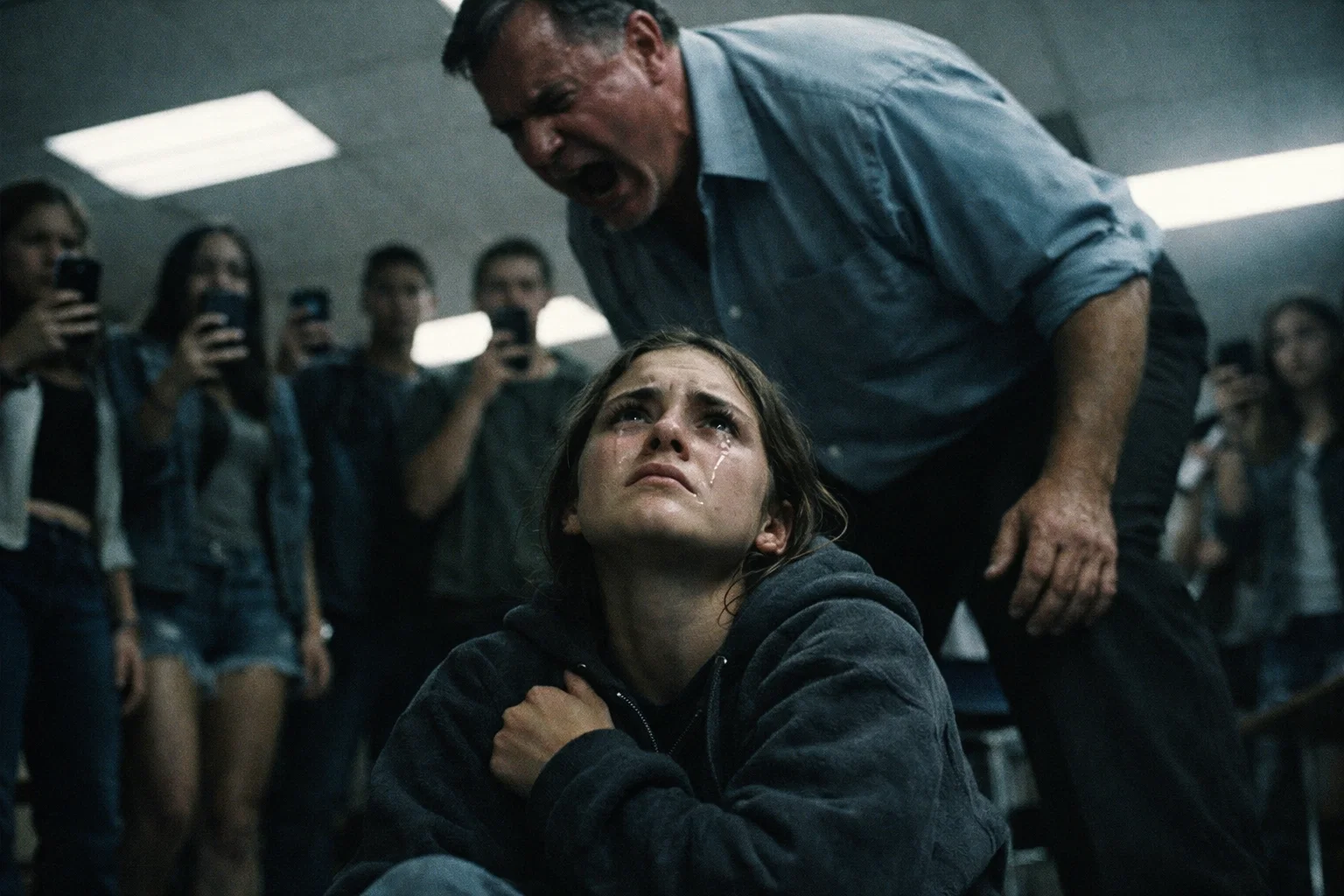
Thomas Reeves had owned the same jewelry store on Millfield’s main street for over twenty years.
To everyone in town he was the quiet one. Polite. Steady. The man who remembered your anniversary date and asked about your kids by name.
Nobody guessed that behind the calm face was a man who had been broken for eighteen years.
His daughter Anna vanished at eleven. A crowded state fair, two towns over. One second she was beside him. The next she was gone.
He’d let go of her hand for maybe thirty seconds. He bought two lemonades. When he turned around, the space where she’d been standing was just air and strangers.
“Anna?” He said it once, calm, sure she was close. Then again, louder. Then he was running, shoving through the crowd, screaming a name that the noise swallowed whole.
He searched until searching stopped being a thing he did and became a thing he was. Every crowd. Every girl the right age. Every dead-end lead.
His wife lasted six years before the grief took her in a different way — a slow quiet fading, then a heart that simply stopped one morning. The doctors called it natural. Thomas knew better. She had died of a missing daughter.
Eighteen years. Nothing.
What Thomas never learned was that a couple named Gerald and Patricia Holt had taken Anna on purpose. They wanted a child. They decided wanting was enough.
They’d been circling that fair all afternoon, watching. A girl who wandered a step too far. A father distracted by a lemonade stand. They didn’t grab her. They didn’t have to. Gerald just crouched down and said the words they’d practiced.
“Sweetheart, your dad sent me. He’s hurt — he’s over by the cars. Come on, quick, he’s asking for you.”
Anna was eleven and trusting and terrified for her father. She went.
By the time she understood something was wrong, they were an hour down the highway and her cries had turned to a silence that would last years.
They drove her three states away and told her she was theirs. They said the blank spot in her memory was from an accident — a fall, a bad concussion. That there was nothing before them worth remembering.
“You hit your head, honey,” Patricia would say, smoothing her hair in a way that never felt like comfort. “You’re lucky we found you. Some children don’t get found.”
She was eleven. She had nothing else to hold. So she believed them.
The Holts were never warm. Convincing for a few years, maybe. They fed her, clothed her, sent her to school under a name that wasn’t hers. Claire, they called her. Claire Holt.
But there was always a coldness under it, a sense that she was a thing that had been acquired rather than a person who was loved.
Then Patricia got pregnant, and their real son arrived, and Anna became invisible almost overnight.
Not cruel at first. Just the slow fade of a person no longer needed. The good spot at the table went to the baby. Then the new clothes. Then the attention, all of it, every scrap.
“Claire, take the baby.” “Claire, the dishes.” “Claire, we don’t have money for that this year — you understand.”
By nine years old their son had a bedroom twice the size of hers. By the time he was six she was doing the cooking.
By seventeen she ran her own life inside their house, a boarder more than a daughter. She learned not to ask for things. She learned that needing was dangerous, that it made you a burden, and burdens got set down.
By eighteen they handed her some cash and an address and wished her well in a tone that told her they didn’t mean it.
“You’re an adult now,” Gerald said, not looking up from the paper. “Time to stand on your own feet.”
“That’s it?” she asked.
“What did you expect?”
She didn’t have an answer. She’d stopped expecting things a long time ago.
She left with one thing. A gold locket she’d worn since before memory. On the back, an engraving she never understood.
For my Anna. You are my whole heart. Always. Dad.
Her name was Claire. She had no dad worth the word. She figured the locket belonged to someone before her — some other girl, some other family. She kept it anyway. It was the only thing that felt permanently hers.
Sometimes, alone at night, she’d trace the words with her thumb. For my Anna. She’d wonder who Anna was, and whether the man who wrote it had loved her the way the words sounded. She’d wonder what it felt like to be someone’s whole heart.
She built a small, honest life. Waitressing overnight shifts. Community college a class at a time. A one-room apartment with a hotplate and a mattress on the floor.
Then Daniel, at a study group — gentle, patient, the kind of man who looked at her like she was worth the looking.
“You always sit in the back,” he said the first night, sliding into the chair beside her.
“I like the back.”
“Nobody likes the back. They just think they don’t deserve the front.” He smiled. “I’m Daniel.”
It took her months to believe he meant it. That someone could just stay. That kindness didn’t have a bill attached at the end.
“Why me?” she asked him once, later, when they were serious.
“Because you flinch when people are nice to you,” he said. “And I want to be nice to you until you stop.”
They married in a courthouse with two witnesses and a bouquet from a grocery store. Had a son. Named him Eli.
For the first time in her life, Claire had something that was hers and couldn’t be taken. A family that chose her. A little boy who reached for her in the night and called her the only name that had ever felt true — Mom.
Then Daniel got sick.
It started as a cough he couldn’t shake. Then the tiredness. Then the word nobody wants to hear in a doctor’s small quiet office.
“How long?” Claire asked. Her voice didn’t shake. She’d learned young how to keep it still.
The doctor was kind about it. “We’ll do everything we can.”
That wasn’t an answer. She knew it wasn’t. Eighteen months, it turned out. Eighteen months of hospital chairs and second opinions and a three-year-old who didn’t understand why Daddy was always sleeping.
Near the end, Daniel gripped her hand. “You have to promise me something.”
“Don’t,” she said. “Don’t do the promise thing.”
“Promise me you’ll let someone love you again. You’re so sure everyone leaves. But I didn’t leave, Claire. I got taken. There’s a difference.”
She was twenty-four when he was gone. Twenty-four with a three-year-old and a grief that sat in her chest like a load-bearing wall.
She packed the car and drove until the road ran out of reasons. She didn’t pick a direction. She just needed the one she was in to end.
A job listing on a diner window. A cheap apartment above a laundromat. A quiet town she could breathe in.
She had no idea it was the same town she’d been stolen from.
She didn’t know that four blocks from her new apartment, a silver-haired man opened a jewelry store every morning and scanned the face of every woman who walked past the window, the way he’d done for eighteen years, looking for a ghost.
The chest infection had been getting worse for two weeks. A cough that rattled, a fever that came at night. She kept working through it because rent didn’t care that she was sick.
When she finally saw a doctor, the prescription cost more than she had that week. She stood at the pharmacy counter and did the math three times and it never came out different.
She looked around the apartment that night for anything to sell fast. There wasn’t much. A television. A watch of Daniel’s she couldn’t part with. And the locket.
The locket had always been off the table. She’d never once considered it. It was the only thing older than her memory, the one constant thread through every version of her life.
But Eli needed his mother well. And a mother who couldn’t breathe couldn’t work, and a mother who couldn’t work couldn’t feed him.
“It’s just a thing,” she told herself, holding it in her palm. “He’s not just a thing.”
She sent Eli to the little jewelry store on the main street — the one she’d passed a dozen times, the one that always tugged at something she couldn’t name. She was too weak to walk the four blocks herself, coughing into her sleeve, and Eli was a serious, careful boy.
“You go straight there and straight back,” she told him, tucking the locket into his jacket pocket and zipping it shut. “You give it to the man behind the counter. You tell him your mom is sick and needs medicine. You take whatever he gives you and you come right home. Nowhere else.”
“What if he says no?”
“Then you bring it home and we figure something else out. But you be polite either way. What do we say?”
“Please and thank you,” Eli recited.
“That’s my boy.”
Eli was eight and very serious about jobs from his mom. He walked the four blocks, checking both ways at every corner the way she’d taught him, and pushed open the door.
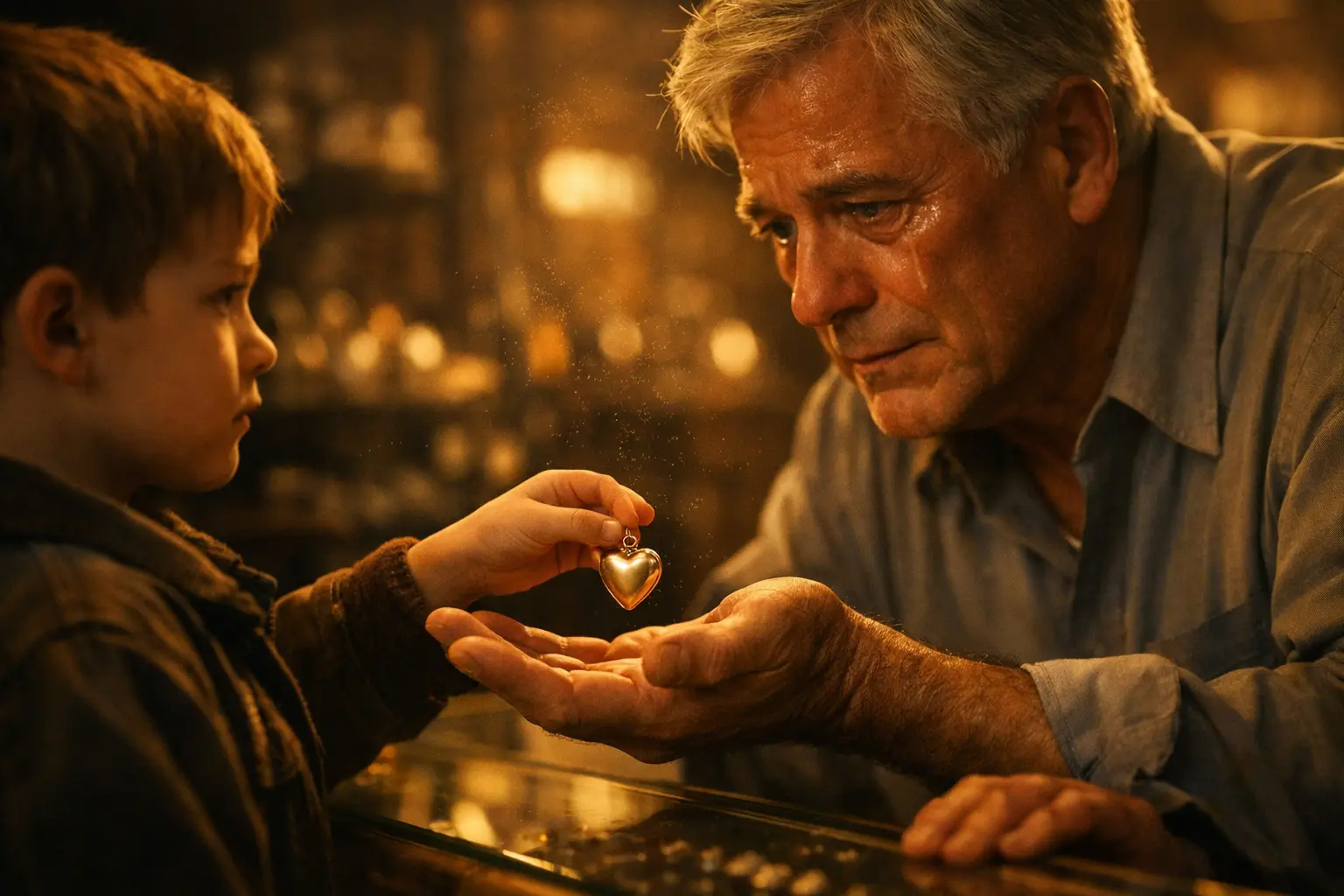
A little bell rang overhead. The store was warm and gold with late-afternoon light. Behind the glass counter stood an old man with silver hair.
Eli unzipped his pocket, took out the locket, and set it on the counter. He had to stand on his toes to reach.
“My mom is sick. She needs medicine. She said to sell this.”
Thomas smiled the way he smiled at every customer, reached over, and picked it up out of habit.
He turned it over.
And stopped breathing.
For my Anna. You are my whole heart. Always. Dad.
He had written those words himself. He had stood in this exact spot while the engraver worked, thinking about his daughter’s face when she’d open it on her birthday — three weeks before she disappeared.
He knew the scratch on the clasp. He knew the way the A in Anna was slightly deeper than the other letters because the engraver’s hand had slipped and Thomas had said leave it, it’s perfect.
His hands shook so hard he nearly dropped it. He pried it open. A tiny, faded photo. Him. His wife, still alive in the picture, still smiling. Anna at nine. Gap-toothed and grinning up at a camera held by a father who thought he had all the time in the world.
He looked up at the boy. The boy had a serious face. A careful, watchful face. A face that, around the eyes, around the set of the mouth —
“Where did your mother get this?” His voice came out wrong. Thin.
“She’s always had it,” Eli said, like it was obvious.
“Always? Since — since when? How long?”
“Since forever. She wears it every day. She only wants to sell it ’cause she’s sick.” A flicker of worry crossed the boy’s face. “Is it not worth anything?”
Thomas gripped the edge of the counter to stay standing. The room tilted.
“What’s your mother’s name?”
“Claire.”
Claire. Not Anna. His heart lurched and dropped — and then he looked at the locket again, at the photo, at the boy’s face, and something older than logic told him it didn’t matter what name they’d put on her.
“I gave this to my daughter,” he said, and the tears came now, freely, running down into the lines of his face. “Eighteen years ago. She’s been missing for eighteen years.”
Eli’s eyes went wide. “Missing?”
“Where do you live, son? Can you take me to your mother? Please.”
The police were called within the hour. Thomas didn’t let go of that locket the entire time. He held it in his fist like it might vanish the way she had.
The detective who came was a woman named Reyes, sharp and calm, who had heard a thousand impossible stories and knew the difference between the ones people wanted to be true and the ones that were.
She looked at the engraving. She looked at the eighteen-year-old case file Thomas had practically memorized. She looked at the address of a woman named Claire who had moved to town eight months ago with a young son.
“Mr. Reeves,” she said quietly, “I’m not going to promise you anything. But I’ve been doing this a long time, and I don’t get this feeling often. We’re going to run a DNA test. Can you sit tight?”
“I’ve been sitting tight for eighteen years,” Thomas said.
The DNA only confirmed what he already knew the moment he read the engraving. The woman four blocks away — the one with the chest infection and the serious little boy — was his Anna.
When they told Claire, she didn’t believe it. She sat in a plastic chair in a small room at the station with her arms wrapped around herself and shook her head.
“There’s a mistake,” she said. “My name is Claire Holt. I don’t — I don’t have a father. I never had a father.”
“The people who raised you,” Detective Reyes said carefully. “Gerald and Patricia Holt. How did they come to have you?”
“I was in an accident. When I was little. I hit my head, I don’t remember anything before. They found me. They took me in.” She said it flat, rehearsed, the way you say a thing you’ve repeated so many times it’s worn smooth. “They told me —”
She stopped.
“They told me,” she said again, slower now, and for the first time in eighteen years she heard how it sounded out loud. A child with no past, no records, no family, no photographs. Found. Taken in. By people who never once treated her like she was found and treasured.
“I’d like to sit with him,” she said finally, very quietly. “The man. Just to see.”
They brought Thomas in.
He came through the door and stopped, both hands pressed to his mouth, drinking in the sight of her like a man who had crossed a desert seeing water.
“Anna,” he breathed.
“That’s not my name,” she said. But it came out gentle, uncertain, an apology more than a correction.
“No. No, of course. I’m sorry.” He sat down slowly across the table from her, careful, like she was something that might spook and run. “You don’t have to be anyone you don’t want to be. I just — may I sit with you? Just for a minute?”
She nodded.
He didn’t reach for her. He didn’t push. He just talked. Small things, in a low steady voice.
“You had a yellow bedroom. You picked the color yourself — the man at the paint store said it was too bright and you told him bright was the point.” A wet laugh. “You had a cat. Biscuit. Orange, mean as anything, only ever nice to you.”
Something moved behind Claire’s eyes.
“You hated the seams in your socks. Your mother had to buy the special ones. And you had a gap right here —” he touched his own front teeth — “and you refused to smile in pictures for a whole year because a boy at school made fun of it. And then one day you just decided you didn’t care and you grinned in every photo after that.”
Claire’s hand had risen to her mouth without her deciding it.
“The fair,” she said. Barely a whisper. “There was a fair.”
“Yes.” His voice broke. “There was a fair.”
“Lemonade. It was so hot. You bought lemonade and —” She stopped. Her breath caught. “And you let go of my hand.”
“For thirty seconds,” Thomas said, and now he was weeping openly, no attempt to hide it. “For thirty seconds. I’ve hated myself for eighteen years for thirty seconds.”
Claire looked down at the locket sitting on the table between them. Read the words she’d read ten thousand times and never once believed were meant for her.
For my Anna. You are my whole heart. Always. Dad.
“I used to trace these words at night,” she said. “I thought I made you up. The warm feeling. I thought I invented a father because I needed one so badly. I thought there was something wrong with me for missing something I never had.”
“You didn’t invent it,” Thomas said. “It was real. I was real. I never stopped looking. Not for one day. Not one.”
“They told me there was nothing before them.”
“There was everything before them. There was a whole life. There was a mother who loved you and a cat who bit everyone but you and a father who —” He couldn’t finish.
She looked up at the man across the table. At the silver hair and the wet eyes and the trembling hands that had carried her locket for the last two hours like it was made of glass.
And she said a word she hadn’t said and meant in eighteen years.
“Dad.”
He came apart completely. And then he laughed through it, a broken, joyful sound, because she was here, she was real, she was found. And when she came around the table he held her the way he’d held nothing but her memory for eighteen years, and neither of them let go for a long, long time.
In the doorway, Eli watched, and then walked over and tugged the old man’s sleeve.
“Are you my grandpa?”
Thomas knelt down, tears streaming, and looked at the serious careful boy who had walked four blocks to sell a locket for medicine.
“If your mom says it’s okay,” he said, “I would like that more than anything in the whole world.”
Eli considered this gravely. Then he nodded. “Okay. But you have to make her better first. That was the job.”
Thomas laughed and pulled the boy in. “Deal. First thing. I promise.”
The Holts were located within the week.
Gerald tried the story they’d built for two decades. Confusion. Misunderstanding. A closed private adoption they’d been assured was perfectly legal, papers long since lost in a move.
Detective Reyes let him talk. She let him build the whole thing, brick by brick, and then she slid a single photograph across the table.
The state fair. A grainy security still, time-stamped and archived for eighteen years, that no one had ever been able to make anything of. A man leading a small girl by the hand toward the parking lot. The girl’s face turned back over her shoulder, searching the crowd.
“We’ve had this the whole time,” Reyes said. “Eighteen years. We just never had a name to put on the man.” She tapped the image. “That’s you, Gerald. We have your height, your build, and now we have your DNA next to a girl you spent two decades calling your daughter. Would you like to keep talking about the adoption papers?”
Gerald’s mouth opened. Nothing came out.
Patricia broke first, in the next room. “We gave her a good life,” she said, chin up, defiant. “We fed her. We raised her. She never wanted for anything.”
“You gave her away twice,” Reyes answered. “Once when you took her from a father at a fair. And again the day she turned eighteen, when you handed her some cash and told her to get out, because by then you had a real child and she was just the one you’d stolen.”
“That’s not —”
“She did your cooking. She raised your son. She slept in a room half the size of his. And the day she stopped being useful, you set her down like a bag you were tired of carrying.” Reyes closed the file. “You didn’t rescue a girl who was lost, Mrs. Holt. You made a girl lost, and then you spent eighteen years telling her it was her own broken memory’s fault.”
The charges were serious and the file was thick. Kidnapping. False imprisonment. Falsified records. Eighteen years of it, documented, undeniable.
They did not find the mercy they had never once extended to the girl they took and then discarded. A jury took less than a day. The judge, reading the sentence, looked at them over her glasses and said the only thing that needed saying: “A child is not something you are entitled to simply because you want one badly enough.”
Anna stayed in Millfield.
She kept the name Claire, in the end — it was the name Daniel had loved, the name Eli called across a room. But she took her real name back too, and wore both, the way you can hold two true things at once.
Her father was four blocks away with eighteen years of presence to make up for, and he set about it like a man who’d been waiting his whole life for the chance. He paid for the medicine before she could argue. Then he paid for the good doctor. Then, quietly, he moved her and Eli out of the apartment above the laundromat and into a house with a yard, and when she protested he just said, “I’ve had eighteen years of savings and no one to spend it on. Let me. Please.”
Eli got a grandfather who spoiled him without apology, who taught him how to open the back of a watch and name every tiny gear, who came to every school event in the front row.
And Anna got the thing she’d worn around her neck her whole life without ever knowing what it was.
Her real name. And a father who never once stopped looking.
He looked for eighteen years. Through every crowd, every face, every dead-end lead, through the loss of his wife and the slow erosion of hope into something that was mostly just habit.
And one ordinary afternoon, his answer walked through the door of his shop — in the hands of a serious little boy who just wanted medicine for his mom.
Original fictional stories. AI-assisted creative content.