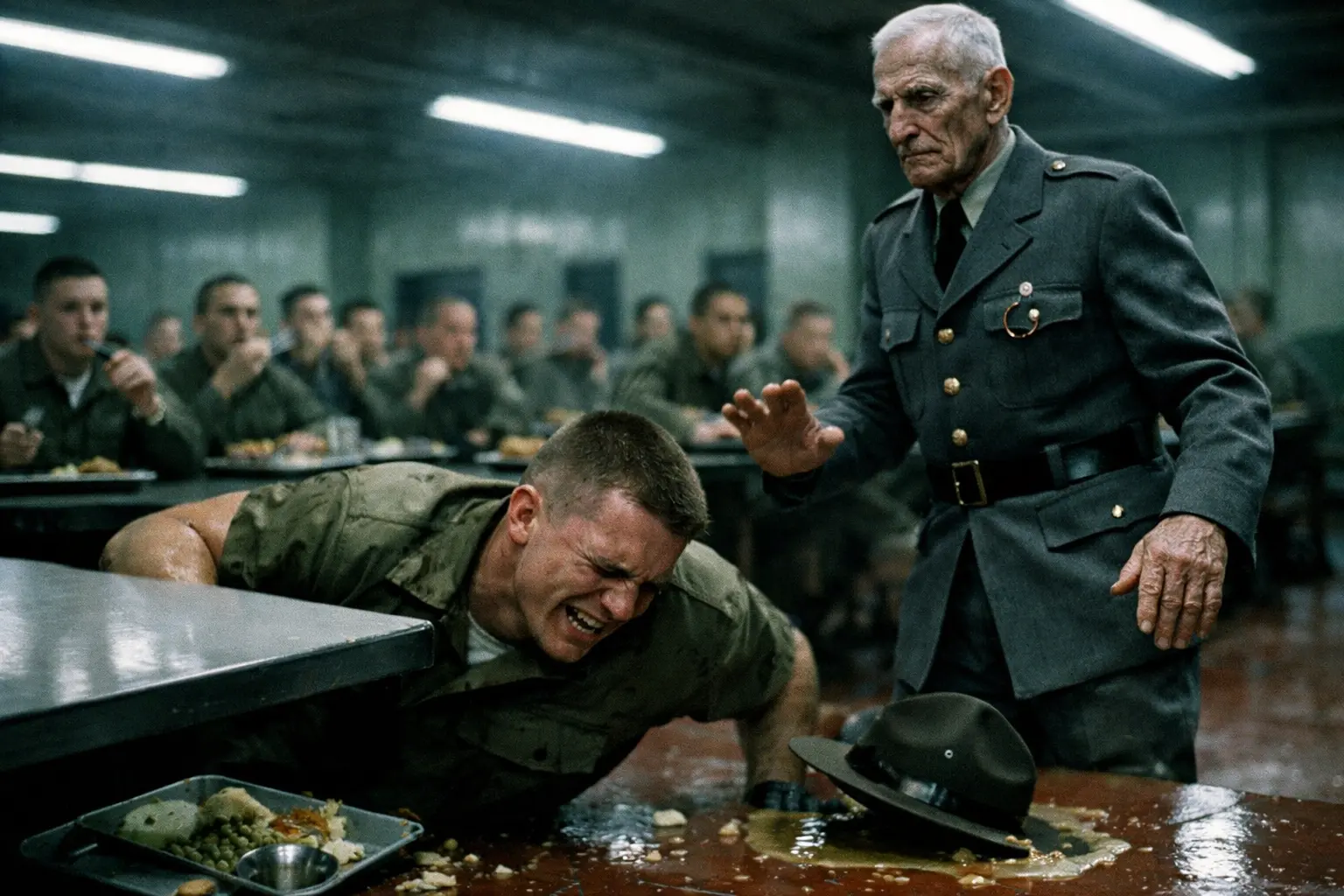
The mess hall smelled like boiled starch and bleach. Two hundred men who’d drilled six hours on dry clay went quiet when Miller knocked his own tray to the floor.
He did it on purpose. Meatloaf and gravy slid across the red tile. A calculated mess, right at the old man’s boots.
“You’re blocking the egress, Instructor,” he said, too loud.
The old man didn’t move. His gray wool uniform was pressed razor-sharp. One silver button was missing, replaced by a loop of copper wire.
“The tray belongs in the rack, Recruit,” he said, dry as autumn leaves. “The protocol isn’t a suggestion. It’s the line.”
“The line is for people who have time to waste.” Miller squared his shoulders. He was twenty-two, five-mile-morning strong. A slow grin spread across his face as he looked the old man up and down. “And what are you gonna do about it, old man?”
He leaned in to shove past the gray shoulder.
The shift was too fast to track. The heel of the old man’s palm caught Miller square in the sternum. His boot clipped Miller’s lead ankle with a click like an iron latch.
The floor came up hard. Miller’s shoulder slammed the table edge. His hat spun into the gravy.
Nobody breathed.
Miller looked up, ribs screaming. The Instructor hadn’t shifted an inch.
“Don’t ever do that again, kid,” the old man said.
Miller stayed down a second longer than he needed to. He’d come to the academy angry—angry at a father who’d worn the same gray wool and come home in a flag-draped box, angry at the recruiters who’d promised glory and handed him dry clay and blisters. He’d spent three weeks looking for someone to make pay for all of it. He’d picked the oldest, slowest target in the room. And the target hadn’t even breathed hard.
The double doors hissed open.
Captain Vance walked the center aisle, collar starched stiff. Flint-dark eyes swept the overturned tray, the splattered gravy, Miller trembling on the floor.
“Detail, attention,” he barked. Two hundred chairs scraped back.
Vance stopped two paces from the old man. “Instructor Vance. Is there a breakdown in protocol here?”
The name hit Miller like a punch. Vance. Same last name. Same cold eyes.
“The recruit dropped his equipment, Captain,” the old man said, staring at the far wall. “He was recovering it.”
“He’s out of uniform,” Vance said. “And he seems to have forgotten how to breathe. Get to your feet, Recruit. Report to Container Bay Nine at eighteen hundred. You’ll be inventorying the archive crates. Alone.”
The container bay sat at the edge of the rail yard, iron boxes rusting under a low fog. A single sodium lamp buzzed overhead, throwing everything in sick amber. Miller’s breath fogged in the cold. He’d expected the punishment to feel like punishment. Instead it felt like being sent somewhere the academy wanted forgotten.
He pried the third crate open with a groan of old nails and found rows of zinc stencil blocks—old cipher plates, ink still crusted in the grooves. Serial marks he didn’t recognize. Dates that went back before he was born.
One read ST-04.
He ran his thumb across it. The metal was colder than the air.
The Instructor stepped through the container door without a sound. He held a crowbar flat against his thigh, knuckles gray with old graphite. In the amber light the lines on his face looked carved rather than worn.
“The boxes were shifting under the humidity,” he said. “The timber inside was rotting. I was adjusting the lean before the steel took a permanent twist.”
“You’re not on the inventory detail,” Miller said.
“Neither were you, an hour ago.” The old man crossed to the crate and looked down at the plates without touching them. Something moved behind his eyes—not surprise. Recognition. The look of a man seeing an old debt come due. “Some of these were supposed to be melted twenty years ago. Somebody kept them instead. I always wondered who.”
“Why would anyone keep old stencils?”
“Because a stencil is a signature, kid. And a man who’s afraid of the truth never quite manages to burn his own name.”
Boots on gravel. Captain Vance stepped down into the box, leather gloves brushing the zinc plate, tracing the ST-04 cipher.
That’s when Miller saw it—a split along the seam of the Captain’s right glove, and tucked in the lining, a silver signet ring with a cracked-scale ivory inlay.
“This cipher belongs to the Commander’s old field allocation,” Vance said softly. His flint eyes fixed on the old man. “Three volumes are missing from the 2004 ledger. Checked out under your authorization code. But the receipts aren’t in the basket. They’re inside the Commander’s private desk.”
The silence in the iron box went heavy.
“Your father knew how to handle a clearance, Captain,” the old man said. “He didn’t look for cracks in the foundation unless he was ready to replace the timber under the roof.”
Vance’s hand froze on the plate.
“The Commander told me the Linebrook collapse was a failure of tactical synchronization,” he muttered. “He said the field coordinator didn’t verify the load limits. He told me the name on the casualty manifest was mine to carry.”
“The name on that manifest belongs to the man who ordered the steel, kid.” The old man’s voice filled the container. “Nineteen men crossed the Linebrook span that morning. The load rating said it would hold three times their weight. It didn’t hold once. The plates folded like wet cardboard because they were never grade steel—they were foundry scrap, stamped and painted to pass a paper inspection nobody ran.”
He turned the crowbar slowly in his hands.
“Sterling didn’t send a recovery unit into Sector 4 to pull those men out. He sent them to bury the procurement logs before the board could audit the foundry. By the time anyone counted the bodies, the paperwork said the bridge failed because a coordinator missed a load check. That coordinator was me. I signed nothing. I ordered nothing. But my name fit the hole in the story.”
His eyes went to Vance, and softened by a fraction.
“Your father was a lieutenant then. Green as spring wheat, and honest to a fault. If I’d fought it, they’d have widened the net until it caught every man who ever touched that requisition—him included. So I let them hang the sign on me. I took the reprimand. I took the desk in Block C and I stood on the line for twenty years so there’d still be a line for you two to stand on. I never once regretted it. But I never once forgot their names either.”
Vance stood slowly. His shoulders squared—not like an officer, like a man holding a door.
He dropped the stencil back into the dark corner of the bin. The clang was final.
“The change-of-command ceremony is at oh-eight-hundred,” Vance said, voice flat as the fog. “The board locks the logs by midday. If your ledger isn’t clean by then, Miller, your name goes on the transfer list for the salt flats.” He looked at the old man. “And yours goes with it, Instructor.”
He swung out of the container and was gone.
Miller stood in the amber light a long moment. The ST-04 plate was still cold in his hand. Somewhere under twenty years of paint and paperwork, nineteen men were still waiting for someone to say their names right. He looked at the old instructor—the slow walk, the salvaged button, the crowbar he carried like it weighed nothing—and understood for the first time what he’d actually shoved at in that mess hall.
“He’ll bury us both by noon,” Miller said. “You know that.”
“Maybe.” The old man set the crowbar down against the crate. “But a man who’s spent his life holding a roof up learns one thing, kid. You don’t let go just because the weight finally lands on you.” He nodded at the plate in Miller’s fist. “Bring that. We’re going to go stand on the line.”
The command chamber doors yielded with a pressurized sigh. Chicory coffee, floor wax, cold morning light through tall windows.
Commander Sterling sat motionless behind his slate desk, silver stars polished to needle points. In the center of the blotter sat a single steel cylinder pin—clean, uncut, no grease, no rust. A component from a twenty-year-old field winch, drawn fresh from the vault.
“You’re early, Vance,” Sterling said. His eyes stayed on the old Instructor by the door.
The old man had left his cap off. White hair like iron wire, coat held together with salvaged webbing. He stood driven into the floorboards like a pillar that had taken a falling roof and refused to split.
“The clock in Block C runs on the line, Sterling,” he said. “It doesn’t slow down for ceremonies.”
The door clicked. Captain Vance entered, belt starched hard as iron, and moved to the flank—hand resting over the split seam of his glove.
“The board completed the log integration, Commander,” Vance said. “The structural failure on the north ridge was logged as an uncoordinated material collapse. Aging drainage vaults.”
Sterling’s thumb traced the rim of the steel pin. “An aging vault is a clean signature, Captain. It leaves the walls standing. Keeps the funding running through the winter.”
“The sheet isn’t clean, Sterling.”
Miller didn’t wait for permission. He stepped forward and set the hand-turned zinc stencil down beside the pristine pin. It landed with a heavy clank that rang off the ceiling.
“The bridge plates weren’t aged. They were scrap before the extraction team ever reached Sector 4. You signed the requisition for the low-grade steel three months before the operation collapsed. The name on the procurement order wasn’t Vance. It was yours.”
The Commander didn’t look down.
“You have fast feet, Recruit,” Sterling said quietly. “But fast feet don’t change the load-bearing requirements of this institution. If the board pulls that file, the logistics division takes the whole district. They’ll clear the cadre, turn these halls into a parts depot, run your platoon until their lungs fill with sand.”
He looked at the old man.
“I gave twenty years to keep this roof up, Vance. I signed the forms that kept coal in the boilers. I built the desks that kept the next generation from sleeping in the dry clay.”
“You built the desks out of the men you left under the bridge, Sterling.” The old man’s knuckles stayed locked behind his back. “The line isn’t protected by hiding the scrap ledger. It’s protected by staying upright when the machine breaks under your feet. The boy isn’t signing the statement. And the Captain isn’t carrying your manifest.”
Vance took a step off the doorframe. He reached into the split glove, pulled out the silver signet ring, and dropped it on the slate desk beside the stencil.
“The transfer list for the salt flats has been cleared, Commander,” he said flatly. “The Instructor stays on the line. The recruit stays in Third Platoon. If the board asks about the file marks on the chronometer, I’ll tell them the rust was cleared by hand. And I’m handing the 2004 ledger and the procurement order to the Inspector General before the ceremony bell.”
Sterling looked at the ring. Then at the three men holding the lane before his desk. They didn’t look like an administrative cadre anymore. They looked like an iron wall that had outlasted the foundry that cast them.
His hand slid off the logbook and dropped into his lap.
The change-of-command whistle shrieked across the parade ground below. By noon the Inspector General’s team had the file. By the winter freeze, Sterling’s stars were gone and his name sat alone on the transfer list for the salt flats.
The old Instructor turned on his heel without a salute, gray coat flapping against his shins, boots striking the limestone with that same heavy, unbreakable cadence.
The line still held.
Original fictional stories. AI-assisted creative content.