The rain had been falling for an hour when Harold Briggs sat down on the metal bench outside the Route 14 bus stop.
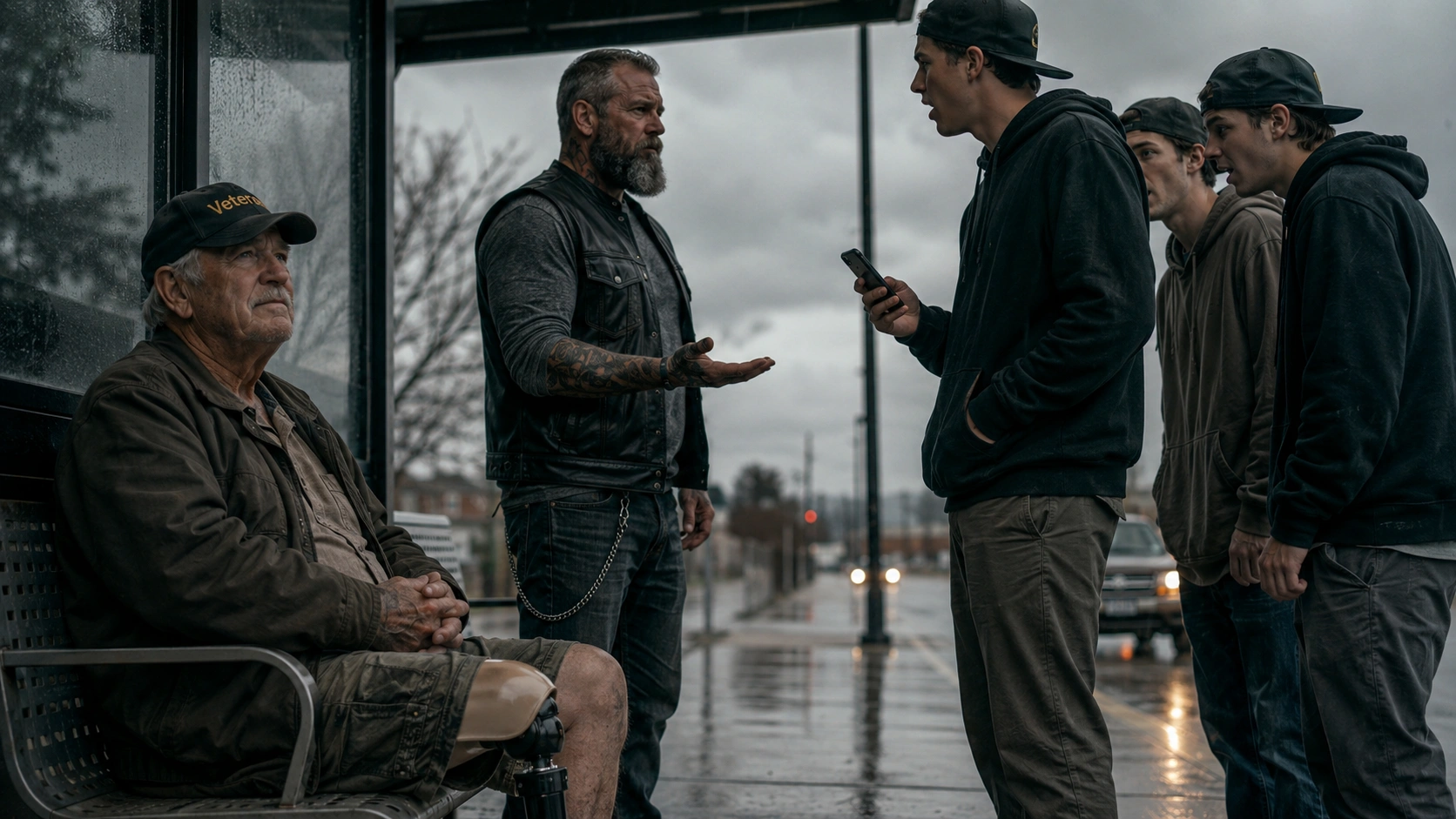
He was seventy-one. His prosthetic leg peeked out beneath frayed cargo shorts. The cap on his head, faded almost gray, still had one word stitched across the front.
Veteran.
He didn’t look up when people passed. He’d stopped looking up years ago.
A woman with a stroller crossed the street to avoid him. A man in a suit checked his watch and pretended the bench wasn’t there. Harold understood. He’d been invisible for a long time.
He was thinking about Danny Alvarez. Danny had been nineteen the day he died. Harold still remembered the weight of him.
“Hey. Hey, old man.”
Harold blinked back to the street.
Three kids. Early twenties. Backward caps, oversized hoodies, the kind of laugh that always came before something ugly.
“That thing real?” the tallest one said, pointing at Harold’s leg. “Or you just cosplaying?”
The other two cracked up.
“Bro, look at it. It’s like a Terminator leg.”
“You buy that at Home Depot, gramps?”
Harold looked at the wet pavement.
“Yo, I’m talking to you.” The tall one stepped closer. “You deaf too?”
“Maybe his hearing aid’s in the leg,” the shortest one said, and they howled.
Harold’s hands folded slowly in his lap.
“Does it charge overnight?”
“Do the TSA guys freak out?”
“Man, does it get cold in winter? Like, do you gotta wrap it in a blanket?”
The tall one pulled out his phone. Flipped the camera to selfie mode. Angled it so Harold was in the frame behind him.
“Yo, chat, look at this dude. Certified robocop right here.”
Harold spoke for the first time.
“Please put the phone down, son.”
“Oh, he speaks!” The kid laughed. “Hey, say something for the stream. Say ‘I’ll be back.'”
The other two doubled over.
An older woman waiting for the bus turned her head away. A man reading a newspaper folded it tighter, stepped six feet down the sidewalk.
Nobody said a word.
Harold closed his eyes for a second.
He thought about the letter in his jacket pocket. His wife had signed the divorce papers eight years ago. His last living Army buddy, Walt, had died in March. There was nobody at home. There was nobody anywhere.
“Yo, gramps, don’t fall asleep on us.”
“His battery’s dying, bro.”
“Somebody get this man a charger.”
Harold opened his eyes.
“I’d like it if you boys moved along,” he said quietly.
“Or what?” The tall one leaned in. “You gonna kick me? With which leg?”
That was when a shadow fell across all three of them.
The shadow was six-foot-four and built like a freight car.
The man wore a black leather vest over a gray henley, sleeves pushed up to the elbows. His arms were covered in old ink — an eagle, a flag, a set of dog tags rendered in dark green. His beard was gray at the chin. His eyes were not.
He’d been standing near the corner for the last four minutes. Long enough to hear everything.
“Evening, gentlemen,” he said.
The three kids turned around. The tall one’s grin flickered.
“We good, man. Just talking to grandpa here.”
“That right.” The biker didn’t phrase it as a question. “Because from where I was standing, it sounded like you were filming a man in uniform without his permission.”
“He ain’t in uniform.”
The biker’s eyes dropped to Harold’s cap.
Then lifted back up.
“You want to try that sentence again?”
The kid’s jaw worked. He didn’t answer.
“Give me the phone,” the biker said.
“What?”
“The phone. Give it to me.”
“Bro, you can’t just—”
The biker held out his hand. He didn’t raise his voice.
“Son. Give me the phone.”
The kid gave him the phone.
The biker looked down at the screen. Watched maybe five seconds of the video. His jaw tightened. He deleted it. Then he handed the phone back.
“Now,” the biker said, “I want you three to look at this man.”
Nobody moved.
“Look at him.”
They looked.
Harold sat with his hands in his lap, his eyes on the ground.
“His name is Harold Briggs,” the biker said. “How do I know that? Because he’s wearing a Third Battalion pin on that cap. That pin says he was in Ramadi in 2004. You boys know what happened in Ramadi in 2004?”
Silence.
“Didn’t think so.”
The biker took a slow breath.
“That leg you were laughing at. He didn’t lose it in a car accident. He didn’t lose it falling off a ladder. He lost it because a nineteen-year-old kid named Danny Alvarez stepped on an IED, and Sergeant Briggs threw himself on top of him to shield him from the blast.”
The tall kid opened his mouth. Closed it.
“Danny didn’t make it,” the biker said. “But his mother did. She got her son’s body back to bury because this man decided his own legs were worth less than another woman’s child.”
The short kid’s face had gone pale.
“You,” the biker said, pointing at the tallest one, “made a joke about a battery.”
“I—”
“You made a joke about airport security.”
“Bro, we didn’t know—”
“You didn’t ask.”
The biker stepped closer. Not threatening. Just closer.
“You want to know why he sat there quiet while you laughed? Because he’s already heard worse. Because he’s already lost more than the three of you combined will lose in your entire lives. And because men like him don’t waste breath on boys like you.”
The short kid was looking at the pavement.
“We were just messing around,” he mumbled.
“No,” the biker said. “You were being cruel. There’s a difference. Cruel is when you know the person can’t fight back and you do it anyway.”
Nobody spoke.
The rain kept falling.
“Take the caps off,” the biker said.
“What?”
“Your caps. Take them off.”
The tall one hesitated. The biker just looked at him.
All three caps came off.
“Now walk over there,” the biker said, pointing to Harold, “and apologize to him. Not to me. To him.”
The tall kid moved first. Slow. Awkward. He stopped in front of the bench.
“Sir. I’m sorry.”
Harold looked up.
His eyes were tired but clear.
“Say it like you mean it, son.”
The kid swallowed.
“I’m really sorry. I didn’t know. I shouldn’t have — even if I didn’t know, I shouldn’t have.”
Harold nodded once.
The second kid came up.
“I’m sorry, sir. That was messed up. My uncle served. I should’ve known better.”
“Then act like you know better next time,” Harold said quietly.
The third kid was crying. He didn’t try to hide it.
“My grandpa was in Vietnam,” he said. “He would’ve — he would’ve hated me for what I just did.”
Harold looked at him for a long moment.
“Then don’t do it again,” he said. “That’s how you make it right.”
The kid nodded and stepped back.
The biker watched all of it. His arms were crossed.
“Phones,” he said.
The three of them handed over their phones. The biker went through each one. Deleted everything from the last ten minutes. Handed them back.
“You’re going to go home,” he said. “You’re going to think about this. And the next time you see a man wearing a Veteran cap, you’re going to nod. You’re going to say thank you. You’re not going to say a goddamn other word. Are we clear?”
“Yes sir.”
“Yes sir.”
“Yes sir.”
“Now walk.”
They walked.
The biker watched them until they’d turned the corner at the end of the block. Then he turned back to Harold.
“Mind if I sit, Sergeant?”
Harold moved over.
The biker sat down. The bench creaked under him.
They didn’t speak for a while.
“How’d you know about the pin?” Harold finally asked.
The biker pulled up his sleeve. On the inside of his right forearm was a tattoo of the same battalion insignia.
“Second Battalion,” he said. “Fallujah. ’04 and ’06.”
Harold looked at him for a long moment.
“You’re a long way from home, brother.”
“I ride with a group out of Bakersfield,” the biker said. “Rolling Thunder chapter. We do escorts for veteran funerals. We were up here for one this morning.”
“Who?”
“Marine named Cortez. Ninety-one. Iwo Jima.”
Harold nodded slowly.
“Good man?”
“Everybody said so.”
They sat with that.
“My name’s Mike Delaney,” the biker said, extending a hand.
“Harold.”
They shook.
“You got somebody waiting on you at home, Harold?”
Harold’s mouth pulled at the corner. Not a smile.
“No.”
“When’s the last time you had a hot meal with another vet at the table?”
Harold thought about it.
“March,” he said.
Mike nodded like that was what he’d expected.
“There’s a diner two blocks that way. Ruby’s. You had breakfast?”
“No.”
“You want some?”
Harold looked at him.
“You don’t owe me anything, son.”
“Sergeant.” Mike’s voice was quiet. “I’m not asking because I owe you. I’m asking because I’d like to sit across from you and hear about Ramadi. If you feel like talking. And if you don’t, we can eat eggs and say nothing. Either way’s fine.”
Harold looked at the wet street.
He’d been sitting at that bus stop for almost half an hour. He didn’t actually have anywhere to be. He hadn’t had anywhere to be in eight years.
“I could eat,” he said.
Mike stood up. Held out an arm.
Harold used it to get his prosthetic under him. Steadied himself on his cane.
“There’s a couple more of my guys at Ruby’s already,” Mike said. “One of them was a corpsman. Another was Airborne. They’d want to meet you.”
“That right.”
“That’s right.”
They started walking. Slow. Mike didn’t rush him.
Halfway down the block, a woman came out of a coffee shop, saw Harold’s cap, and stopped.
“Sir,” she said. “Thank you for your service.”
Harold touched the brim of his cap.
“Thank you, ma’am.”
She kept walking.
A block later, a man in a delivery uniform did the same thing.
Harold started to wonder if this was what it had always been like and he’d just stopped looking up.
At the corner, Mike stopped and turned to him.
“Sergeant. One more thing.”
“Yeah?”
“Those three boys back there. You know what happens now?”
“What?”
“I’ve got their faces. My guys have their faces. Every time we roll through this town, we’re going to be looking. And if any of us ever see them do something like that again, to anybody — a vet, an old woman, a kid, anybody — they’re going to find out what a real bad day looks like.”
Harold looked at him.
“You think they learned?”
Mike considered it.
“The third one did. The one who cried. He’ll never do it again in his life. The other two — we’ll see. But they know they’re being watched now. And sometimes that’s enough.”
Harold nodded.
They kept walking.
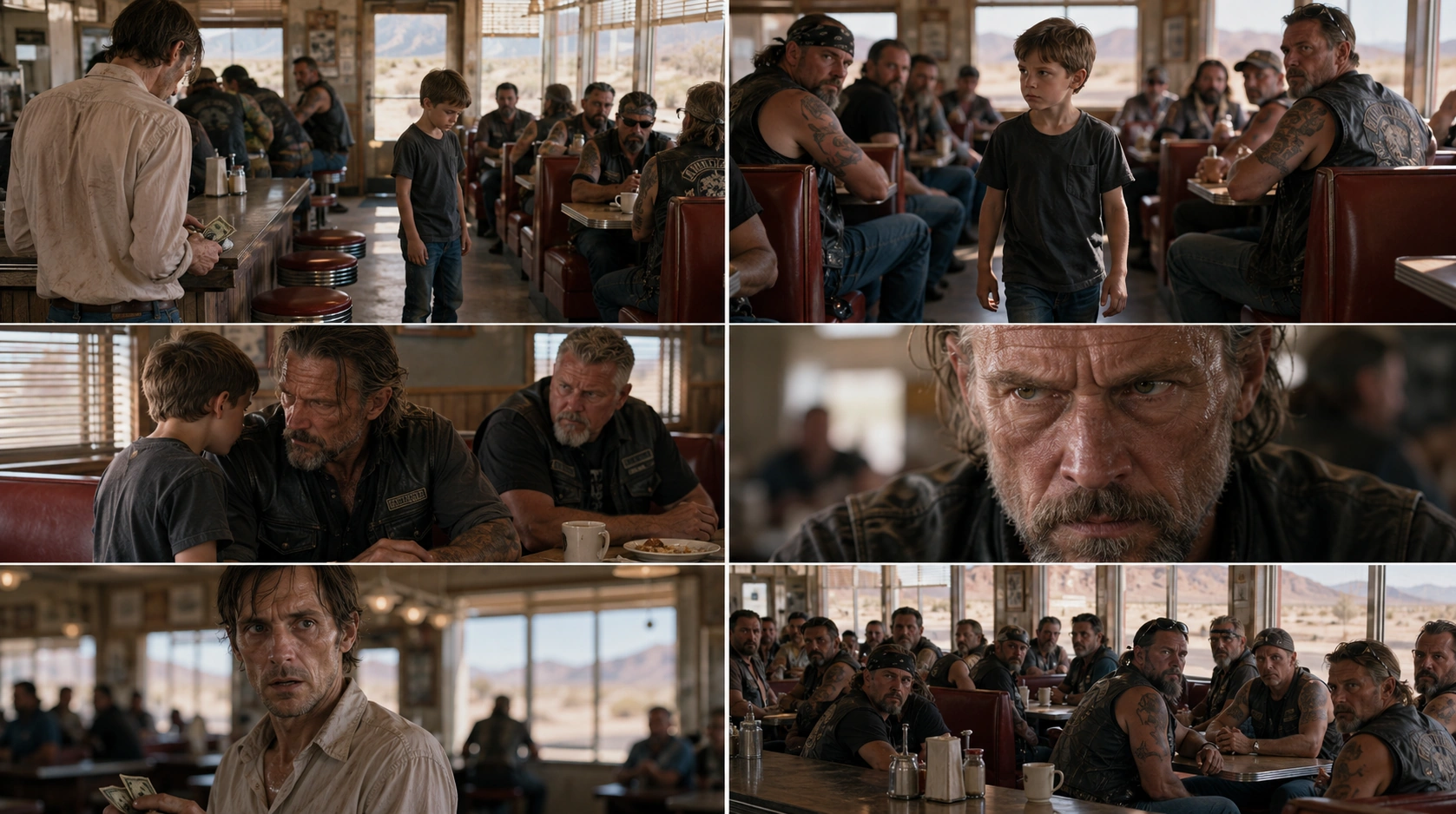
At Ruby’s diner, three men in leather vests were already at a corner booth. They stood up when Harold walked in. All three of them.
The oldest one, gray-bearded and missing two fingers on his left hand, saluted.
Harold’s throat closed up.
He hadn’t been saluted in twenty-three years.
He returned it.
The corpsman slid over to make room. The Airborne guy poured him coffee before he’d even sat down.
“Sergeant Briggs,” Mike said, taking the seat across from him. “These are my brothers.”
Harold sat down slowly. His prosthetic clicked against the booth.
Nobody laughed at it.
Nobody stared.
The waitress came over with a pot of coffee and a smile.
“You gentlemen ready?”
“He’s got the check,” Mike said, jerking his thumb at Harold. “For the rest of his life. Just kidding. Put it on mine.”
Harold started to protest.
Mike shook his head.
“Sergeant. Just this once. Let somebody else carry it.”
Harold looked down at the coffee in front of him. Steam rising off the top.
He hadn’t cried in a long time.
He didn’t cry now.
But something in his chest, something that had been locked up tight for eight years, quietly clicked open.
“Okay,” he said. “Just this once.”
And for the first time in longer than he could remember, Harold Briggs looked up.
Original fictional stories. AI-assisted creative content.