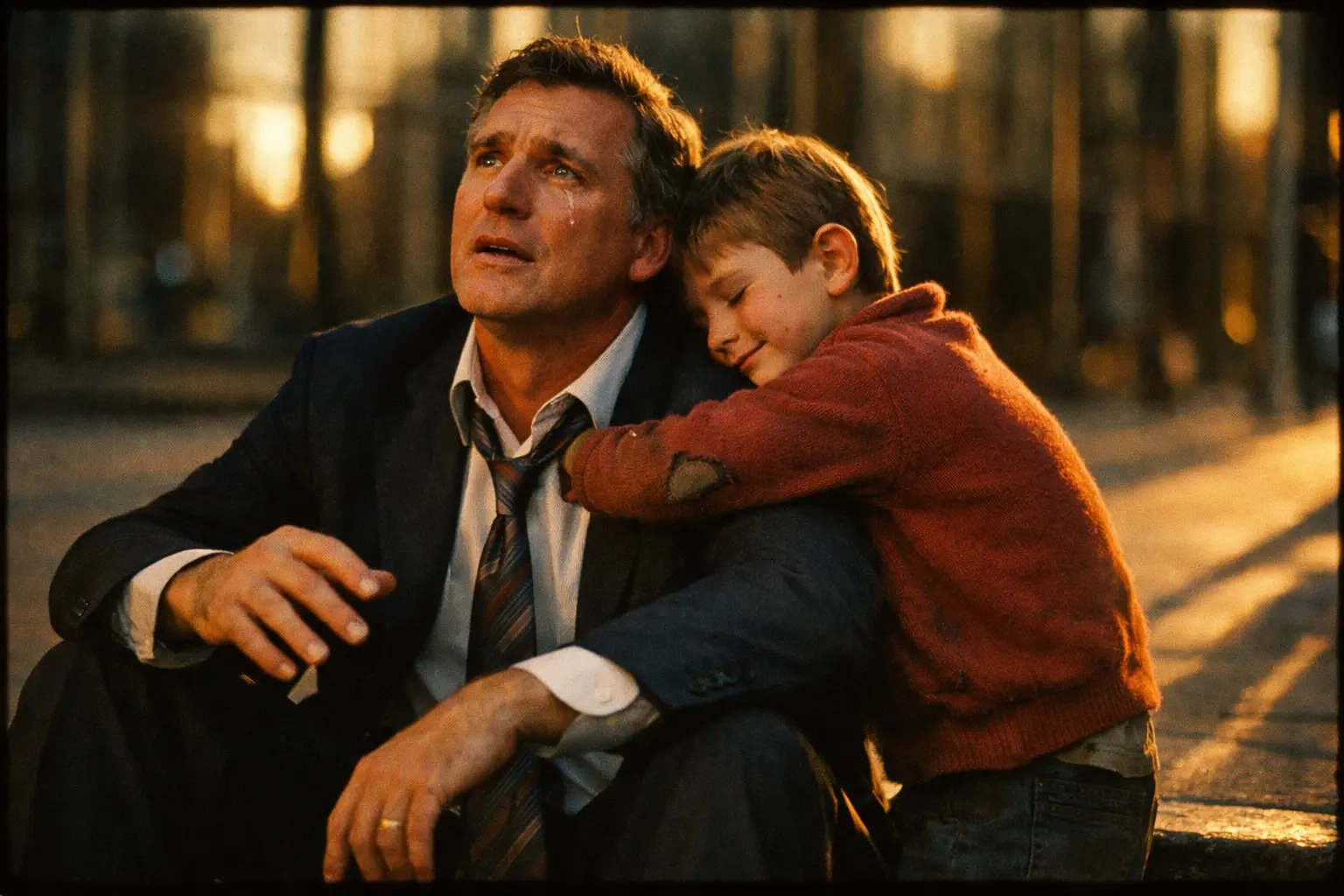
Alexander sat on the curb outside his own building, tie loosened, hands shaking.
Forty-two floors of glass behind him. None of it his anymore.
“Sir? You okay?”
He looked up. A small boy stood there. Red sweater, torn elbows. Dirt on his cheeks.
“I’m fine, kid. Go home.”
“Can I give you a hug?”
Alexander blinked. “What?”
“When I’m sad, a hug always helps.”
Before he could answer, thin arms wrapped around his neck. The boy smelled like cardboard and rain. Alexander froze — then something inside him cracked open.
“What’s your name?” he whispered.
“Noah. I live here.” The boy pointed at a kiosk across the street. “Well. I sleep here.”
“Where’s your family?”
“Miss Carmen took care of me. She sold tamales. Then she got sick and an ambulance came. A bigger boy said he’d watch me. He took my money and left.”
No bitterness. Just facts.
Alexander stared at him. This child had nothing. And he was the one giving comfort.
“Come on,” Alexander said, standing. “Let’s get you food.”
They ate at a diner two blocks down. Noah devoured three pancakes and half a plate of eggs.
“You eat like it’s your job,” Alexander said.
“It kind of is.”
Alexander laughed for the first time in a week.
“Where do you live, mister?”
“I had a penthouse. Twenty minutes ago I still had it. My brother took the company. Legally. My signature was on the wrong page.”
“Your brother is mean.”
“Yeah. He is.”
Noah chewed thoughtfully. “Bad people are sad inside. That’s what Miss Carmen said.”
Alexander set his coffee down. “You believe that?”
“I have to. Otherwise I’d be scared all the time.”
Alexander still had the key. The lock hadn’t been changed yet. He took Noah upstairs.
“Whoa.” Noah spun in the foyer. “Is this a hotel?”
“For tonight, yeah.”
He drew Noah a bath. Found an old t-shirt that hung to the boy’s knees. Made toast. Watched him fall asleep on the couch mid-bite.
Then the door slammed open.
Marcus walked in flanked by two officers and a woman in a gray suit.
“Ten minutes, Alex. Get out.”
“You couldn’t wait till morning?”
“No.” Marcus’s eyes landed on Noah. Slowly, a smile crawled across his face. “Officer. My brother kidnapped this child. Look at him. Look at his clothes.”
The taller officer stepped forward. “Sir, we’re going to need you to—”
“NO!”
Noah was awake. Standing on the couch. Small fists clenched.
“He didn’t take me! I asked him for a hug! He bought me pancakes! He’s the bad one!” Noah pointed at Marcus.
The officer looked at Marcus. Then at the boy. Then at the penthouse.
“Sir,” he said flatly, “we’re leaving.”
“What? No — arrest him!”
“There’s no crime here, Mr. Reed. File a report if you’d like. We’re done.”
They left. The lawyer left. Marcus stood alone, red-faced.
“You think a street kid saves you?” he hissed. “You have nothing. Nothing.“
Alexander picked up Noah’s shoes. “Keep the apartment, Marcus. Money never bought you a soul. It sure didn’t buy mine.”
They walked out with one duffel bag between them.
The motel had orange carpet and a TV that only got two channels.
“This is cool,” Noah said, jumping on the bed.
“You’re easily impressed.”
“You’re easily depressed.”
Alexander stared at him. “Where did you learn to talk like that?”
“Miss Carmen watched a lot of talk shows.”
The next morning Alexander started calling hospitals. Public wards. Charity beds. Places he’d never set foot in.
Five days. Twelve hospitals.
Finally — a nurse in East County said, “Carmen Ruiz? Yeah. Pneumonia. She’s not doing great.”
They drove ninety minutes. Alexander used a credit card he was pretty sure still worked.
Carmen was gray-skinned in a bed by a window with no view.
Noah ran across the room and climbed onto the mattress.
“Miss Carmen! Miss Carmen it’s me!”
Her eyes fluttered. Then filled.
“Mijo. You’re alive. You’re alive.”
“I knew you didn’t leave!”
Alexander stood in the doorway. Watched.
Then walked to the front desk. “I want her transferred. Today. Private clinic. Bill me.”
“Sir, that costs—”
“I know what it costs.”
It took the last of his liquid cash. He didn’t care.
Three weeks later Carmen could sit up. Six weeks later she could walk.
She sat across from Alexander in the clinic garden, thin but sharp-eyed.
“You spent everything on me.”
“Not everything.”
“Why?”
Alexander looked at Noah kicking a pinecone across the path.
“Because he asked me if I needed a hug. And I did. And nobody had asked me that in thirty years.”
Carmen was quiet a long time.
“So what now, Mr. Alexander?”
“Now we figure out how to be a family. If you’ll have us.”
She reached across the table and took his hand.
“I’ve been alone a long time too.”
They rented a two-bedroom on the east side. Nothing fancy. A radiator that clanked. A kitchen Carmen took over on day one.
Alexander got a job. Sales, mid-level, at a firm that used to send him Christmas gifts when he was CEO. The manager tried not to smirk when he shook his hand.
Alexander didn’t care. He walked Noah to school every morning. He came home to Carmen’s cooking every night.
For the first time he could remember — he slept through the night.
Then Marcus called.
“Alex. I need help.”
“Goodbye, Marcus.”
“They’re going to kill me, Alex.”
Silence.
“Meet me. Please.”
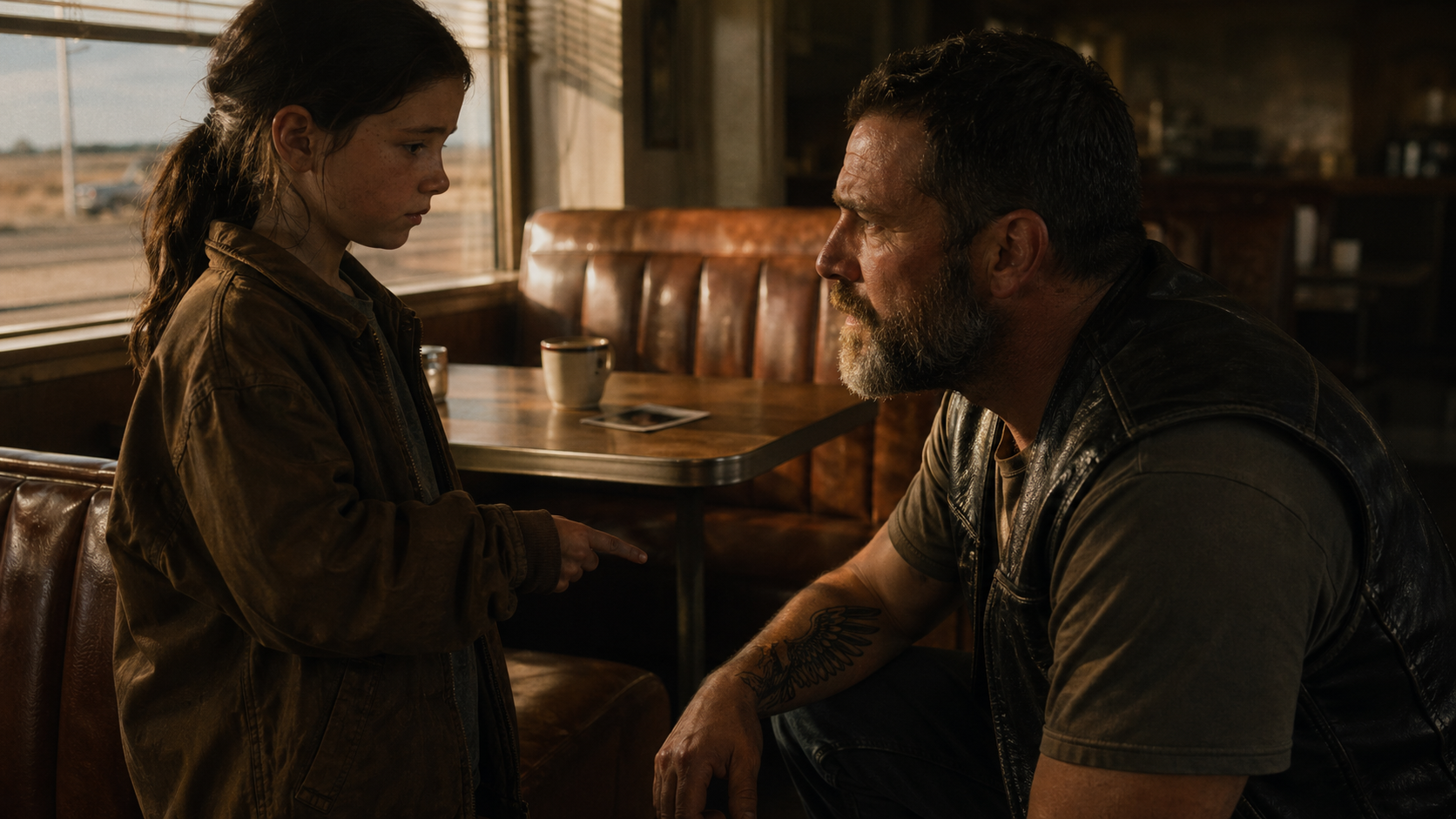
They met at a diner near the highway. Marcus looked twenty years older. His hands wouldn’t stop moving.
“I owe eight hundred thousand to people who don’t take checks. The company’s bankrupt. The board’s gone. I have nothing.”
“Neither do I.”
“You have a name. You have contacts. One phone call from you and I get thirty days.”
Alexander stirred his coffee.
“Noah said something once. ‘Bad people are sad inside.’ You sad, Marcus?”
“I’m scared. Is that enough?”
“It’s a start.” Alexander set the spoon down. “Two conditions. You sign the company back to me. Every share. Every asset. Backdated to before the transfer.”
“Alex—”
“And we restructure it. Housing. For families like Noah’s before I found him. That’s what the company does now. Nothing else.”
Marcus stared. “You’re insane.”
“I’m free. There’s a difference.”
Marcus signed the papers that night on a diner napkin, witnessed by the waitress. His lawyer formalized it Monday.
Alexander made three calls. Marcus’s debt got restructured. He got a job — a real one, entry level, at the new company. A cubicle. A name tag.
“You’ll hate me for this,” Marcus said.
“I already didn’t. That’s the whole trick.”
Two months later a woman in a charcoal suit walked into Alexander’s office.
“My name is Victoria Hayes. I’m a family law attorney. I got a call from a hospital social worker about a Carmen Ruiz.”
Alexander stood slowly. “Yes?”
“She’s my mother.”
He sat back down.
“I was adopted at three. I’ve been looking for her for eleven years. The social worker said someone paid her medical bills. That someone was you.”
“Have you told her?”
“No. I wanted to meet you first. To make sure she was — safe. With you.”
“Come to dinner tonight.”
Carmen dropped a bowl of rice when Victoria walked in.
Neither of them spoke for a full minute. Then Carmen crossed the kitchen and put both hands on Victoria’s face like she was checking she was real.
“Mi hija.“
“Mom.”
Noah watched from the couch, wide-eyed. Then he tugged Alexander’s sleeve.
“Do I have a sister now?”
“Looks like it.”
“Cool.”
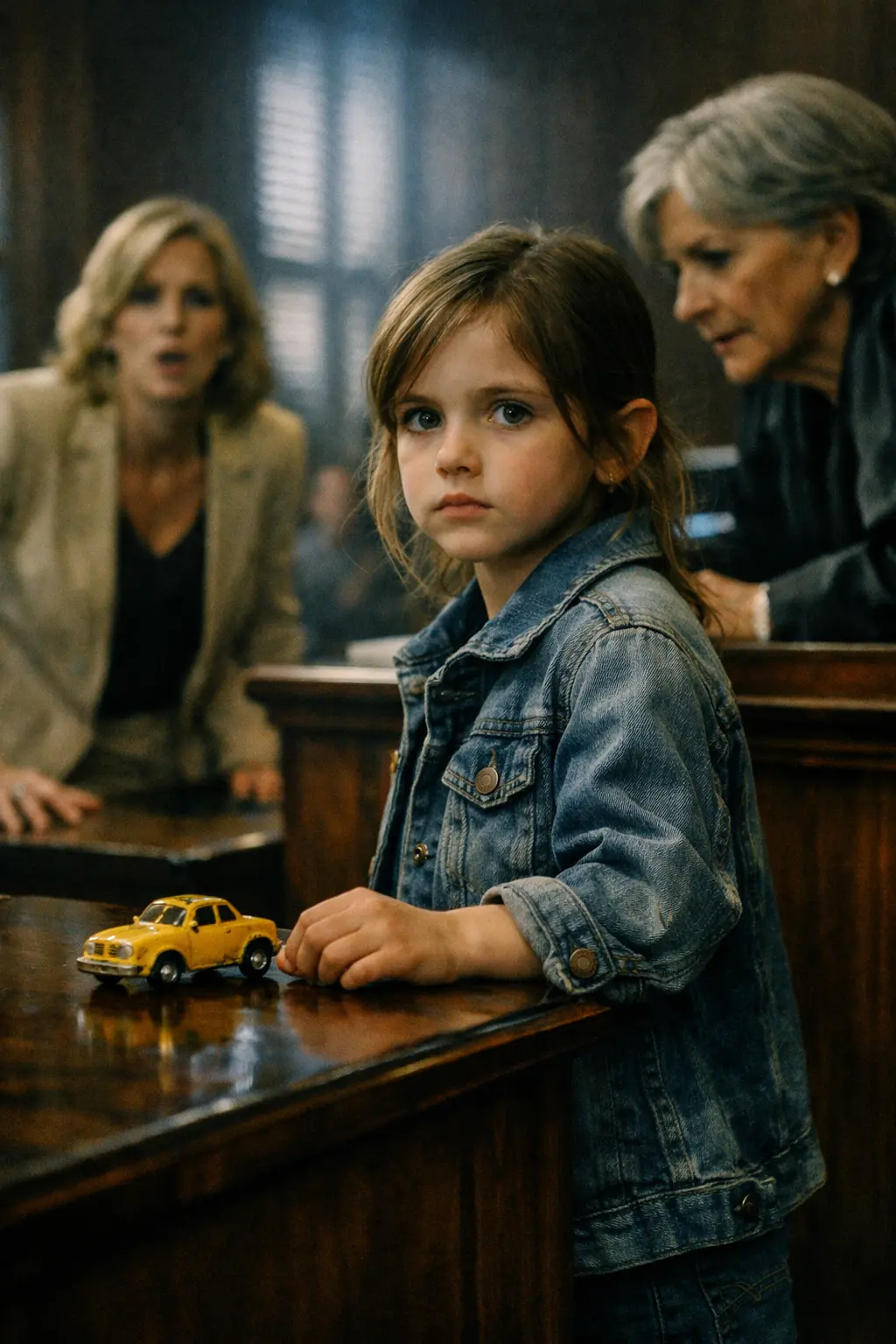
Alexander filed adoption papers a month later. Noah signed his own name on the line the judge showed him, careful and slow, tongue between his teeth.
“You’re stuck with me now, kid,” Alexander said in the courthouse hallway.
“Good.”
Two years passed. The company built its first sixty units. Then two hundred. Then a whole block in the neighborhood Noah used to sleep in.
Carmen ran three community kitchens. Victoria did pro bono custody work out of a converted storefront. Marcus worked payroll and didn’t complain, not even once.
Then, on a Tuesday in October, someone knocked on the door.
A woman. Late thirties. Thin. Nervous. Clean clothes but old.
“I’m looking for a boy named Noah. I’m — I was his mother.”
Alexander’s hand tightened on the doorframe.
“Come in.”
Her name was Rosa. She’d been using when Noah was three. She left him with a neighbor and didn’t come back. The neighbor was Carmen.
She was eighteen months sober. She’d been searching for six of those months.
Noah listened from the kitchen doorway. Twelve years old now. Taller than the last time she’d seen him by two feet.
“I’m not asking for anything,” Rosa said. Her voice shook. “I just needed you to know I’m alive. And I’m sorry.”
Noah walked over. Stood in front of her.
“I forgive you.”
She started crying before he finished the sentence.
“But this is my family now. You gave me life. They taught me how to live it.”
She nodded, over and over, unable to speak.
Alexander stepped forward. “We have an opening in the kitchens. Carmen needs a manager. It’s not charity. It’s work.”
Rosa looked up. “Why?”
“Because Noah once told me bad people are sad inside. And you’re not bad. You were just sad. And now you’re trying.”
She took the job.
Six years later, Noah stood at a podium in a gymnasium wearing a graduation gown two sizes too big.
He looked out at the crowd. Found his people in the third row.
Alexander. Carmen. Victoria. Rosa, in the seat next to Carmen — the two of them holding hands. Marcus at the end, awkward in a tie.
“I used to sleep under a kiosk on Fremont Street,” Noah began. “I thought the world belonged to whoever was cruelest. Then I met a man sitting on a curb who’d lost everything, and I asked him if he needed a hug.”
Someone in the back was already crying.
“He said yes. And that yes changed both our lives. My father didn’t build a company. He built a family out of people the world threw away. And every single one of us — every one — is still here.”
He looked at Alexander.
“Thanks for saying yes, Dad.”
The room stood.
Alexander closed his eyes.
And for the first time since he was a boy himself — he was exactly where he was supposed to be.
Original fictional stories. AI-assisted creative content.