The Obsidian Room didn’t serve regular customers. It served power.
Arthur Pendelton sat at his usual corner table, navy suit pressed to perfection, wine glass half full. Five years ago today, he’d buried his wife.
He still wore the date like a scar.
“More wine, sir?”
Arthur looked up. The waiter was a kid — maybe sixteen — white shirt, navy vest, a cloth folded over his arm like he’d done this a thousand times.
“Just the check.”
The boy nodded and reached across the table to clear a glass.
That’s when the candlelight caught it.
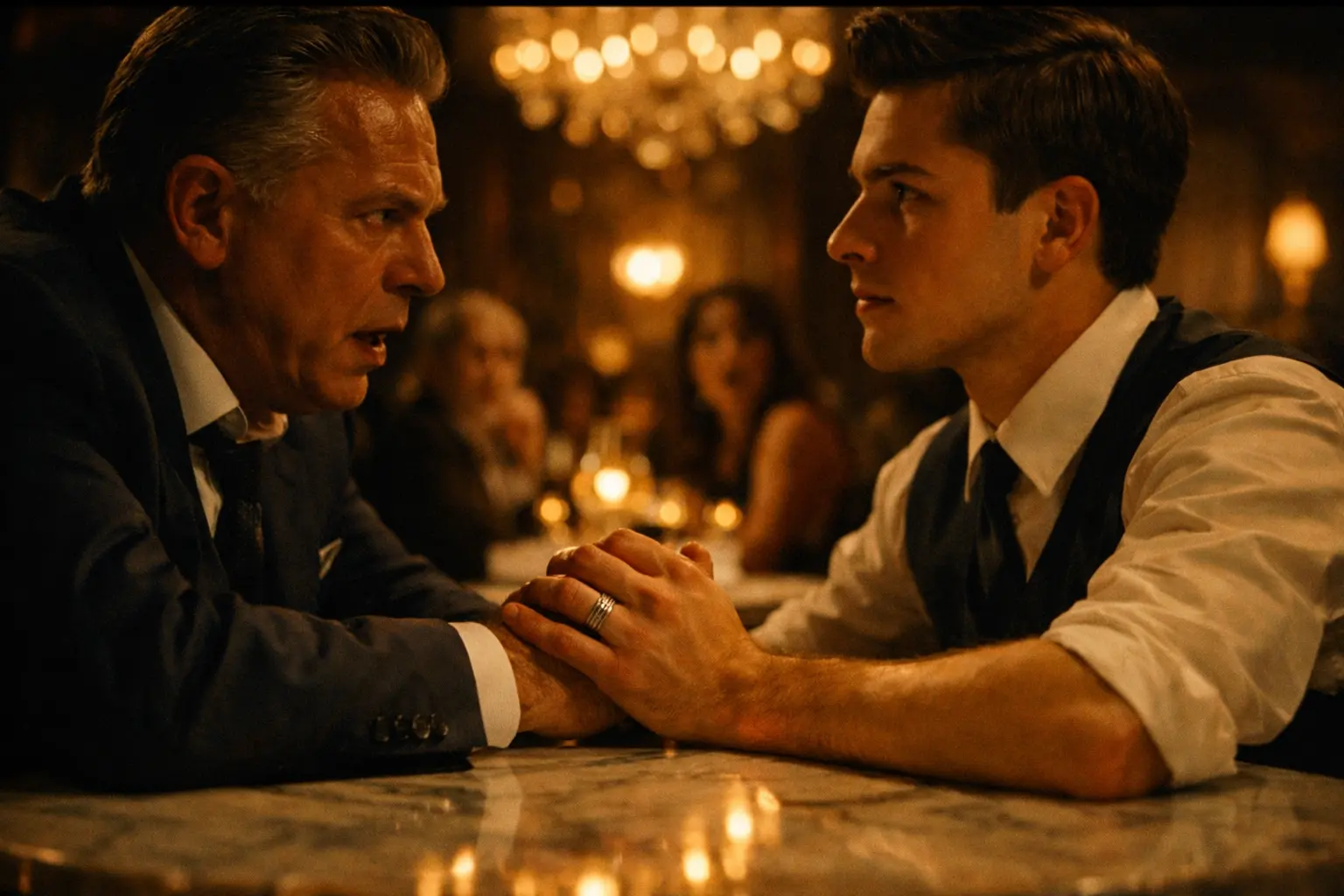
A silver ring. Engraved. A crest Arthur had paid a jeweler eleven thousand dollars to design — and only one — for the woman he’d married.
The woman he’d buried.
Arthur’s hand shot out and locked around the boy’s wrist before either of them understood what was happening.
“Where,” Arthur said, voice flat and cold, “did you get that ring?”
The boy didn’t flinch. He didn’t pull back. He looked at Arthur’s hand on his wrist like it was a mildly interesting accessory.
“My mom gave it to me.”
“That ring,” Arthur said, leaning in, “was buried with my wife. Five years ago. Today.”
Conversations at nearby tables died. Forks paused mid-air. Somewhere, a sommelier froze with a bottle in his hand, unsure whether to intervene or pretend he’d seen nothing.
The boy tilted his head, slow and deliberate, like he was studying Arthur for the first time.
“Then maybe,” he said, voice dropping to something between a whisper and a warning, “you buried the wrong person.”
Arthur’s grip loosened. Not from politeness — from shock punching the air out of his lungs.
“That’s not possible.” His voice cracked on the word possible.
The boy slid his wrist free, smooth as water, and straightened his vest.
“Enjoy your evening, Mr. Pendelton.”
He turned and walked through the kitchen doors like he hadn’t just detonated a bomb in the middle of the city’s most expensive restaurant.
Arthur didn’t remember standing up. He didn’t remember crossing the dining room. He found himself in the kitchen doorway, breathing hard, staring at a row of stainless steel counters and exactly zero teenage waiters.
“Where’s the kid,” he said to the first person he saw — a line cook mid-plate.
“What kid?”
“The waiter. Sixteen. Navy vest. He was just at my table.”
The cook frowned. “Sir, we don’t have anyone that age on shift tonight. Insurance won’t let us staff minors past nine.”
Arthur’s blood went cold for the second time in ten minutes.
“He was right there.”
The restaurant manager appeared, smoothing his jacket, the practiced calm of a man trained to de-escalate billionaires. “Mr. Pendelton, is something wrong?”
“A waiter. Teenager. He had a ring — my wife’s ring. Where is he?”
The manager’s smile faltered, just slightly. “Sir, every server on the floor tonight is over twenty-five. We can pull the schedule if it would put your mind at ease.”
It did not put his mind at ease. It did the opposite.
Arthur walked out of The Obsidian Room without his coat, without paying, without a single thought toward the empire he was due to run a board meeting for in nine hours.
He had one thought, and it consumed him whole:
Eleanor is alive. And someone wants me to know it.
By midnight, Arthur was in his home office, suit jacket discarded on the floor, three different phone calls already made — his head of security, his lawyer, and a private investigator he’d used exactly once before, for something he’d hoped to never need again.
“Pull the file,” Arthur said into the phone. “The accident. Everything. Police report, dental records, the funeral home’s intake log. All of it.”
“Sir, that case was closed five years ago. Are you sure—”
“I want it on my desk by sunrise.”
He hung up and stared at the framed photo on his desk. Eleanor, laughing, the ring catching sunlight on a beach he could no longer remember the name of.
A knock at the door.
His head of security, Marcus, stepped in, tablet in hand, jaw tight.
“Sir. You’re going to want to see this.”
“What.”
“Restaurant cameras. We pulled the footage from tonight.”
Arthur crossed the room in three steps. “Show me.”
Marcus turned the tablet around.
The footage showed Arthur’s table. Showed Arthur’s hand reaching out. Showed the struggle.
But there was no waiter.
Arthur stared at the screen where, on the recording, his hand gripped empty air across the table. No boy. No ring. No vest.
“That’s not right,” Arthur whispered. “He was there. I felt his wrist. I felt it.”
Marcus’s voice was careful. “Sir, I’m not saying you imagined it. I’m saying whoever did this knew exactly how to keep themselves off every camera in that building. That’s not a ghost. That’s a professional.”
Something in Arthur’s chest loosened — not relief, but direction. Fury he could use.
“Then someone planned this.” Arthur’s eyes hardened. “Someone wanted me unhinged. Someone wanted me to doubt five years of grief in one night.”
“Question is who,” Marcus said.
Arthur already had a name circling his mind, one he’d buried as deep as the casket itself.
“Eleanor’s sister,” he said quietly. “Vivian.”
Vivian Hale answered her door in silk pajamas and the practiced surprise of a woman who’d rehearsed this exact moment.
“Arthur? It’s nearly one in the morning.”
“Where’s your nephew, Vivian?”
Her smile twitched. “I don’t have a nephew.”
“The boy at the restaurant. Sixteen. Wearing my wife’s ring.”
Vivian’s hand drifted, almost involuntarily, toward the doorframe — steadying herself.
“I don’t know what you’re talking about.”
“You handled the funeral arrangements,” Arthur said, stepping closer. “You picked the closed casket. You told me it would be too much for me to see her after the crash. You told me to trust you.”
“Because it was too much, Arthur. She was unrecognizable. I was protecting you.”
“Or you were protecting a lie.”
Vivian’s composure cracked for half a second — just long enough for Arthur to see something underneath it. Guilt. Or fear.
“You need to leave,” she said.
“Not until you tell me where Eleanor is.”
The silence that followed lasted four full seconds. Then Vivian’s eyes filled, and for the first time in five years, Arthur saw his sister-in-law as something other than stone.
“She’s not dead, Arthur.” Her voice broke. “But she’s not the woman you buried for, either. There’s no body in that grave. There never was.”
The floor seemed to tilt under Arthur’s feet.
“Where,” he said, voice shaking, “is my wife.”
Vivian led him to a modest house forty minutes outside the city, the kind of place no one would think to look for a Pendelton. The porch light was on. A bike — a kid’s bike — leaned against the railing.
“She’s inside,” Vivian said. “And so is he. Caleb. Your son.”
Arthur’s legs nearly gave out. “My son?”
“She found out she was pregnant two weeks before the accident. The car crash was real, Arthur — but she walked away from it. Barely. And when she woke up in that hospital bed, she made a choice.”
“What choice could possibly justify this?”
Vivian’s eyes were wet. “She found the wire transfers. The ones moving funds out of the company pension fund. The ones with your signature on them.”
Arthur went still.
“She was going to go to the SEC,” Vivian continued. “She had proof. Then the crash happened, and for one night, she had a choice no one should ever have to make — disappear and protect your son from whatever you’d become, or surface and watch you destroy her in court before she could destroy you in front of regulators.”
“That fund was clean,” Arthur said, but the words came out smaller than he meant them to.
“Was it?” Vivian’s voice hardened. “Because she has six years of statements that say otherwise.”
The front door opened.
Eleanor stood in the doorway — older, harder around the eyes, but unmistakably alive. Behind her, the boy from the restaurant. Caleb. Still in his navy vest, like he’d never bothered to change.
“Hello, Arthur,” Eleanor said quietly.
Arthur opened his mouth. Nothing came out.
“You buried an empty casket,” Eleanor said, “and called it grief. I built a life out of the wreckage you left behind, and called it survival.”
“I never—” Arthur started.
“You signed the documents,” Caleb said, stepping beside his mother, voice steady the way it had been at the restaurant. “I found copies in storage when we moved last year. I wanted to see your face when I gave them back.”
He pulled a folded paper from his vest pocket and held it out.
Arthur took it with trembling hands. A wire transfer authorization. His signature. Three million dollars routed through a shell account two weeks before the pension fund “lost” the same amount in what the board had quietly called a clerical error.
“This isn’t—” Arthur’s voice cracked. “I didn’t know about this transfer.”
“Then someone forged your signature for years,” Eleanor said, “and you never once checked. Which means either you’re complicit, or you’re criminally negligent. Pick one, Arthur. Because I have copies in a safe deposit box, and a lawyer on retainer who’s been waiting five years for me to say the word.”
Arthur looked at the paper. Looked at his son. Looked at the wife he’d mourned for half a decade while she’d watched him from a distance, building a case.
“Who,” he said quietly, “actually signed this?”
Eleanor’s jaw tightened. “Your CFO. Daniel Reyes. The man you trusted to run your company while you were too busy grieving a woman who was very much alive.”
The name hit like ice water. Daniel had handled everything after the accident — the will, the company restructuring, even Arthur’s own signature on a hundred documents he’d been too broken to read closely.
“He used your grief as cover,” Eleanor said. “For five years. While I sat forty minutes away, watching the company you built get bled dry by the man you let take the wheel.”
The board meeting nine hours later was not the one Arthur had prepared for.
He walked into the glass-walled conference room with Eleanor’s documents in a folder under his arm and Daniel Reyes already seated at the head of the table, comfortable, unaware.
“Arthur.” Daniel smiled, smooth as ever. “Big morning. You look like hell, by the way.”
“I had a long night,” Arthur said, sliding into his chair. “I met my son.”
Daniel’s smile didn’t move, but something behind his eyes did.
“Your son,” Daniel repeated carefully.
“Sixteen years old. Works at The Obsidian Room. Has his mother’s eyes and his father’s patience for waiting five years to expose a fraud.”
The room went silent. Board members shifted in their seats.
“I don’t know what you’re implying,” Daniel said.
Arthur opened the folder and slid the wire transfer authorization across the table. “This is my signature. Except I never signed it. You did. Eleven times over five years, each one routed through the same shell account that funded your lake house, your boat, and your son’s tuition at a school I never once saw you write a check for from your own salary.”
Daniel’s composure finally cracked. “Arthur, let’s talk about this privately—”
“We’re done talking privately.” Arthur stood. “Eleanor has the originals. The SEC has copies as of seven a.m. this morning. And in about—” he checked his watch “—four minutes, security is going to walk in here and escort you out of a building you spent five years quietly robbing.”
Right on cue, the conference room door opened. Two security officers stepped in.
Daniel rose, face pale, voice rising. “You’ll regret this, Arthur. You think a few documents change anything? I ran this company while you were too busy playing widower.”
“You ran it into the ground,” Arthur said. “And you used my grief like a key to every locked door in this building. That ends today.”
Security took Daniel by the arms. He didn’t resist — just stared at Arthur with the kind of hatred that comes from finally being seen for exactly what he was.
As the doors closed behind him, the boardroom remained silent until one of the senior board members cleared his throat.
“Arthur,” she said carefully, “is it true? About your wife?”
Arthur looked out the glass wall, toward the city, toward a house forty minutes away where his son was probably getting ready for school in a navy vest he didn’t need to wear anymore.
“My wife isn’t dead,” he said. “She’s the reason I’m not in prison right now for a fraud I didn’t even know I was committing. I owe her everything. Starting with an apology I should have given five years ago, if I’d ever bothered to ask the right questions.”
That evening, Arthur drove to the house with the bike on the porch. Eleanor opened the door before he knocked, like she’d been watching the road.
“Daniel’s gone,” Arthur said. “Resigned, charged, and the board froze every account he touched. The SEC has everything you gave them.”
“Good.” Eleanor crossed her arms, still guarded, still not ready to forgive five years in one conversation. “And Caleb?”
“I’d like to know my son. If you’ll let me.”
Caleb appeared in the doorway behind his mother, still in regular clothes now, looking less like a ghost and more like a teenager who’d just won something enormous and wasn’t sure how to hold it.
“You’re not what I expected,” Caleb said.
“Neither are you,” Arthur admitted. “You scared the hell out of me last night.”
“Good,” Caleb said, the faintest smile finally breaking through. “You should be scared of people you underestimate. Mom taught me that.”
Eleanor’s mouth twitched — not quite a smile, but close enough that Arthur felt something in his chest unclench for the first time in five years.
“You buried me once,” Eleanor said. “Don’t make me disappear again.”
“I won’t,” Arthur said. “I’m done burying things that are still alive.”
He stepped onto the porch, and for the first time since a stormy night five years ago, the Pendelton name carried something other than grief.
It carried the truth.
Original fictional stories. AI-assisted creative content.