The tray hit the floor hard.
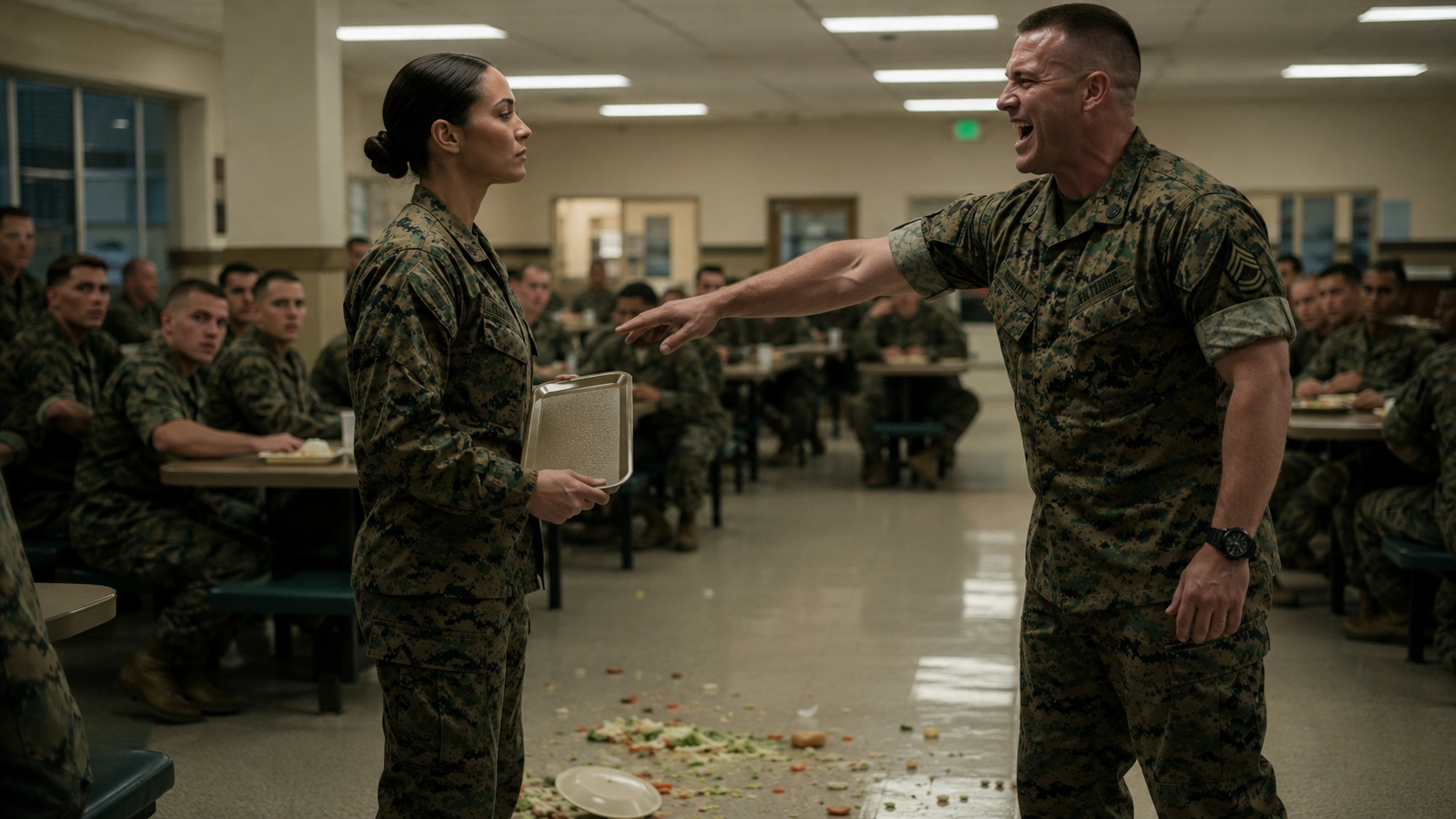
The metallic crash split through the mess hall like a gunshot, and every Marine in the room froze.
Staff Sergeant Derek Kowalski stood over her, arms folded, jaw set. She was maybe twenty-eight. Plain cammies. Regulation haircut. Nothing on her collar he’d bothered to look at. Nothing about her, in his estimation, said she belonged anywhere near the front of his line.
Two weeks ago, one of his junior Marines had put in a formal complaint against him. It had gone nowhere — buried in paperwork, quietly reassigned to the bottom of somebody’s desk. Kowalski had walked out of that meeting certain of one thing: nobody at Fort Redstone was going to touch him. Not the colonel. Not the IG. Nobody.
So when the woman in front of him didn’t move out of his way at the serving line — when she just stood there in unmarked cammies holding her tray like she had every right to be there — something in him decided to make an example.
He’d bumped her. Hard. On purpose.
She’d stumbled back.
And he’d knocked the tray out of her hands and laughed.
“Oops,” he said, loud enough for the tables behind him to hear. “Looks like you took a wrong turn, lady.”
She didn’t move.
Not right away.
She looked at him — not up at him the way junior Marines usually did when Kowalski used that voice. She looked at him. Like she was cataloguing something.
“I don’t think you know who I am,” she said.
Kowalski laughed. One short, dismissive sound.
“I know exactly who you are. Somebody who’s about to be somewhere else.”
A few NCOs nearby shifted in their seats. Something about the moment didn’t sit right, but no one could name it, so no one said anything.
The woman bent down, picked up the tray from the floor, and set it on the counter beside her. She straightened, took a single breath, and walked out of the mess hall without another word.
No argument. No tears. No scrambling.
Just exit.
And the silence she left behind didn’t lift.
Private First Class Tomas Reyes watched her go from his seat near the window. He’d only been at Fort Redstone three weeks. Still learning everything. But something about the way that woman walked bothered him.
“Sarge,” he said quietly to the Marine next to him, “that lady—”
“Eat your food, Reyes.”
He ate his food.
Outside, the afternoon air was dry and hot.
Major Eleanor Whitmore walked away from the building at a measured pace, pulled out her phone, and made one call.
“Colonel Voss.”
“Major.” His voice was careful. He’d been waiting.
“The IG team — confirm they’re in position.”
“Confirmed. All three units embedded as support staff since yesterday morning. Observation logs are already compiling.”
“Good.” She glanced back at the building. Through the windows, she could see figures moving, resuming meals, pretending the moment had already been forgotten. “Expand the review window. I want documentation on NCO conduct going back eighteen months. Grievance filings. Counseling records. Anything flagged and buried. In particular, pull everything on Staff Sergeant Derek Kowalski.”
A pause on the line.
“You think this goes deeper than one sergeant?”
“I think one sergeant wouldn’t have done that if he wasn’t certain he could. Someone taught him he could.”
She ended the call and kept walking.
Whitmore was not stationed at Fort Redstone. She had flown in forty-eight hours earlier from IG Command, driven herself from the airport in a rental car, checked into a room off-base under a routine TDY order, and reported to the installation the previous morning in plain cammies with her rank tabs and name tape swapped for a blank set — a standard IG observation protocol used exactly twice a year, on installations flagged by pattern analysis.
Fort Redstone had been flagged three months ago. A junior Marine’s buried complaint. A pattern of grievances that stopped mid-process. A staff sergeant named Kowalski whose file had one commendation for every two verbal counselings, none of which had ever escalated.
She had spent the previous afternoon observing three separate areas of the installation — motor pool, administrative services, training yard — before dinner.
The mess hall had been her last stop of the day.
It had told her more than all three combined.
Back inside, Kowalski was finishing his meal.
Corporal Dana Fitch slid into the seat across from him, glancing toward the door the woman had used.
“You know who that was?” Fitch asked.
“Someone who didn’t read the room.”
“She didn’t look like someone who doesn’t read the room.”
“She didn’t have rank on her collar. Case closed.”
Fitch let it drop.
But she didn’t stop thinking about it.
The woman’s posture. The way she’d held still after being shoved. The way she hadn’t raised her voice, hadn’t flinched, hadn’t done anything the way someone surprised or frightened would do it.
The way her eyes, after she stood back up, had moved across the room like she was counting something.
Fitch picked up her fork and looked down at her plate.
“Derek,” she said.
“What?”
“When’s the last time IG did an unannounced observation?”
Kowalski snorted. “They don’t do those.”
“Right,” she said.
She didn’t say anything else.
At 0530 the next morning, orders came down.
Command staff assembly. Briefing room. 0800. Mandatory. No exceptions.
Kowalski got the message while he was shaving. He wasn’t worried. Command assemblies happened. He’d been to a dozen. They were usually about readiness metrics or budget presentations or some new protocol someone at the Pentagon had decided was important.
He showed up at 0755 and took a position near the back of the room.
By 0800, everyone was there.
By 0801, no one was talking.
Because the woman from the mess hall had just walked through the door.
Except now her cammies had a name tape, rank tabs, and an IG shoulder brassard.
And the rank was Major.
Kowalski felt the blood leave his face before his brain had finished processing what his eyes were telling him. The woman — the nobody in the serving line — moved to the front of the room with the kind of unhurried authority that doesn’t need announcement. The room adjusted to her the way a room full of trained professionals adjusts when IG walks in.
The base commander, Colonel James Hartwell, was already pale.
The IG officer who had accompanied her stood near the wall, a tablet in his hand, expression neutral.
Whitmore set a thin folder on the table.
She did not say good morning.
“This installation has been under Inspector General review since 0600 the day before yesterday,” she said. “The findings will be formally submitted within seventy-two hours. What I am about to address with you now is not the full picture. It is the frame.”
No one breathed.
“A unit’s culture is not determined by its best day,” she said. “It is determined by what it does when no one is watching.”
She opened the folder.
“Yesterday, I conducted an observation of this facility in unmarked cammies. In the motor pool, I observed two junior enlisted Marines being corrected in front of their peers using personal insults rather than performance guidance.” She turned a page. “In administrative services, I observed a senior NCO ignore a formal request for counseling documentation from a junior Marine. Documentation that Marine has a right to under regulation.” Another page. “In the mess hall, I was physically assaulted by a staff sergeant who, without verifying my identity, my rank, or my access authorization, chose to escalate a moment of ordinary line traffic into a public act of humiliation.”
She looked up.
The room was a collection of statues.
“Staff Sergeant Kowalski.”
His body responded before he’d decided to let it. He stepped forward.
“Ma’am.”
She looked at him. Not with anger. Worse than anger. With assessment.
“When you knocked that tray out of my hands yesterday, what outcome were you expecting?”
He swallowed. “Ma’am, I believed the individual was—”
“That’s not what I asked.” Her voice didn’t rise. “What outcome did you expect for yourself?”
Silence.
“None, ma’am.”
“Because?”
The word was a scalpel.
He opened his mouth. Closed it.
“Because I thought… there wouldn’t be one.”
Whitmore nodded slowly.
“That answer,” she said, “is the most useful thing you’ve said since I arrived at this installation.”
She turned back to the room.
“The individual actions I observed yesterday are not the issue. They are symptoms. The issue is an environment in which certain individuals have concluded, correctly, that accountability is selective.” She paused. “That is a command failure. Not a personnel failure. A command failure.”
The word landed on Colonel Hartwell like something physical. He didn’t move.
“The Inspector General review will identify structural changes required within this command,” Whitmore continued. “Those changes will be implemented. In the meantime, effective immediately, Staff Sergeant Kowalski is relieved of his current supervisory duties pending formal review. His prior grievance file — the one filed against him two weeks ago and quietly reassigned — has been recovered and reopened.”
Kowalski didn’t protest. Didn’t argue. Couldn’t.
“That is not punishment,” Whitmore said, almost as if she’d read the room. “That is the beginning of a correction. There is a difference.”
She closed the folder.
“You are all dismissed with the exception of Colonel Hartwell and the unit NCO leads. We will meet individually beginning at 0830.”
Chairs moved. People filed out.
Kowalski was the last to leave. At the door, he paused.
He didn’t turn around.
But he stopped.
“Staff Sergeant.”
Her voice reached him without effort.
He turned halfway.
“A leader who can only lead people who don’t know better,” she said, “is not a leader. He’s a pressure system.” She held his gaze. “You have the record of someone who could have been more than that. That door is not closed. But it doesn’t open from where you’re standing right now.”
He held her gaze for one second.
Two.
Then he nodded, once, and walked out.
Corporal Fitch caught up with him in the corridor.
“Derek—”
“Don’t.”
“I’m not going to say I told you so.”
“Then don’t say anything.”
She fell into step beside him anyway. They walked in silence for a moment down the corridor, past two junior Marines who lowered their eyes and moved to the side.
“Was it her?” Fitch said finally. “The woman from yesterday?”
“Yeah.”
“Major?”
“Yeah. IG.”
She exhaled slowly through her nose. “How long do you think she was watching before the mess hall?”
Kowalski stopped walking.
He hadn’t thought about that.
He stood still for a moment in the corridor, and for the first time since yesterday afternoon, something that wasn’t defensiveness moved through him.
Something colder.
Something closer to understanding.
“Long enough,” he said.
By midday, the base had changed its posture.
Not dramatically. Not in any way a photograph could capture.
But Reyes noticed it at lunch when he went back through the serving line and nobody rushed him. When a senior corporal helped him carry his tray without being asked. When the noise level in the mess hall had a different quality — not quieter exactly, but more even. Less performance.
He sat with his food and thought about the woman from yesterday.
He’d heard the story by now. Everyone had.
A PFC two seats down leaned over.
“Crazy, right? That she just walked in like that?”
“Yeah,” Reyes said.
“You think she planned it?”
Reyes thought about it.
“I think she knew exactly what she was doing,” he said. “From the second she walked in.”
He ate his food.
That afternoon, Whitmore walked the base again — this time in full uniform.
She had already spent four hours in back-to-back interviews with NCO leads — not interrogations, conversations. Direct, documented, deliberate. She asked each of them the same baseline question:
When was the last time a junior Marine under your supervision told you something that changed a decision you were about to make?
The answers had been informative.
Seven out of twelve could not think of an example.
Three gave examples that, on examination, turned out to be situations where the junior Marine had simply confirmed what the NCO already intended to do.
Two gave real answers.
She filed all of it.
Now she walked through the motor pool, the training yard, the administrative wing. Not to be seen — although now she was seen. To see.
At the far end of the training yard, a group of junior Marines were running a technical drill under the guidance of a young sergeant she hadn’t interviewed yet. She paused at the edge and watched.
The sergeant corrected one Marine’s form.
Then explained why.
Then asked the Marine to demonstrate it back and confirmed when he got it right.
Clean. Functional. Respectful.
She noted the name on his cammies and moved on.
That was the point.
Colonel Hartwell found her at the east edge of the installation at 1630, looking out toward the perimeter road.
“Major.”
“Colonel.”
He stood beside her.
“I want you to know,” he said after a moment, “that yesterday’s incident in the mess hall—”
“Was one data point.”
“—was not representative of what I’ve tried to build here.”
She was quiet for a moment.
“The sergeant who assaulted me,” she said. “He didn’t act the way he did because you failed to create a policy against it. He acted the way he did because the environment made him believe he could. That’s different.” She turned to look at Hartwell. “The policies are mostly fine, Colonel. The culture isn’t. And culture doesn’t come from policy. It comes from what leadership models every day — and what leadership tolerates.”
He looked at the ground.
“The IG review,” she said. “Cooperate fully. Don’t manage the narrative. Don’t protect people who need correction. The review isn’t the enemy of this installation. It’s the instrument of its recovery.”
“Yes, ma’am.”
“The NCO leads — two of them gave me answers today that suggested real leadership instincts. Sergeant Okonkwo and Sergeant Park. Put them in expanded mentorship roles during the transition period. Build around what’s working.”
He nodded, pulling out a small notebook.
“And Kowalski?” he asked.
“Reassigned to a non-supervisory role pending review. If the review finds no deeper pattern of abuse beyond what we already have, he goes into a structured performance improvement track. He’s got twelve years of service. That’s not nothing.” She looked back toward the perimeter. “Throwing people away is easy. Fixing the system that produced them is harder. We do the harder thing.”
Hartwell was quiet.
“Permission to speak freely, Major?”
“Always.”
“Why didn’t you identify yourself? When he shoved you. You could have — it would have been enough.”
She let the question sit for a moment.
“Because if I had identified myself the moment I was challenged, I would have only learned what this unit looks like when it knows it’s being watched.” She glanced at him. “I already know what that looks like. I needed to know what it looks like when it doesn’t.”
He nodded slowly.
“And now you know.”
“And now I know.”
She looked at her watch.
“The preliminary IG report will reach your desk by 0700 tomorrow. Read it in full. Don’t delegate. Come prepared to discuss section four in particular — it addresses a pattern in grievance handling that predates your command and is not your fault. But it is your responsibility to correct.”
“Understood.”
“Good night, Colonel.”
“Good night, Major.”
She walked back toward the gate.
Behind her, Fort Redstone was settling into evening routine. Shift changes. Mess hall second service. The distant sound of a vehicle making rounds.
It sounded almost the same as it had yesterday.
But it wasn’t.
Because the people inside it knew, now, that the Marine eating quietly in the corner might be watching.
And that was enough.
That was always enough.
The next morning, before she left the base, Whitmore stopped in the mess hall one final time.
She took a tray.
She stood in line.
A young corporal behind the counter looked up at her — saw the rank on her collar, went rigid — and she shook her head slightly.
“Just a plate,” she said.
He gave her a plate.
She found a seat near the window. Ate slowly. Let the noise of the room settle around her — the conversations, the clanging trays, the machinery of a large organization going about its morning.
PFC Reyes walked past her table, paused, and then — not fully sure why — stopped.
“Ma’am,” he said.
She looked up.
“Good morning, Private.”
“I was in here yesterday,” he said. “When the—” He stopped. “I didn’t say anything. When he shoved you. I didn’t do anything.”
She looked at him for a long moment.
“Why are you telling me that?”
“Because I’ve been thinking about it all night,” he said. “And I think I should’ve said something.”
She set down her fork.
“How long have you been here?”
“Three weeks, ma’am.”
“And in three weeks, what have you learned about what happens to junior Marines who speak up?”
He was quiet.
“That it usually doesn’t go well for them,” he said.
“So you made a calculated assessment,” she said. “Under social pressure, in an environment you hadn’t fully mapped yet, you defaulted to safety.” She picked up her fork again. “That’s not cowardice, Private. That’s three weeks of training telling you to observe before you act.” She met his eyes. “The fact that you’ve been awake all night thinking about whether that was right — that’s the instinct we build careers on.”
He stood there for a moment.
“What do I do with that, ma’am?”
“You remember it,” she said. “And next time, you’ll act on it.”
He nodded.
“Yes, ma’am.”
He walked to his table.
Whitmore finished her meal.
She returned her tray, walked out of the mess hall, got into her car, and drove toward the gate.
The IG review would run for thirty more days. Kowalski’s performance track would take six months minimum. The cultural restructuring of NCO leadership would take longer — a year, maybe more, of sustained attention and accountability from Hartwell.
None of it happened in a dramatic moment.
None of it came with music.
It came with paperwork, and meetings, and decisions made at 0600 by people who chose, again and again, to do the harder thing.
That was how it worked.
That was how it had always worked.
At the gate, the sentry — a young lance corporal — straightened when her car approached, rendered a sharp salute, and held it.
She returned it with equal precision.
Then she drove off base.
And Fort Redstone, behind her, began the work of becoming what it was supposed to be.
Original fictional stories. AI-assisted creative content.