The knock came at 12:17 a.m.
Three hard raps on steel. Not the drunk kind. Not the cop kind. The kind that knows it’s asking for something it has no right to ask for.
Travis straightened up from the carburetor. “Nobody knocks on that door this late, Marcus.”
“I heard it.”
Earl wiped his hands on a rag. “Could be trouble.”
“Could be somebody else’s trouble that just became ours,” I said.
I walked to the door slow. Not scared. Just careful. Eleven years as president of the River Reign Riders teaches you that rushing gets people hurt.
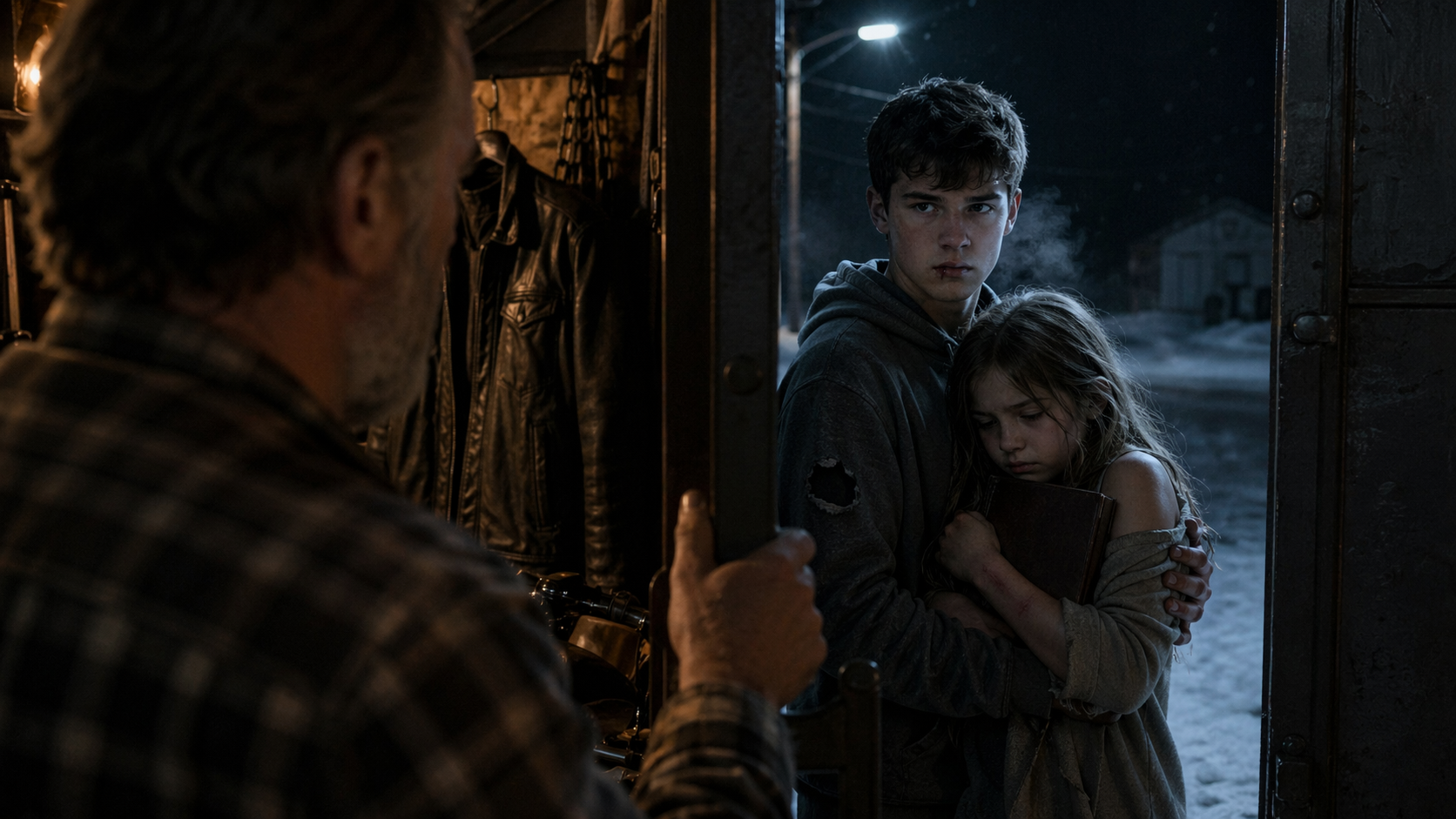
I cracked the door six inches.
A boy stood under the flickering light, maybe sixteen, lip split, hoodie torn at the cuff. In his arms, a little girl clutching a paperback against her chest like it was body armor.
“Please,” the boy said. “Just for tonight. I swear we’ll be gone by sunrise.”
“What’s your name, son?”
“Noah. This is Lily. She’s my sister.”
“How old?”
“Sixteen. She’s ten.”
The girl wouldn’t look up. Her sleeve rode up when she shifted, and I saw the bruises on her wrist. Old ones. New ones. The kind that come in layers.
“Where are your parents, Noah?”
“Mom died two years ago.”
“And your dad?”
“Stepdad. Raymond Cutter.” He said it like the name burned going out. “He’s not somebody you want showing up here.”
Behind me, Travis shifted. “That name’s gonna follow him, Marcus.”
I knew it was. I knew it the second the kid said it.
I stepped aside anyway.
“Get in here. Both of you.”
The door shut behind them with a sound that felt heavier than it should have.
Lily stood in the middle of the garage like she’d been dropped on the moon. Her eyes moved over the bikes, the vests on the hooks, the tattoos, the boots. I wondered what she’d been told about men like us. I wondered who’d told her.
Travis came out of the kitchenette with a mug. “Hot chocolate. It’s too sweet for me anyway.”
She took it with both hands. “Thank you,” she whispered.
It was the softest thank you I’ve ever heard.
Noah didn’t sit. He scanned exits. Counted windows. Calculated.
“When’d you last sleep, kid?” I asked.
“Doesn’t matter.”
“It matters here,” Earl said.
Noah’s jaw worked. He didn’t answer. But twenty minutes later, sitting on a folding cot with a blanket we’d pulled from the cabinet, his head tipped forward and he was gone. Out like a blown fuse.
Travis watched him sleep. “You know this doesn’t end at sunrise.”
“I know.”
“The second that man finds out where they are—”
“I said I know, Travis.”
Earl poured three cups of coffee. “So what are we doing, Marcus?”
“We’re doing what anybody with a pulse would do. We’re keeping them safe until we figure out the rest.”
“And the rest?”
I looked at Lily, curled up in a chair with the mug still in her hands, finally asleep, her fingers loose around the cup for the first time all night.
“The rest,” I said, “we’ll handle.”
By 9 a.m. we had a name, a photo, and a problem.
Raymond Cutter. Forty-four. Contractor, on paper. Clean enough public record to shake hands at church fundraisers. Dirty enough that three different people we called knew to lower their voice when we said his name.
“He runs with Bracken’s crew out of Middletown,” Earl said, setting his phone down. “Part-time. Enforcement. Nothing that ever got filed.”
Travis leaned against the workbench. “Bracken hates us.”
“Bracken hates everybody.”
“Yeah, but he hates us specifically.”
I sat down across from Noah at the office table. He was awake now, hands wrapped around a coffee he wasn’t drinking.
“Noah, I need to tell you something, and I need you to hear me.”
“Okay.”
“Your stepdad runs with people who don’t like this club. If he finds out you’re here, it won’t just be him coming. And if we react the way he wants us to react, we hand him exactly what he needs.”
Noah’s eyes went hard. “I won’t let him take her back. I don’t care what it costs.”
“You won’t have to.”
“You don’t know him.”
“I know enough.”
“He broke her arm last year.” Noah’s voice was flat. Controlled. That scared me more than if he’d yelled. “He told the ER she fell off the porch. She was seven. She weighed fifty-two pounds. He said she fell off a two-step porch and snapped her radius.”
I didn’t say anything for a long moment.
“Nobody’s taking her back, Noah.”
“You don’t know that.”
“I do know that. Because I’m telling you right now.”
He looked at me. Really looked. And for the first time since he’d walked through the door, something in his shoulders came down a quarter inch.
“Okay,” he said.
“Okay.”
Two nights later, a brick came through our front window.
The note was wrapped in rubber bands. Three words. Send them back.
Travis was on his feet before the glass stopped falling. “That’s it. Let’s go.”
“Sit down.”
“Marcus—”
“I said sit down.”
“They threw a brick through our window!”
“And that’s exactly what they want us to respond to.”
Earl was already sweeping glass. He didn’t look up. “He’s right, Travis. If we ride out tonight, we’re the violent biker gang that started a war over a domestic. That’s the story. That’s the only story.”
“So we just eat it?”
“No,” I said. “We play the long game.”
Travis laughed, but there was nothing in it. “Long game. They got a ten-year-old in their crosshairs, Marcus.”
“I know how old she is. I know exactly how old she is. That’s why we’re not doing this their way.”
I picked up the note. Read it again. Three words. A threat and a dare, both.
“Earl. Call Detective Morales.”
Earl looked up. “You’re sure?”
“I’m sure.”
Here’s what most people don’t know about Dayton.
There’s a difference between the cops who hate us and the cops who just don’t trust us. The ones who hate us, you avoid. The ones who don’t trust us, you can work with, if you give them a reason.
Detective Elena Morales worked a desk in financial crimes. Twenty-two years on the force. She’d crossed paths with our club three times, and three times she’d walked away knowing we weren’t who the papers said we were.
She came in through the side door on a Thursday afternoon. Plain clothes. Alone.
She looked at Lily coloring at the office table. She looked at Noah reading a paperback next to her. She looked at me.
“Marcus.”
“Detective.”
“Tell me what I’m looking at.”
I told her. All of it. The knock. The bruises. The brick. The name.
She listened without interrupting. When I finished, she took a long breath.
“Raymond Cutter,” she said.
“You know him?”
“I know of him. We’ve been building something for a year and a half. Shell companies. Missing receipts. A contracting business that cashes checks for work that never happened.”
Travis leaned forward. “How close are you?”
“Close enough that if somebody gave me a reason to knock on his door today, I wouldn’t say no.”
I glanced at Noah. He was watching her like she was a door he didn’t know whether to walk through.
“Noah,” I said. “This is your call. You want to tell her what you told me?”
He swallowed. Looked at Lily. Looked back at Morales.
“Yeah,” he said. “I’ll tell her.”
The interview took four hours.
Morales sat across from Noah with a recorder and a notebook. Lily stayed in the corner with Earl, drawing motorcycles with flowers in the spokes.
I stood in the doorway. Not interfering. Just present.
Noah talked about the ER visit. The locked basement door. The money his mom had left in a savings account that Cutter had drained in six months. The letters from the school Cutter had thrown away. The night Lily had tried to call 911 and Cutter had smashed her hand with the phone.
Morales wrote it all down.
At the end, she closed her notebook.
“Noah. I have to ask you something, and I need an honest answer.”
“Okay.”
“Is there anywhere else you could go? Any family. Any friends. Anyone at all.”
He thought about it. A long time.
“No,” he said. “There’s nobody.”
Morales nodded slowly. “All right. Then here’s what happens next. I’m going to talk to a judge tonight. I’m going to get an emergency protective order. Tomorrow, I’m going to talk to my captain about the financial case. And by the end of next week, if I do my job right, Raymond Cutter is going to be looking at the inside of a room he can’t leave.”
Noah’s face didn’t move. But his hands were shaking.
“And Lily?” he said.
“Temporary guardianship,” Morales said. “We’ll need somebody the court approves of. Somebody with a stable residence, no priors, willing to take responsibility.”
Everybody in the room looked at me.
I looked at Lily.
Lily looked up from her drawing and, very quietly, said, “Can I finish this first?”
“Yeah, sweetheart,” I said. “Take your time.”
Raymond Cutter was arrested on a Tuesday.
It wasn’t the dramatic raid Travis had wanted. No kicked-in doors. No shouting. Morales and two detectives walked into his office at 2:47 p.m. with a warrant, and forty minutes later he walked out in cuffs in front of his secretary and three clients.
The domestic charges came first. Then the financial charges. Then the federal charges, because it turned out Cutter had been running invoices through a shell company that touched federal contracts, which is the kind of thing that turns a county problem into a different pay grade entirely.
The bond was denied.
Bracken’s crew, when asked, claimed they barely knew the man.
Funny how that works.
The brick through our window turned out to be the last move Bracken made.
Not because he suddenly grew a conscience. Because the second Cutter’s name hit the papers, anybody connected to him was on fire, and Bracken had the self-preservation instincts of a man who’d been dodging charges for thirty years.
Word came back to us through a mutual acquaintance. This whole thing’s done. The kid’s not coming back. Don’t push it.
Travis wanted to push it anyway.
“One ride,” he said. “Just to make a point.”
“The point’s already made,” I told him. “We made it by not riding.”
He didn’t like it. But he understood it. That’s the thing about Travis. He runs hot, but he learns.
The guardianship hearing was on a Wednesday in April.
I wore the only suit I owned. Earl came with me. Travis watched the clubhouse.
The judge was a woman in her sixties with reading glasses on a chain and a face that had heard every story twice. She read my file. Read the background check. Read Morales’s report. Read the letter Noah had written.
She looked up over the glasses.
“Mr. Hale.”
“Your Honor.”
“You understand what you’re taking on.”
“I believe I do, ma’am.”
“A ten-year-old girl with trauma. A sixteen-year-old boy who’s been his sister’s parent for two years. School enrollments. Therapy. Medical records. Parent-teacher conferences.”
“Yes, ma’am.”
“In a motorcycle clubhouse.”
“No, ma’am. I have a house. Three bedrooms. In Kettering. I’ve owned it for nine years. The clubhouse is where I work. The house is where they’ll live.”
She looked at me over the glasses a long moment.
“You’ve thought about this.”
“I’ve thought about very little else for the past two months, Your Honor.”
She signed the paper.
I drove them home in the truck that night. Lily in the middle. Noah by the window. Neither of them spoke for the first ten minutes.
Then Lily said, “Is it far?”
“About twenty minutes.”
“Does it have stairs?”
“It has stairs.”
“Can I have the room that’s farthest from the door?”
I glanced at her. “Yeah. You can have whichever room you want.”
“Is there a lock?”
“On every door.”
She nodded once, small and tight, and went quiet again.
Noah spoke without turning his head. “Marcus.”
“Yeah.”
“If we mess this up—”
“You’re not gonna mess it up.”
“But if we do—”
“Noah. Look at me.”
He looked.
“You’re not going back. Not to him. Not to anywhere like him. That’s not how this ends. You understand me?”
He swallowed. “Yeah.”
“Say it.”
“I understand.”
“Good.”
The rest of the drive, nobody said anything. But Lily’s hands, which had been clenched in her lap, slowly opened.
The first night in the house, Lily wouldn’t sleep in the bedroom.
She dragged her pillow to the hallway and curled up outside Noah’s door.
I didn’t argue. I just brought her a blanket and left the hall light on.
The second night, she slept half in the bedroom, half in the doorway.
The third night, she closed the door.
On the fourth night, she came into the kitchen at 11 p.m. and stood in the doorway holding her paperback.
“Marcus?”
“Yeah, sweetheart.”
“Can I ask you something?”
“Anything.”
She held the book up. It was a beat-up copy of Charlotte’s Web. The spine was held together with packing tape.
“Will you read me a chapter?”
I was fifty-three years old. I’d been in two bar fights, one motorcycle accident, and a courtroom. I’d buried my father and my best friend. I’d carried a ten-year-old’s paperwork through four different offices.
None of it hit me the way that question hit me.
“Yeah,” I said. “I’ll read you a chapter.”
We read three.
A year went by.
Noah got his GED and started classes at Sinclair. He wanted to be a paramedic. Said he was tired of being the one who showed up at the ER — wanted to be the one who showed up before that.
Lily started fifth grade at a school where nobody knew her last name. She joined the art club. She brought home a certificate for perfect attendance. She hung it on the fridge with a magnet shaped like a motorcycle.
Raymond Cutter took a plea. Nine years, federal. No parole on the federal charges. His lawyer tried for less and got laughed out of the room.
Morales stopped by the clubhouse one afternoon in October, just to say hello. Lily showed her a drawing of a motorcycle with sunflowers in the spokes. Morales asked if she could have it.
Lily said yes, but only if Morales promised to hang it up.
Morales hung it in her office. I saw it there two months later when I stopped by to drop off paperwork.
Two years after the knock at the door, Noah graduated top of his paramedic certification class.
The ceremony was in a high school auditorium on the west side. Fluorescent lights, folding chairs, a stage with a cheap podium.
I sat in the third row with Earl and Travis. Lily sat next to me in a bright blue jacket. Twelve years old now. Taller. Her wrists clear. Her eyes up.
When they called Noah’s name, she stood on her chair to see him better.
Nobody told her to sit down.
Noah walked across the stage, shook the instructor’s hand, and took his certificate. He paused at the microphone.
“I want to thank my sister, Lily,” he said. “Who kept me going when I wanted to quit.”
He paused.
“And I want to thank Marcus Hale. Who opened a door.”
I don’t cry. I want that on record. I don’t cry.
But I wiped my eyes with the back of my hand, and Lily saw me do it, and she took my hand in both of hers and didn’t let go until Noah had walked all the way back to his seat.
On the ride home, Lily sat in the passenger seat of the truck with her brother’s certificate on her lap.
“Marcus?”
“Yeah.”
“Do you remember what I was holding when I knocked on your door?”
“Charlotte’s Web.“
“I still have it.”
“I know.”
She was quiet for a minute.
“I was going to leave it with you,” she said. “If you said no. I was going to leave it on the step, so you’d know somebody had been there. So somebody would know we were real.”
I gripped the wheel a little tighter.
“Lily.”
“Yeah?”
“I’m really glad I said yes.”
She looked out the window. The streetlights went by slow.
“Me too,” she said.
People ask me sometimes what the hardest part was.
They expect me to say the court dates. Or the threats. Or the brick through the window.
It wasn’t any of that.
The hardest part was the quiet. The nights when Lily would sit at the kitchen table doing her homework, and I’d realize I had no idea how to help with fifth-grade math. The Saturday mornings when Noah would make pancakes and hum a song his mother used to sing, and I’d have to leave the room because I didn’t want him to see my face. The parent-teacher conference where a woman I’d never met shook my hand and said, You must be so proud of her, and I realized I was. I was so proud of her I couldn’t speak for a second.
The hardest part was learning that love isn’t loud. It’s a hallway light left on. It’s a chapter of Charlotte’s Web at 11 p.m. It’s a blue jacket with no marks on the wrists underneath.
The door at the clubhouse is still steel. It still makes the same heavy sound when it closes.
But when I hear a knock at midnight now, I don’t hesitate anymore. I don’t weigh it. I don’t argue with Travis about whether to open it.
I just walk over, and I open it.
Because somebody opened one for me a long time ago, and I didn’t know it until the night Noah and Lily knocked on mine.
And now I know.
Original fictional stories. AI-assisted creative content.