Every Sunday, Caleb Warren rode the back roads of northern Idaho alone.
Three years since the accident. Three years of white lilies, gravel paths, and a silence that never got easier.
He was six-foot-three, leather vest, graying beard. People crossed the street when they saw him coming. They didn’t know he was just a father who couldn’t stop visiting a small grave in Pine Hollow Memorial Cemetery.
That Sunday, the fog hadn’t lifted yet.
He killed the engine, pulled the lilies from his saddlebag, and started up the gravel path. Same route. Past the crooked angel statue Lily used to call “sad and tired.” Past the row of oaks.
Then he stopped.
Someone was kneeling at his daughter’s grave.
A small figure, hunched over the dirt, hands scraping at the soil. Caleb’s chest locked. This was sacred ground. This was his child.
“Hey!” he shouted.
The figure flinched and scrambled backward. Not a vandal. A boy. Maybe twelve, soaked hoodie hanging off him like it belonged to someone else.
“I didn’t mean to!” the boy cried. “I was just trying to fix it!”
Caleb closed the distance. “What are you doing here? Who are you?”
“I’m sorry. I’m really sorry.”
“Empty your hands.”
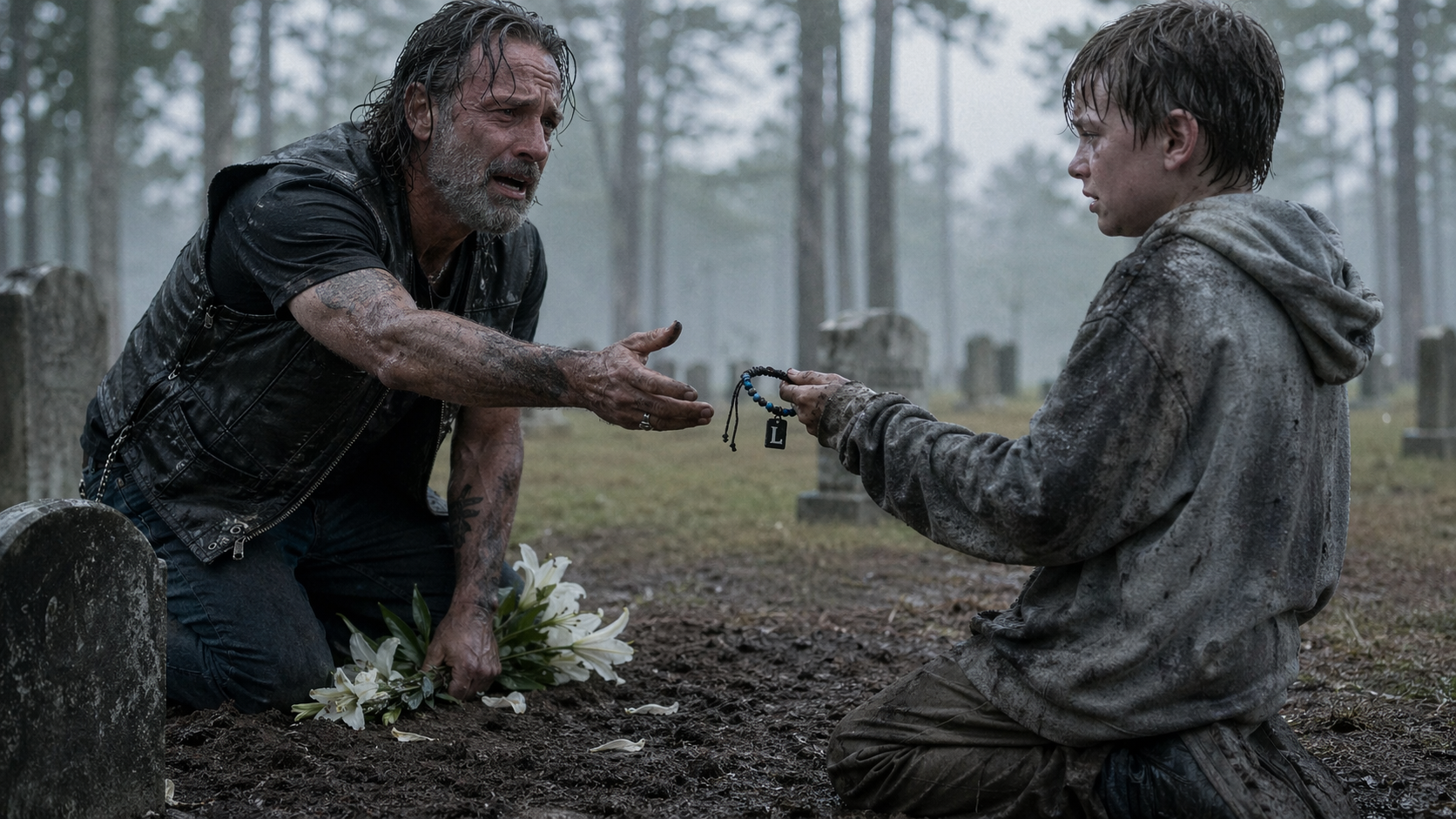
The boy hesitated. Then slowly opened his fist.
Caleb’s world tilted.
Lying in the boy’s palm was a worn leather bracelet with faded blue beads. A single stitched letter on it: L.
Lily’s bracelet.
He had tied it on her wrist himself. Before they closed the casket.
“Where did you get that?” Caleb whispered. “That doesn’t belong above ground.”
The boy burst into tears. “The rain uncovered it months ago. I didn’t steal it, I swear. I’ve been keeping it safe. I was putting it back so she wouldn’t lose it again.”
Caleb dropped to his knees. Mud soaked through his jeans. He didn’t feel it.
“What’s your name?”
“Miles.”
“How do you know my daughter, Miles?”
The boy’s shoulders shook. “She was my only friend. And she died because she was trying to help me.”
Caleb’s hands went cold.
“Tell me.”
Miles wiped his nose with a wet sleeve. “I used to sleep behind the old diner on Third Street. Where her mom worked. Lily saw me one day. She brought me a sandwich wrapped in a napkin. Next day, another one. She drew little suns on the napkins.”
He swallowed hard.
“She wrote notes on them. ‘You matter.’ ‘Tomorrow will be better.’ Stuff like that. She said nobody should be cold alone.”
Caleb remembered. That was Lily. That was exactly Lily.
“The night she died,” Miles said, voice breaking, “it was freezing. Rain turning to ice. She saw me shaking. She said, ‘Wait right here. I’ll bring you a blanket from home. I’ll be right back.'”
He looked up at Caleb.
“I waited all night, mister. She never came back.”
Caleb remembered that night too. Lily had begged to run back out after dinner. He’d said no at first. She’d insisted. She’d said it was important.
He’d thought she was being reckless.
She’d been brave.
Caleb closed Miles’s fingers around the bracelet.
“You keep it.”
“But it’s hers—”
“She would want you to have it.”
Miles stared at him like he didn’t understand the words.
“Where do you sleep now, Miles?”
The boy looked at his shoes. “Under the highway bridge off Route 9.”
“Show me.”
The ride was quiet. Miles clung to Caleb’s jacket, stiff for the first mile, then slowly loosening as the bike’s warmth reached him.
Under the bridge, Caleb saw cardboard flattened into a mattress. A torn sleeping bag. A shoebox. Inside the shoebox, folded carefully like treasure, were Lily’s notes. Every one.
Caleb pulled off his leather vest and draped it over the boy’s shoulders. It swallowed him.
“You’re not sleeping here tonight.”
“I don’t have anywhere else.”
“Yes you do.”
Miles looked up at him, eyes red.
“Why?”
“Because my daughter made you a promise,” Caleb said. “And I’m keeping it for her.”
The Iron Ridge Motorcycle Club went dead silent when Caleb walked through the door with a homeless kid behind him.
Twenty men at the bar. Pool game stopped mid-shot.
“Brothers,” Caleb said. “I need to tell you something.”
He told them everything. About Lily. About the diner. About the blanket she never delivered. About the bracelet in the mud.
Nobody interrupted.
When he finished, an old biker named Hank set down his beer.
“What are you asking, Warren?”
“I’m asking the club to stand with me. The boy stays with me. He’s mine now.”
Hank looked at Miles. Miles was trying not to cry.
“All in favor?”
Every hand went up.
Someone shouted, “Get him a vest!”
A week later, Miles had one. Small, black, with a single word stitched across the back: FINCH.
“Small doesn’t mean weak,” Hank told him. “Finches survive winters nobody else does.”
Miles went back to school. He slept in a real bed for the first time in two years. Caleb taught him how to change oil. Miles taught Caleb how to make grilled cheese without burning it.
One night, Miles sat cross-legged on his bed, bracelet in his palm.
“She used to write ‘tomorrow will be better’ on the napkins,” he said. “I didn’t believe her.”
Caleb sat down beside him.
“And now?”
Miles looked around his room. The desk. The warm lamp. The framed picture of Lily on the shelf.
“She was right.”
Caleb nodded. “She usually was.”
Three years later, a line of motorcycles stretched a mile long down the road to Pine Hollow Cemetery.
Hundreds of riders. Each one carrying a single white lily.
Miles stood at the front, sixteen now, taller than Caleb expected, wearing the FINCH vest that finally fit. The bracelet was on his wrist.
He stepped up to the microphone in front of Lily’s grave.
“She didn’t bring me a blanket that night,” Miles said. The crowd went still. “But she brought me something better.”
He looked at Caleb. Caleb’s jaw was tight.
“She brought me a family.”
Grown men in leather wiped their eyes and didn’t pretend otherwise.
Miles walked to the grave and laid his lily down. Then he turned and hugged Caleb — a full, chest-to-chest hug, the kind a son gives a father.
Caleb held him for a long time.
“She sent you to me,” Caleb said into the boy’s hair. “I know that now.”
“I know,” Miles whispered back.
They rode home together as the sun dropped behind the pines, two riders on one long road, and for the first time in six years, Caleb Warren didn’t feel the weight in his chest.
He felt his daughter. Keeping her promise. Through the boy riding behind him.
And he was, finally, not alone.
Original fictional stories. AI-assisted creative content.