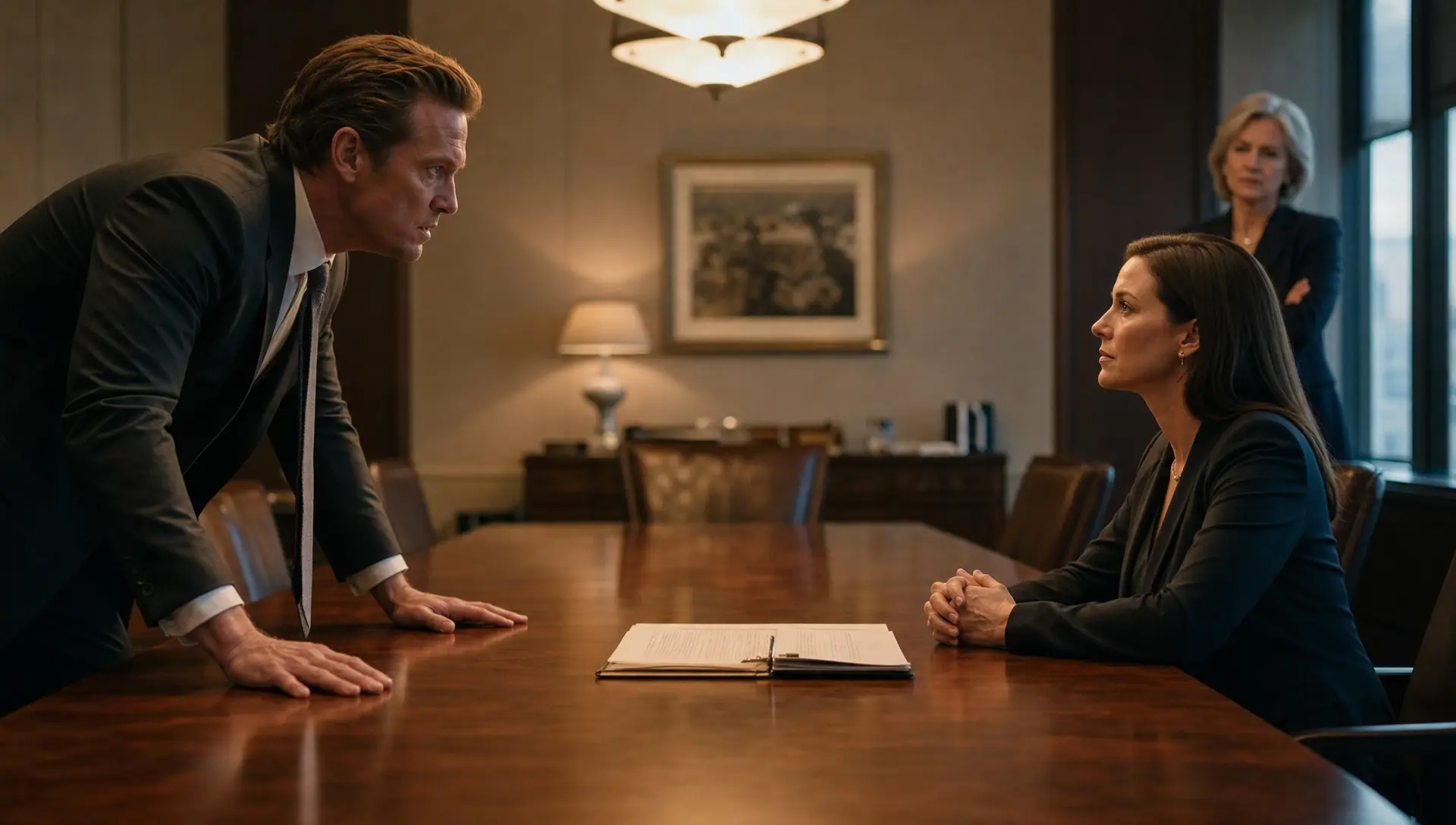
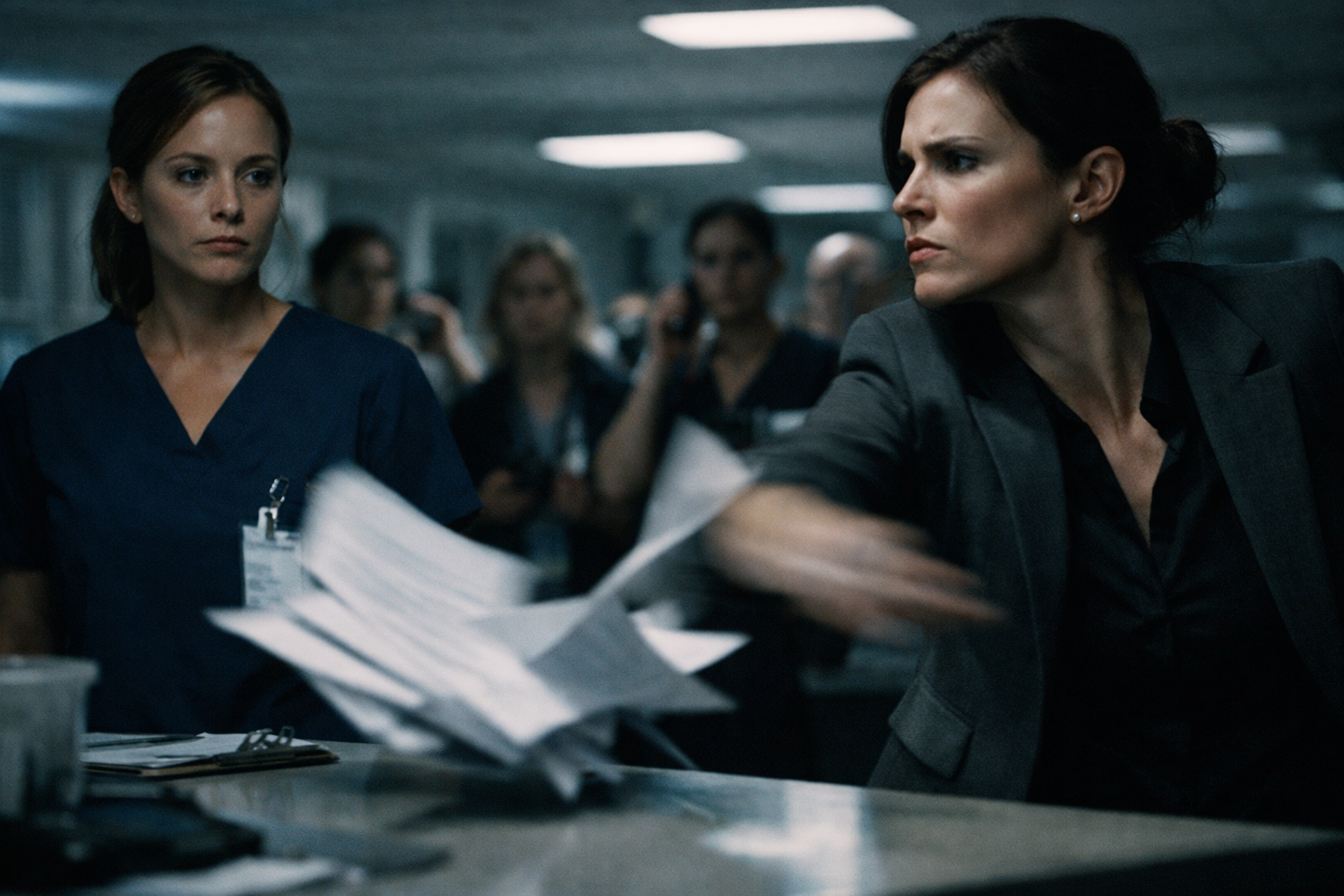
The folder hit the floor between them.
Sandra Holt didn’t look down. She stood at the nurses’ station with her arms crossed and her chin up, breathing hard through her nose, the way she always did when she’d decided something was final.
“Pack your things and get out,” she said. “You’re done here.”
Twelve staff members turned. Three patient families looked up from the waiting area. A charge nurse named Rachel Torres quietly opened Instagram Live on her phone and held it at her side.
Dr. Claire Mercer — currently listed in the hospital employee system as Nurse C. Mercer, per her own instructions — didn’t move. Her navy scrubs were wrinkled from a sixteen-hour shift. Hair pulled back. Hands loose at her sides.
She looked at the papers spread across the linoleum. Then she looked at Sandra.
“What specific policy violations are you citing?”
Sandra laughed — sharp, dismissive. “Policy? This isn’t about policy. This is about you. It’s always been about you.” She stepped forward. “You undermine me every time I walk into this unit. You go around me, you question me in front of my staff, you act like you run this floor.”
Rachel’s phone showed 34 viewers. Then 71. Then 128.
Tori, a nursing student standing by the supply closet, went completely still.
“And don’t think about applying anywhere else in this city,” Sandra continued. “I have fifteen years of connections here. Your career in nursing is finished.”
Dr. Ellen Park, an attending physician, stepped forward carefully. “Sandra — maybe we should handle this privately?”
“No need.” Sandra didn’t look at her. “This is exactly where it should happen. In front of everyone.”
Claire continued standing where she was. Pen in hand. Small leather notebook open. Writing.
“Have you consulted the board of directors about this decision?”
Sandra’s eyes narrowed. “Board of directors? They don’t involve themselves in personnel matters. I am the authority here. I decide who stays and who goes on this floor.”
The hospital’s main phone began ringing at the front desk. Rachel’s stream hit 287.
Pam Briggs, assistant administrator, hurried toward the unit. “What’s happening here?”
“Personnel issue,” Sandra said smoothly. “Nearly handled.”
Pam frowned. No termination memo had crossed her desk.
“Six minutes,” Sandra announced, checking her watch.
Danny Walsh, one of the responding security guards, approached slowly. Something about the woman in scrubs nagged at him — a face from somewhere important, somewhere that wasn’t a hospital floor — but he couldn’t place it.
“Ma’am,” he said quietly. “I’m sorry, but we need you to gather your things.”
His partner Mike looked equally uncomfortable. Neither had details. Only orders.
Claire walked to her locker. She entered the combination with steady fingers. Inside: a Harvard Medical School diploma in a protective sleeve. A stack of business cards. Legal documents in a manila folder.
She placed the diploma in her bag. A pair of first-class airline ticket stubs sat visible at the top of her purse.
“Four minutes,” Sandra called out to the room. “Let this be a lesson. Ambition without loyalty gets you exactly this.”
Rachel’s screen showed 1,104 viewers.
Tori finally spoke. Voice small but steady. “This isn’t right.”
Sandra turned. “Excuse me?”
“She’s the best nurse on this floor. You know that.”
“You’re a student,” Sandra said flatly. “Students don’t weigh in on personnel decisions. Remember that when you’re applying for jobs.”
Two minutes left. Claire closed her locker. She turned to face the room — staff, patients, families, security. Phones everywhere. Uncertain faces. The weight of everyone watching, no one moving.
“Time’s up,” Sandra said. “Security. Please escort her out.”
The room waited. For tears. For pleading. For the thing that was supposed to happen next.
Instead, Claire smiled — just slightly.
She walked toward the main corridor. Not the exit.
“That’s the wrong direction,” Sandra called after her.
Claire didn’t answer.
She approached the locked administrative display case mounted near the corridor wall — the one marked Hospital Administration. She reached into her keychain. Among several ordinary keys was a small, distinct one that caught the fluorescent light.
It slid into the lock. The case opened with a soft click.
Rachel’s stream hit 1,712. Comments scrolled too fast to read.
Danny stopped mid-step. The recognition he’d been chasing finally arrived — a face from a business magazine, a profile piece his wife had read aloud to him at breakfast, months ago.
Claire opened the administrative directory inside the case. She removed a professional headshot — boardroom, not badge — and placed it in the Board of Directors section. She reached into her notebook and produced a small placard.
She set it below the photo: Dr. Claire Mercer, MD, MBA — Chairman of the Board and Primary Shareholder.
The hallway went completely silent.
Sandra’s face changed.
“That… that can’t be right.”
Claire pulled her real business cards from the notebook — heavy stock, embossed — and placed one in the information holder.
Mercer Medical Holdings. Healthcare Investment and Reform. 67% ownership, St. Catherine’s Healthcare System.
Dr. Harmon’s clipboard clattered to the floor. Pam Briggs’s phone slipped from her fingers. Danny turned to Mike and said nothing. He just pointed at the placard.
The stream exploded past 2,800. She owns the hospital. Sandra is done.
Sandra stood frozen. Her mouth worked.
“That’s — no. You can’t be. You’re a nurse. You’ve been here six months. You worked nights. You filed charts.”
“I did,” Claire said, expression unhurried. “How else would I know what’s actually happening here?”
Sandra stumbled backward. Her heel caught the linoleum.
Stream count: 4,600. She OWNS it. Wait wait wait.
Dr. Harmon moved forward slowly. “Dr. Mercer? The Dr. Mercer — the hospital reform papers? The Johns Hopkins restructuring?”
“That’s correct.”
Pam’s voice came out thin. “But your employee file says—”
“Exactly what I needed it to say.” Claire held up her full credentials. “Mercer Medical Holdings acquired this facility twenty months ago. I’ve been working as a nurse to understand the culture directly. From the inside.”
Danny exhaled. “My wife showed me your profile. You spoke at the Governor’s healthcare summit.”
Sandra’s breathing went shallow. “You wore scrubs. You showed up for night shifts. You cleaned—”
“Yes,” Claire said simply. “That’s what nurses do. I wanted to understand what my staff experiences every day.”
The stream hit 7,200. A local news van was already in the parking lot.
Dr. Park stepped forward. “Dr. Mercer — I should have said something earlier. I’m sorry I didn’t.”
Claire gave a small nod.
Then she turned back to Sandra.
“You’ve told me twice today that you decide who stays and who goes on this floor.” Claire’s voice was measured, precise. “I want to be clear about something. The floor belongs to the hospital. The hospital belongs to the board. And I chair the board.” She paused. “So let’s revisit that authority structure.”
Sandra had no response.
“And Sandra — just so you understand the full picture.” Claire opened her notebook to a tabbed section. “Section 4.2 of our employee handbook prohibits hostile conduct directed at colleagues. Section 7.1 requires documented cause before any disciplinary action. Section 12.3 mandates HR consultation before termination.” She looked up. “You violated all three. In front of witnesses. On a live stream now approaching twelve thousand viewers.”
Sandra made one last attempt, voice dropping. “Dr. Mercer. Please. I have a family. I’ve given fifteen years to this hospital. I just — I didn’t think—”
“I know,” Claire said. “That’s exactly the problem.”
She dialed her phone. “Patricia, it’s Dr. Mercer. I need a board meeting at five. Full attendance. Yes — the incident I flagged six weeks ago. It’s come to a head.”
Sandra’s knees nearly buckled. Stream count: 12,000.
CEO Tom Aldridge burst through the main doors in a jacket he’d clearly grabbed in a hurry, face flushed. His eyes swept the crowd, the phones, the news van outside, and landed on Claire.
“Dr. Mercer.” Carefully controlled. “I came as soon as I heard.”
“Tom.” Neutral acknowledgment. “Perfect timing. You’ll want to be in the room for the board discussion.”
He glanced at Sandra. Then at the phones. Then at the reporters setting up outside.
“Perhaps somewhere private—”
“Sandra conducted her business here,” Claire said. “I see no reason to change the venue.”
The next hour passed in slow-motion collapse for Sandra Holt. Staff gave statements in the parking lot. Rachel’s stream was picked up by a local affiliate. The clip of the document throw had already been clipped and posted a hundred times over.
Sandra sat on a hallway bench, blazer wrinkled, phone pressed to her ear cycling through HR contacts, a union rep, anyone who might have an angle. No one did.
At 4:55 p.m., Claire walked into Conference Room A.
Board members were assembled — four in person, three on video. Dr. Carol Sutton, chief of internal medicine, spoke first.
“Dr. Mercer. We’ve reviewed everything you sent. We’re ready.”
Claire took her seat at the head of the table — the chair that had always been hers — and opened her folder.
She clicked a remote. The wall screen lit up with a presentation.
“Before we address today’s incident,” she said, “I want to share what prompted our undercover assessment program in the first place.”
Slide one: staff complaints filed in the last eighteen months — 34 formal grievances, 12 involving the same supervisor. Resolution rate: 6%.
“Three nurses resigned in Sandra’s unit last quarter alone,” she continued. “Exit interviews cited the same pattern: targeted hostility, public humiliation, retaliation for competence perceived as threatening.” She advanced the slide. “Today was not an aberration. It was the pattern completing itself.”
Board member Dr. Alan Brooks, joining from Denver, leaned forward. “What are you proposing, Claire?”
“Immediate termination of Sandra Holt for documented violations of sections 4.2, 7.1, and 12.3, and for sustained conduct unbecoming a supervisory role. A full audit of supervisory conduct across all units. A new anonymous reporting channel. And a staff relations officer reporting directly to me.”
The vote was unanimous.
At 5:47 p.m., Sandra Holt was escorted from the building by the same security guards she’d sent after Claire. Danny held the door. He didn’t say anything.
Claire stood in the corridor as Sandra passed. She spoke once.
“Sandra.” She waited until Sandra looked at her. “I’m not doing this to end you. I’m doing it because the next person who walks onto that floor deserves a supervisor who builds them up instead of tearing them down. I hope you find a way to be that.”
Sandra said nothing. She walked out.
Three months later, St. Catherine’s Hospital looked different — not cosmetically, but functionally.
The StaffVoice app — an anonymous reporting system developed by Claire’s team — had received over 900 submissions in its first sixty days. Eleven supervisors had completed mandatory conduct reviews. Three had resigned rather than comply.
Patient satisfaction scores rose from 69% to 87%. Staff retention climbed across every unit.
Rachel Torres had been promoted to unit manager. Her live stream, now viewed over three million times, had been cited in two industry publications as an unexpected model of real-time workplace accountability. She found that funny.
“I was just holding my phone,” she told her team. “Claire did everything else.”
Tori received a letter four weeks after the incident. Full scholarship to nurse practitioner school. Signed by the Mercer Medical Holdings Education Fund.
She called the number on the letterhead half-expecting voicemail. Claire picked up on the second ring.
“You said something when it was easier to stay quiet,” Claire told her. “That takes more than people think.”
Danny Walsh’s daughter received a similar letter the following week — full funding for her pre-med program. Danny framed the letter and the business card side by side on his desk at home.
Dr. Harmon, who had stayed silent in the corridor, found Claire in the elevator six weeks later.
“Dr. Mercer.” He held the door. “I’ve been thinking about why I didn’t say anything that day.”
“What did you come up with?”
“I told myself it wasn’t my place. I’ve been rethinking what that phrase actually means.” He paused. “Last Tuesday I filed a StaffVoice report when I witnessed a colleague being dismissed in a team meeting. I wanted you to know.”
“How did it feel?”
“Uncomfortable. Then correct.”
Claire nodded once. The elevator opened. She stepped out.
Sandra Holt completed a mandatory professional conduct program and accepted a position at a smaller outpatient clinic two counties over — different scope, quieter days.
In a brief comment published in a regional HR newsletter, she said only: “I thought I was protecting my unit. I was protecting my ego. There’s a difference, and it took losing everything for me to see it.”
Claire read the quote. She didn’t comment.
Eight months after the board meeting, she stood at a podium at the National Healthcare Leadership Conference. The clip of the corridor confrontation had been viewed sixty-one million times. Three hospital networks had requested consultations on the StaffVoice model.
“I had a choice that morning,” she told the room. “Respond to Sandra as a person, or respond to the system that made Sandra possible. Personal response would have felt satisfying for about a week. Systemic response lasts.”
She paused.
“Build the tools. Change the conditions. Make it easier for the next person to speak up than it was for them to stay silent. That’s the only thing that compounds.”
The applause started before she finished the sentence.
But the moment Claire returned to most often came from a Tuesday in October, before the conferences, before the press coverage, before any of it had a name.
She was doing a floor walk at 6 a.m. when she passed an open break room door and heard a voice inside — patient, unhurried.
She stopped.
A senior nurse was talking through a charting issue with a new hire who looked like she was trying not to cry. “It’s okay,” the senior nurse was saying. “You document it. You use StaffVoice if you need to. You’re not alone on this floor. That’s not how we do things here anymore.”
Claire stood there for a moment, unnoticed.
Then she kept walking.
That was the whole point.
“Real power isn’t the corner office. It’s building systems where no one needs saving.” — Dr. Claire Mercer
Original fictional stories. AI-assisted creative content.