My name is Wesley Moore. I’m thirty-one years old, and I used to drive deliveries across Central Texas — those long, forgotten roads that slice through cotton fields and dry land that hasn’t been touched in years. I’ve seen plenty of things on those roads. Stranded cars. Dead deer. The kind of sunrises that make you pull over just to breathe. But nothing I ever saw came close to what happened on October 17th, around one in the afternoon.
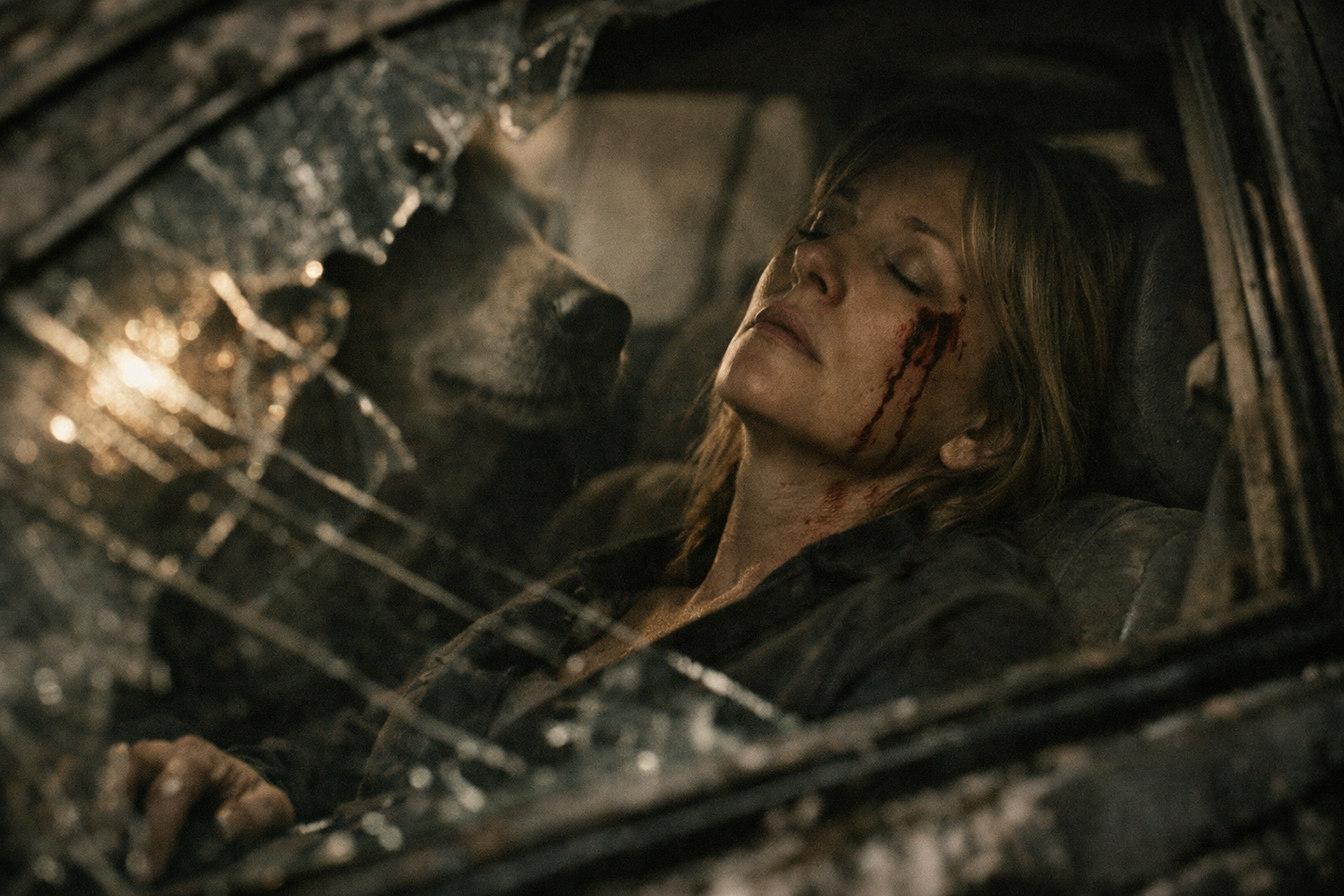
I had the window cracked. Texas in October still holds heat like a grudge. The music was low, almost a murmur, and I was doing about seventy kilometers an hour when I caught something out of the corner of my eye. About fifty meters off the right shoulder, halfway buried in dry yellow grass, was a car. An old sedan. It had left the road at some point and hit a rock — a big one, the kind the earth just leaves out there for no reason. The windshield was spiderwebbed. All the doors were closed.
And something was pulling on the front passenger door.
I slowed down. I thought it was a trick of the light, or a piece of fabric caught in the wind. Then I heard it.
A cry.
Not a bark. Not a whimper. Something between the two — a sound that reached through the glass and the music and the warm October air and grabbed me somewhere below the ribs.
I pulled off the road before I’d made any conscious decision to do so.
The grass in the field was knee-high and dry, and it scraped against my jeans as I crossed it. I could see the animal now — a pit bull, light-colored, almost sandy, with a broad chest and ribs that pressed against his coat like knuckles. He was filthy. There were burrs tangled in his flanks and dried mud caked along his belly. He had the door handle gripped in his teeth — actually gripped it — and he was pulling.
He wasn’t barking at me. He wasn’t even looking at me. Every ounce of his focus, every trembling muscle, every shallow, desperate breath, was aimed at that door handle.
I stopped a few feet away and looked through the shattered passenger window.
A woman. Middle-aged, brown hair, dust covering half her face. One leg was pinned under the collapsed dashboard. Her hand rose, maybe an inch, then fell back against her side. Her lips were moving but nothing came out.
“Hey,” I said. My voice came out wrong, too quiet. “Hey, can you hear me?”
Nothing. Just the soft drag of her breathing.
I looked down at the dog.
He stopped pulling. For the first time, he looked at me. His eyes were wide — you could see white around the edges — but there was nothing threatening in them. It was something else. Something I’ve never seen in a person’s eyes, let alone a dog’s. It was a plea so direct it felt like a hand on my chest.
He released the handle, gasped once, his tongue dropping out, slicked with blood from where the metal had cut into his gums. Then he bit down again and pulled.
“Okay,” I said. “Okay. I’ve got it. Stop. I’ve got it.”
He stopped again. He sat back on his haunches and looked at me, then at the car, then back at me.
I ran to my truck.
I kept a crowbar under the back seat — had for years, habit more than planning. When I came back, the dog hadn’t moved. He was sitting where I’d left him, breathing hard, watching the car door like it had personally offended him.
“Move back a little,” I said.
He did. I don’t know if it was the tone or the gesture, but he shifted back two steps and sat down again.
I worked the crowbar into the gap between the door and the body. The metal had warped inward from the impact and the lock mechanism was jammed solid. I pushed. Nothing. The dog’s breathing was audible — rapid, shallow, just at my elbow. I pushed again, throwing my full weight into it.
The door groaned.
On the third try, it tore open with a shriek of metal that made my back teeth ache. I caught it before it swung into the woman’s legs, pulled it back, and ducked inside.
“You’re okay,” I said, though I had no way of knowing if that was true. “I’m getting you out. You’re going to be okay.”
Her lips moved again. I thought I heard something — a letter, maybe a syllable — but I couldn’t make it out.
Her leg was trapped under the buckled dashboard, the kind of crumple that happens when a car hits something immovable at the wrong angle. I worked carefully, keeping one hand on her shoulder so she could feel I was there, talking the whole time. I freed her leg in about two minutes. She made a small sound when it came loose — pain, or relief, or both.
I got her out. She was lighter than she should have been.
As I helped her toward my truck, the dog walked beside us. Not ahead, not behind — beside, matching our pace, never taking his eyes off her face.
I laid her down in the back, found a blanket behind the seat, wrapped it around her. She was shaking. Her eyes were half-open, unfocused, but they were open. I called 911. They said thirty minutes.
I sat with her. I talked. I didn’t know what else to do.
And then the dog did something I still can’t fully explain without my throat tightening.
He put his front paws up on the truck bed, and then his back paws, and climbed in beside her. Gently. Like he was asking permission with every movement. He lay down and rested his head on her chest — right over her heart — and closed his eyes.
Just like that. After hours of pulling, hours of blood and effort and refusing to leave, he finally rested.
Because he could hear her heart.
“Hey,” I said quietly.
He didn’t open his eyes.
The ambulance came thirty-one minutes later. I stood beside the truck while the paramedics worked, one hand resting on the dog’s back because I was afraid he’d panic when they moved her. He didn’t panic. He just watched. When they loaded the stretcher into the ambulance, he looked at me.
I opened the truck door.
“Come on,” I said. “We’ll follow her.”
He got in without hesitation.
Her name was Margaret Calloway. She was fifty-four, lived alone outside of a small town about twelve miles from where she’d gone off the road. The doctors said she had two fractured ribs, a hairline fracture in her left tibia, and severe dehydration. She’d been in that car for nearly seven hours before I found her.
Seven hours.
The dog had been there for most of it.
I sat in the hospital waiting room with him. The nurses weren’t entirely sure what to do with us. One of them brought a bowl of water. He drank half of it and then lay down on my feet and went to sleep.
“He’s not mine,” I told the nurse.
She looked at him. “He seems to think differently.”
Margaret was in intensive care for two days. On the morning of the third day, they told me she was awake and asking questions. I went in with the dog — I’d spent enough time in that hallway that the staff had stopped arguing about it — and she looked at us from the bed with eyes that were still clouded but present.
She looked at the dog for a long moment.
“Ben,” she said.
I didn’t understand at first. “Sorry?”
“His name is Ben.” Her voice was rough, barely above a whisper. “I always wanted a dog named Ben. Never let myself get one.” She looked at me. “You found him out there?”
“He found you,” I said.
She was quiet for a while. Then: “He didn’t leave, did he.”
It wasn’t a question.
“No,” I said. “He didn’t leave.”
She reached out her hand. He put his head under it without being asked.
Three weeks later, I drove them both home.
Margaret’s house was small and neat, with a front porch that faced west toward a line of live oak trees. Ben walked inside like he’d done it a hundred times before. He sniffed every corner, every doorway, every baseboard. Then he came back to Margaret, sat down at her feet, and rested his head on her lap.
Same as he’d done in the truck. Same as he’d done in the field.
“I think he’s staying,” I said.
“I think so too,” she said.
She was smiling. It was the first time I’d seen her smile.
Six months have passed.
Ben is not the same dog I found in that field. He has a bed — a real one, near the foot of Margaret’s — and a food bowl, and a set of toys he treats with varying degrees of respect depending on his mood. His coat is clean now, shiny, almost gold in the afternoon light. His teeth healed. He put on weight. The ribs you could count from across a room have disappeared beneath muscle.
But here’s the thing I keep coming back to when I visit them on Sundays.
When I knock on the door, Ben is the one who answers it. Not barking, not jumping — just coming to the door and waiting, and when I come in he sits down at my feet and puts his head on my knee. Every single time.
As if he’s saying: You remember. You stopped.
I remember everything.
I remember the blood on his gums and the way he looked at me — that look that wasn’t panic, wasn’t confusion, just pure determined hope. I remember how he climbed into the truck beside her. I remember him closing his eyes the moment she was safe, like he’d been holding himself together through sheer will and could finally let go.
I think about who he was before that day. A stray. No name, no home, no one waiting for him anywhere. He had every reason to keep walking. He didn’t.
He saw someone who needed help, and he stayed. He pulled at a metal door with his teeth until his gums bled, for hours, because the alternative was leaving — and leaving wasn’t something he was willing to do.
I’m not a delivery driver anymore.
About two months after Margaret came home, I started volunteering at a rescue organization in our county — intake, transport, socialization work with dogs that have histories like Ben’s. I go twice a week. Sometimes three times.
And whenever I’m on those roads — and I’m still on those roads — I slow down when I see a dog by the shoulder. I stop when I can. I keep a blanket in the back of my truck and a water bowl and a leash.
Because I know what’s possible.
I know that one of those dogs might be the one who saves someone’s life on a Tuesday in October, in a field no one will ever visit, for no reward, with no one watching.
I know that love isn’t something you feel. It’s something you do when there’s no reason to, when no one’s keeping score, when the only thing waiting on the other side is a heart that keeps beating.
Ben taught me that.
And I intend to keep showing up.
Original fictional stories. AI-assisted creative content.