The elevator opened on the forty-second floor, and Elena Morrow stepped out carrying nothing but a leather portfolio and the kind of calm that comes from knowing something no one else in the building does.
She’d dressed deliberately. No designer label. No power suit. A simple charcoal blouse, dark slacks, flat shoes. The kind of outfit that made people in buildings like this look right through you.
That was the point.
The receptionist looked up, already frowning.
“Can I help you?”
“I’m here for the board meeting,” Elena said.
The receptionist glanced at her screen, then back at Elena, her expression sharpening into the particular kind of politeness that means you don’t belong here.
“The board meeting is invitation-only. Do you have credentials?”
“I was told to come,” Elena said. “Room 4201.”
“By whom?”
Elena smiled slightly. “Check with the room. They’ll sort it out.”
The receptionist hesitated, then picked up her phone. After a brief exchange, she hung up and gestured toward the hallway with visible reluctance.
“Down the hall. Last door on the left.”
“Thank you.”
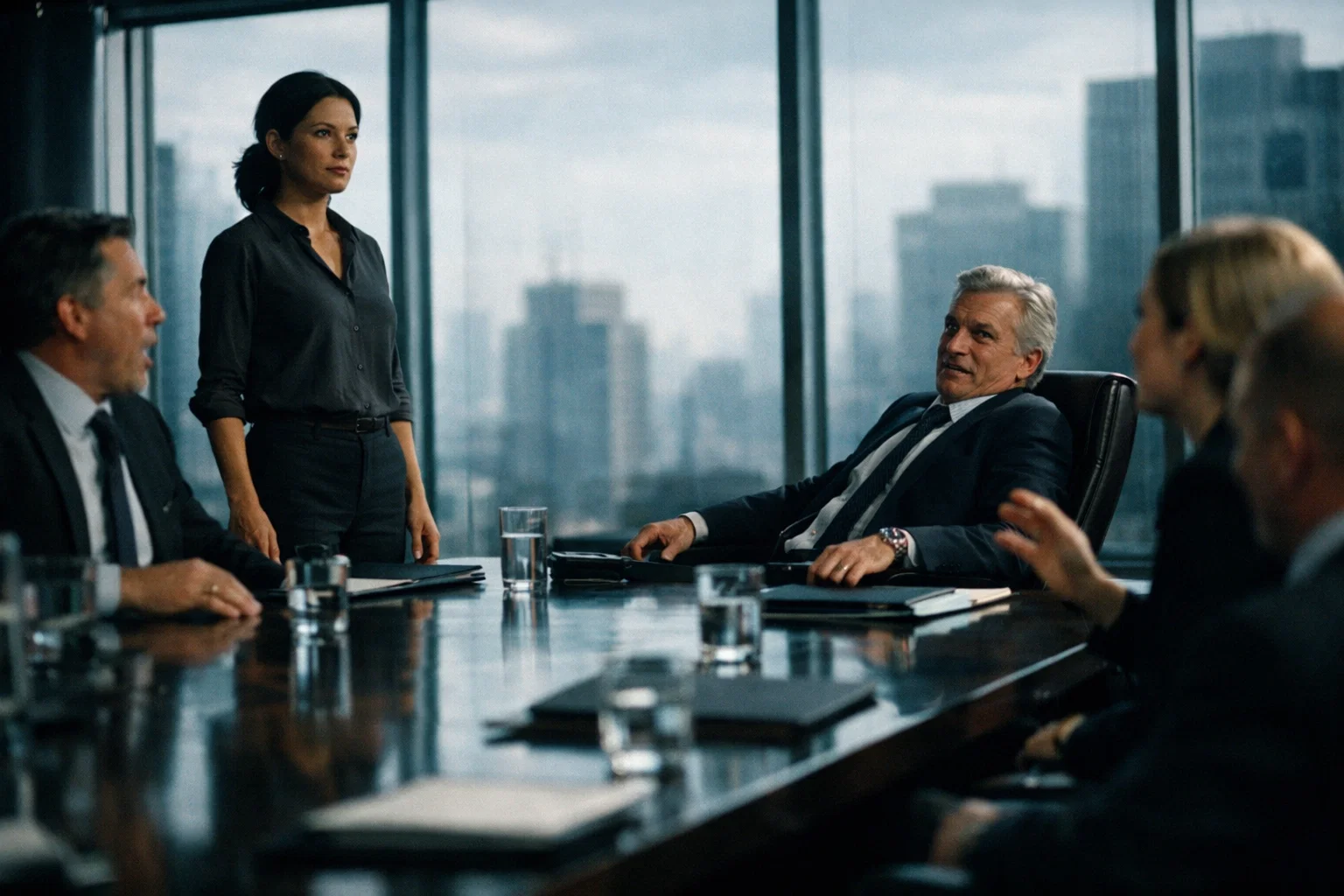
Elena walked the corridor slowly, her flats silent on the marble. Through the glass walls she could see them — twelve people arranged around a table that cost more than most apartments. Posture rigid. Faces careful. Water glasses perfectly aligned.
And at the head of the table, standing because sitting would suggest he was equal to the rest, was Victor Hale.
She’d studied him for months. Built from nothing, which he mentioned in every interview. Self-made, which he used as a weapon against anyone who hadn’t suffered enough to earn his respect. He ran Hale Dynamics like a kingdom, and the board existed not to govern but to applaud.
Elena pushed open the door.
Twelve heads turned.
The room smelled like expensive coffee and tension.
Victor stopped mid-sentence. His eyes tracked her from the door to the edge of the table, and she watched him perform the calculation — clothes, posture, lack of badge — and arrive at his conclusion in under two seconds.
“And you are?” he said.
“Elena. I was told to come here.”
“Told by whom?”
“That’s a longer conversation.”
A few board members exchanged glances. Richard Calloway, the CFO, leaned back slightly, already amused. Patricia Voss, head of legal, tapped her pen against her notepad — once, twice — a nervous habit she probably didn’t know she had.
Victor tilted his head. The gesture was rehearsed. She’d seen him do it in three different interviews. It meant: I’m giving you one more chance to not waste my time.
“This is a closed board meeting,” he said. “If you don’t have business here, I suggest you find the door you came through.”
“I do have business here,” Elena said.
“Then state it.”
“I’d rather sit down first.”
The silence that followed wasn’t empty. It was loaded. Every person in that room understood that what Elena had just done — refusing to perform on command — was not how things worked on the forty-second floor.
Victor’s jaw tightened. Just slightly. Just enough.
“There are no empty seats,” he said, “because everyone in this room was invited.”
“There’s one at the far end,” Elena said, nodding toward it.
“That seat belongs to a board member who’s running late.”
“He’s not coming,” Elena said. “I spoke with Martin Webb this morning. He sends his regrets.”
That landed. Patricia Voss stopped tapping her pen. Richard Calloway’s smirk faded. Martin Webb was the longest-serving board member, the one who’d been with Victor since the company had three employees and a storage unit for an office.
“You spoke with Martin,” Victor repeated.
“I did.”
“About what?”
“About the future of this company.”
Victor stared at her for a long beat. Then he laughed — short, sharp, dismissive.
“Okay,” he said. “I’ve been patient. Security.”
He didn’t even reach for a phone. He just said the word, and two men in dark suits materialized from outside the glass doors as if they’d been waiting for exactly this signal. They probably had been.
“Escort this woman out,” Victor said. “And find out how she got past reception.”
The guards moved toward her. Elena didn’t step back.
“You might want to hold off on that,” she said.
“I really don’t.”
“Victor.” She said his name the way a doctor says a diagnosis — not unkind, but final. “I’m asking you, respectfully, to wait sixty seconds.”
“And I’m telling you, respectfully, that you have about ten before you’re in the elevator.”
The guards flanked her. One reached for her arm.
“Don’t touch me,” Elena said quietly.
Something in her voice — not anger, not fear, just an absolute certainty that she was not someone who should be touched — made the guard hesitate. He looked at Victor for confirmation.
Victor nodded. “Get her out.”
The guard gripped her elbow. Elena didn’t resist, but she looked directly at Victor and said, clearly enough for every person in the room to hear:
“Do you always remove people before finding out what they know?”
“When they’re wasting my time? Yes.”
“Even when what they know could save you?”
Victor smiled. It was the smile he wore on magazine covers — confident, controlled, a little cruel.
“I don’t need saving,” he said. “I built this.”
“You did,” Elena agreed. “And you should be proud of that. But buildings have foundations, Victor. And yours has cracks you haven’t checked in a very long time.”
“Philosophical. Remove her.”
The guards started walking her toward the door. Elena went without struggle, her expression unchanged, her portfolio still tucked under her arm. She was three steps from the exit when Patricia Voss’s phone buzzed.
Patricia glanced down. Her face went white.
Not gradually. Not subtly. White, like the blood had simply left.
“Victor,” she said.
He didn’t hear her. He was already turning back to the table, straightening his cuffs, ready to resume.
“Victor.” Louder this time.
He looked up, irritated. “What?”
Patricia held up her phone. Her hand was shaking.
“You need to read this.”
“I’m in the middle of—”
“Right now.”
The room noticed. Richard Calloway pulled out his own phone. Then David Park, VP of operations. Then Sarah Chen from investor relations. One by one, screens lit up around the table, and one by one, faces changed.
Richard said, “What the hell?”
David said nothing. He just stared at his screen like it had personally betrayed him.
Sarah Chen put her phone face-down on the table and pressed both hands flat, as if the table might tilt.
Victor snatched up his tablet. He swiped to his email. The subject line read:
Notice of Completed Acquisition — Hale Dynamics Inc.
He opened it.
Elena watched from the doorway, still held loosely by the guards, who had also stopped moving because even they could feel the atmospheric pressure in the room dropping.
Victor read. His eyes moved fast at first, then slower, then stopped entirely on a paragraph near the middle. His thumb hovered over the screen. His breathing changed.
“This is a joke,” he said.
No one laughed.
“This is — Richard. Tell me this is a joke.”
Richard Calloway shook his head slowly. “It’s from Whitfield & Associates. I know their letterhead. It’s real.”
“It can’t be real. You can’t acquire a company without — there are procedures. There are approvals. The board has to—”
“The board did,” Patricia said quietly.
Victor turned to her.
“What?”
Patricia set down her phone. She couldn’t look at him.
“Three weeks ago. The special session you skipped because you were in Aspen. Martin Webb called a vote. Proxy authorization for a structured acquisition under Section 12.4 of the charter. It passed seven to five.”
“Seven to — that’s a majority. That’s binding.”
“Yes.”
“And no one told me?”
“You were notified,” Patricia said. “Your office received the documentation. Your assistant signed for it.”
Victor’s face was a study in collapse. Not dramatic. Not cinematic. Just the slow, terrible crumbling of a man realizing that the machine he built had been turned against him while he was skiing.
He looked at Elena.
She was still standing by the door. The guards had released her arms. She hadn’t moved.
“Who are you?” he asked.
This time the question had no edge. No authority. No performance. It was just a question from a man who suddenly needed an answer he didn’t have.
Elena walked back into the room. She set her portfolio on the table, opened it, and removed a single sheet of paper, which she placed face-up in front of the nearest board member.
“My name is Elena Morrow,” she said. “I’m the founder and managing director of Morrow Capital Partners. As of nine o’clock this morning, my firm completed a full acquisition of Hale Dynamics through a structured buyout authorized by your own board under your own corporate charter.”
Victor gripped the edge of the table.
“That’s — you can’t just—”
“I can,” she said. “And I did. Legally, fully, and irreversibly. Your attorneys will confirm it. In fact—” she glanced at Patricia “—I believe your head of legal already has.”
Patricia nodded once. She looked sick.
Victor’s voice dropped. “Why?”
Elena pulled out a chair — the one she’d pointed to earlier, Martin Webb’s chair — and sat down. She crossed one leg over the other, placed her hands on the table, and looked at him with the same steady calm she’d carried since she walked through the door.
“Because I wanted to see,” she said.
“See what?”
“How you lead.”
Victor blinked. “What?”
“I’ve been considering this acquisition for eleven months. The numbers were right after three. The legal structure was viable after six. But I held off because I wanted to understand something that doesn’t show up in spreadsheets.”
She paused.
“I wanted to know what kind of man runs this company. Not on camera. Not in interviews. Not when he knows someone is watching. I wanted to see what happens when someone walks into your room who doesn’t look like they belong, and how you respond.”
The room was silent. No phones buzzing. No pens tapping. No one shifting in their seats. Just twelve people watching two.
“And what did you see?” Victor said. The question came out hoarse.
Elena looked at him for a long moment.
“I saw a man who decided I was nothing before I said a word. Who called security before asking a single question. Who used his guards the way other people use arguments — to end conversations he doesn’t want to have.”
She leaned forward slightly.
“I saw a man who built something extraordinary and then forgot the most basic principle that makes any of it work.”
“And what’s that?”
“That you don’t know what someone carries until you let them speak.”
Victor’s hands were flat on the table now. His knuckles were white.
“I built this company from a one-room office,” he said. “I had nothing. No investors. No connections. No safety net. Every person in this room is here because I created a place for them to be.”
“That’s true,” Elena said. “And it’s also the problem.”
“How is that a problem?”
“Because you think creation is the same as ownership. You think building something means you get to decide who’s worthy of being inside it. But a company isn’t a kingdom, Victor. It’s a system. And when the system’s leader treats people as disposable based on how they look walking through a door, the system is broken.”
Victor opened his mouth, then closed it.
Richard Calloway cleared his throat. “Elena — Ms. Morrow — what happens now? Operationally, I mean.”
Elena turned to him. “That depends on the people in this room.”
“Meaning?”
“Meaning I didn’t buy this company to gut it. Hale Dynamics has exceptional talent, strong infrastructure, and a market position that most firms would spend a decade trying to reach. I have no interest in dismantling that.”
“Then what do you want?” David Park asked.
“Better leadership,” Elena said simply.
Victor flinched. It was small, involuntary, and everyone in the room saw it.
“You’re firing me,” he said.
Elena looked at him steadily. “I’m removing you as CEO, effective immediately. You’ll retain your equity stake per the acquisition terms, and you’ll receive a separation package that reflects your contributions to the company’s growth. But you will no longer make decisions that affect the people in this building.”
“You can’t—”
“I can. Read Section 8 of the acquisition agreement. Your own legal team drafted the template. Patricia can walk you through it.”
Patricia looked like she wanted the floor to swallow her. She nodded anyway.
Victor stood up. For a moment, Elena thought he might shout. His jaw was clenched, his shoulders rigid, his eyes bright with something between fury and humiliation.
But he didn’t shout.
He looked around the table — at the faces of people who had worked alongside him for years, people who had laughed at his jokes and deferred to his judgment and tolerated his cruelty because the alternative was worse — and he saw something he had never bothered to look for before.
Relief.
Not all of them. Not openly. But enough. A loosening of shoulders. A breath held too long finally released. The barely perceptible relaxation of people who had spent years performing comfort in the presence of a man who made them afraid.
That was what broke him. Not the acquisition. Not the legal documents. Not losing his title.
Seeing that the people he’d led were glad to see him go.
His mouth opened. Nothing came out.
Elena stood.
“I want to be clear about something,” she said, addressing the room now, not just Victor. “What happened today wasn’t a trap. It wasn’t a performance. I walked into this room the way any person might walk into any room — without credentials, without a title, without the markers that tell people like Victor that you’re worth listening to.”
She looked at each of them in turn.
“And I was treated exactly the way I expected to be. Not by all of you. But by the person at the top. And that tells me everything I need to know about the culture in this building.”
She closed her portfolio.
“Starting Monday, there will be a new interim CEO. Her name is Grace Nakamura. She’s run three successful turnarounds, and she doesn’t make decisions based on what people are wearing. You’ll receive her introduction and transition plan by end of business tomorrow.”
She turned to Victor one last time.
“You built something real, Victor. That’s not nothing. But you forgot that the people inside the building matter as much as the building itself. Maybe more.”
Victor said nothing.
“Your access credentials will be deactivated at five o’clock today. Security will help you collect your personal belongings. HR will contact you Monday regarding your separation terms.”
She extended her hand.
He stared at it.
For five seconds, the room held its breath.
Then Victor Hale shook her hand. His grip was weak. His eyes were wet. He let go quickly, gathered his tablet and his jacket, and walked to the door.
He stopped with his hand on the frame.
“You could have told me at the start,” he said without turning around. “You could have walked in, announced who you were, and none of this would have happened.”
“Yes,” Elena said. “But then I wouldn’t have seen the truth. And neither would you.”
He stood there for another moment. Then he walked out.
The glass door closed behind him with a soft click.
Elena sat back down in Martin Webb’s chair and opened her portfolio to a fresh page.
“Alright,” she said calmly. “Let’s talk about what this company looks like going forward.”
Richard Calloway leaned forward. “Where do we start?”
“With a question,” Elena said. “When was the last time anyone in this room disagreed with Victor in a meeting and wasn’t punished for it?”
Silence.
“That’s what I thought,” she said. “So here’s the new rule. In this room, disagreement isn’t disloyalty. It’s a requirement. If you see a problem, you say it. If you have a better idea, you bring it. And if someone walks through that door who doesn’t look like they belong, you ask them what they know before you ask them to leave.”
Patricia Voss set down her pen. “I should have said something. When he called security. I knew it was wrong, and I sat here.”
“You all did,” Elena said. Not unkindly. Just factually. “And that’s not entirely your fault. Fear is a management strategy, and Victor used it well. But fear only works until something bigger walks through the door.”
She smiled slightly.
“Today, something bigger walked through the door.”
David Park exhaled. “So what do you actually need from us right now?”
“Three things. First, I want a full audit of internal complaints filed in the last two years — every grievance, every HR report, every exit interview. I want to know what people were afraid to say out loud.”
She held up a second finger.
“Second, I want a leadership review of every department head. Not performance metrics — I have those. I want to know how they treat the people under them. I want references from assistants, junior staff, interns. The people who see everything and get asked about nothing.”
Third finger.
“And third, I want a town hall scheduled for Friday. Every employee. I’ll introduce myself, explain the transition, and take questions. No script, no screening, no planted softballs. If someone wants to ask me something uncomfortable, they get to ask it.”
Richard whistled softly. “Victor would never have done any of that.”
“That’s why Victor is in the elevator right now,” Elena said.
A ripple of something moved through the room. Not laughter, exactly. But close. The kind of sound people make when the pressure finally drops.
Sarah Chen spoke for the first time. “Ms. Morrow, I have to ask — when you were standing by the door, and the guards had your arm, were you worried at all? That it might not go the way you planned?”
Elena considered the question.
“No,” she said. “Because it wasn’t about whether I stayed in the room. It was about what happened while I was in it. If Victor had asked me one real question — just one — I would have had a very different conversation with this board today.”
“What kind of conversation?”
“The kind where he kept his job.”
The room absorbed that.
“He was that close?” Patricia said.
“One question,” Elena confirmed. “That’s all it would have taken. ‘Why are you here? What do you need? Can I help you?’ Any of those. One moment of basic decency, and I would have restructured the acquisition to keep him as CEO with oversight.”
She tapped the table once.
“But he didn’t ask. He decided. And the thing about decisions made without information is that they tend to be the ones you can’t take back.”
Patricia closed her legal pad. Her eyes were red, but her voice was steady. “I’ve worked for Victor for nine years. I told myself the way he treated people was just — intensity. Drive. The cost of ambition.”
“It wasn’t,” Elena said gently.
“No,” Patricia agreed. “It wasn’t.”
The afternoon light shifted through the glass walls, casting long rectangles across the conference table. The city below kept moving — cabs, pedestrians, delivery trucks — unaware that forty-two floors above, something had fundamentally changed.
Elena spent the next two hours with the board. She went through the transition timeline, the leadership structure, the communication plan. She answered every question directly. She admitted what she didn’t know. She asked for input and wrote down the answers.
At four-thirty, she closed her portfolio and stood.
“One more thing,” she said. “I want you to know that I don’t think everyone in this room is guilty of what Victor did. Some of you pushed back quietly. Some of you protected people when he wasn’t looking. I know because I did my research.”
She looked at Sarah Chen. “You hired three employees Victor had blacklisted from the industry. You did it through a subsidiary so he wouldn’t notice.”
Sarah’s eyes went wide.
Elena looked at David Park. “You redirected budget to fund mental health resources for the operations team after Victor cut the wellness program. You told accounting it was a consulting expense.”
David swallowed hard.
“I see things,” Elena said. “Not because I’m watching. Because I pay attention. And I want leaders who do the same.”
She walked to the door, then turned back.
“The measure of a company isn’t what it builds. It’s how it treats the person who walks through the door with nothing. Remember that.”
She left.
The board sat in silence for a full minute.
Then Patricia Voss opened her legal pad to a fresh page, uncapped her pen, and said, “Alright. You heard her. Let’s get to work.”
And for the first time in nine years, every person at that table spoke freely.
Downstairs, Victor Hale stood on the sidewalk outside the building that bore his name. A security guard held a cardboard box containing his personal items — a fountain pen, a framed photo, a leather desk pad.
His phone buzzed. A text from his assistant: Your credentials have been deactivated. HR will call Monday.
He stared up at the forty-second floor. The lights were still on. The meeting was still going.
Without him.
A cab pulled up. The driver leaned over. “Where to?”
Victor looked at the building one more time. Then he got in.
“Home,” he said.
The cab pulled away. The city swallowed it whole.
And forty-two floors above, Elena Morrow’s voice carried clearly through the glass walls as she outlined a future built on something Victor Hale had never thought to try.
Respect.
Original fictional stories. AI-assisted creative content.