Some mornings feel ordinary right up until the second they stop.
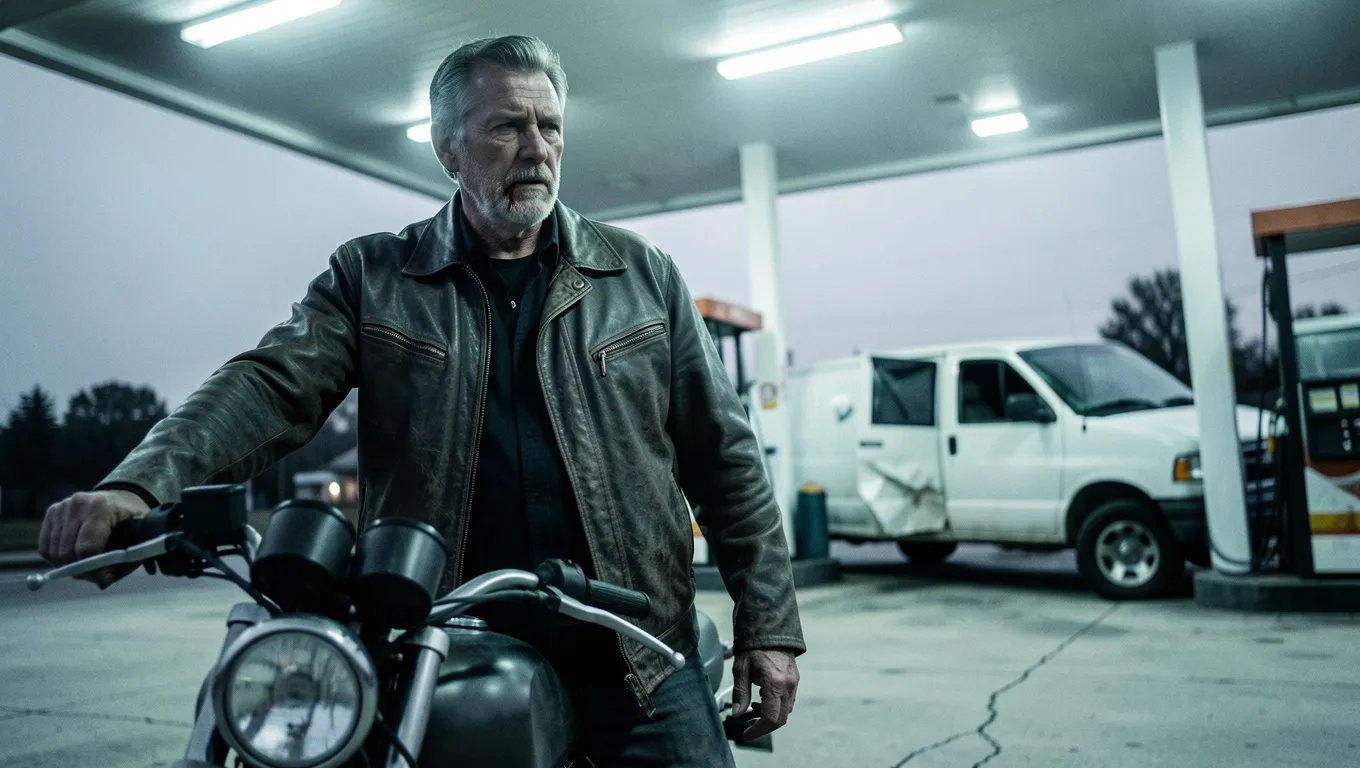
Graham Callahan rolled his motorcycle under the gas station canopy at 5:47 a.m. and killed the engine. Cold hit him immediately—that specific Indiana cold that felt personal, like it had been waiting. The fluorescent lights above the pumps buzzed faintly against a sky that hadn’t decided yet whether it was night or morning.
He swung off the bike, stiff from three hours of highway, and slid the nozzle into his tank.
That’s when he saw the girl.
She was standing near the trash bin at the edge of the lot—maybe eight years old, pink coat too thin for the weather, pigtails that someone had put in a long time ago and hadn’t fixed since. She wasn’t playing. She wasn’t waiting.
She was watching the van.
Graham didn’t look at the van. He watched the pump numbers instead and kept his breathing easy.
He knew that look. He’d spent enough years in security work—transport routes, facility protection, the kind of jobs that required reading rooms full of dangerous people—to understand what controlled fear looked like on a child’s face. They stopped crying. They stopped asking. They performed calm, and all the panic went into their eyes.
The girl started toward him.
Slow steps. Deliberate.
She held out a crumpled piece of paper with both hands.
“Sir.” Her voice barely cleared the hum of the canopy. “I think you dropped this.”
Graham took it without expression. No concern. No sudden questions. The wrong reaction could ruin everything.
She stepped back immediately, eyes down.
He waited until she’d moved away, then opened the note.
Three lines in shaky pencil:
HELP ME HE’S NOT MY DAD HE SAID DON’T TELL
Everything in Graham went still in the way a wire goes still before it snaps.
He replaced the gas nozzle slowly, glanced toward the van without raising his head, and catalogued what he saw: broad-shouldered man in a baseball cap, one hand resting on the steering wheel, facing the pump island. Still. Watchful. Too watchful.
The girl had already drifted back toward the store. Smart kid.
The van’s door opened.
“Lacey,” the man called, too casually. “Come on. We’re leaving.”
The girl froze.
Graham swung onto the bike, hit the ignition, and let the engine roar. He rolled forward—not toward the road—sideways, deliberately, then turned the motorcycle broad across the exit lane. Six hundred pounds of steel and chrome blocked the only clean path out.
The man’s eyes found him immediately.
“You got a problem?”
Graham pulled off his gloves one finger at a time. “Maybe.”
“My daughter forgot something inside. We’re in a hurry.”
“Funny thing.” Graham’s voice was flat and quiet. “She doesn’t look like she is.”
The girl reached the door and stepped inside.
The man’s face changed for a fraction of a second. Not frustration. Not inconvenience.
Panic.
Graham raised his voice just enough. “Ma’am!” He aimed the words through the gas station’s glass. “Lock the door and call 911.”
Everything broke at once.
The man lunged for the van door. Graham was already off the bike and moving, crossing the gap faster than a man his age had any right to. He caught the door edge and drove it back hard—metal cracking against the frame.
“Get out of my way!”
“No.”
The man swung.
His fist clipped Graham’s jaw, split something inside his cheek. Graham staggered one step, then answered with a short body shot that folded the man at the middle. The driver crashed back against the van’s side panel, gasping.
Inside the station, the cashier—a woman in her fifties, hands shaking—was dragging the girl behind the counter, already reaching for the phone.
The man recovered, reached into his jacket.
Graham’s pulse spiked.
It came out as a set of keys.
The man pivoted and ran for the driver’s door, one last desperate play. Graham crossed back to the bike in three strides, twisted the throttle hard. The motorcycle launched forward and slammed into the van’s front quarter panel with a crunch that shuddered up through his arms. The van wedged sideways against the curb. Driver’s door pinned.
The man stared.
Graham looked at him through the blood beginning to sting at the corner of his mouth. “Told you,” he said quietly. “You’re not leaving.”
Sirens rose in the distance—faint, then fast, then everywhere.
The man turned and ran toward the side of the building. Graham followed, boots hammering frozen pavement, lungs burning in the cold. Not as fast as he’d once been. He didn’t need to be.
Fear makes men sloppy.
The man hit a patch of black ice near the dumpster and went down hard.
Graham was on him in a second—one arm wrenched behind the back, knee pinned between the shoulders, face-down on the frozen asphalt.
The man bucked and screamed. “You have no idea what you’re doing!”
Graham leaned close. “I know exactly what I’m doing.”
The first deputy arrived ninety seconds later. Then a second. The man was hauled upright, cuffed, searched, and pushed into the back of a cruiser while he kept shouting about misunderstandings.
Graham stood aside, chest heaving, blood drying on his jaw.
A deputy approached. “Sir, are you injured?”
“Nothing important.”
“Can you tell me what happened?”
Graham looked through the glass. The girl was wrapped in the cashier’s coat now, eyes huge but steady. She was looking at him.
“She handed me a note,” he said.
The deputy’s expression shifted immediately. “A note?”
Graham passed it over.
A female officer arrived minutes later and knelt beside the girl. The conversation lasted a long time. When the officer stood, her face told Graham everything before she said a word.
It was bad.
Very bad.
The man wasn’t her father. He wasn’t related to her at all. He’d taken her from a supermarket parking lot in Ohio the previous afternoon. Law enforcement across two states had been searching through the night.
The note had likely saved her life.
As dawn pushed above the horizon, the station transformed under growing light. It no longer looked forgotten or eerie. It looked raw and honest. Graham sat on the curb while a paramedic cleaned the cut on his face.
The girl came out a while later with the female deputy.
She approached slowly, clutching a paper cup of hot chocolate with both hands.
“You believed me,” she said.
Graham looked up at her. “You were brave enough to ask for help.”
She shook her head. “I was scared.”
“Brave usually is.”
Her lower lip trembled. “He said nobody would notice me.”
Graham held her gaze. “He was wrong.”
The deputy gently explained that the girl’s mother was already on her way. Ohio state police had made contact. She would be there soon.
The girl hesitated, then held something out.
A small silver charm bracelet—cheap, the kind that came off a spinning rack at a drugstore. One heart-shaped charm had broken loose and hung crooked.
“For luck,” she whispered.
“You should keep it.”
“I want you to have it.”
He accepted it carefully, as if taking custody of something rare.
An hour later, a car came in on a patrol escort. The woman inside was out of it before it finished stopping—wild-eyed, already crying. The moment she spotted her daughter, something broke loose in her that had no word for it. The girl ran across the lot and collided with her mother like a wave hitting a wall.
They both went down to their knees, clinging to each other, both sobbing, both alive.
Graham turned away.
He was halfway to his bike when the mother called after him.
He stopped.
She crossed the lot, tears still fresh on her face. “They told me what you did.” Her voice cracked in the middle. “How do you thank someone for this?”
“You don’t owe me anything.”
“I owe you everything.”
“No.” He shook his head once. “She saved herself. I just listened.”
She stepped forward and hugged him anyway—tight, silent, full. Graham stood stiffly for a moment, then let himself return it with one rough hand between her shoulders.
When she stepped back, she pressed a folded business card into his palm. “Please,” she said. “So we can tell you later. So she can tell you herself.”
Graham slipped it into his jacket.
Then he righted the bike. The front fender was bent. The headlamp bracket hung at a bad angle. Rideable. He strapped on his gloves, looped the little silver bracelet around the mirror stem, and swung into the saddle.
Before he put on his helmet, he looked once more at the girl.
She raised one small hand.
He nodded back.
Then he rode out as the sun finally broke free of the horizon and poured gold across the canopy, across the cruiser roofs, across the battered white van still wedged against the curb, and down the long black ribbon of highway ahead.
For three counties, Graham rode without stopping.
At a roadside diner near the state line, he pulled in for breakfast. The waitress—a college kid with tired eyes—poured his coffee and nodded toward the small TV mounted in the corner.
Morning news.
His stomach tightened.
A school portrait filled the screen beneath a headline: MISSING CHILD FOUND SAFE IN INDIANA.
He exhaled slowly.
Then the anchor continued.
Authorities had identified the abductor. He wasn’t a drifter. Not a random predator. He was a retired family court psychologist—an expert witness who had testified in custody cases across three states for over a decade. Praised. Trusted. Brought in to help judges decide which adults were safe for children.
Graham stared at the screen.
The waitress frowned. “That’s messed up.”
The anchor wasn’t finished.
Investigators had recovered pages of notes in the van: observations, names, dates, planned routes. Not for one child.
For several.
And one line, underlined twice, made Graham’s hand tighten around the coffee cup until it nearly cracked.
Children don’t ask the dangerous-looking men for help. They ask the safe ones.
The man had built his entire plan around that assumption.
Counted on appearances.
Counted on fear.
Counted on the certainty that a little girl would never trust someone who looked like Graham Callahan—scarred jacket, rough hands, motorcycle, and a face that didn’t invite questions.
She’d trusted him anyway.
The waitress turned down the volume, unsettled.
“Guess he picked the wrong station.”
Graham looked out the window at his scarred motorcycle. At the bent fender catching morning light. At the small silver bracelet hanging from the mirror, the broken heart charm catching a glint of gold.
He picked up his coffee.
For the first time all morning, he smiled.
“Yeah,” he said quietly.
“He really did.”
Original fictional stories. AI-assisted creative content.