The dog hadn’t moved in twenty minutes.
It lay on the wet sidewalk beside the diner’s back door, nose pressed to the soggy edge of a hamburger patty someone had dropped. Its ribs showed through short dirty fur. One back leg was bent wrong — the result of a kick it had taken from a man in a gray hoodie who’d walked past fifteen minutes ago, cursing at it to get out of his way.
The rain came harder.
The dog lifted its head anyway.
Not because of the food. Because of the sound.
Forty feet away, in the dark gap between the diner and the parking structure, two men in ski masks had their hands on a third man — expensive coat, no tie, briefcase still strapped to his wrist. One mask pressed a gloved hand over the man’s mouth. The other pulled open the side door of a black van idling against the wall.
The wealthy man’s name was Daniel Marsh. He was fifty-three years old. He had a driver, a penthouse, and a court date at nine the next morning. He was the only witness who could place Victor Hale’s operation in front of a federal jury.
Right now he was losing the fight against the curb.
His shoes kept slipping on the wet pavement. He tried to dig his heel in, but the man on his left had his arm twisted behind his back, and the pain was making his vision go white at the edges.
Get in the van, the shorter one hissed against his ear. Nobody’s watching.
The dog stood up.
It happened slowly. One front leg. Then the other. Then the bad back leg unfolded, and the animal flinched hard but didn’t go back down. It limped two steps forward, stopped, and looked down the alley.
Then it barked.
Not a warning bark. A full-volume, sudden, here bark — the kind that splits through rain noise and traffic and the low hum of a refrigerated van engine.
The shorter thug flinched. His grip on Daniel’s mouth slipped an inch.
That was enough.
Daniel twisted his whole upper body and wrenched his right arm free. He got one hand on the van’s door frame and pushed back hard. The taller man shoved him forward again, trying to get his legs off the pavement and into the vehicle.
The dog reached them.
It bit down on the taller man’s left pant leg just above the boot, pulled sideways with both front paws planted, and yanked. The taller man’s knee buckled. He went down hard on the wet concrete, one hand slapping out to catch himself.
What the—
The shorter one spun and swung his arm down at the dog. The dog ducked left, released, and immediately repositioned — planting itself between Daniel and the van door, teeth showing, growling low and continuous.
Get the dog out of the way, the shorter man said.
You get it, the taller one said, getting back to his feet. His knee was bleeding through the denim.
Daniel pressed himself against the diner wall, gasping. His left wrist had been twisted. His coat was soaked through. He looked down at the dog — its back legs were trembling, its ribs were heaving, and one hind leg was dragging — and for a second he couldn’t process what he was seeing.
Then something white caught his eye.
A manila folder had fallen from the taller man’s coat when he hit the ground. It had landed face-up in the rain. The cover was laminated, and even in the dark and the downpour, Daniel could see the photo.
His photo.
His car’s license plate. His building’s entry schedule. His parking structure access times. And below all of it, one printed line in plain black font:
Before court testimony.
Daniel’s throat closed.
This isn’t a robbery.
He knew Victor Hale’s name. He had spent fourteen months building the case with federal prosecutors, handing over bank transfers, shell company records, the fake charity accounts that had funneled eleven million dollars through a chain of mid-tier restaurants while actual employees worked for nothing. He had agreed to testify because a prosecutor named Ellen Voss had told him, You’re the only one who can close this.
And someone had decided to solve that problem tonight, in the rain, behind a diner he’d stopped at on the way home from a dinner he’d left early.
The shorter thug grabbed his shoulder.
Daniel swung the briefcase.
It caught the man across the jaw — not hard enough to drop him, but enough to make him stumble and curse. The dog shot forward again and bit down on his forearm. The man shouted and tried to shake it off. The dog held.
Shoot it, the taller man said.
We’re not supposed to make noise, the shorter one snapped back.
Then pull it off me.
The motion sensor light came on.
It was mounted above the diner’s rear service door — a harsh white industrial flood that someone had installed to catch delivery drivers on a bad night. It lit up the entire width of the alley: the van, its rear plate, the two masked men, the dog with its teeth in one man’s sleeve, and Daniel Marsh pressed against the wall with a soaked briefcase and a face full of someone else’s fingerprint bruises.
Across the street, sixty feet away, a black town car was parked at the curb.
Marcus Webb had been Daniel’s driver for eleven years. He was fifty-eight years old and had never once called the police from inside a vehicle. He called them now. He already had his door open before the dispatcher picked up.
The shorter thug saw the light. He saw the town car door swing open. He pulled his arm back from the dog and looked at his partner.
We’re done, he said. Go.
The folder—
Leave it. Go.
They ran for the far end of the alley.
The dog lunged after the shorter one. It covered twelve feet on three good legs and bit into his calf, just above the heel. The man went down face-first onto the wet pavement, scraping both palms and his chin.
Get off—
He kicked back hard. The dog took the blow to its ribs, made a short pained sound, and let go. But it had done its job. The shorter man scrambled upright, limping now, and ran — only to find Marcus Webb standing at the alley’s end with both arms out.
Marcus was not a small man.
Nobody’s going anywhere, Marcus said.
He didn’t have a weapon. He didn’t need one. He stood in the center of the alley exit with his arms spread and his feet planted and stared at the two masked men like he had been waiting his entire life for this exact moment.
The taller man tried to go around him. Marcus stepped into him — chest to shoulder — and just stood there, absorbing the impact, not moving.
Police are coming, Marcus said. You can fight me if you want. But they’re already turning onto this block.
The sirens confirmed it three seconds later.
Four squad cars and a federal vehicle reached the alley within ninety seconds. The two men were cuffed on the wet pavement while Daniel stood ten feet away, watching, with the folder still in his hand.
A detective named Samuels came to him first.
Mr. Marsh. You okay?
I’m okay. He paused. They had a file on me. Photo, schedule, vehicle information. There’s an assassination contract inside — it’s in a pocket in the van’s rear seat. I didn’t touch anything.
Samuels looked at him for a moment. How do you know where—
Because I watched one of them put it there before they came for me.
Samuels called it in and walked toward the van. Daniel didn’t follow.
He turned around.
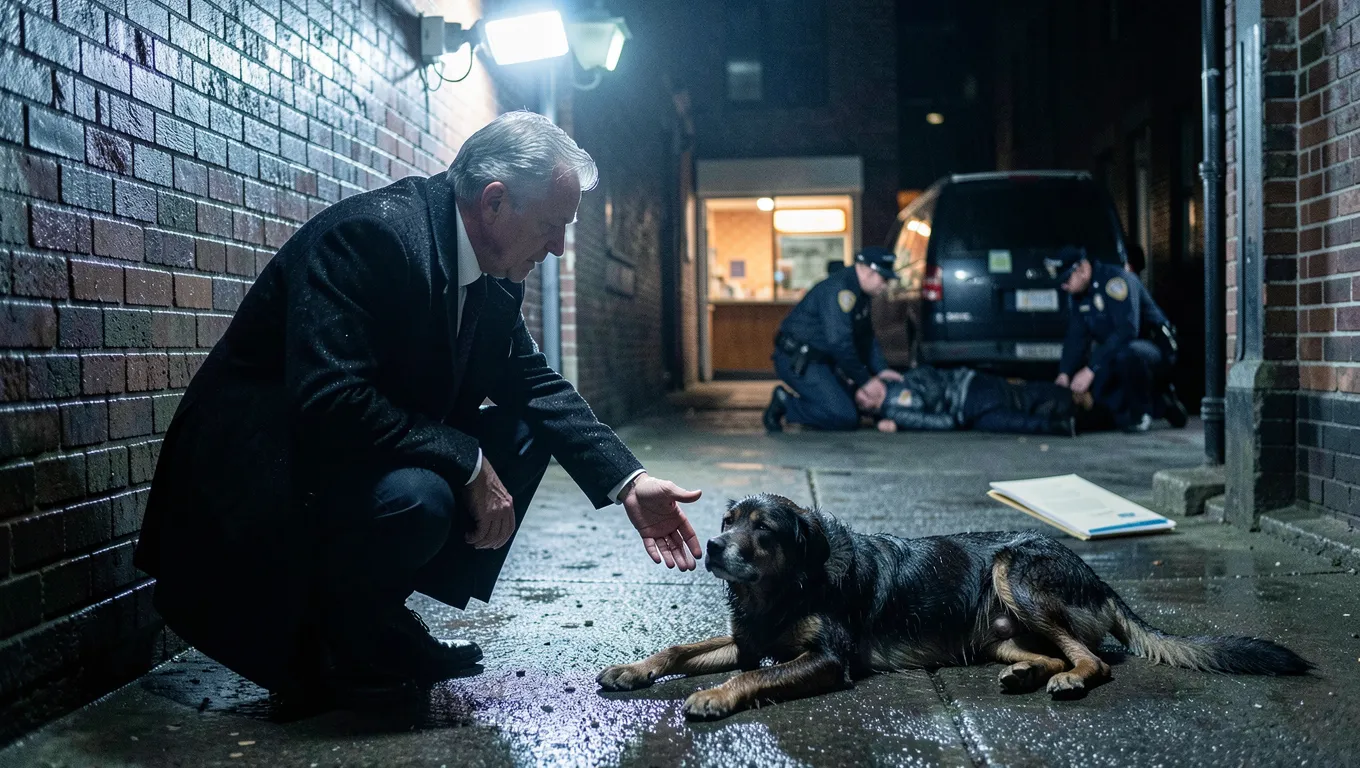
The dog had made it back to the alley entrance. It was lying on its side on the wet pavement, one hind leg extended at an angle, its sides rising and falling too fast. Its eyes were still open. It was watching the two cuffed men the way a dog watches something it has already decided it doesn’t trust.
Daniel walked over and crouched down.
The dog looked at him.
It didn’t move. It didn’t growl. It just looked at him with the particular steadiness of an animal that has spent a long time learning which people were safe and which ones weren’t, and had apparently filed Daniel somewhere in the first category.
Hey, Daniel said.
He put his hand out, palm down, close to the dog’s nose. The dog sniffed it once. Then it exhaled — a long, slow exhale — and its eyes half-closed.
You ate about four bites of that burger, Daniel said. And then you did all of that.
He wasn’t a man who cried easily. He hadn’t cried at his mother’s funeral. He hadn’t cried when his company’s stock dropped forty points in a single afternoon two years ago. He didn’t cry now, but it was closer than it had been in a long time.
He pulled his coat off and laid it over the dog carefully, tucking the edge under its side.
Marcus appeared behind him. I called an emergency vet, Mr. Marsh. Twenty-four hour clinic. They’re sending someone.
Tell them we’ll pay whatever it costs.
Already told them.
Good. Daniel didn’t stand up. Tell them we’re also paying for whatever comes after.
The vet’s name was Dr. Tina Park. She arrived in a white SUV twelve minutes later, moved through the police tape without being asked twice, and crouched beside Daniel with a portable kit and a calm efficiency that made him feel, for the first time all night, like things were going to be okay.
She ran her hands along the dog’s frame. Rib fracture, at least one. Hind leg is a clean break — looks like blunt trauma, maybe a week old, partially weight-bearing still, which is remarkable. Malnourished, obviously. Dehydrated. She looked up. But no internal bleeding that I can feel. Heart rate is fast but steady.
Can you save it?
I can absolutely save it. She looked at him. Is this your dog?
Daniel looked at the dog. The dog looked back at him from under the coat.
It is now, he said.
The van’s rear seat pocket contained exactly what Daniel had told Detective Samuels it would: a folded contract on plain paper, unsigned, specifying target removal prior to testimony — no trace, no body recovery. The two men were identified within six hours. Both had prior arrests connected to shell entities that federal investigators had already been watching in relation to Victor Hale’s network. The shorter man — the one the dog had brought down at the alley exit — had a burner phone with a single encrypted message thread that prosecutors would later describe in court as the most self-incriminating document we’ve ever seen submitted into evidence.
Victor Hale was arrested at his home the next morning at 6 a.m., four hours before Daniel Marsh was scheduled to take the stand. He was arrested anyway. The contract, the phone, and the testimony still on record were more than enough.
Ellen Voss called Daniel at 8:15 a.m.
You okay? she asked.
I’m fine, he said. How are we looking?
We’re looking like a conviction. She paused. I heard about the dog.
Yeah.
Is it—
She’s in surgery right now. Vet says she’ll be walking in two weeks. He looked out the hospital waiting room window. I’m naming her Sadie.
A short pause. That’s a good name.
I thought so.
Three weeks later, Daniel Marsh walked into the federal courthouse at 8:58 a.m. with a brace on his left wrist and a case assistant carrying three banker’s boxes of documents. He testified for four hours. He was calm, precise, and answered every question in full without embellishment.
Victor Hale’s defense team cross-examined him for two hours. They suggested his account was motivated by personal grievance. They questioned his timeline. They introduced a character witness who described Daniel as aggressive and litigious in business dealings.
The jury deliberated for eleven hours.
They came back with guilty on all fourteen counts.
Sadie was asleep in the back seat when Marcus pulled up to the courthouse steps to collect Daniel at 4:40 p.m.
She had a blue collar now, and a tag with Daniel’s address on it, and a slightly awkward gait from the healed leg that the vet said would probably never fully resolve. She was also approximately thirty pounds heavier than she had been on the night in the alley, which Daniel considered a reasonable start.
She raised her head when he opened the door.
Hey, Sadie.
She thumped her tail twice against the leather seat.
Daniel got in, closed the door, and looked at her for a moment.
We won, he said.
She put her head back down on her paws.
Marcus, Daniel said. Take us home.
Yes, sir, Marcus said.
The town car pulled away from the courthouse into the late afternoon traffic, and the city moved around them, and Sadie slept the whole way.
Two months after the verdict, Victor Hale was sentenced to twenty-two years without the possibility of early release. His restaurant chain’s assets were frozen and distributed to the workers who had been underpaid across eleven locations for six years. The two assassins pled guilty in a separate proceeding and received twelve and fourteen years respectively. The diner owner, who had seen Daniel Marsh eating alone at the counter earlier that night and had twice thought about checking on the limping dog out back and hadn’t, donated the equivalent of a full year’s revenue to an urban animal rescue organization. He never said why. The people who knew him guessed.
Original fictional stories. AI-assisted creative content.