The gym smelled like popcorn and floor wax. Balloons bumped against the ceiling. Everywhere I looked, fathers were spinning their daughters around, stepping on tiny shoes, laughing like nothing else mattered.
My daughter Sophia sat on a folding chair against the wall. Lavender dress. White shoes she’d picked out herself. Hands folded in her lap like she was waiting for something she already knew wasn’t coming.
Her father, Logan, had been killed in a training accident at Camp Pendleton three months ago. Marine Corps. Fifteen years of service. He’d survived two deployments to come home and die on American soil in a mechanical failure nobody could explain.
Sophia hadn’t wanted to come tonight. I was the one who pushed it.
“We’ll go together,” I’d told her. “You and me. We’ll dance.”
She’d looked at me with those big brown eyes — Logan’s eyes — and said, “It’s called a Father-Daughter Dance, Mom. Not a Mother-Daughter Dance.”
She was eight. She wasn’t wrong.
Now she sat frozen while the gym swirled with laughter around her. A girl from her class, Mia, twirled past in a pink tutu, her dad lifting her off the ground. Sophia watched, then looked down at her shoes.
“Mom,” she whispered. “Can we leave?”
“Five more minutes,” I said. I didn’t know why. I just felt like we should stay.
A woman I recognized from the PTA — Karen Hollister — leaned toward another mom near the punch table. She didn’t whisper quietly enough.
“Honestly, it’s a little awkward. If there’s no father in the picture, maybe skip the event? It’s not fair to the other families.”
I felt the blood drain from my face, then rush right back.
I stood up.
“Excuse me,” I said, loud enough for three rows of chairs to hear. “Her father is in the picture. He gave his life in uniform so people like you could stand around judging an eight-year-old at a school dance.”
Karen’s mouth opened. Nothing came out.
Sophia tugged at my sleeve. “Mom. Stop. Please.”
I sat back down. My hands were shaking.
“I’m sorry, baby.”
“It’s okay,” she said. But it wasn’t. Her chin was trembling. Her eyes were wet. She was trying so hard to be brave that it broke my heart clean in half.
I pulled her close. “You want to go? We’ll go.”
She nodded into my shoulder.
I stood, took her hand, and turned toward the exit.
That’s when the doors exploded open.
Not exploded — but that’s what it felt like. Both gym doors swung wide at the same time, slamming against the rubber stops with a crack that silenced the entire room. The DJ killed the music mid-song. Every head turned.
Six Marines stood in the doorway in full dress blues. White gloves. Covers tucked under their arms. Boots polished to mirrors. They stood in two perfect rows of three, shoulders back, jaws set, eyes forward.
Behind them, a man stepped through. Silver hair. Four stars on each shoulder. His uniform was immaculate. He moved with the kind of calm that only comes from decades of command — the kind that fills a room without raising a voice.
General Richard Avery. I recognized him from the funeral. He’d handed me the folded flag.
He walked straight down the center of the gym. The Marines followed in lockstep, boots hitting the wood floor in unison. Every father stopped dancing. Every child went still. A little boy near the bleachers whispered, “Are those real soldiers?”
General Avery stopped six feet in front of Sophia.
She was frozen, her hand still in mine, tears still on her cheeks.
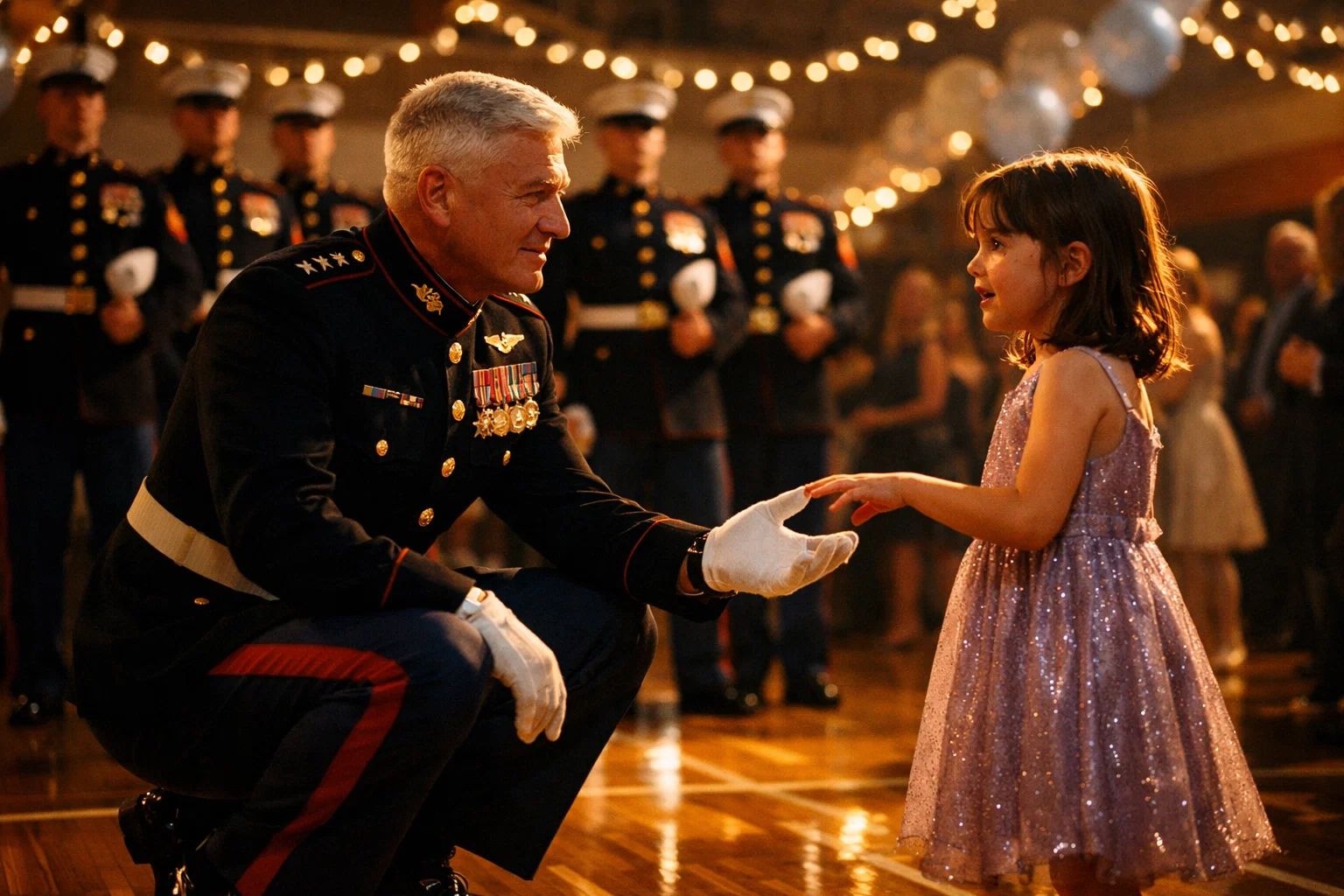
He lowered himself onto one knee. Slowly. Deliberately. The way you do when you want a child to know she matters.
“Sophia Brennan?” he said.
She nodded, her lip quivering.
“My name is General Avery. I served with your dad for eleven years. He was one of the finest Marines I’ve ever known.”
Sophia’s breath caught.
“He talked about you all the time,” the General continued. “Every briefing, every late night, every long deployment — you were the first thing he mentioned and the last thing on his mind.”
“He did?” Sophia whispered.
“Every single day.” The General reached into his breast pocket and pulled out a small, worn photograph. He held it out to her. “He carried this everywhere.”
Sophia took it with both hands. I leaned over to see. It was a photo of Sophia at age five, sitting on Logan’s shoulders at the beach, both of them laughing, the ocean behind them catching the light.
“Oh,” Sophia said. Just that. Just “oh.” And then the tears came hard and fast, and she pressed the photo against her chest like it was the most precious thing in the world.
General Avery didn’t rush her. He waited.
When she looked up again, he said, “Your dad made us promise something.”
“What?” she asked.
“That if there ever came a day you needed someone to show up for you, we would. All of us. No questions asked.” He gestured behind him. The six Marines stood at perfect attention. “So here we are.”
Sophia looked past him at the Marines. Her mouth fell open.
“All of them?” she whispered. “For me?”
“For you,” the General said. “Now — I believe there’s a dance tonight. And I believe you need a partner.”
He stood and extended his white-gloved hand.
Sophia looked at me. I couldn’t speak. I just nodded.
She took his hand.
The DJ, who had been standing slack-jawed behind his table, scrambled for his laptop. A slow song filled the gym — something soft and warm, piano and strings.
General Avery placed one hand on Sophia’s back and held her other hand gently, the way you hold something you’re afraid of breaking. They began to sway. Simple, small movements. Sophia’s feet barely left the ground.
One of the Marines — a young corporal who couldn’t have been older than twenty-two — stepped forward and knelt beside me.
“Ma’am,” he said. “Sergeant Brennan saved my life in Helmand Province. I wouldn’t be standing here without him. Would you honor me with a dance?”
I lost it. Right there in front of the entire gym, I fell apart.
“Yes,” I managed. “Yes, I’d be honored.”
We stepped onto the floor. The other Marines paired up — one with an elderly teacher who’d been chaperoning alone, another with a little girl whose father had stepped aside, smiling, so she could say she’d danced with a real Marine.
Karen Hollister stood near the bleachers, clutching her punch cup so hard the plastic crumpled. Her husband stood next to her, looking at the floor. Neither of them moved.
The song ended. General Avery looked down at Sophia.
“How was that?” he asked.
“Good,” she said. Then she paused. “But my dad was a better dancer.”
The General laughed — a real laugh, the kind that shakes your shoulders. “He absolutely was. He told me that, too.”
Sophia smiled. A real smile. The first one I’d seen in three months.
Then the General did something I didn’t expect. He turned to face the entire gym. The Marines formed a line behind him.
“Ladies and gentlemen,” he said, his voice carrying to every corner. “I want to introduce you to Sophia Brennan. Her father, Sergeant First Class Logan Brennan, served this country for fifteen years. He was awarded the Bronze Star, the Purple Heart, and the Marine Corps Medal of Valor.”
The gym was silent.
“He died three months ago in service to every person in this room. Every one of you. Your safety. Your freedom. Your Friday night dances.”
He paused. Let it land.
“Sophia didn’t come here tonight looking for sympathy. She came because she’s brave — just like her dad. And I want every person in this room to remember that the next time you see a child sitting alone, the story behind that empty chair might be bigger than anything you can imagine.”
He didn’t look at Karen Hollister. He didn’t have to. I saw her turn white.
The Marines snapped to attention. In one synchronized motion, they saluted Sophia.
Sophia stood up straight. She pressed her lips together hard. She raised her small hand to her forehead in the best salute an eight-year-old could manage.
The gym erupted.
Parents clapped. Children cheered. Fathers wiped their eyes. The music came back on, louder now, and suddenly everyone wanted to dance near Sophia, wanted to talk to her, wanted to tell her how brave she was.
Mia — the girl in the pink tutu — ran up and hugged her. “That was the coolest thing I’ve ever seen,” she said.
Sophia hugged her back. “My dad sent them,” she said. “He promised he’d always show up.”
At the end of the night, as families filtered out, Karen Hollister approached me near the coatracks. Her face was blotchy. Her eyes were red.
“I’m sorry,” she said. Her voice cracked on the second word. “What I said earlier was disgusting. I had no right.”
I looked at her for a long moment.
“You’re right,” I said. “You didn’t.”
She flinched. Then nodded. “I’ll do better.”
“Good,” I said. “Start by apologizing to my daughter.”
Karen walked over to Sophia, who was holding the General’s photograph against her chest like a shield. Karen knelt down.
“Sophia, I said something very mean tonight, and I’m sorry. Your dad is a hero. I should have known that.”
Sophia studied her for a moment with a seriousness that made her look decades older.
“My dad always said people say mean things when they’re scared,” Sophia said. “He said the brave thing is to fix it.” She paused. “So… okay.”
Karen pressed her hand over her mouth and walked away quickly, tears streaming.
General Avery stood by the gym doors, watching. When I approached him, he handed me a thick envelope.
“What’s this?” I asked.
“Logan’s unit put together an education fund for Sophia. Every Marine who served with him contributed. It’s enough to cover a full ride through college.”
I stared at the envelope. “He never told me—”
“He didn’t know. They started it the day he died. Two hundred and fourteen Marines. Every single one of them donated.”
I pressed the envelope against my chest the same way Sophia had pressed that photograph.
“Thank you,” I said. “For everything. For showing up.”
General Avery straightened his cover on his head and looked toward Sophia, who was showing Mia the beach photograph, narrating the day it was taken with wide gestures and a grin that lit up her entire face.
“Ma’am,” he said, “your husband was the kind of Marine who made the rest of us want to be better. Showing up tonight was the least we could do.”
He saluted me. Then he turned, and the Marines fell in behind him, and they walked out through the gym doors the same way they’d come in — boots in rhythm, shoulders square, leaving silence and awe in their wake.
Sophia ran to me as the doors closed.
“Mom,” she said, breathless. “Did you see? Did you see them salute me?”
“I saw, baby.”
“Dad sent them. I know he did.”
I lifted her up — all forty-seven pounds of lavender dress and tangled hair and that fierce, unbreakable heart — and held her so tight she squeaked.
“He did,” I said. “And he always will.”
We walked out into the cool April night. Sophia held the photograph in one hand and my hand in the other. The parking lot was quiet. Stars were out.
“Mom?” she said.
“Yeah?”
“I want to come back next year.”
I smiled. Not the polite kind. The real kind.
“Then we’ll come back next year.”
Sophia looked up at the sky, and I swear — I swear on everything — a single shooting star streaked across the darkness at that exact moment. She gasped, then laughed, then whispered, “Hi, Daddy.”
And standing there in that parking lot, holding my daughter’s hand, I knew something with absolute certainty: Logan Brennan had kept every promise he’d ever made. In life. In death. And in a crowded school gym on a Friday night in April, his love had shown up in dress blues and white gloves — and it had changed everything.
Karen Hollister sent a handwritten apology letter to our house three days later. She also donated five thousand dollars to the Sergeant Logan Brennan Memorial Scholarship at Sophia’s school.
The PTA changed the name of the event the following year. It was no longer called the Father-Daughter Dance. It was called the Family Dance. And on the poster outside the gym, in small print at the bottom, it read:
“In honor of Sergeant First Class Logan Brennan — because every child deserves someone who shows up.”
Sophia danced every single year after that. And every single year, at least one Marine was there.
Logan kept his promise. And so did they.
Original fictional stories. AI-assisted creative content.