The most dangerous moment for a man who rules through fear isn’t when someone stands against him.
It’s when people quietly stop being afraid.
Sheriff Wade Hollister felt that moment before anyone else did.
Not from a challenge. Not from a raised voice. From a heartbeat of hesitation inside Ruby Lane Diner that no one but him would have noticed — and that only men who live off fear learn to sense.
Because fear is a currency.
And those who spend it always feel the first crack before the foundation gives.
That morning, I was sitting in my regular booth when Wade arrived.
He never knocked. Never waited. He moved through the door of Ruby Lane like a man who owned the air inside it — which, in Oak Hollow, he effectively did.
His deputies trailed him in a loose formation. Three of them. Young, soft-faced, armed.
June Lane was refilling coffee behind the counter. Her hands were steady, but her eyes tracked Wade the moment he crossed the threshold. That was a reflex she had developed over nine years of serving him breakfast for free.
Wade stopped at my booth.
“Arthur.”
“Wade.”
“You look tired.”
“I sleep fine.”
He smiled at that — the kind of smile a man uses when he wants you to know the pleasantry is a warning.
Then he sat down across from me.
Not at his booth. Mine.
A chair scraped somewhere near the counter. A cup was set down without a sound. The whole diner contracted around that small violation the way lungs contract before a cold-water dive.
“Heard you’ve been asking questions,” Wade said.
“I ask a lot of things. Old habit.”
“What kind of questions?”
“The kind retired colonels ask when they move back to their hometown and notice things don’t add up.”
He watched me.
“You’ve been here eleven months, Arthur.”
“I have.”
“Eleven months is a long time to ask questions without talking to me first.”
I set down my coffee. “I didn’t want to tip you off.”
The smile left his face.
Three people near the window found their plates suddenly very interesting.
Wade stood slowly and reached across the table. He picked up my coffee cup, looked at it, then set it on the seat beside me.
“You’re in my spot,” he said.
“This is my booth, Wade.”
The deputies shifted. A chair pushed back.
“It’s whoever’s spot I say it is,” Wade said.
I did not move.
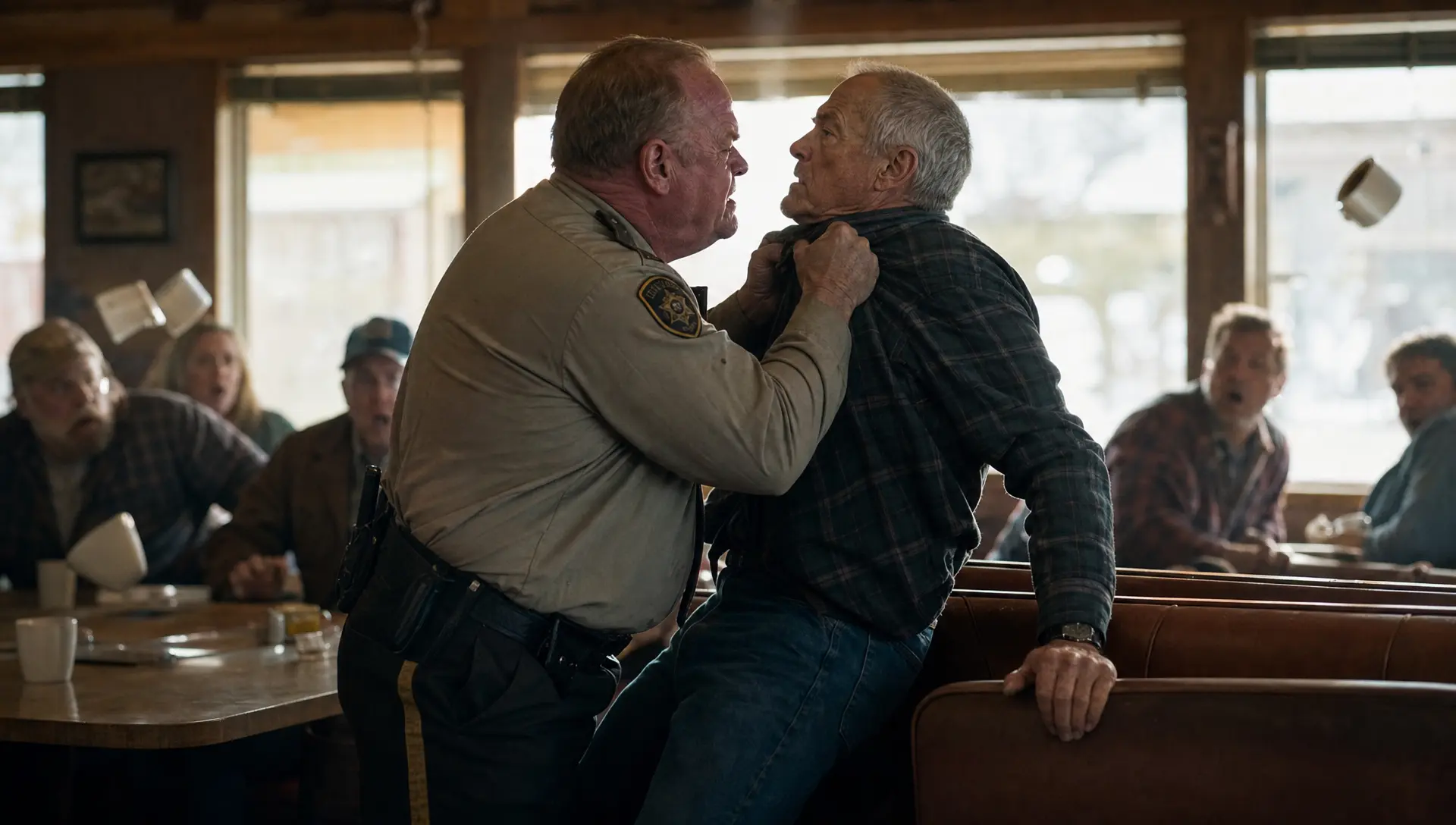
He grabbed the front of my collar and yanked me half out of the seat.
The coffee cup hit the floor. A plate followed. A woman near the kitchen made a sound like she was swallowing a scream.
I reached for my phone.
Wade saw it and drove my arm into the counter edge.
The phone flew.
He shoved me backward. My shoulder hit the display case. Glass cracked. I went down hard onto one knee, and the side of my head caught the corner of the counter on the way.
Blood came fast.
The diner went completely silent.
Not peaceful quiet. The other kind. The silence that follows violence, that settles over witnesses who desperately want to believe they didn’t just see what they saw.
Wade straightened his jacket. Picked up the fork from my plate. Sat down in my booth.
Began eating.
Nobody moved.
Nobody spoke.
Nobody looked at the blood on the floor.
Fear had lived inside Ruby Lane Diner long enough to become furniture. Long enough that most people had stopped noticing it at all. That’s the cruelest thing about fear — it almost never arrives with warnings. It slips in quietly. Then stays until everyone mistakes it for ordinary life.
June appeared beside me. She pressed a folded towel against the cut above my eye.
Her hands were shaking.
“You need a hospital.”
“I need a minute.”
“Arthur—”
“One minute, June.”
I found my phone beneath the counter. The screen was cracked but lit. I dialed.
Two rings.
“It’s me,” I said. “Now.”
Then I ended the call.
In the booth, Wade laughed at something Deputy Mercer said. Too loudly. Too comfortably.
Cruel men always perform after violence. They need witnesses. They need everyone in the room to remember exactly who is in control.
But something had changed.
A waitress near the kitchen kept glancing toward the parking lot.
The truck driver in the corner quietly unlocked his phone.
The old rancher at the counter turned his chair slowly toward the windows.
None of them knew what was coming. They only knew something was.
And for the first time in fifteen years, Sheriff Wade Hollister failed to read the room.
That was his first mistake.
His second arrived exactly fourteen minutes later.
Three black SUVs rolled into the parking lot.
Slowly. Deliberately. Not like visitors. Like people who already knew exactly where they belonged.
Every conversation inside Ruby Lane disappeared.
The passenger door of the lead vehicle opened before the engine had fully settled. A polished black shoe touched the gravel. Then another. A tall woman in a navy suit stepped into the sunlight, closed the door without looking back, and lifted her eyes toward the diner.
Special Agent Elena Marquez had not changed much in twelve years.
A little more silver near her temples. A few sharper lines around the mouth. The same stillness in her face that made guilty men start talking before she ever asked a question.
Three more agents emerged behind her. Two from the second vehicle. The third SUV stayed closed.
Wade stopped chewing.
His fork hovered above the plate.
Only for a second.
Then he smiled — smaller than before. The smile of a man trying to calculate whether the danger outside understood who he was.
Deputy Mercer shifted. “Sheriff?”
Wade set the fork down carefully. “Probably lost.”
Nobody answered.
The bell above the diner door rang.
Marquez entered. Morning light framed her silhouette before the door swung shut behind the last agent.
Her gaze moved across the shattered dishes. The overturned chair. The blood on my collar. June’s shaking hands.
Then Wade.
She stopped in the center aisle.
“Sheriff Hollister.”
“Agent Marquez.” He said the name easily. Too easily. The tightening beneath his left eye gave him away.
Marquez looked at me.
“Colonel Mercer.”
A murmur moved through the diner.
Wade’s eyes went from her to me. He had known me as Arthur Mercer. Old man. Widower. The veteran who drank black coffee in the corner booth every morning. He had never asked what rank I left with. Men like Wade rarely ask questions when they believe the answers cannot threaten them.
“Retired,” I said.
“Still counts,” Marquez answered.
Wade laughed. “Is this some kind of reunion?”
Marquez faced him fully. “No.”
The agents spread quietly through the diner. One near the entrance. One beside the hallway to the kitchen. No weapons drawn. They didn’t need to be. Their calm did what shouting couldn’t — it made Wade’s deputies understand that the room no longer belonged to them.
Wade looked around. “You planning to tell me why federal agents are disrupting my breakfast?”
Marquez removed a folded document from her jacket.
“I have a warrant authorizing the immediate seizure of all Oak Hollow County Sheriff’s Department financial records, evidence logs, internal communications, weapons inventories, civil-forfeiture files, and personnel devices.”
The smile left Wade’s face.
Deputy Mercer’s chair scraped backward.
Marquez didn’t even turn. “Sit down.”
He sat.
Not because she raised her voice.
Because for the first time in years, one of Wade’s deputies had received an order without checking whether Wade permitted it.
Wade leaned forward. “You walked into my county with a piece of paper and think you own the place?”
“No,” Marquez said. “The Constitution owns the place. You appear to have forgotten.”
A breath escaped near the counter — almost a laugh.
Wade heard it. His head turned sharply.
The old rancher looked down at his coffee, but not quickly enough.
Something dangerous moved across Wade’s face.
“So did everyone else,” Marquez continued, steady as weather.
Wade stood. The booth groaned. His hand moved toward his belt.
Every federal agent shifted at once. The sound of jackets brushing holsters filled the diner.
Wade froze with his fingers inches from his weapon.
“Take your hand away,” Marquez said.
He stared at her.
No one breathed.
Then Wade lowered his hand.
Slowly.
The first visible surrender Oak Hollow had witnessed in fifteen years.
“Colonel, did Sheriff Hollister assault you?” Marquez asked.
I removed June’s towel. Blood had soaked through two layers.
“Yes.”
“Would you like medical assistance?”
“In a minute.”
Wade pointed at me. “He resisted lawful detention.”
Marquez didn’t look at him. “Were you detained?”
“No.”
“Under arrest?”
“No.”
“Informed of a charge?”
“No.”
Wade’s voice hardened. “He interfered with an investigation.”
“Which investigation?” Marquez asked.
He hesitated. The question was simple. That made it worse.
“Ruby Lane’s liquor license.”
June went still beside me.
Marquez looked at her. “Ms. Lane, has the sheriff’s department threatened your business license?”
June’s eyes moved toward Wade automatically. The old reflex. The need to check whether the truth was permitted.
Wade’s face didn’t move. But she knew him well enough to hear every warning he wasn’t saying out loud.
June’s hands trembled. The towel sagged between her fingers. I watched the fight happen inside her — not between fear and courage, but between everything Wade had already taken and everything he could still take if the people outside failed.
Her diner. Her employees. Her brother’s parole. Her daughter’s custody case. Every pressure point Wade had spent years collecting.
June looked down at the blood on the towel.
Then at the shattered plate near my shoes.
When she lifted her eyes again, she did not look at Wade.
“Yes,” she whispered.
“Please speak clearly,” Marquez said.
June drew a shaking breath.
“Yes. He threatened my liquor license. My health permit too. He said if I stopped providing free meals to his department, inspectors would find enough violations to close me.”
Wade laughed once. “She’s lying because she’s scared.”
June turned toward him.
“I am scared.”
Her voice cracked through the whole diner.
“I’ve been scared of you for nine years.”
Something changed in the room.
Not loudly. A chair creaked. A spoon touched a saucer.
The truck driver near the window lowered his phone and stood.
“He took my delivery truck.” His knees were visibly shaking. He kept going. “Said it was used in a narcotics investigation. There were no drugs. No charges. The county auctioned it three weeks later to Wade’s cousin.”
One of Marquez’s agents began taking notes.
Wade pointed at him. “Sit down before you make this worse for yourself.”
The driver’s face went pale.
But he stayed standing.
The old rancher turned fully from the counter.
“He made my grandson sign over six acres after a traffic stop.”
A woman near the kitchen covered her mouth. Then spoke through her fingers.
“My husband spent four nights in holding because Wade wanted him to withdraw a complaint against Deputy Mercer.”
Mercer looked at her. “That’s not what happened.”
Her shoulders pulled inward.
Then June stepped beside her.
Not in front. Beside.
The woman lowered her hand.
“He came home with two broken ribs.”
Wade looked around the diner.
His control had always depended on isolation. One victim at a time. One whispered threat that made each person believe everyone else had chosen obedience willingly.
Now the stories were touching.
Fear was learning it had neighbors.
“Enough,” Wade said.
Nobody stopped.
A mechanic described cash payments demanded after citations. A mother described her son’s arrest record being altered when she refused to sell land to one of Wade’s business partners. A waitress said deputies regularly lifted money from the tip jar.
Each voice started quietly. Each became stronger when the next one joined.
Marquez let the room speak.
She understood something Wade never had.
Authority doesn’t always need to fill silence. Sometimes it only needs to protect it long enough for truth to enter.
Wade turned toward me.
“You brought them here.”
“Yes.”
“You’ve been planning this.”
“For eleven months.”
His eyes narrowed. He thought intention meant entrapment.
“I started documenting,” I said, “after Deputy Mercer stopped Samuel Ortega outside the feed store.”
The name silenced several people.
Samuel had been nineteen. Quiet. Small for his age. He had been charged with assaulting an officer, resisting arrest, and possession of narcotics. The body-camera file had supposedly corrupted. Samuel served fourteen months. His mother lost the family grocery store paying legal bills.
Most of Oak Hollow believed the official story because believing anything else required admitting what kind of town they had helped build.
Wade crossed his arms. “Ortega was guilty.”
“No,” I said. “He was convenient.”
Mercer shifted. Sweat darkened his collar.
Wade saw it. “Clay.”
One word. A warning.
Marquez nodded toward an agent, who stepped behind Mercer’s chair.
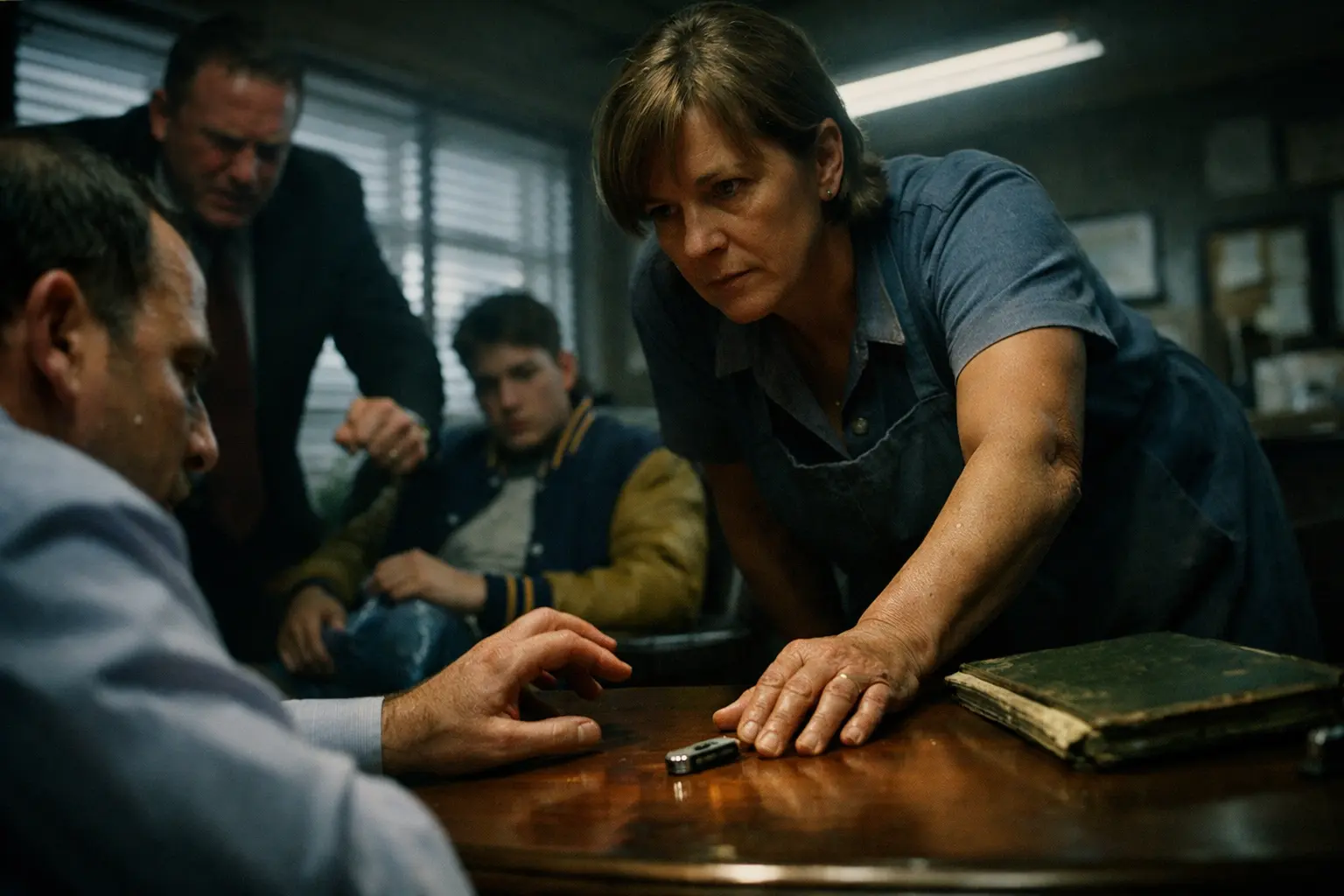
I reached slowly inside my jacket. Two agents watched my hand. I removed a small silver recorder and set it on the table.
Wade stared at it.
“For eleven months,” I said, “I listened.”
I had returned to Oak Hollow after forty-three years because my sister was dying. June had been her closest friend. I stayed after the funeral because the town I remembered no longer existed. People spoke in unfinished sentences. Doors closed when patrol cars passed. Parents taught children which deputies not to look at.
At first I thought age had made everyone cautious.
Then Samuel’s mother showed me the photographs.
Then June showed me the inspection notices.
Then a former dispatcher gave me copied call logs that never reached state databases.
I began recording.
Wade’s boasts over breakfast. His deputies collecting envelopes in the parking lot. Threats made when men like him assumed an old veteran’s hearing aid meant he couldn’t hear.
Wade looked from the recorder to me.
“You recorded law enforcement without consent.”
“Texas is a one-party-consent state,” Marquez said.
His jaw tightened.
I reached into my pocket again.
This time I removed a flash drive.
“Audio was only the beginning.”
Marquez accepted it.
Wade took one step forward. An agent blocked him.
“What’s on there?” Wade asked.
I looked at Deputy Mercer.
“Samuel Ortega’s body-camera footage.”
Mercer stopped breathing.
Wade’s eyes snapped to him. “Clay?”
Mercer stared at the floor.
The original file had never been corrupted. A dispatcher named Beth Colson had copied it before Wade ordered the server wiped. She had hidden it for nearly two years. Then she developed pancreatic cancer. Three weeks before she died, she mailed it to me with a note written on the back of an Oak Hollow utility bill.
I was afraid while it happened. I was ashamed afterward. Please make fear the smaller thing.
Marquez handed the drive to an agent with a laptop.
He opened the file.
The diner’s television connected to the same outlet behind the counter.
June reached for the remote.
Her hand stopped.
She looked at me.
I nodded.
The screen came alive.
Not with the morning news.
Darkness. A shaky body-camera image. Samuel Ortega standing beside his truck under the feed store’s security light. Hands visible. Voice frightened.
Deputy Mercer ordering him to turn around.
Samuel asking why.
Mercer grabbing him.
Samuel falling against the truck.
Then Wade entering the frame.
No drugs. No attack. No resistance. Only a terrified nineteen-year-old begging them to stop.
The diner watched Wade kneel beside Samuel and remove a small plastic bag from his own pocket. Watched him slide it beneath the truck seat. Watched Mercer turn off his body camera after Wade said, quietly, “Now he has a reason to learn.”
The video ended.
Nobody moved.
Deputy Mercer covered his face with both hands.
Wade stared at the blank screen.
Somewhere in the kitchen, a faucet dripped.
Once.
Twice.
Three times.
Marquez closed the laptop.
“Sheriff Wade Hollister, turn around and place your hands behind your back.”
He didn’t move.
She stepped closer.
“You are under arrest for conspiracy against rights, deprivation of rights under color of law, evidence tampering, obstruction of justice, extortion, and related federal offenses.”
He looked around the diner. This was the moment he expected loyalty. Not affection. Fear. A deputy reaching for a weapon. A witness retracting. Someone reminding federal agents that this was his county.
Nobody moved.
Deputy Mercer lowered his hands. His face was wet.
“I’ll testify.”
Wade turned toward him. The hatred in his expression stripped away every last illusion.
“You weak little—”
“I kept copies,” Mercer blurted.
Wade went still.
“Property seizures. Cash transfers. The evidence-room ledger before you changed it. I kept everything.”
“Why?” Marquez asked.
Mercer looked toward the blank television screen.
“Because I knew one day he’d blame me for all of it.”
Wade lunged.
The agents moved faster.
His shoulder struck the table edge. Plates crashed. A coffee cup shattered beneath his boot. They forced his arms behind him. Metal cuffs closed around his wrists.
For years, people had imagined Wade’s downfall with gunfire. Sirens. Some explosion equal to the damage he had done.
Instead, it arrived with a small mechanical click.
The sound of handcuffs locking.
Wade struggled once. Then stopped. He looked at me over his shoulder. Blood from my forehead had dried along my cheek.
“You think this changes anything?”
I stood slowly. My ribs hurt where I had struck the floor.
“It already has.”
Wade looked around one final time.
The waitress was no longer avoiding his eyes.
The rancher stood with both hands resting on his cane.
The truck driver held his phone openly.
June faced Wade without lowering her head.
He saw what I had sensed fourteen minutes ago.
People were still afraid.
But they were no longer afraid alone.
The agents led him toward the door.
At the threshold, Wade twisted back.
“This town will beg me to return when you see what happens without me.”
Nobody answered.
The bell rang above his head.
Sunlight swallowed him.
Through the windows, Oak Hollow watched the man who had ruled it for fifteen years be placed in the rear of a federal vehicle. No deputy opened the door. No one saluted. The SUV pulled away. State police appeared on the highway. Then news vans. Then ambulances.
The diner did not erupt in celebration. Justice rarely feels like victory while the wound is still bleeding.
People remained where they were, absorbing the shape of a world in which Wade Hollister was no longer the most powerful man in the room.
June sat me near the counter. A paramedic cleaned the cut above my eye.
Across from me, Rosa Ortega stood beside the television. She had come in during the arrest without anyone noticing. Both hands pressed against her chest.
I rose before the bandage was finished.
“Rosa.”
She looked at me.
For two years, I had visited her shuttered grocery store. I had told her I believed Samuel. Belief hadn’t freed him. Belief hadn’t restored fourteen months.
I held out the flash drive.
“We found it.”
Her mouth trembled. “Did he know you were looking?”
“No.”
“He stopped calling me.” Her voice folded. “At the hearing, I told him to accept the plea. I told my own son to say he had done something he didn’t do because I was afraid they’d give him ten years.” She shook her head hard. “I watched him look at me when I said it.”
I placed the drive in her palm.
“You were trying to keep him alive.”
“I taught him the truth mattered.”
“You also taught him a mother stays.”
Rosa closed her fingers around the drive. Her knees weakened.
June reached her first.
The two women held each other beside the counter where Wade had eaten breakfast as though nothing could ever touch him.
Forty-eight hours later, the state filed emergency motions.
Samuel Ortega walked out of a transport van wearing prison-issued shoes and a shirt two sizes too large.
The town gathered outside the courthouse — not because anyone organized it, but because people came.
Samuel stepped down. He had aged more than two years.
Rosa moved through the crowd and stopped several feet away. Neither of them ran. Neither spoke. She lifted one hand toward his face, then hesitated — as though she had lost the right.
Samuel closed the distance. He rested his forehead against hers.
Rosa made one small sound.
Then he wrapped both arms around her.
The crowd looked away.
Not from shame.
From respect.
Oak Hollow had spent years making suffering public and compassion private. That afternoon, it began to reverse the habit.
On the first anniversary of Wade’s arrest, Oak Hollow gathered at Ruby Lane Diner.
Not to celebrate him.
To remember the morning fear lost its favorite booth.
June served breakfast without charging anyone. Samuel cooked beside her. Rosa ran the register and refused every tip until the jar overflowed. The old rancher brought photographs of the land returned to his grandson. The truck driver parked his recovered vehicle near the entrance, freshly painted but still carrying one dent from the day deputies seized it.
Agent Marquez arrived without a convoy. Daniel Brooks from the state oversight board came with a stack of newly published civil-rights procedures. Children moved between tables that had once gone silent whenever Wade entered.
Near noon, June tapped a spoon against a glass.
A wooden plaque hung where Wade’s booth had stood. No sheriff’s star. No government seal. Only three words from my sister’s notebook:
Make them see one another.
June asked me to speak.
I stood slowly. Every face turned toward me. A year earlier, that kind of attention made people lower their eyes. Now they looked openly.
I had prepared a speech. Three pages folded inside my jacket.
I left them there.
“Fear convinced us we were alone,” I said. “Wade did not create every silence in this town. We helped him — by believing no one else would speak.”
Nobody shifted.
“No one person ended it either. Not me. Not the federal agents. Not one recording.”
I looked at June. Rosa. Samuel. The rancher. The driver. Marquez.
“All Wade ever needed was for each of us to look away from everyone else.”
My voice tightened.
“My sister understood the answer before I did.”
I touched the plaque.
“See one another.”
That was all.
No applause came immediately.
Then Samuel stood and walked toward Rosa. Took her hand.
June stepped beside the waitress who had once been too frightened to speak.
The truck driver rested a palm on the rancher’s shoulder.
People turned toward one another.
The room filled — not with noise, but with recognition.
Applause followed slowly. Warmly. Not for me.
For all of us.
That evening, after the last customer left, June locked the front door.
Sunset lay across the tables in long amber bands. The diner smelled of coffee, pie crust, and the faint lemon cleaner she used on the counter.
I sat in my old booth. Not Wade’s. Mine. The repaired one near the window where I had taken breakfast every morning since returning to Oak Hollow.
June carried two cups of coffee and sat across from me.
“No towel this time,” she said.
I touched the scar above my eye. “I’m improving.”
She smiled. A real one — not the careful expression Wade had trained from her over nine years.
Outside, Samuel helped Rosa load empty trays into her car. The rancher’s grandson waved as he drove past. A new deputy walked the sidewalk without making anyone inside go quiet.
June watched him disappear.
“You leaving?” she asked.
The question was casual only on the surface.
For years, movement had been my answer to every ending. A new posting. A new assignment. A new place where usefulness could protect me from belonging.
I looked at my sister’s words on the wall.
Make them see one another.
And I thought: sometimes courage is staying where love put you.
“No,” I said.
June’s fingers relaxed around her cup.
“Good.”
That single word carried no demand. No promise.
Only room.
We drank in silence while the final sunlight moved across the floor.
The silence felt different now. Not the silence after violence. Not the silence of witnesses looking away. The silence of two people no longer needing to fill every empty space with fear.
When we stepped outside, June left the diner door open behind us for a moment. Warm light spilled onto the sidewalk. The bell moved gently in the evening breeze.
Across Oak Hollow, porch lights appeared one by one. Windows glowed. Voices traveled from yards.
Nothing looked dramatic.
That was the final gift.
Freedom didn’t arrive as a parade. It arrived as ordinary life no longer shaped around one man’s shadow.
June turned the key in the lock. I offered my arm. She looked at it, then at me. Her smile deepened.
She took it.
Together, we walked beneath the old oak trees toward the square.
Behind us, Ruby Lane Diner stood warm and bright against the gathering dark. Inside, three words remained on the wall.
Make them see one another.
And for the first time in longer than anyone could remember — Oak Hollow did.
Original fictional stories. AI-assisted creative content.