The parking lot outside Hargrove & Associates was the kind of place where nobody looked twice at anything.
Concrete. White lines. A row of expensive cars baking under a Tuesday afternoon sun.
Claire Hargrove pulled in at 5:47, already on her phone, already running the numbers from the Denfeld account in her head. She was a senior partner now. She had a reserved spot with her name on a small green sign. She had a dry-clean-only wardrobe and a calendar that did not have room for surprises.
She did not see the boy until she opened the car door.
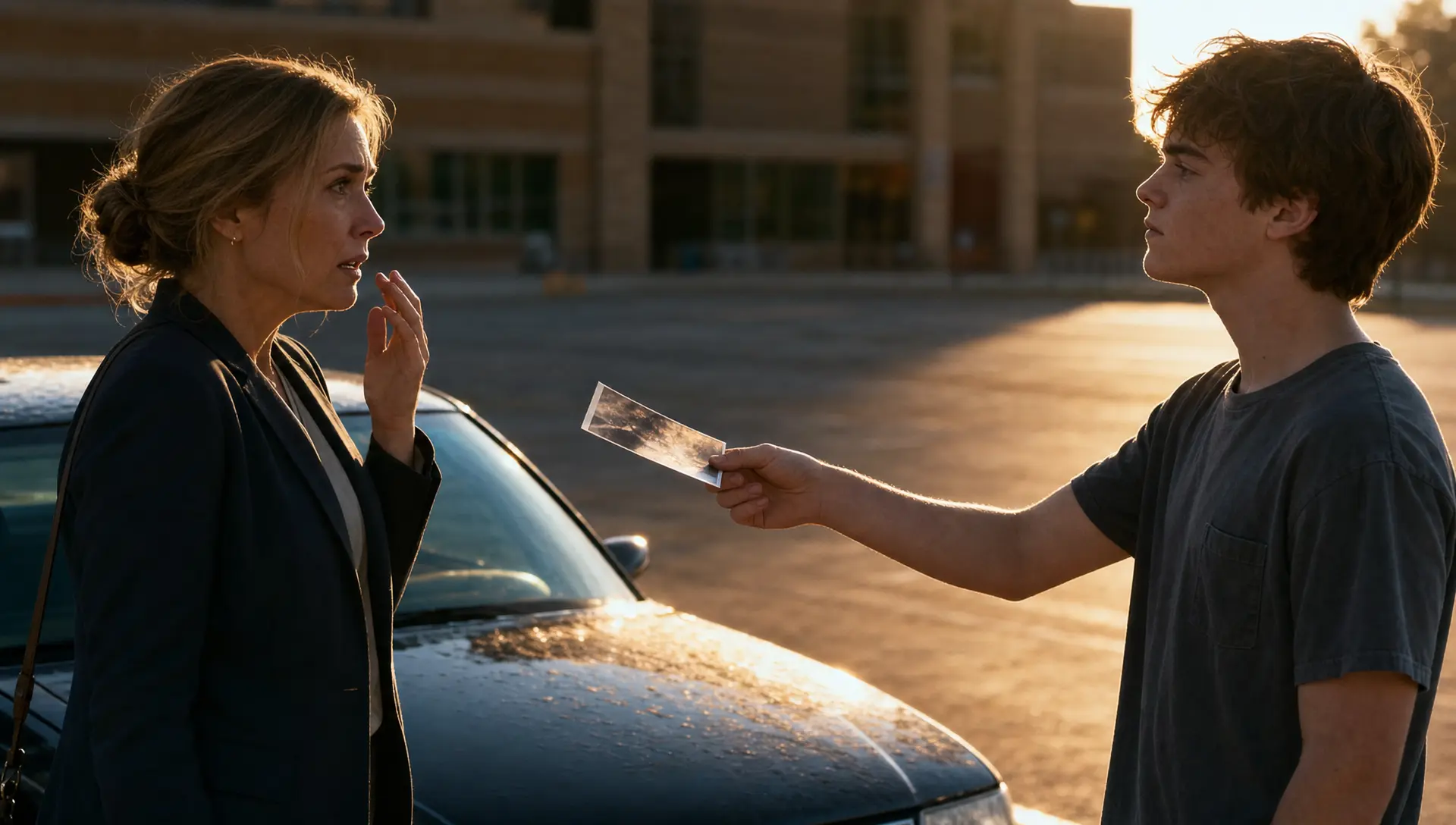
He was standing at the front of her Mercedes, maybe fifteen, sixteen. Worn sneakers. A faded gray T-shirt. A plastic bucket at his feet and a sponge in his hand — and water running in slow rivers off the hood of her car, dripping onto the concrete, pooling around the front tires.
Her phone dropped to her side.
“What are you doing?”
The boy didn’t flinch. “Washing your car.”
“I can see that.” Her voice rose. “I didn’t ask you to wash my car. Who told you to touch my car?”
He squeezed the sponge over the bucket. Water hit the concrete. He didn’t answer.
“Hey.” She stepped toward him. “I’m talking to you. Do you know what this car costs?”
He looked up then.
His eyes were dark and steady and entirely too calm for a kid holding a sponge in a stranger’s parking lot.
“Yeah,” he said. “I know exactly what it costs.”
Something in his tone made her stop.
Not the words. The certainty behind them.
“You have about thirty seconds,” she said, “before I call security.”
He set the sponge down on the bucket lid. Reached into the back pocket of his jeans. Pulled out a photograph, worn at the corners, creased down the middle like it had been folded and unfolded a thousand times.
He held it out to her.
She didn’t take it.
So he held it higher.
It was a family photo. Summer. A backyard she recognized immediately because she had stood in it every summer of her thirties. A plastic kiddie pool. A yellow umbrella. A grill trailing smoke.
And a woman — younger, softer, laughing — holding a toddler against her hip. The toddler had both hands full of watermelon.
Claire’s face was the woman’s face.
The toddler’s eyes were the boy’s eyes.
The photograph shook slightly in his hand. Or maybe her vision was shaking. She couldn’t tell.
“Where did you get that?”
“My dad kept it.” His voice didn’t waver. “Box under his bed. He said you used to love this car. Said if I ever wanted to find you, look for a black Mercedes E-Class with a dent in the rear bumper from the time you backed into a mailbox.”
Claire’s hand went to her mouth.
The dent was there. She’d never fixed it.
“Your dad,” she said.
“Marcus Webb.” He said the name flat, like a fact, not a question. “He died eight months ago.”
The parking lot tilted.
“Marcus—”
“Heart attack. He was fifty-one.” The boy’s jaw tightened, just slightly. “I’m Ryan.”
She knew the name. She had chosen it herself, eleven years ago, in a hospital room she had spent a decade trying to stop seeing when she closed her eyes.
“Ryan,” she said. It came out wrong — too soft, too careful, like she was afraid the word would break.
“I’m not here for money.” He picked the sponge back up. “I washed your car because I needed you to stop. Because every time I’ve tried to get into this building they tell me you’re unavailable.”
“How many times—”
“Four.” He looked at her steadily. “I’ve been in this city for three weeks.”
Three weeks.
He had been forty minutes away for three weeks.
“Ryan, I—”
“I don’t need an explanation right now.” His voice cracked at the edges, just barely. “I just needed to see what you looked like. Up close.”
He looked at her the way people look at things they’ve been imagining for so long the real version feels slightly unreal.
Claire looked back at him.
She had left when he was four. That was the version she told herself — she had left, she had not abandoned, there was a difference, there had been reasons, there had always been reasons. Marcus had understood. Or said he understood. Or said enough that she could drive away and keep driving.
She had sent money every year until Ryan turned twelve. Then Marcus stopped cashing the checks.
She had told herself that meant they were fine.
She had told herself a lot of things.
“You look like him,” she said.
“I know.”
“You have his—” Her voice broke. “The way you hold your chin up when you’re angry. That’s Marcus.”
Ryan said nothing.
“I taught you that word.” She was barely speaking now. “Ryan. Your dad wanted something else. I wanted Ryan.”
“He told me.”
“He kept the name.”
“He kept everything.” Ryan looked down at the bucket. “He wasn’t the type to throw things away.”
The late sun made the wet hood of the car blaze. A coworker walked past the parking lot entrance, glanced over, moved on. Nobody stopped. The world continued at its normal speed.
Claire sat down on the edge of the curb.
Not gracefully. Not the way a senior partner sits. She just sat down on the concrete in her dry-clean-only blazer and looked at her hands.
“I was going to come back,” she said.
Ryan stayed standing. “Okay.”
“I mean it. That’s not — I’m not asking you to believe it. I just want you to know that I thought about it.”
“How often?”
Honest question. No softness in it, no cruelty either.
“Every year,” she said. “On your birthday.”
“March ninth.”
“Yes.”
He was quiet for a moment. Then: “Dad made pancakes every March ninth. Even when things were bad. He said it was a tradition.”
Claire covered her eyes.
She was crying now. She hadn’t decided to, it had just happened, the way things happen when you’ve been holding them at the wrong angle for too long.
Ryan watched her.
He didn’t walk away.
He also didn’t move closer. Not yet.
“He wasn’t angry at you,” Ryan said finally. “That’s the thing. I was angry enough for both of us, so he didn’t have to be.”
She looked up. “And now?”
He considered it the way his father used to consider things — slowly, honestly, without performing the answer.
“I came here,” he said. “That’s what I know.”
She stood up from the curb. Her blazer was dusty at the back. She didn’t brush it off.
“I have an office on the fourteenth floor,” she said. “With a window that faces the street. I’ve been up there for nine years.”
“I know. I looked you up.”
“You could have emailed.”
“I wanted you to see me standing in front of you.” He said it without apology. “I wanted it to be harder to look away.”
That hit her somewhere below the ribs.
She took a step toward him.
He didn’t step back.
“Ryan.” She stopped two feet away. “I don’t know how to do this. I don’t know what you need from me or what I owe you or whether sorry is even the right word for something this large.”
“It’s a start,” he said.
“I know that’s not enough.”
“I didn’t say it was enough. I said it’s a start.”
She reached out slowly — not grabbing, not pulling — and put her hand on his shoulder.
He went still.
Then something released in him, somewhere deep, and he stepped forward and let her wrap her arms around him. He was taller than she expected. He smelled like dish soap and summer heat.
She held on.
He held on back.
Not long. Maybe twenty seconds. But real — the kind of real that doesn’t need to be long to matter.
When he stepped back, his eyes were dry. Hers weren’t.
He picked up the bucket.
“Your car’s done,” he said. “Back window still has a streak.”
She laughed — surprised out of it, half-sob — and wiped her face with the back of her hand.
“Come upstairs,” she said. “I’ll buy you a coffee. Or — do you drink coffee?”
“I’m sixteen.”
“Right.” She picked up her phone. “There’s a place around the corner. They do good hot chocolate.”
He looked at her for a moment. Then nodded once.
They walked out of the parking lot together.
The Mercedes gleamed behind them in the late sun, clean except for one streak on the back window.
She’d fix it herself tomorrow.
Original fictional stories. AI-assisted creative content.