The revolving door of the Grand Aurelia turned once, and a man in a torn coat stepped inside.
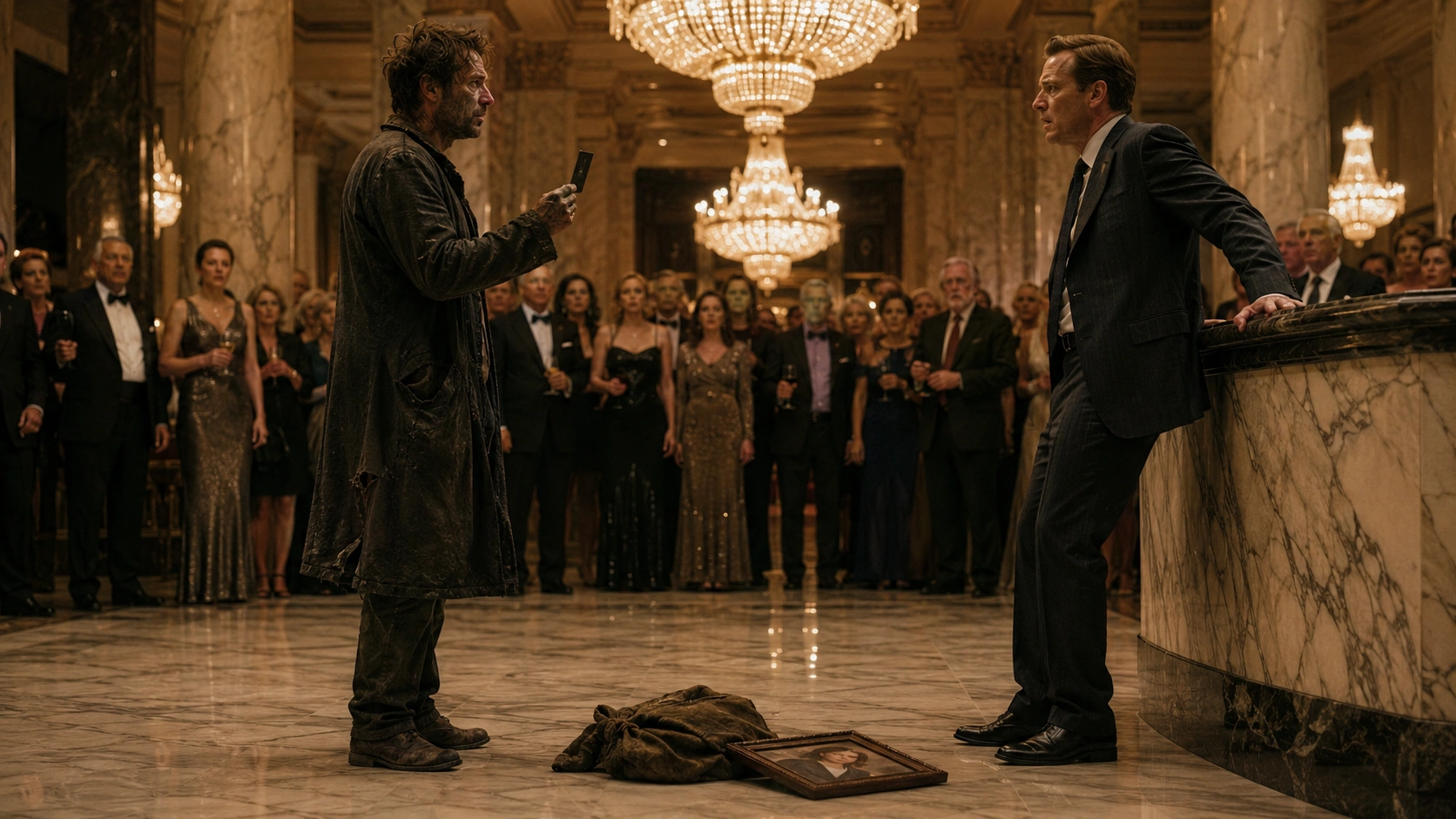
Dust clung to his boots. His dark hair was uncombed. In one hand he carried a cloth bag that had clearly survived more roads than most people ever walked.
Every conversation in the lobby slowed.
A woman in a silk gown covered her nose with two fingers. A businessman looked him up and down and smirked into his drink. The chandeliers overhead poured warm gold light over marble that had never seen a stain.
The man didn’t look at any of them.
He walked toward the front desk, quiet and exhausted, until a tall figure in a charcoal suit stepped directly into his path.
“Stop right there,” Martin Vale said.
The whole lobby turned.
Martin’s smile was polished, cruel, practiced. He was the general manager, and he had spent fifteen years learning exactly how to make people feel small.
“People like you don’t belong here.”
A few guests laughed softly. Someone whispered, “Is that a homeless man?”
The tired stranger lifted his eyes. “I came for the owner.”
The laughter grew louder.
“The owner?” Martin tilted his head, mocking. “Do you even know where you are?”
“The Grand Aurelia.”
“This is a five-star hotel.” Martin’s voice sharpened. “Not a shelter.”
“I need to speak to the owner.”
Martin laughed once, sharply.
Then, without warning, he swung his polished shoe forward and kicked the cloth bag out of the man’s hand.
The bag flew across the marble. It struck the base of a gold column and burst open. A worn shirt spilled out. An old leather notebook. And a cracked photo frame that skidded to a stop in front of a woman in pearls.
The lobby went quiet.
For the first time, real pain crossed the stranger’s face.
He walked slowly to the scattered belongings and knelt on the marble. He picked up the photo frame first. Inside was a faded picture of a woman standing on the steps of the Grand Aurelia, back when the sign was still new.
Martin sneered down at him. “What is that? Some fantasy?”
“My mother worked here.”
“Many people worked here. That doesn’t make you important.”
The man looked up.
“My mother died waiting for someone in this hotel to tell the truth.”
For one flicker of a second, Martin’s smile faltered.
Then he leaned down, close enough that only the front row of guests could hear.
“Listen to me carefully. The owner would never meet a beggar. Walk out that door or I’ll have security drag you out.”
The stranger stood slowly.
The guests waited for him to leave.
He didn’t.
Something in him changed. Not fear. Something colder.
He reached into the inside pocket of his torn coat and pulled out a sleek black card. No name. No number. Just a deep black surface with a metallic edge that caught the chandelier light like a blade.
A wealthy guest near the desk gasped.
Martin’s face lost every drop of color.
He knew what it was. Everyone in the luxury world knew. A private acquisition card. Not something you booked rooms with. Something you bought buildings with.
The stranger held it between two fingers.
“I told you,” he said quietly. “I came for the owner.”
“Sir…” Martin’s voice cracked. “I…”
“Twenty-two years ago,” the man continued, “my mother was thrown out of this hotel after she discovered forged ownership papers.”
The lobby stopped breathing.
“She lost her job. Her home. Her name. And no one listened, because the men who stole this hotel were rich.”
He looked up at the chandeliers.
“She died believing the truth would never come out.”
His eyes returned to Martin.
“But she left me every document.”
“This is a misunderstanding,” Martin said quickly.
The stranger gave a faint, tired smile.
“No. This is a return.”
The glass elevator opened behind him with a soft chime.
Two security guards stepped out, and behind them, an old man in a black velvet suit — silver-haired, straight-backed, with the kind of quiet authority that turns a room without a word.
Edward Whitmore. The owner of the Grand Aurelia. He hadn’t set foot in the lobby in three years.
Martin turned toward him instantly. “Mr. Whitmore, thank God. This man is causing a scene. I was just removing him.”
Mr. Whitmore didn’t look at Martin.
He looked only at the stranger.
Then his eyes dropped to the cracked photo frame in the man’s hand.
His face went pale.
“Anna,” he whispered.
The stranger’s fingers tightened around the frame. “That was my mother.”
The old owner took one trembling step forward.
“Your mother… was innocent.”
“I know.”
“And this hotel,” Mr. Whitmore said, “should have belonged to her.”
A shock passed through the lobby like a physical wave. Someone dropped a champagne flute. It shattered against the marble, and no one even flinched.
Martin’s mouth opened. Closed. Opened again.
The stranger raised the black card.
“Then tonight,” he said, “I’m here to finish what she started.”
Mr. Whitmore looked at him for a long moment. Then turned to the guards.
“Close the doors.”
The heavy front doors of the Grand Aurelia sealed shut with a deep, final sound. Every guest in the lobby was suddenly a witness to something none of them had paid for.
Martin’s breathing became uneven. “Mr. Whitmore, sir, if I could just—”
“Be quiet, Martin.”
The stranger stepped forward. He no longer looked like a beggar. He looked like a verdict walking toward the bench.
“My name is Ethan Hale,” he said, loud enough for the entire lobby to hear. “And I’ve spent twenty-two years learning how to buy this building without any of you noticing.”
He nodded once at the acquisition card.
“The sale closed at six o’clock this evening. In New York. Every share. Every subsidiary.”
He looked at Mr. Whitmore.
“With your signature.”
The old owner nodded slowly. “I signed it three months ago.”
The whispers turned into open shock. An investor near the bar swore softly. A woman gripped her husband’s arm.
Martin’s voice cracked. “That’s not possible.”
“It’s already done,” Ethan said.
Martin looked toward the guests, searching for an ally. He found none. The same faces that had laughed with him ten minutes ago now looked at him the way people look at a stain on a table cloth.
“Mr. Whitmore,” Martin said desperately, “you can’t just—”
“Martin.” The old man’s voice was quiet, but it cut. “You handled internal investigations back then.”
Martin froze.
“You were the last person seen entering the archive.”
“That was—” Martin started. “That was twenty years ago. I was a junior—”
“You were the one Anna reported to that afternoon.”
The lobby went absolutely silent.
Ethan reached into his bag and lifted out the leather notebook. He set it on the polished reception counter, and every executive in the room leaned slightly forward without meaning to.
“My mother copied everything,” Ethan said. “Every forged signature. Every account number. Every property transfer.”
He opened the notebook to the first page. The handwriting was small, neat, careful. Twenty-two years old and still perfectly legible.
An elderly accountant near the front stepped forward, staring. “I know this handwriting.”
Ethan didn’t look up. “You verified the numbers for her.”
“I did.” The accountant’s voice trembled. “I told her they were genuine. I sent the file up.” He turned toward Mr. Whitmore. “You told me the file had been destroyed by mistake.”
“That’s what I was told,” Mr. Whitmore said.
“By who?”
Mr. Whitmore’s eyes moved slowly to Martin.
Martin backed up a step. “This is insane.”
“You told me the archive was empty,” Mr. Whitmore said. “You told me Anna had lied. You told me the police had cleared it.”
“I was young. I made mistakes.”
“You made a career.”
Ethan turned the notebook to a specific page.
“Page forty-one,” he said. “A wire transfer of two million dollars. Dated one week after my mother was fired. The receiving account is registered in Miami. Under your name, Martin.”
Martin’s mouth opened. No sound came out.
“Your name wasn’t Vale then, was it?”
Martin said nothing.
“Say it.”
“Lancaster.” The word came out like something torn. “Martin Lancaster.”
The whispers in the lobby became a low murmur.
“My father was Richard Lancaster,” Martin said. Something in him had broken open. “He gave me the money. I took it. I didn’t know what it was for.”
“You knew,” Ethan said quietly.
“I was twenty-three.”
“So was I when I started building the company that just bought your hotel.”
Silence.
Martin looked around the lobby one last time, at the faces of guests he had bowed to for years, and saw nothing but distance.
“Sir…” he tried, turning back to Mr. Whitmore. “Please. Let me explain—”
“You are dismissed, Martin,” Mr. Whitmore said. “Effective the moment those doors closed.”
“You can’t just—”
“He can,” Ethan said. “I own the hotel now. And I already have.”
Martin’s knees didn’t buckle theatrically. He just seemed to shrink, the way expensive fabric loses its shape when it gets wet.
Ethan looked at the accountant. “Sir, would you please make a photocopy of every page in this notebook, and hand the originals to the officers who are waiting outside.”
The accountant blinked. “Officers?”
Ethan glanced at his watch.
“They should be arriving now.”
Outside, through the tall glass doors, the wash of blue and red lights suddenly rolled across the marble. Three unmarked cars had pulled up in front of the entrance. Two men in plain suits stepped out, badges already visible on their belts.
Martin turned toward them. Then back toward Ethan. Then toward the closed doors, as if there were still somewhere in the building he could go.
“I filed the report last month,” Ethan said, almost gently. “Wire fraud. Document forgery. Conspiracy. The federal statute of limitations doesn’t run on fraud you’re still profiting from.”
Martin sat down on the marble floor.
Just sat down.
His polished shoe was still on the same tile where he had kicked the cloth bag half an hour earlier.
The guards opened the front doors. The two officers walked in without hurry.
“Martin Lancaster?”
“Yes.”
They read him his rights while the entire lobby watched, and no one filmed it on their phones, because something about the moment felt older and heavier than the internet.
When they walked him out, Martin looked at Ethan once. Not with hatred. With something closer to recognition.
Ethan didn’t look back.
He turned to Mr. Whitmore.
The old owner’s shoulders had dropped. Two decades of quiet guilt had come off him at once, and he suddenly looked every year of his age.
“Ethan,” he said. “I owe your mother more than I can ever—”
“You believed him because he was next to you every day,” Ethan said. “And she wasn’t.”
“That doesn’t make it right.”
“No. But she’d want me to tell you it’s done.”
Mr. Whitmore’s eyes filled.
Ethan bent down and picked up the cracked photo frame from the marble. He held it carefully, the way you hold something that has finally stopped needing to be protected.
“Sir, one more thing.”
“Yes.”
Ethan handed him a folded document from his coat.
“The staff who were quietly let go the year my mother was fired. There are eleven of them still living. Their families were listed with hers. I want each of them found this week. Back pay, with interest. Public apology. Their choice of position if they want to return.”
Mr. Whitmore took the paper with both hands.
“I should have done that twenty-two years ago.”
“You’re doing it tonight.”
Ethan turned toward the guests, who had stood frozen through the whole hour, holding drinks that had lost their chill.
“You came here tonight for dinner,” he said. “The kitchen will serve it. On the house.”
A stunned pause. Then a scatter of nervous, uncertain applause. It grew. Some of the older employees near the back — the ones who had been silent twenty-two years ago because they were afraid — began to cry openly.
Ethan walked back to the reception desk. He set the cracked photo frame on the marble counter, facing the lobby, so that the faded picture of his mother looked out over the room she had loved.
The elderly accountant approached him quietly. “Mr. Hale. She’d be proud.”
“She’d be furious I waited this long,” Ethan said. Then, softer: “But yes. She would.”
He picked up his old cloth bag from where it lay in the middle of the floor. The worn shirt. The leather notebook, already back in his hand. And the frame — he tucked it carefully into the inside pocket of the torn coat.
At the door, he stopped once and looked up at the chandeliers.
“You can leave the lights on tonight,” he told the doorman. “Every one of them.”
Then Ethan Hale walked out into the street where his mother had been thrown out twenty-two years earlier, and this time, no one moved to stop him.
Behind him, the golden lobby of the Grand Aurelia stayed open until dawn.
And for the first time in a long time, it felt like it belonged to someone who deserved it.
Original fictional stories. AI-assisted creative content.