Arthur Callahan sat on the edge of the bed in Room 318, cardigan hanging off thin shoulders, shoes tied, discharge papers stacked neat on the tray.
Everything was ready.
Except the person who was supposed to take him home.
Charge nurse Elena Brooks stood just outside the door, phone against her ear.
“Yes, I understand,” she said softly. “But he’s eighty-three. He shouldn’t be alone today.”
A pause.
“No, sir. I’m not asking you to move in with him. I’m asking if you can pick him up.”
Another pause. Her jaw tightened.
“I see. Thank you anyway.”
She hung up.
Arthur did not look up. “That was my nephew, wasn’t it?”
Elena stepped inside carefully. “He said he couldn’t leave work.”
“Busy man,” Arthur said quickly. “Good job. Can’t blame him.”
But his mouth folded inward, and his eyes shone.
Elena had been a nurse nineteen years. She’d seen families weep, families fight, families vanish. Something about Arthur hurt more than most. Maybe it was how he kept defending the people who forgot him.
“You can stay a little longer,” she said.
Arthur gave a laugh like paper tearing. “Hospitals aren’t hotels, Nurse Brooks.”
“Arthur—”
“I have a house.”
“You fell in that house.”
“I got careless.”
“You were on the floor almost six hours.”
His jaw tightened. The monitor beeped softly.
“I raised a daughter in that house,” he said. “Buried my wife from that house. Planted yellow roses out front because Margaret liked them.” His voice thinned. “A man ought to be allowed to go home.”
Before Elena could answer, a whisper drifted from the nurses’ station.
“Please don’t let that biker near the papers.”
Elena turned.
The elevator doors had opened.
The man was broad-shouldered, impossible to ignore. Black leather vest worn at the seams. Heavy boots leaving damp marks. Beard thick and gray. Face lined by years of sun and road.
A young mother pulled her child closer. A visitor murmured, “He doesn’t belong here.”
But the biker did not look lost. He did not ask directions.
He walked straight toward Room 318.
Elena moved into the doorway. “Sir. Can I help you?”
The man looked at the room number. Then at her.
“I’m here for Arthur.”
Elena froze.
Not Mr. Callahan. Not the patient. Arthur.
From inside the room came a sound so soft it might have been a breath breaking.
“No,” Arthur whispered.
The biker’s hard expression softened. “Hello, Arthur.”
“You can’t be.”
Elena looked between them. “Arthur, do you know this man?”
Arthur’s lips parted, but no answer came. His eyes filled so suddenly it startled her.
The biker took one slow step in. “I know I look a little different.”
“You were just a boy.”
The hallway had gone silent. Nurses pretended not to watch. Visitors leaned in.
The biker reached into his vest. Elena instinctively stepped forward. He lifted a hand.
“It’s okay.”
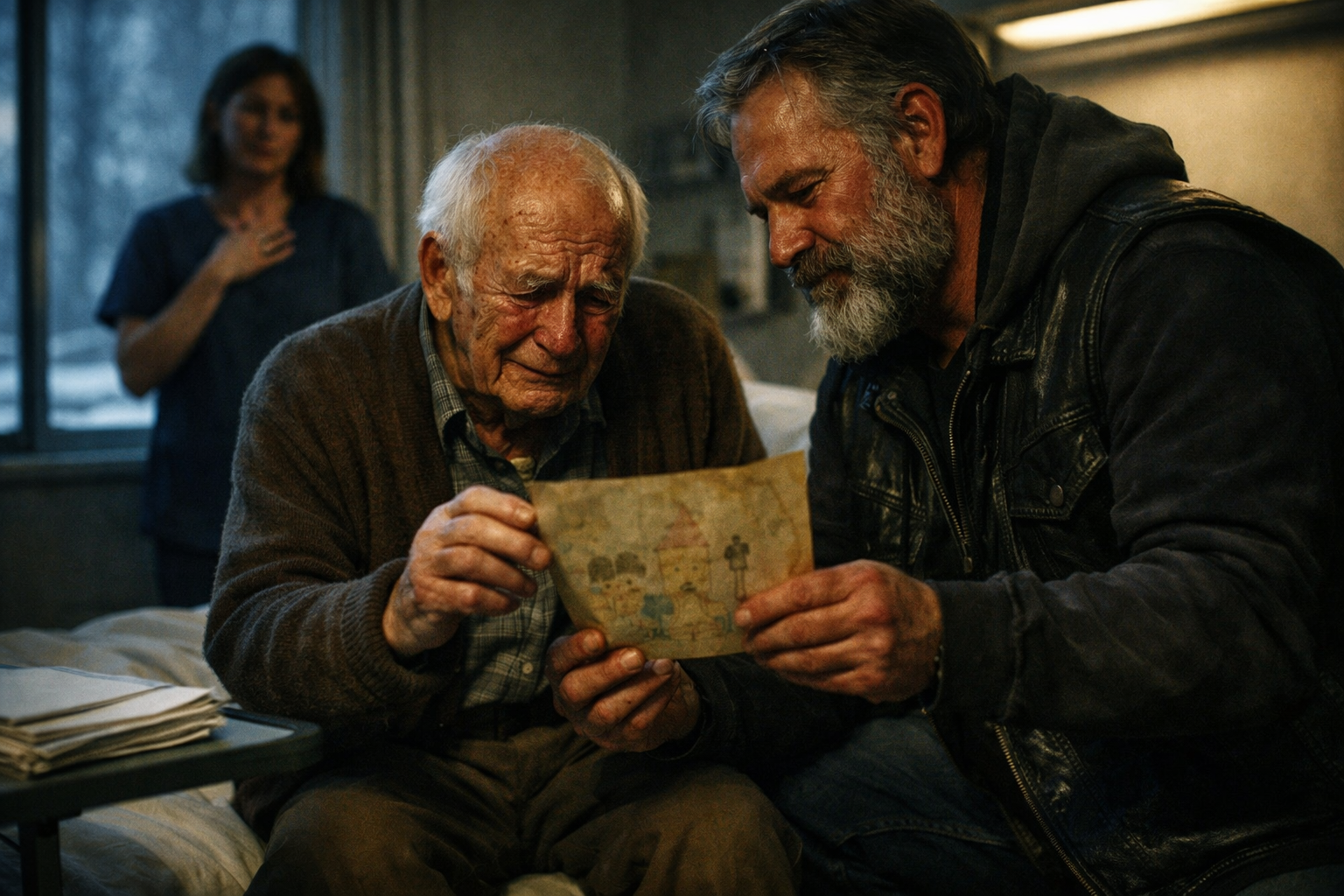
He pulled out a folded piece of paper sealed in a clear plastic sleeve. Old. Corners soft. Paper yellowed. Crayon marks faded but stubborn against time.
He unfolded it with careful fingers.
Arthur covered his mouth.
Two stick figures. One tall with gray hair and a crooked smile. One small, beside a red motorcycle with uneven wheels. Above them, in a child’s shaky handwriting:
When you are old and need help, I will come get you.
Arthur made a broken sound.
“I was eight years old when I wrote this,” the biker said.
“You kept it?” Arthur whispered.
“I carried it through foster homes. Juvenile court. My first job. My first bike. My first jail cell.” A humorless smile. “I carried it after my wife died. After my son stopped talking to me. I kept thinking, one day, maybe I’ll get the chance to pay the debt.”
“There was no debt.”
“There was to me.”
Elena stepped closer. “What happened?”
The biker looked at Arthur, silently asking permission.
Arthur closed his eyes. When he opened them, he was looking somewhere seventy-five years away.
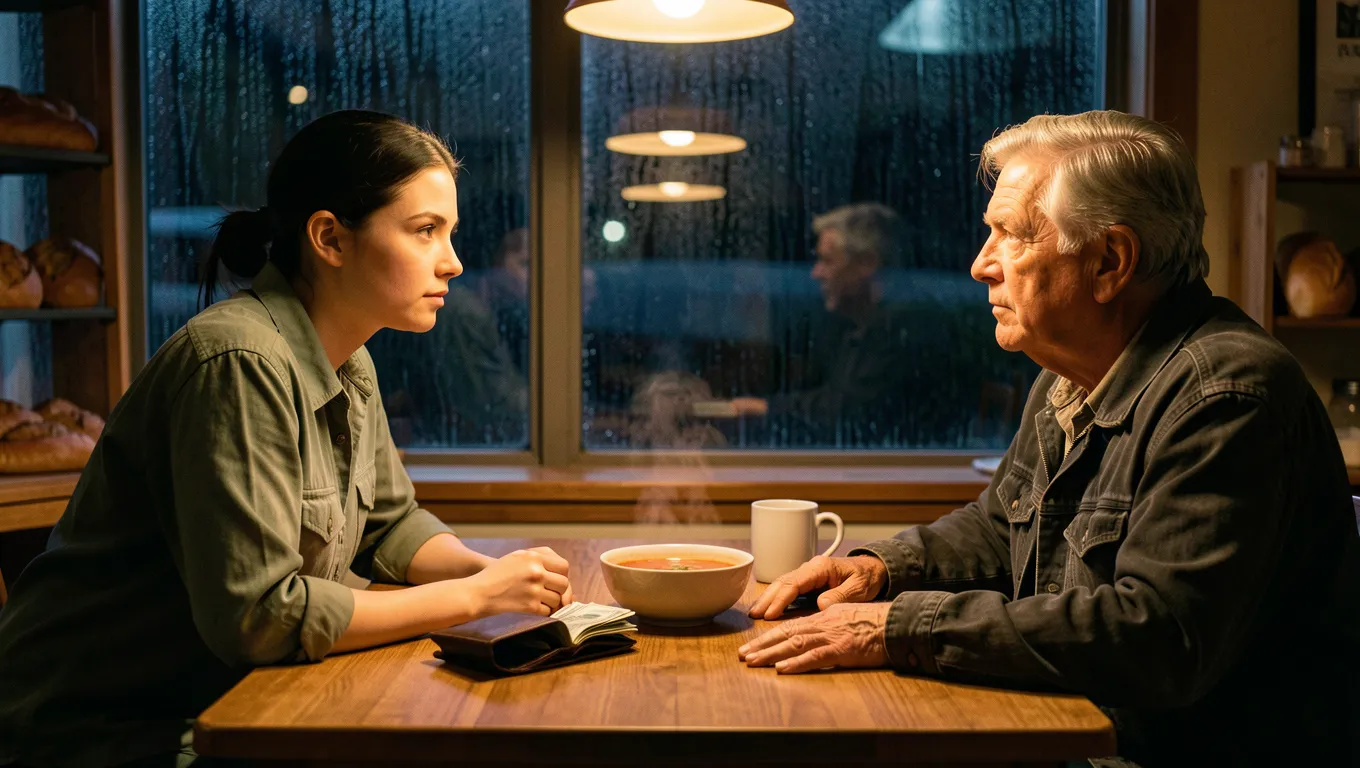
“It was winter. A bad one. I was twenty-eight. Margaret and I had been married two years. Doctors said we couldn’t have children.” His fingers trembled. “I found him behind the old bakery on Fifth Street. Barefoot. Coat too small. One eye swollen shut. Digging in a trash bin.”
The biker’s jaw clenched.
“Elena,” Arthur said softly, “his name was Daniel.”
The biker looked down.
“I bought him soup. Got him boots. Margaret wrapped him in three blankets and cried after he fell asleep at our kitchen table.”
“He told me I mattered,” Daniel said, voice rough. “Nobody had ever said that to me like they meant it.”
Arthur smiled through tears. “You were furious when I called child services.”
“I thought you were sending me away.”
“I was trying to keep you alive.”
“I know that now.”
Daniel held up the crayon promise. “You gave me red crayons that night. Said every boy should draw something loud.”
Arthur laughed once, wet and trembling. “You drew a motorcycle before you’d ever ridden one.”
“I told you I’d come back on one.”
“You did.”
Elena’s eyes drifted to the discharge papers. Daniel noticed.
“He’s leaving today?”
“He was cleared medically. But he needs support at home.”
Arthur stiffened. “I told you, I’ll manage.”
Daniel looked at him. “No, you won’t.”
Arthur gave him an offended glare that briefly made him look thirty years younger. “I beg your pardon?”
“I said no.”
The hallway gave a collective silent gasp.
“You don’t get to show up after seventy-five years and start bossing me around.”
Daniel leaned closer, eyes shining. “I do if I promised.”
Arthur’s mouth trembled.
Daniel reached for the discharge papers. “Elena, what does he need?”
“I am sitting right here.”
“I know,” Daniel said. “That’s why I came.”
Elena cleared her throat. “He needs help with medication, meals, mobility, follow-up appointments. At least for a while.”
“Done.”
“Done?”
“I have a truck downstairs. Your steps need railing, I’ll build it. You need groceries, I’ll get them. You need someone to sit on the porch while you complain about my boots, I’ll do that too.”
A tear slid down Arthur’s cheek. “You don’t owe me your life.”
Daniel’s voice broke. “Arthur, you’re the reason I had one.”
That was the moment the hospital stopped pretending not to listen.
The woman near the nurses’ station began crying quietly. A young nurse wiped her face with her sleeve.
Then a sharp voice cut through the tenderness.
“What exactly is going on here?”
A woman stood at the end of the hallway in a cream coat, phone in hand, expensive purse over one shoulder. Hair perfect. Expression tight.
Arthur went still.
Elena recognized her from the emergency contact list. “Mrs. Whitmore? You’re Arthur’s daughter?”
“I got six missed calls. I was in meetings.”
Arthur’s face changed. Hope. Then shame. Then something smaller.
“Claire.”
She barely looked at him. Her eyes locked on Daniel. “Who is this?”
“An old friend.”
Her gaze dropped to his leather vest. “Of course.”
Arthur flinched. Elena felt anger stir.
“I can sign whatever needs signing,” Claire said, “but I’m not taking him today. I arranged a facility months ago. He refused.”
“It was a nursing home,” Arthur whispered.
“It was care,” Claire snapped. “Which you need.”
Daniel stepped between them slightly. “Care isn’t abandonment.”
“And you are?”
“Someone who came.”
The words landed hard. Claire’s face reddened.
“You have no idea what this man is like. Everyone thinks he’s some sweet old saint. Ask him why his daughter stopped coming. Ask him why his wife died angry. Ask him what he did.”
The room chilled.
Daniel turned slowly toward him. “Arthur?”
Arthur’s face crumpled.
“Tell him,” Claire said, voice shaking with an old wound.
Arthur closed his eyes. “I lied.”
Daniel frowned. “About what?”
“About child services.”
Daniel went utterly still. The monitor beeped once.
“They didn’t come that night because I called them. They came because Margaret did.”
Claire’s expression flickered.
“I wanted to keep you,” Arthur said. “I wanted to ask if we could foster you. Adopt you. Margaret said we had no money, no room, no right to make promises we couldn’t keep. She was right. But I was angry. I told her if she let them take you, I’d never forgive her.”
“Dad…” Claire whispered.
“She called anyway. And when they took you, you screamed my name. You thought I betrayed you.” He wiped his face. “So I let you believe I made the responsible choice. I let Margaret carry the blame in silence. For years.”
Arthur looked at Claire.
“Your mother died thinking I hated her for doing the right thing.”
Claire’s eyes filled. “You did hate her.”
“No. I hated myself.”
The silence was enormous.
Daniel stared at the drawing.
“I’m sorry,” Arthur said. “I’m sorry for every year you thought I sent you away without wanting you.”
“You wanted me?”
Arthur gave a broken laugh. “We painted the small bedroom blue before the caseworker said no.”
Claire covered her mouth. Daniel took a step back.
For decades, he’d carried a story of a kind man who saved him one night and vanished. He’d built his life around a promise made to a memory.
But the truth was sharper.
Arthur had not forgotten him. Arthur had lost him.
Daniel looked at Claire. “Your mother’s name was Margaret?”
Claire nodded.
He reached again into his vest.
“I didn’t only bring the drawing.”
Arthur looked up.
Daniel pulled out a small envelope, brittle with age. Arthur stopped breathing.
“This was in my foster file. I got it when the records opened. I never read it. I was too angry.”
On the front, in faded handwriting:
For Daniel, when he is old enough to understand. — Margaret Callahan
Claire let out a sob.
“No,” Arthur whispered.
Daniel opened the envelope. His hands shook. He read silently at first. His face changed. Confusion. Pain. Wonder.
Then he read aloud.
“Dear Daniel, if this letter finds you, please know Arthur wanted you. He wanted you so much that it frightened me. I was afraid love would not be enough to protect you from hunger, debt, and a world that was already cruel. I called the authorities because I believed it would give you a better chance. I have regretted the pain in your eyes every day since.”
Arthur was weeping openly now.
Daniel continued.
“Arthur keeps the red crayon you dropped under the kitchen chair. He pretends not to. He looks for you in every boy with dark hair. Leaving our home did not mean leaving our hearts.”
Claire bent forward, crying into her hands.
Daniel’s voice cracked on the last line.
“And if you ever return, please forgive us both.”
For a long time, no one spoke.
“Margaret,” Arthur whispered.
The name was not grief anymore. It was release.
Claire crossed the room. For the first time in years, she sat beside her father.
Arthur flinched, expecting judgment.
Instead, she took his hand. “I thought you didn’t know how to love anyone.”
“I knew. I just kept failing at it.”
Daniel stood at the foot of the bed, the old promise in one hand, Margaret’s letter in the other.
Then he smiled through tears. “Well. Good news.”
Arthur blinked.
“I’m still here to pick you up.”
Claire wiped her face. “I’ll come too.”
Arthur stared at his daughter as if she’d stepped out of a dream. “You will?”
She squeezed his hand. “I don’t know how to fix all of it. But I can start by driving behind the truck.”
And then, after a lifetime of pride, silence, and almost-missed mercy, Arthur Callahan laughed.
It started small, fragile, disbelieving. Then Daniel laughed too. Then Claire. Then Elena, wiping both cheeks as she signed the final form.
Twenty minutes later, Daniel wheeled Arthur toward the elevator. Claire on one side, Elena on the other.
At the elevator, Arthur looked up. “What happened to the red motorcycle?”
Daniel grinned. “Still in the garage at home. Red, like the drawing.”
Arthur smiled toward the window where gray light spilled across the floor. “Margaret would’ve liked that.”
“I think she already did.”
Arthur frowned.
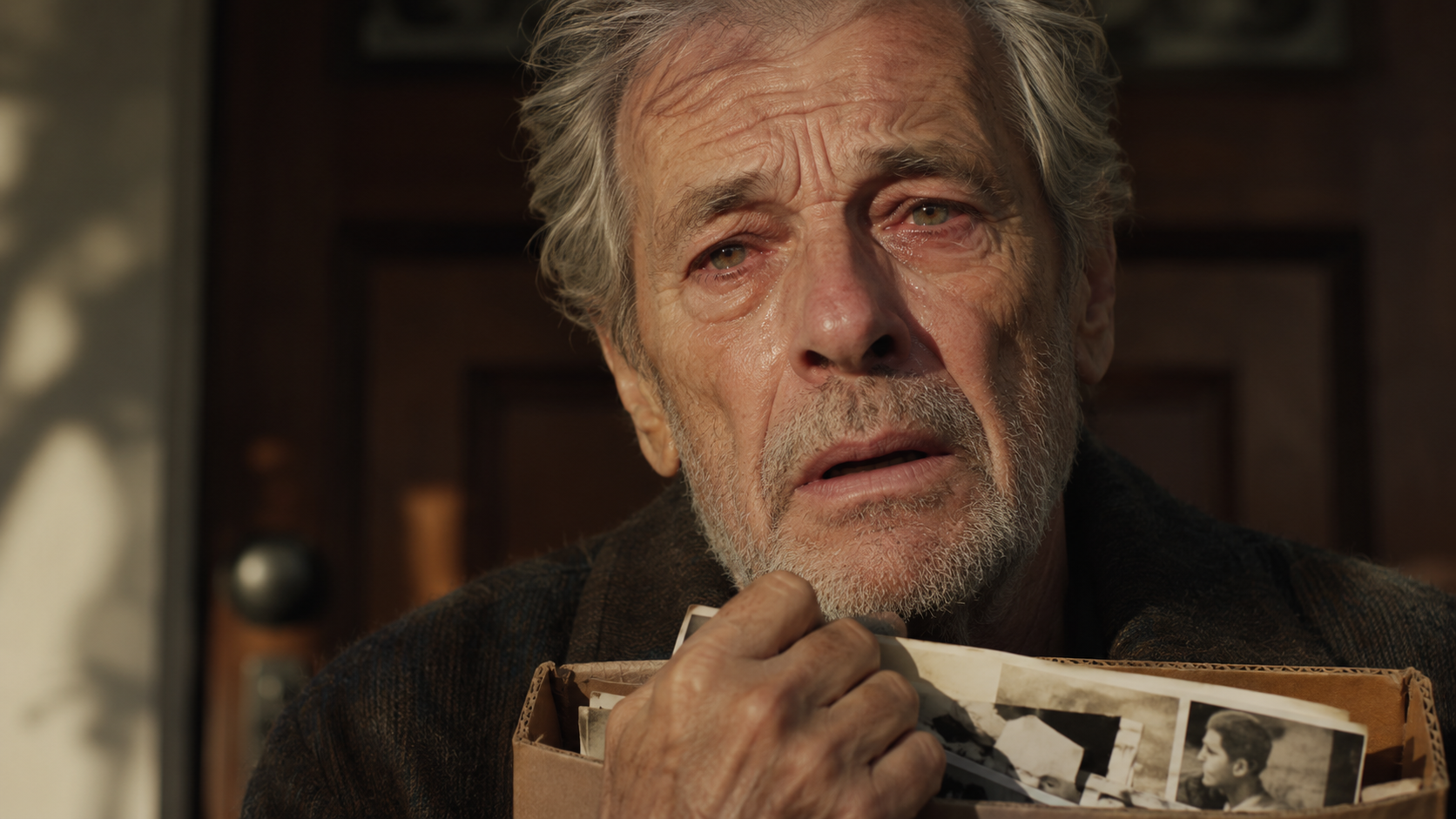
Daniel reached into the envelope one last time and pulled out something small. A photograph. Old. Faded. Creased.
Arthur took it with trembling fingers.
A young Margaret on their front porch, smiling beside a small red tricycle. Next to her, a younger Arthur, holding up the crayon drawing.
And between them, a little boy in oversized boots.
Claire leaned in and gasped.
On the back, in Margaret’s hand, seven words:
Our son, even if only for one night.
Arthur pressed the photograph to his heart.
Daniel knelt in front of him.
Arthur lifted a shaking hand and touched Daniel’s bearded face. Then he finally whispered the name he had carried for seventy-five years.
“Danny.”
And Daniel, the biker everyone had feared, bowed his head into the old man’s hand and answered like a child coming home.
“I’m here, Dad.”
Original fictional stories. AI-assisted creative content.