The engines came in low through the whiteout.
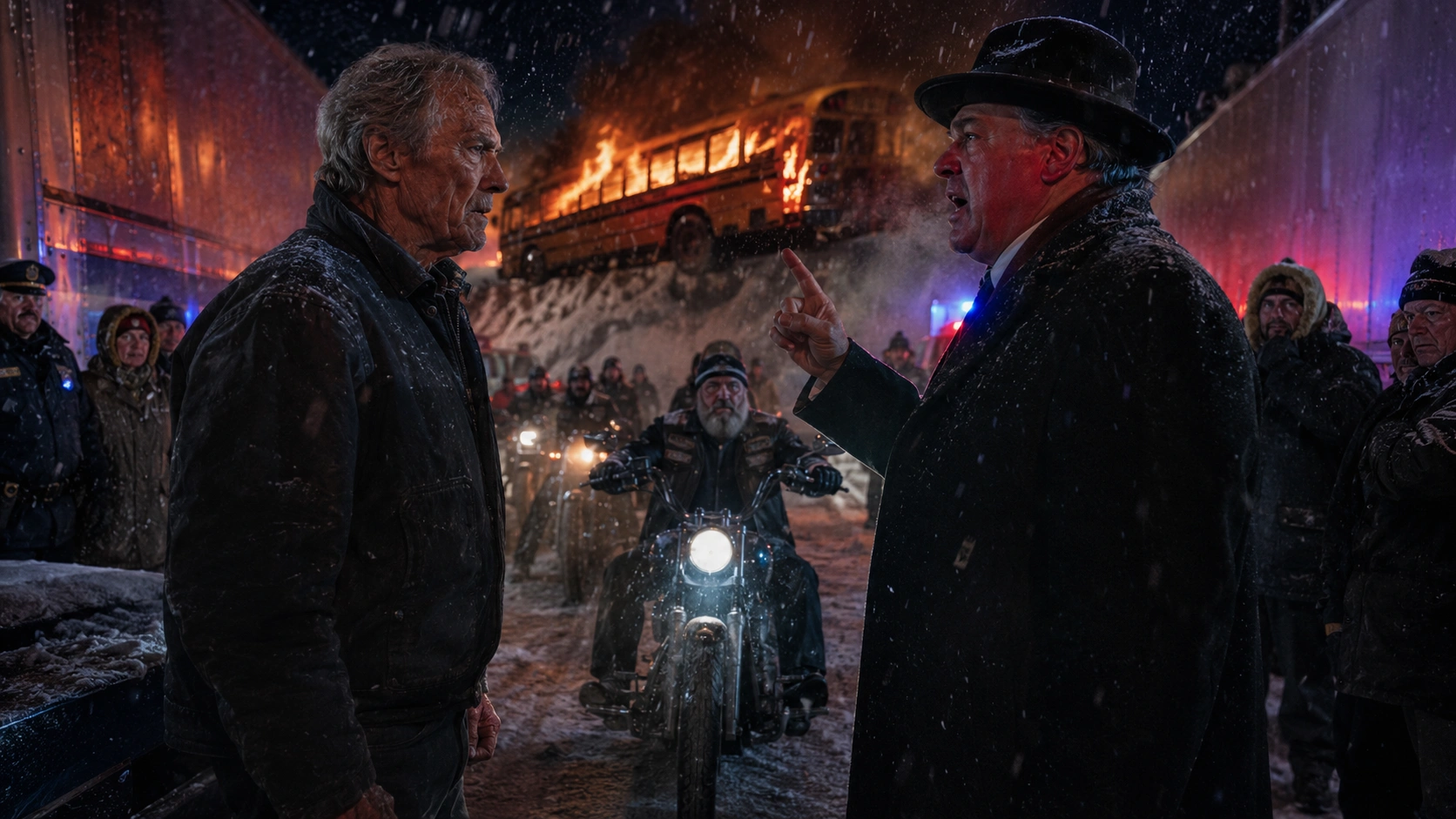
At the interstate crossing, everyone first thought it was another line of freight trucks bulling through the storm. Then the sound dropped an octave. Rougher. Older.
A state trooper lifted his flashlight. The beam caught a chrome handlebar sliding between two jackknifed trailers.
Robert Hale did not smile.
He stood in the snow, one swollen hand pressed against his knuckles, the other resting on the seat of his old Harley like it was the last solid thing in the world. Behind him, inside a crushed yellow school bus, a child knocked again.
Tap. Tap. Tap.
“Robert,” Fire Captain Dennis Pike said, low, “please tell me you didn’t call them.”
“I called the only men in this county who can ride through a six-inch gap without asking permission.”
Dick Malone, owner of Malone Freight, turned red beneath his wool hat. “You brought criminals to my accident scene?”
Robert finally looked at him. “No, Dick. You brought the accident.”
A hush fell over the crowd close enough to hear it. Parents. Troopers. Truck drivers. Paramedics trapped behind a wall of steel.
“You better watch your mouth,” Dick said. “I employ half this county.”
Robert’s jaw tightened. His joints felt packed with broken glass. But he did not step back. Not in front of those parents.
He raised his voice.
“Here’s the deal, Dick. You move your trucks, or I move around them. You keep blocking this road, and I’ll make sure every camera here sees why three kids had to wait while your freight kept idling.”
Dick laughed thin. “You can’t even close your fist.”
“No,” Robert said. “But I can still keep a promise.”
The first biker rolled fully into view.
A massive man in his late sixties. Gray beard frozen white at the edges. Leather vest dusted with snow. Vince Carver.
Twenty-two years earlier, Robert had arrested Vince outside a bar. Ten years earlier, Vince had stood outside the courthouse and told him, “One day you’ll need us, badge man. And I hope it hurts to ask.”
Now Vince looked at the crushed bus. Then at Dick. Then at the old sheriff.
“Hurts?”
“Like hell,” Robert said.
Vince shut off his engine.
Behind him, more riders squeezed through the wreckage in single file. Not young show-offs. Men and women with gray hair, scarred hands, and old grudges. The Iron Saints Motorcycle Club.
Tonight the line was different. Tonight the children were on one side, and every adult with a heart was on the other.
A mother in a red parka broke through a trooper’s hold. “My son is on that bus! Please!”
The tap came again. Only twice this time.
Captain Pike stared at the trapped fire engine, its ladder wedged behind two Malone Freight trailers sprawled across every lane. “Fifteen minutes before that bus settles deeper. Maybe less.”
A young firefighter wiped his face shield. “The gap is twenty-eight inches at the narrowest. We can’t get a rescue sled through. We can’t even carry the hydraulic spreader.”
Vince looked at Robert. “You said twenty minutes.”
“I was being polite.”
Dick cut in, loud enough for the news crew to swing their camera. “You’re going to let a biker gang interfere with an official rescue?”
Pike stared at him. “Your trucks are interfering with an official rescue.”
“My drivers followed dispatch orders.”
“Whose orders?” Robert asked.
Dick’s mouth snapped shut.
That silence did more damage than any confession. Because every Malone driver standing there knew the answer. They had been told to keep moving. Christmas contracts mattered more than road restrictions.
One driver — young man, blood on his cheek — looked down at his boots.
“We asked to pull over,” he whispered.
Dick spun on him. “Shut up, Kyle.”
Robert heard the name. He remembered the boy. Kyle had been seventeen when Robert caught him stealing gasoline from the co-op. Instead of the system, Robert drove him home and got him a job changing tires.
“What did dispatch tell you?” Robert asked.
Dick pointed. “You say another word, you’re done.”
Kyle looked at the mother in the red parka. Then at the bus. Then at Robert.
“He said no delays. He said if we missed the Chicago window, we’d all be replaced.”
The crowd erupted.
“How dare you?”
“There were children on that road!”
Dick raised both hands. “You people don’t understand logistics.”
Robert stepped closer, every inch paid for in pain.
“No, Dick. We understand a child knocking from inside a crushed bus while a rich man explains his schedule.”
That line hit the crowd like a match in gasoline.
Robert turned to Vince. “I need four bikes through the gap. Two carry thermal blankets. One carries the compact cutter. One carries Pike.”
Pike blinked. “Me?”
“You’re the smallest firefighter with the steadiest hands.”
“I’m forty-eight.”
“Then tonight you’re young.”
Vince was already pointing. “Mara. Blue. Eddie. Preacher. Strip the saddlebags.”
A woman in her sixties with silver hair braided under her helmet pulled folded emergency blankets from her saddlebag.
Robert saw Dick staring.
“What? You thought they only carried trouble?”
Mara glanced at Dick. “We carry what old men forget young people might need.”
That shut him up.
Bikers and firefighters worked shoulder to shoulder under spinning red lights. Robert walked stiff-legged to his Harley. Vince followed.
“You ain’t riding.”
“I know the line.”
“You know the line from twenty years ago.”
“And you still owe me a taillight from 2003.”
Vince laughed once. Short. Unbelieving. “Old fool.”
“Old sheriff.”
The mother in the red parka stumbled over. “Sheriff Hale? My boy is Noah. He’s seven. Blue backpack. He gets scared in the dark. Please tell him his mom is here.”
Robert’s throat tightened. For one terrible second he was not on the interstate. He was in a hospital hallway seventeen years ago, snow melting off his boots, a doctor telling him his daughter had been gone before the ambulance arrived.
Her name had been Emily. Twenty-six. A teacher. A girl who used to fall asleep in the back of his patrol car so she could be near him. A girl who called him one bad night when her car slid into a ditch — and got voicemail because he was busy arresting Vince Carver’s nephew.
Five minutes, he’d thought. I’ll call her back in five minutes.
Five minutes became forever.
Robert looked at Noah’s mother. “I’ll tell him.”
She grabbed his sleeve. “And if he can’t hear you?”
“Then I’ll get close enough until he can.”
Vince knew. Of course he knew. Small towns keep secrets in public. He looked at the buried bus, then back at Robert.
“Is that why you called me?”
“I called because you can ride.”
“That ain’t what I asked.”
Robert started the Harley. The engine coughed, spat, then caught with a stubborn roar.
“Ask me after the children are out.”
The first run through the gap was impossible to watch.
Mara went first, standing slightly on the pegs, handlebar missing a trailer by less than an inch. Then Blue. Then Eddie with the cutter across his back. Then Vince. Then Robert.
His Harley fishtailed halfway through. For one awful second, the rear tire slipped toward the underside of a trailer. A trooper shouted, “Sheriff!”
Robert’s right hand clenched on instinct. Pain exploded up his arm. His fingers almost failed.
Vince, ahead of him, kicked one boot sideways and shoved the Harley’s front fork just enough to straighten it.
Robert cleared the gap.
He did not hear the crowd behind him.
All he heard was the tapping. Still there. Weak. But still there.
The bus was worse up close. Front end crushed against a frozen embankment. One side folded inward. Snow blew through broken windows.
Pike ran to the emergency door. “Kids! Can you hear me?”
A small voice answered. “Mom?”
Back at the barricade, the mother’s knees buckled when the radio carried it.
Pike looked at Robert. “One conscious. Maybe more.”
Robert knelt by the broken side window. The movement nearly took him down. He pulled off one glove with his teeth and reached through. His bare fingers touched a sleeve. A child’s arm.
“Hey,” Robert said, gentle as Sunday morning. “Is your name Noah?”
A tiny voice. “Yes.”
“Your mama’s here.”
A sob came through the dark. “She mad?”
Robert closed his eyes.
“No, son. She’s not mad. She’s waiting to hug the stuffing out of you.”
A second voice whimpered. “I’m cold.”
“What’s your name, sweetheart?”
“Lily.”
“Lily, can you wiggle your toes?”
A pause. “My left ones.”
Pike mouthed, Good sign.
A third child coughed. Noah whispered, “Mason won’t wake up.”
The air changed.
“Eddie, cutter,” Pike snapped. “Mara, blanket. Vince, light.”
Back at the barricade, Dick was arguing with a state police lieutenant. “You can’t let them broadcast driver statements without corporate counsel.”
“Sir, three children are trapped.”
“And my company is being defamed in real time.”
That was when Kyle did something no one expected.
He pulled his phone from his pocket. Hands shaking. Walked toward a local news reporter.
“I have the dispatch recording.”
Dick lunged. A trooper stepped between them. “Don’t touch him.”
Kyle looked straight into the camera. “My name is Kyle Mercer. At 4:12, county alerts told commercial vehicles to hold position because of whiteout conditions. At 4:16, our boss told dispatch to keep us moving because fines were cheaper than missed contracts.”
Dick shouted, “That is private company communication!”
“A school bus got hit because we were still on the road.”
The reporter’s face went pale. “Can you play the recording?”
Kyle looked toward the bus. Then he pressed play.
Dick’s own voice came out of the phone. Tinny. Clear. Unforgivable.
“I don’t care what the county says. Keep rolling. Anybody parks before the interchange is fired.”
The crowd went silent.
Not healing. Not hope. Proof.
Dick’s power cracked right there in the snow.
But Robert did not know any of that yet. He was inside a smaller world. Metal edges. Shaking children. One boy who was not waking up.
Pike cut the window frame. Sparks hissed in the falling snow. Robert kept his bare hand wrapped around Noah’s fingers.
“Tell me about your backpack.”
“It’s blue.”
“Your mama told me.”
“It has dinosaurs.”
“Good taste.”
“My dad says dinosaurs are too baby.”
“Your dad is wrong.”
Noah gave one tiny laugh. His mother, at the barricade, covered her mouth and sobbed.
Vince shone the light deeper into the bus. “I see the third kid.”
“Mason?”
No answer.
Mara crawled halfway through the window. “Eyes on him. Pinned by the seatback. Breathing, but slow.”
Robert looked at Pike. “What do you need?”
“Time.”
The bus shifted. A low metallic groan rolled beneath them.
Vince swore. “Time ain’t on the list.”
“I need someone small enough to hold Mason’s head steady while I cut,” Pike said.
Everyone looked at Mara. She was already trying, but her shoulder could not fit past a bent support beam.
Robert stared at the opening.
Vince saw the thought before Robert said it. “No.”
Robert pulled his other glove off. “Move.”
“You’ll get stuck.”
“Then cut around me.”
“You’re seventy-three.”
“And narrow.”
“Your hands won’t hold.”
“They held a badge for forty years.”
Vince grabbed his sleeve.
“That badge didn’t save Emily.”
The words landed like a slap.
Everyone froze. Even Pike.
Robert looked at Vince. The old hatred rose between them. So did the old grief.
Vince’s jaw worked as if he wished he could pull the words back.
Robert’s voice came out quiet. “No. It didn’t.”
Then he leaned closer. “But maybe these hands can save Mason.”
Vince let go.
Robert slid through the broken window.
His coat snagged on glass. His knee hit metal. His ribs scraped the frame. He bit down until he tasted blood, because pain was not allowed to be louder than a child’s breathing.
Inside, the cold was different. Dead cold. Trapped cold. Lunchboxes floated in a puddle of melted snow and spilled juice. A math worksheet stuck to the ceiling.
Robert reached Mason. Placed two fingers against the boy’s neck.
There. Faint. But there.
“I’ve got a pulse.”
The radio carried it. Outside, Mason’s father made a sound no one there forgot. Something from the bottom of the soul.
Pike crawled in as far as he could and guided the cutter. “Robert, hold his head still. If that seat shifts wrong—”
“I know.”
“Your hand is bleeding.”
“I know.”
“Can you feel your fingers?”
Robert looked at Mason. “No.”
So he used his wrist. Then his forearm. Then the weight of his whole failing body. He braced Mason’s head as Pike cut through the twisted brace inch by inch.
Mara pulled Lily free first, wrapped in a silver blanket, crying for her grandmother. The crowd saw her. Hope became visible.
Blue carried Noah out next. His mother broke past every hand trying to hold her and caught him as if the world would end if she let go.
“Noah! Noah, baby!”
The boy lifted a shaking hand. “I wasn’t scared.”
“Yes, you were,” she whispered. “And you were brave anyway.”
Two out. One left.
The bus groaned again. Vince climbed onto the side and hooked a tow strap around a bent rail, passing the other end to six bikers and three firefighters. “On my count! We stabilize, not pull!”
Dick Malone stood alone now. No one near him. His drivers had moved to help. His assistant had stopped answering. The camera was still rolling. Kyle’s recording was already on its way to state police.
For the first time in thirty years, Dick looked like a man who could not buy the room back.
Inside the bus, Pike freed the last brace. “Mason’s loose!”
Robert tried to lift the boy.
His hands failed.
The shame hit him harder than the pain. For one second he was back in that hospital hallway. Too late. Too old. Too weak. Always almost.
Mason slipped an inch. Robert made a sound through clenched teeth. “No.”
Vince appeared at the window. “Robert!”
“I can’t grip him.”
“Then don’t grip. Push him to me.”
Robert curled around the boy as much as his aching spine allowed, and used his forearms to slide Mason toward the window. Pike guided the shoulders. Vince caught him.
“Got him!”
The crowd roared.
But Mason did not wake.
A paramedic took him and dropped to the pavement. “Oxygen! Now!”
Mason’s father tried to run forward. Troopers held him.
One breath. Two. Three. Nothing.
Robert watched through the broken frame as if watching through the wrong end of a tunnel.
The paramedic pressed the mask over the boy’s face. “Come on, buddy.”
Mason’s father whispered, “Please.”
The whole interstate held still.
Then Mason coughed. Small, wet, angry. His eyes fluttered.
“He’s breathing!”
The sound from the crowd was not applause. It was release. Parents cried into strangers’ shoulders. A firefighter bent over with both hands on his knees. An Iron Saint took off his helmet and wiped his eyes.
Vince looked into the bus at Robert. “Three kids, old man.”
Robert shut his eyes.
For a moment, he let himself hear it. Not the storm. Not the metal. Not Emily’s unanswered call.
Three children breathing. Three families still whole.
Then his body gave out.
Vince and Pike dragged him from the bus. When Robert’s boots hit the ground his knees buckled. Vince caught him under one arm.
“You done showing off?”
Robert’s teeth chattered too hard to answer.
The mother in the red parka came with Noah wrapped against her chest.
“Sheriff Hale? Noah said you told him I wasn’t mad.”
Robert swallowed. “I did.”
“He also said you told him his dad was wrong about dinosaurs.”
A tired smile touched Robert’s face. “I stand by that.”
She cried harder then. Not because of the joke. Because a broken old man had crawled into the kind of cold that steals breath from children, and carried warmth in with him.
Dick tried to leave during the confusion.
He made it as far as his pickup.
Kyle blocked the door.
Not with a weapon. Just his body.
“Move,” Dick snapped.
Kyle shook his head. “No.”
“You’re fired.”
Kyle looked past him at the ambulances. “I quit before you killed them. I just didn’t know it yet.”
A state police lieutenant stepped up. “Richard Malone?”
“My attorney—”
“You can call him from the station. Reckless endangerment, obstruction at an emergency scene, and violation of county emergency travel restrictions pending review.”
Dick looked around. At the cameras. At the drivers. At Robert.
No one helped him.
That was the first consequence. It was not the last.
By morning, Kyle’s recording was everywhere. By noon, the state transportation board had suspended Malone Freight’s operating authority. By the end of the week, three families and seven injured motorists had joined a civil action. Insurance partners froze contracts. Retail clients walked. Drivers came forward with logs and texts showing the same pattern.
Six months later, Malone Freight was gone. The equipment was auctioned. The dispatch headquarters went dark. Dick’s name came off the building in big plastic letters while former drivers stood across the street drinking gas station coffee, saying nothing.
Some endings do not need speeches. Some sound like screws hitting pavement.
Three weeks after the blizzard, the town held a dinner at McGinty’s Tavern. Vince walked in with two glasses of ginger ale.
“Doctor said no whiskey for you.”
“Doctor talks too much.”
They clinked glasses. The tavern grew quiet.
Vince cleared his throat. “For years, this town saw us as trouble. Sometimes we earned it. Sometimes we didn’t. Sheriff Hale treated us like a problem. Sometimes we earned that too.”
Robert muttered, “Mostly.”
Vince ignored him. “But that night, nobody asked who wore a patch or who had a badge. There were kids in the cold. That was enough.”
He lifted his glass. “From now on, the Iron Saints ride in the charity parade without three squad cars behind them.”
The police chief raised an eyebrow.
“One squad car,” Vince amended.
The room laughed.
Robert lifted his glass too. “And the sheriff’s office calls the Saints before the storm gets worse. For kids.”
“For kids,” Vince said.
They drank.
No lawyers. No plaque. Just two old men in a small-town tavern, tired of burying the same hatred, choosing to put it down before it poisoned another generation.
Dick Malone served fourteen months and lost every dollar the lawsuits could reach. His house sold. His name became something people wiped off boots at the door. The interstate crossing where three children almost died got new emergency barriers and a memorial sign.
Robert hated the sign’s name.
But every winter, when the first serious snow came down, he wrapped his fingers, took the old Harley out of the garage, and followed the rumble of the Iron Saints out to whoever needed blankets and food.
Some nights his hands hurt too much to ride. On those nights he sat by the window with the phone in his lap and let it be quiet.
Emily was still gone. That would never change.
But the phone did not ring like a sentence anymore.
It rang like a memory of a girl he had loved, in a house where a broken old man had finally learned that answering the call — any call — was the only kind of redemption a life like his was ever going to get.
Original fictional stories. AI-assisted creative content.