The ceiling fan clicked every four seconds.
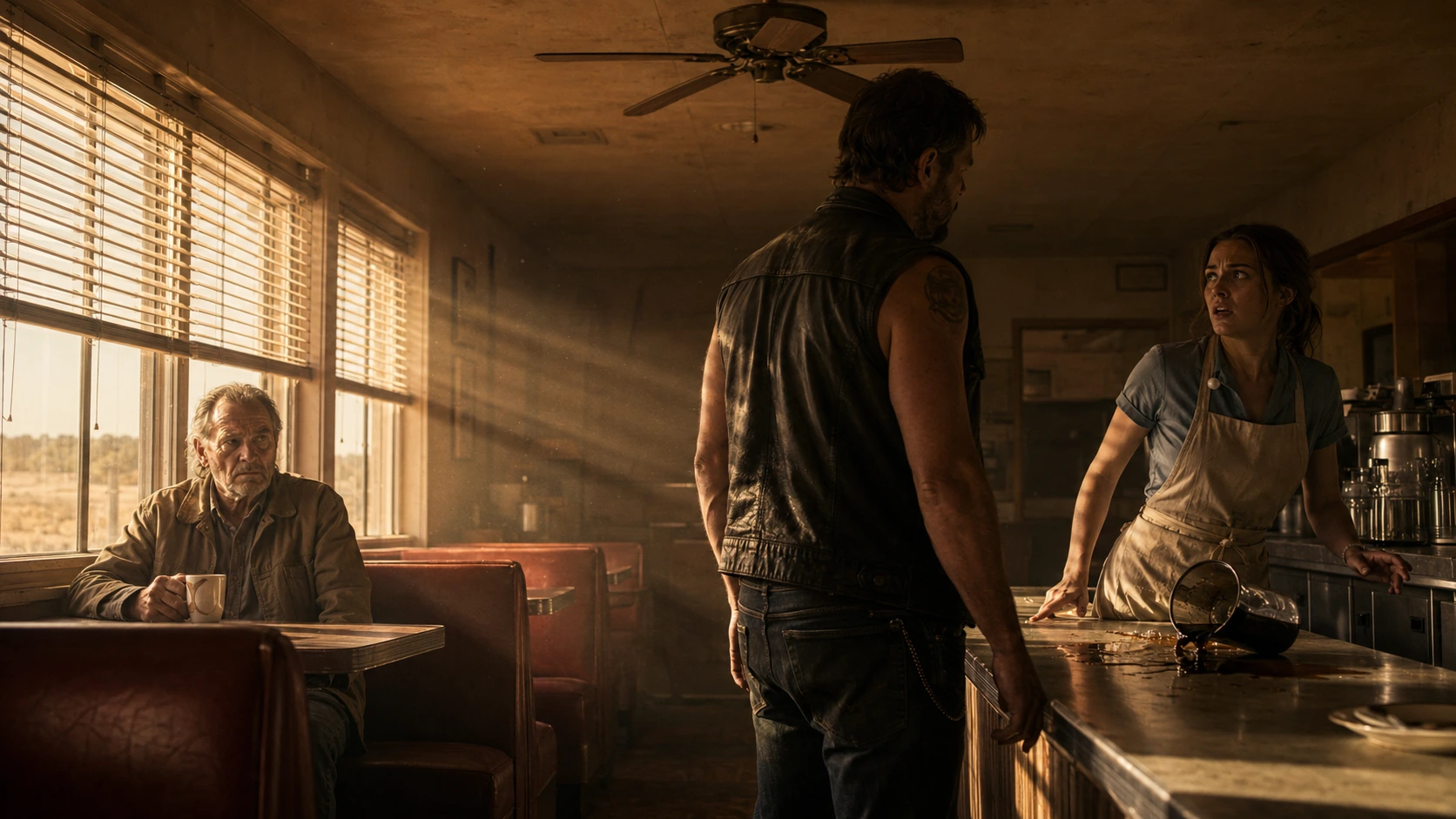
Walter Briggs counted them from the window booth. His coffee had gone cold twenty minutes ago. He kept the chipped mug in his right hand anyway.
Cole Ransom pushed through the door with two men in leather vests behind him. The vests took the back booth. Cole didn’t sit.
He walked to the counter and tapped Sofia Martinez on the shoulder.
“Take a walk, sweetheart.”
“Leave her alone,” Walter said.
Cole turned. He was broad and young and his eyes belonged to a dead woman.
“You talking to me, old man?”
“I’m done talking.”
Cole reached for Walter’s jacket. Walter stood, caught the wrist, guided the forearm down to the table. No strike. No noise. Just a hold he’d learned on scared horses.
“You’re out of your mind,” Cole said.
“Out of time.”
Cole stopped pushing. His eyes dropped to the mug on the table — plain white ceramic, a pale crescent repair curving from rim to handle.
Sofia saw it too. Her mother kept a photograph in a sewing tin. A dark-haired woman on the hood of a pickup, laughing, holding that exact mug.
“Where’d you get that?” Cole asked.
Walter let go and sat back down.
“Sit.”
“I didn’t come here to sit.”
“You came for the deed. And the note your father bought through a shell company. You came to scare Sofia into signing this diner over before sunset.”
Cole’s jaw tightened. Three weeks ago a notice had appeared on the diner door — a loan that had changed hands, thirty years of penalties, transfer or pay. Sofia had been working twelve-hour shifts to keep the lights on.
Cole had called twice. First to offer. Then to promise a visit.
“Your father sent you because he knew I’d recognize you,” Walter said.
“My father doesn’t know you.”
“Wade Ransom knows exactly who I am.”
The two bikers shifted but stayed seated.
Cole pulled a folded transfer document from his vest and set it on the table.
“Sign as witness. She signs as owner. Everybody goes home.”
Sofia came out from behind the counter.
“No.”
“You don’t understand what you owe.”
“I understand you bought a dead loan.”
Walter’s pale eyes stayed on Cole. “The loan isn’t why he wants the building.”
“Then what?”
“What’s under it.”
The diner went quiet except for the fan.
Click. Click. Click.
“You’ve got five minutes,” Cole said.
“No. You’ve got five minutes to decide whether you leave here as Wade Ransom’s collector — or stay long enough to learn why your mother never abandoned you.”
Cole’s face emptied.
For several seconds he didn’t breathe.
“My mother was Mara Ransom.”
“She never used that name when she could help it.”
“She left when I was four.”
“That’s what Wade told you.”
Sofia stepped closer. “You knew her?” she asked Walter.
“I raised her.”
Sofia looked at the mug again. “My mom has a picture.”
“I know.”
“How?”
Cole pulled a chair and sat, angled toward the door. “Start with something that can be checked.”
Walter nodded. “Mara was born in Lubbock. She could rebuild a carburetor before she could drive. She met Wade at a race outside Dalhart. He was charming when he wanted something and cruel when wanting stopped working.”
“You don’t know my father.”
“I knew him before you learned to say his name.”
Walter told it flat. Mara married Wade at nineteen. Cole was born two years later. By the time Cole was three, Wade had moved from stolen parts into insurance fraud and false titles and trucks that crossed county lines carrying cargo no one wrote down.
Mara kept records. She believed records could become a door.
Wade found out.
“One night she drove to my ranch with you asleep in the back seat. Bruised. Carrying that mug because she grabbed the first familiar thing off the counter before she ran.”
“She wanted to disappear with me.”
“Yes.”
“Then why didn’t you help her?”
Walter closed his hands on the table.
“Wade came before sunrise with two deputies and a custody order signed by a judge who owed him money. He said if she fought him, she’d go to prison for what she’d copied.”
“You believed him?”
“I believed the gun in one deputy’s belt. And the other one when he said my ranch would burn before breakfast.”
Sofia’s voice was flat. “So you gave Cole back.”
“Yes.”
Cole shoved the transfer paper aside. “You handed me to him.”
“I did.”
Walter didn’t defend it. He didn’t say fear cancels choice.
“What happened to Mara?” Cole asked.
“She came back three months later without you. Wade had moved you. She’d copied his ledgers and hidden them somewhere he didn’t know about. She said she’d testify if I helped her reach a federal office in Amarillo.”
“And she never made it.”
“No.”
Walter described the crash outside Claude. A straight road. Clear weather. Steering fluid on the frame and a cut line under the reservoir.
“You knew,” Cole said.
“Yes.”
“You stayed quiet.”
“I signed a statement that said the truck had mechanical problems when she left my ranch.”
Sofia covered her mouth.
“You helped him call it an accident.”
“Yes.”
The bikers in the back booth stopped looking like reinforcements and started looking like witnesses who’d chosen the wrong table.
Cole pointed at the mug. “And you kept that?”
“She left it on my workbench the last morning I saw her.”
“You kept a cup and gave away the truth.”
“Yes.”
Sofia stepped closer. “What does my mother have to do with this?”
Walter turned. “Your mother was the paralegal who copied Mara’s records. She was twenty-two. She helped Mara hide the originals beneath this diner before Wade knew the building existed.”
“My mom bought this place fifteen years ago.”
“Because I told her the evidence was still here.”
“You let her build her life over it?”
“She chose to.”
Sofia’s eyes filled but her voice held. “Did she choose to let me work here without knowing?”
“No.”
Cole pushed back from the table. “This is a setup.”
Walter reached under the mug and peeled off the cork pad glued to its base.
A narrow brass key sat in a shallow recess cut into the ceramic foot.
Cole froze.
Walter set the key on the table but didn’t slide it toward anyone.
“Mara put it there herself. She said if Wade ever found the diner, the person who recognized the mug would have to decide whether blood meant obedience or responsibility.”
The fan clicked.
From the highway came the sound of another engine slowing near the lot. One of the men in the back booth reached inside his vest. Cole raised a hand without looking. The man stopped.
“Your father didn’t send you to collect a diner,” Walter said.
Outside, a black pickup pulled across the two exits and idled there. Wade had never needed to enter a room when fear could arrive before him.
Cole’s phone was already ringing.
“Move the truck,” Cole said.
Wade laughed. “You found what I sent you for?”
“You sent me for a building.”
“I sent you for your future.”
Sofia reached under the counter and turned on the diner’s phone recorder. She did it openly. Cole saw and said nothing.
“The old man will tell you stories because stories are all he has left,” Wade said. “I have the club note. The housing contracts. The medical account that paid for Marcy Dunn’s surgery. You walk away from me, those stop being favors.”
Cole’s face tightened. Marcy was the wife of one of the men in the back booth. Her chemo was paid through a fund Wade controlled. The other man’s daughter lived in a house titled to one of Wade’s companies.
Wade had built loyalty from necessities and called it family.
“What do you want?” Cole asked.
“The key. The box. The transfer signed. Elena and the girl get money to start over somewhere else. Walter keeps his ranch until he dies. Your people stay housed.”
Sofia leaned toward the phone.
“My name is Sofia.”
A pause.
“I know who you are.”
“Then say my mother’s name.”
Wade didn’t.
Walter spoke into the phone. “He knows Elena copied the records. He also knows Mara trusted her more than she trusted any Briggs or Ransom man.”
“Walter,” Wade said, “you signed the report. Don’t perform righteousness now.”
“I’m not righteous.”
“Good. Then be practical.”
Walter looked at the mug. For twenty-four years he’d treated it as proof he still loved Mara. Love hadn’t made him brave when she’d needed him. Keeping her cup had cost him nothing.
Practicality had cost everyone else.
Sofia set both palms on the counter. “We open the box with counsel present. We copy everything. We turn it over.”
Wade laughed. “And when the diner closes? When Elena loses her home? When the club families lose coverage? You going to feed them with evidence?”
Cole looked at the two bikers. “Marcy’s next treatment?”
“Tuesday.”
“Your daughter’s lease?”
“Month to month.”
Cole closed his eyes.
Walter reached into his jacket and pulled out a folded deed. Not the diner. The ranch outside Vega, the last thing he owned free and clear.
“I can sell this.”
“It won’t cover everything,” Sofia said.
“It’ll cover rent and medical for a few months. It keeps Wade from using sick people as a lock.”
Wade’s voice came through the phone quiet.
“You sell that ranch, Walter, and the buyer will discover the environmental lien before closing.”
Walter hadn’t known there was one.
“I bought that too,” Wade said.
Cole’s expression changed.
“Dad,” he said. “How long have you owned his lien?”
“Long enough.”
“Before you sent me here?”
“Long before.”
The word father lost part of its meaning.
Walter picked up the brass key. “No more waiting.”
Cole held out his hand. “Give it to me.”
Walter didn’t move.
“If I walk into that pantry with you,” Cole said, “my father knows I chose a side. So do the men behind me. So does everyone dependent on the club.”
“That’s why I’m not giving it to you,” Walter said. “You don’t earn control of Mara’s evidence by changing sides once.”
Cole’s anger flashed. “Then what do I do?”
Sofia answered.
“You stop being the person who decides for everybody else.”
She dialed her lawyer in Amarillo and put the call on speaker. She described the box, the key, the pickup outside. The lawyer said don’t touch the floor. Photograph the access. Keep everyone visible. She’d be there in forty-five minutes with an investigator and a locksmith.
Wade heard all of it.
“You make that record and every account closes tonight.”
Cole looked at the two bikers. One lowered his eyes. The other gave a small nod.
Cole ended the call.
He picked up the transfer document and tore it once down the middle. He set both halves beside the mug.
“This doesn’t make me good.”
“No,” Sofia said.
“It doesn’t make him my grandfather.”
“No.”
“It doesn’t make you my sister.”
“Not unless I decide it does.”
Cole nodded.
Outside, the pickup’s reverse lights came on. It backed away from one exit and stopped across the shoulder — far enough to pretend the road was open, close enough to watch who left.
The ceiling fan had stopped clicking.
Cole turned to the two bikers. “If either of you stays, you stay as witnesses. Not muscle.”
Both men stayed.
Walter set the brass key on the counter in front of Sofia.
The lawyer arrived forty-three minutes later with a county investigator and a locksmith. Wade’s pickup had disappeared five minutes before.
Nobody celebrated.
Sofia led them into the pantry. Walter moved the flour rack. The investigator photographed the access plate, the drain housing, and the key in Sofia’s palm before anything was touched.
The lock opened on the first turn.
Inside a steel box: plastic-wrapped ledger pages, vehicle identification rubbings, photocopied insurance checks, two microcassettes, and a sealed letter addressed to Cole.
Mara’s recorded voice was thin under the tape hiss.
She named Wade’s shell companies. She described a man named Cal cutting the brake line. She admitted she’d once helped move money because she’d believed Wade’s promises and because leaving had seemed more dangerous than staying.
Then she spoke to Cole.
“If you hear this, you’re old enough to know I did not leave because I stopped loving you. I left because I was trying to make a road back.”
Cole listened once. He didn’t ask to hear it again that night.
The tape named Walter too.
Mara said her father had helped her once, failed her twice, and still had time to choose differently if he stopped confusing regret with protection.
Walter lowered his head.
Sofia heard it from the pantry doorway. She didn’t comfort him.
By morning the investigator had taken the box, the key, the cassettes, and the mug as connected evidence.
The diner opened for breakfast because Sofia opened it.
Cole didn’t sit in the back booth with his men. He sat alone at the two-seat booth where Walter had been waiting.
He gave the investigator a statement admitting he’d used intimidation to force the transfer. He surrendered the shell-company documents from Wade’s office. The two bikers gave statements of their own.
Wade’s accounts closed before noon.
Marcy Dunn’s treatment authorization vanished from the hospital system. Three families got notices their rent had failed. The club’s repair contracts were cancelled.
Sofia’s lawyer organized an emergency fund. Walter tried to sell the ranch and learned Wade had buried the environmental lien exactly as promised. Clearing it required money Walter didn’t have.
He signed the ranch into a court-supervised trust anyway. Any recoverable value would support the families Wade had used as leverage.
Wade was indicted four months later on fraud, witness tampering, and conspiracy. The homicide case around Mara stayed under review — Cal was dead, and the physical evidence from the crash had been destroyed years earlier.
Walter was charged with making a false statement and obstructing the original investigation.
He didn’t ask for leniency.
At sentencing he said the sentence he feared most had already been served by people who’d had no choice in his silence.
Cole took a plea. He lost the club presidency, sold his motorcycle to help replenish the emergency fund, and served six months in county followed by supervised release.
He wrote Sofia twice.
She answered neither letter.
Then, eight months after the diner, she sent him one sentence.
Breakfast. Tuesday. Eight-thirty. No vest.
Cole arrived in a work shirt and sat where Walter had once sat.
Sofia placed a coffee cup in front of him. Not Mara’s mug. That one was still in evidence.
“Is Walter coming?” Cole asked.
“No.”
Walter was repairing irrigation pumps outside Canyon as part of his probation. He’d asked whether Sofia wanted him there. She’d said no.
Sofia stayed standing.
“This is not forgiveness.”
“I know.”
“It is not me agreeing you are my brother.”
“I know.”
“It is breakfast.”
Cole wrapped both hands around the ordinary cup.
“Okay.”
They spoke for twenty minutes. Cole told her what he remembered about Mara’s perfume, the song she’d sung while driving, and the night Wade had told him she’d chosen another life.
Sofia told him Elena had kept the photograph because Mara had made her promise there would be one image Wade could never take.
When the chipped mug was finally released from evidence months later, the clerk asked Walter if he wanted it back.
Walter said the decision belonged to Sofia and Cole.
Sofia refused to put it in a glass case. Cole refused to take it home.
Together they brought it back to the diner. Sofia set it on the shelf above the register — not as a shrine, but as a cup still capable of holding coffee.
The pale crescent repair remained visible.
Walter came in three weeks later and stopped beneath it. He didn’t reach up.
Sofia poured him coffee into a different mug and pointed to the booth.
“You can sit,” she said.
Walter sat.
Above the register, the chipped cup caught the morning light and held it steady.
Original fictional stories. AI-assisted creative content.