Caleb hadn’t eaten since yesterday.
He told himself that every morning, like a fact he needed to keep straight. Yesterday afternoon — a gas station hot dog he’d found marked down to thirty cents. That was it.
But hunger wasn’t why he was standing at the chain-link fence.
It was the Harley.
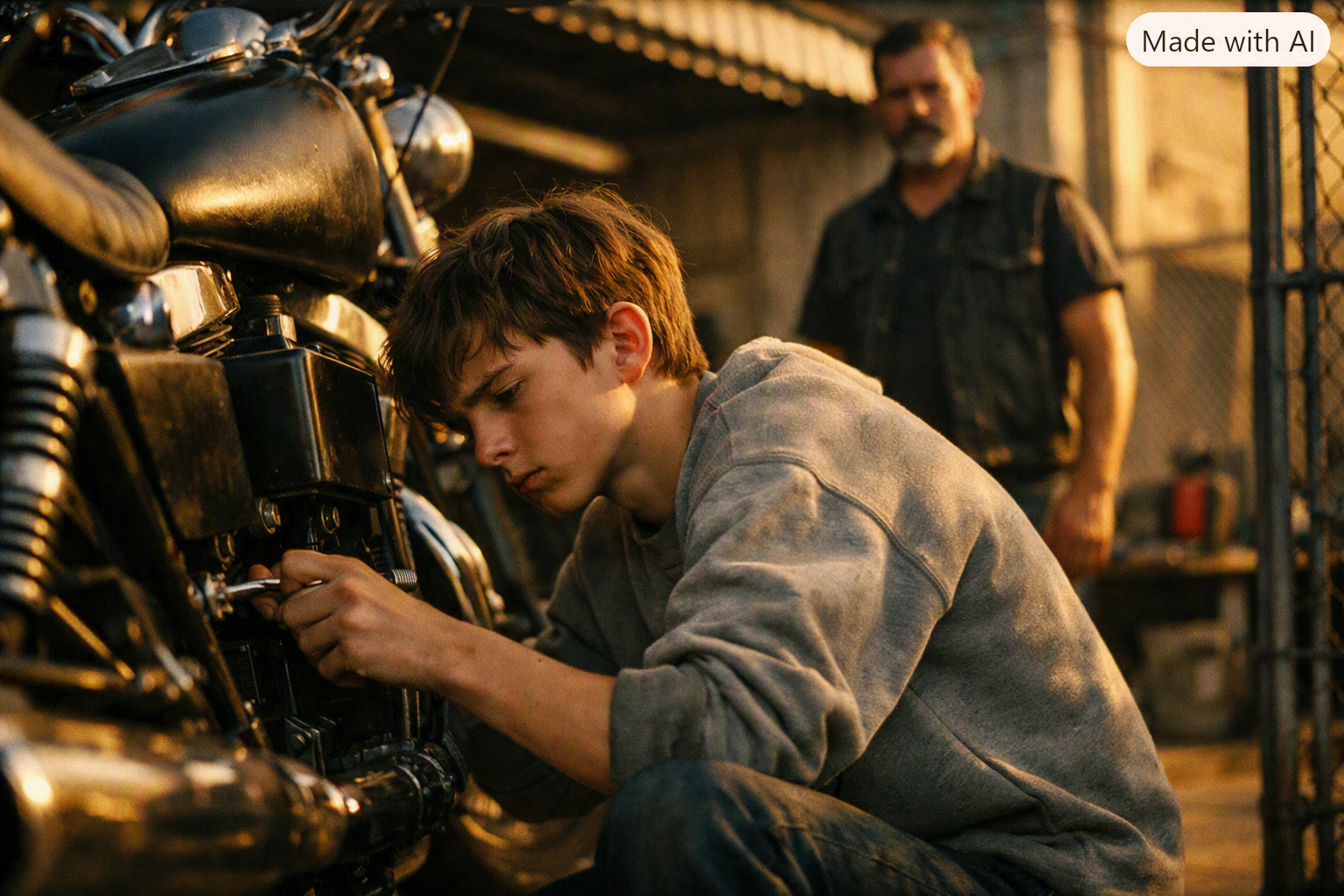
The black 1972 Shovelhead sat beneath a corrugated steel awning behind the Iron Rail clubhouse, and it was gorgeous in the way broken things sometimes are — chrome dulled by fingerprints, grease packed into every seam, the open primary case showing polished metal and teeth like something that had been cut open and left that way. Tools crowded two folding tables. A battery charger hummed against the wall. Three mechanics surrounded the machine like surgeons who’d already lost the patient.
Caleb could see the problem from twenty feet away.
The braided copper ground strap was hanging loose beneath the battery box.
One mechanic slammed a wrench onto the table.
“I’m done.”
The older one wiped his hands on a red shop towel. “You said that forty minutes ago.”
“I mean it this time.”
The third man bent over and hit the starter again. The motor turned, coughed once, then went quiet.
A dozen bikers groaned.
The man at the center of them didn’t make a sound.
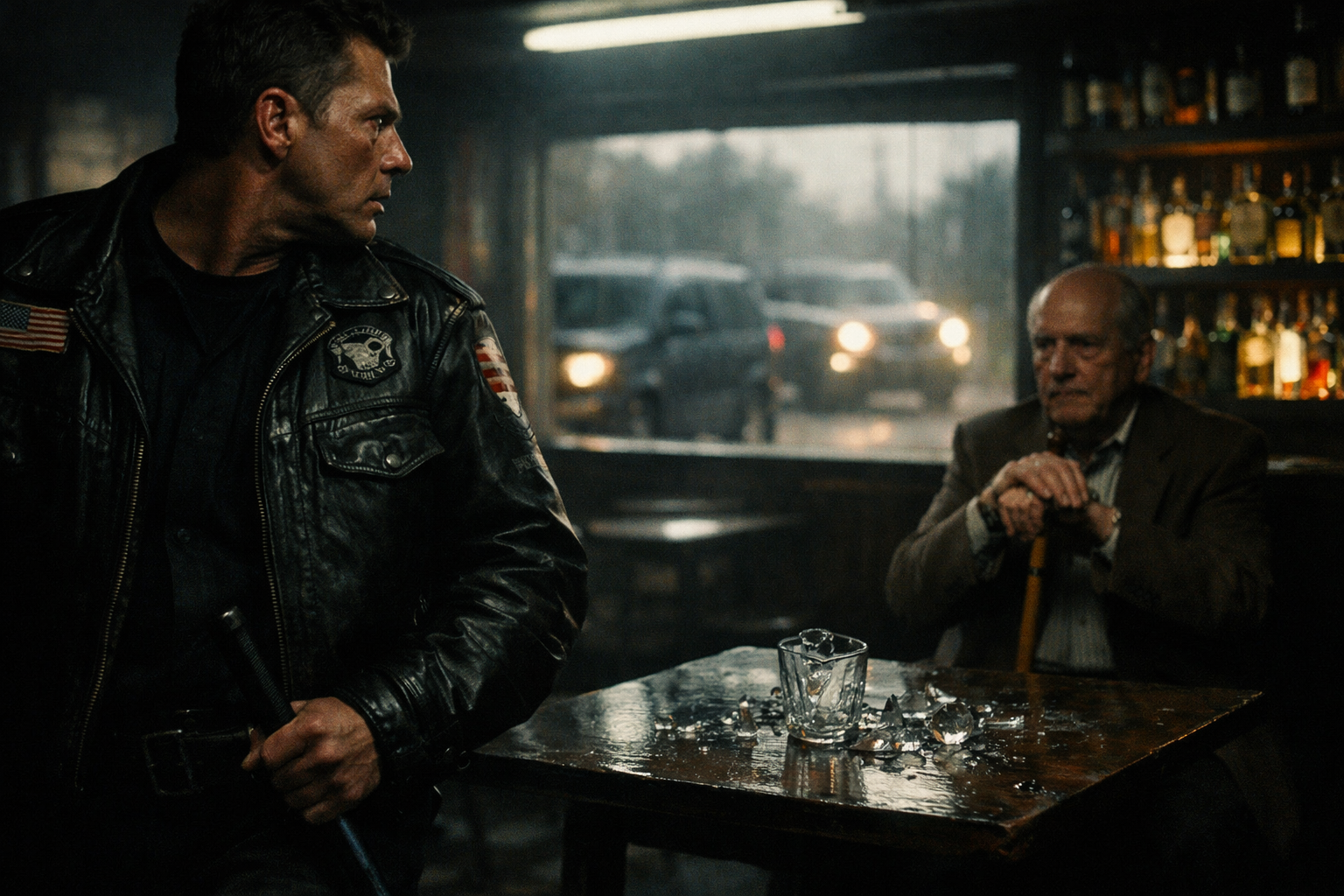
Caleb had heard the name Mason Steel before he ever saw the face. Everyone on Detroit’s south side knew it. Mason was fifty, broad-shouldered, with a weathered square jaw and a charcoal beard trimmed close. His black leather vest carried the Iron Rail patch. He didn’t look angry. He looked like a man who’d passed through anger into somewhere quieter and colder, where everyone else was afraid to follow.
“How long?” Mason asked.
“Four hours.”
“You told me forty minutes.”
“That was before the coil.”
“And?”
“Wasn’t the coil.”
Mason looked toward the other two. “Fuel?”
“Clean.”
“Timing?”
“Dead on.”
“Compression?”
“Good.”
“Battery?”
“New.”
Nobody spoke. A younger biker muttered, “Maybe Black Fury just doesn’t want to ride.”
Mason turned his head. The younger man found something very interesting about his boots.
Caleb’s hands tightened around the chain-link.
He knew he shouldn’t. He knew what happened when a fifteen-year-old kid in a splitting sneakers walked up to a group of bikers and told them they were wrong. He’d learned that lesson the hard way on three separate occasions involving three separate groups of men who didn’t like being corrected by someone who hadn’t earned the right to speak yet.
But the ground strap was right there.
He unlatched the gate before he could stop himself.
“Your ground strap is wrong.”
Silence swallowed the lot.
Every head turned. Mason turned last. His eyes moved over Caleb slowly — the gray sweatshirt that hung off him like a tent, the splitting sneakers, the canvas backpack, the grease under his fingernails that no amount of washing ever fully cleared.
“Who are you?” Mason asked.
“Nobody.”
“Nobody doesn’t usually walk onto my property.”
“The gate was unlocked.”
One of the mechanics took a step forward. Mason raised one hand without looking at him, and the man stopped.
“The ground strap,” Mason said.
“It’s hanging loose under the battery box. Braided copper. You can see it from the fence.” Caleb pointed. “Battery’s reading fine because it’s new and the charge is full, but you’re losing the circuit every time the engine tries to turn over. That’s why it coughs. It’s getting just enough current to try, but not enough to fire.”
The mechanic with the shop towel stared at him. “We checked the battery.”
“You checked the charge. That’s not the same thing as checking the ground.”
Nobody moved.
Mason walked to the motorcycle. He crouched slowly, like a man who’d learned not to rush, and looked beneath the battery box.
The strap hung loose.
He didn’t say anything for a long moment.
Then he stood and looked at the mechanics. “Did any of you check the ground strap?”
The mechanic with the towel opened his mouth. Closed it.
“Get me a ten-millimeter,” Mason said.
“I’ve got it,” Caleb said.
He didn’t know why he said it. He already had the wrench out of his backpack — a small combination wrench he carried because you never knew, because his father had taught him that — and before he’d made a decision about it, he was crouching beside the Harley.
His hands knew what to do even when his brain was still arguing.
He seated the strap, tightened the bolt, checked the connection. He pressed the terminal with his thumb. Solid.
“Try it,” he said.
The third mechanic looked at Mason.
Mason nodded.
The mechanic reached down and pressed the starter.
Black Fury erupted.
The engine caught on the first turn and settled into a deep, rolling idle that Caleb felt in his sternum. The exhaust came up warm against his face. The whole machine vibrated with something that felt, absurdly, like relief.
The lot was completely silent except for the engine.
Then someone started clapping. Then everyone was.
Caleb stood up and stepped back. He put the wrench into his backpack and zipped it closed because he needed something to do with his hands.
Mason watched him.
“You carry tools in a school backpack,” Mason said.
“My dad taught me.”
“Your dad a mechanic?”
Caleb hesitated. “He was a lot of things.”
Mason let that sit. “What’s your name?”
“Caleb.”
“Caleb what?”
“Caleb Mercer.”
Something moved across Mason’s face. Not much. Just a small shift behind the eyes, like a card turning over in a deck.
“Daniel Mercer was your father,” Mason said.
It wasn’t a question.
Caleb went still. “You knew him?”
“Sit down,” Mason said. “I’ll have someone get you something to eat.”
Caleb had not expected food.
He’d expected to be told thank you and escorted off the property, maybe with a twenty pressed into his hand if he was lucky. He had not expected to be sitting inside the Iron Rail clubhouse at a table that smelled like motor oil and old wood, eating a plate of rice and beans that a woman named Marisol had produced from a back kitchen with absolutely no ceremony, as though feeding a stranger was simply what happened here.
“You’re staring at me,” Marisol said, setting down a glass of water.
“Sorry.”
“Don’t be sorry. Just eat.”
He ate.
Mason sat across from him with a cup of coffee and said nothing until the plate was half empty.
“Daniel rode with us for three years,” Mason said. “Left when you were two.”
Caleb kept eating. His hands were steady. He was proud of that.
“He never said why?”
“He said he needed to be somewhere quieter.”
“Was he?”
Mason considered this. “He called, sometimes. Not often. Last time was about four years ago.” He paused. “How long has he been gone?”
“Seven months.”
“Heart?”
“How did you know?”
“He mentioned it. Last call.” Mason wrapped both hands around his coffee cup. “I should have come to the funeral.”
“I didn’t have one.”
Mason looked at him.
“There wasn’t anyone to organize it,” Caleb said. “And I didn’t have the money.”
The clubhouse was quiet except for the sound of someone working in the garage. The engine rumble of Black Fury had stilled outside. Through the window, Caleb could see the bikers drifting back to their own business.
“Where are you living?” Mason asked.
Caleb kept his eyes on his plate. “I move around.”
“How long?”
“Since March.”
Mason set his coffee down. “It’s August.”
“I know.”
“You’ve been on the street since March.”
“I’ve been managing.”
“You walked onto my lot because you spotted a loose ground strap from twenty feet away and you hadn’t eaten since yesterday.” Mason leaned back. “That’s not managing. That’s enduring.”
Caleb looked up at him. “Is there a difference?”
“Yeah,” Mason said. “There is.”
Caleb didn’t mean to come back the next day.
He told himself he was just in the neighborhood. He told himself he was passing through. But the neighborhood he was passing through was six miles from the overpass where he’d slept, and he’d walked there directly, so the argument fell apart before he reached the fence.
Victor was outside, sitting on an overturned bucket, looking at the engine of a disassembled dirt bike.
Victor was sixty-something, short, with a white mustache and hands that seemed to belong to someone twice his size. He looked at Caleb over the top of a pair of reading glasses held together on one side with electrical tape.
“The kid who fixed Black Fury,” Victor said.
“I didn’t fix it. I tightened a bolt.”
“Right answer. Come here.”
Caleb came through the gate. Victor pointed at the dirt bike engine.
“What do you see?”
Caleb looked. “Petcock’s backwards.”
Victor took off his glasses and cleaned them on his shirt. “Fourteen years I’ve been doing this.”
“Fourteen years and a backwards petcock.”
“Tell anyone and I’ll deny it.”
Caleb almost smiled. “Is Mason here?”
“He told me to keep you busy until he got back.” Victor handed him a wrench. “Start with the petcock.”
Mason came back at noon with a folder.
Not a thin folder. A folder that had the weight of institutions behind it — forms, letterheads, the kind of paperwork that governments produced when they wanted to make sure you understood they were paying attention to you.
He set it on the table in front of Caleb.
“There’s a youth services intake office on Fifth. I know the program director. If you go in tomorrow morning and list me as a contact, they can get you into transitional housing within a week.”
Caleb didn’t touch the folder.
“Or,” Mason said, “there’s a small apartment above the garage. It’s not much. But it’s not a folder either.”
“I’m not your problem.”
“No. You’re your own problem. I’m offering to be a resource.”
“Why?”
Mason was quiet for a moment. Outside, Victor and two other men were arguing cheerfully about something Caleb couldn’t make out.
“Because your father sat at this same table twenty years ago,” Mason said, “when he was about your age and about your weight. And nobody offered him a resource. He had to find his own way through, and it took him years he didn’t have to spare.” He paused. “I’m not trying to be your father. I’m not trying to be anything. You fixed a motorcycle. I’m offering a room.”
“I don’t take charity.”
“Good. The garage has work. Victor needs a second set of hands three days a week and he’ll pay fair.” Mason slid the folder to the side. “You’d be earning.”
Caleb looked at the table.
“What’s the catch?” he asked.
“You go to school.”
Caleb looked up.
“Non-negotiable,” Mason said. “You’re fifteen. You go to school or there’s no deal.”
“I’ve been managing without —”
“Enduring,” Mason said. “You’ve been enduring without school. That’s different.”
The room above the garage smelled like oil and old wood and something faintly like coffee. It had one window that looked out over the lot, a small bathroom with a showerhead that worked if you turned the handle exactly right, and enough space for a bed and a desk.
There was a photograph tacked to the wall above the desk.
Two men, young, standing beside a black Harley. One of them was Mason, maybe thirty years younger, thinner, his beard not yet charcoal. The other man had Caleb’s same jaw, his same eyes, a mechanic’s grease under his fingernails.
Daniel Mercer.
Caleb sat on the edge of the bed for a long time and looked at it.
He hadn’t seen a photograph of his father in seven months. He’d lost the ones on his phone when the screen cracked and he couldn’t pay to fix it. He’d thought he would carry his father’s face in his memory clearly, but memory was a machine with a loose ground strap — sometimes it caught, sometimes it coughed and went quiet, and you reached for the image and found only an outline.
This was a print. Glossy. Real.
He could see his father’s hands.
He pressed his thumb to the edge of the photograph and did not cry, because he was fifteen and he had been alone for seven months and somewhere in that time crying had started to feel like a leak rather than a release — like something he couldn’t afford.
But he sat with it a long time.
Victor paid in cash and kept strict records.
“I’m not interested in the IRS,” he explained on the first day, handing Caleb an envelope, “but I’m also not interested in you thinking this is anything other than a legitimate transaction. You worked. Here’s what the work cost me. We’re square.”
“Fair enough,” Caleb said.
“You any good with electrical systems?”
“Better than with people.”
Victor pointed at a stripped Honda sitting against the far wall. “Wiring harness is a disaster. Someone got creative with it. Start there and tell me everything you find.”
Caleb found fourteen separate problems, three of which were structural and two of which were frankly impressive in their inventiveness.
“Whoever did this,” Caleb said, pulling a length of wire that had been spliced with a paper clip and electrical tape, “either didn’t know what they were doing or knew exactly what they were doing for a very specific reason.”
Victor appeared from behind a toolbox. He examined the splice.
“Previous owner,” he said.
“What did they need it to do?”
“Best not to ask.”
Caleb dropped the wire into the parts bin. “Okay.”
He went back to work.
That was how it went between them — Victor would close a conversation, and Caleb would let it close, and they would both return to the motorcycle like two men who’d found an agreement without negotiating one. It suited Caleb. He’d spent seven months in a world where everyone’s motive was visible and usually predatory. It was a relief to be somewhere that rewarded restraint.
School was harder.
Jefferson High was twenty minutes by bus and a different planet from the garage. Caleb had a record of missed days that the attendance officer treated like a personal affront. His first meeting with the counselor involved a stack of forms, an expression of careful concern, and a phrase he’d heard before: “I want to understand your situation.”
“My father died,” Caleb said. “I’ve been housing-insecure since March. I’m currently in a stable situation. I want to catch up on what I missed.”
The counselor, a woman named Ms. Patterson, looked at him over the stack of forms.
“That’s the most direct answer I’ve gotten from a student in six years,” she said.
“Is that a problem?”
“No.” She set the forms down. “What do you need?”
He needed three tutoring sessions per week. He needed the school’s free breakfast program — which he learned about only because Ms. Patterson mentioned it, not because anyone had offered it to him, and which he started the following morning. He needed a pass that let him leave at 2:45 instead of 3:15 because Victor’s afternoon session started at three.
Ms. Patterson arranged all of it within forty-eight hours.
“Thank you,” Caleb told her.
“Don’t thank me,” she said. “Pass algebra.”
He almost didn’t.
Algebra was a specific kind of enemy — not incomprehensible, just built on foundations he’d missed during the seven months of not attending school, the two years before that of sporadic attendance, and the general chaos of a childhood with a single parent whose own stability had been, Caleb now understood, more fragile than it looked.
His tutor was a junior named Darius who was seventeen, tall, and had a way of explaining variables that made Caleb feel like the concepts were physical objects he could hold.
“Think of x as an empty socket,” Darius said. “The socket fits a specific bolt. Your job is to find the bolt.”
“That’s the least mathematical explanation I’ve ever heard.”
“Is it working?”
Caleb looked at the problem. Worked it through. Got it right.
“Yeah,” he said. “It’s working.”
“Then it’s math.”
They met three times a week in the library, and Darius never once asked why Caleb had missed so much school, never commented on the sweatshirt or the shoes, never looked at him with the particular careful sympathy that made Caleb feel like something being documented. He just showed up with the textbook and explained variables as sockets, and Caleb showed up and worked through it.
It was, in a small and specific way, the most ordinary thing in Caleb’s life.
He held onto that.
Victor caught him reading the Iron Rail history one evening.
Caleb hadn’t meant to go through the binders on the shelf by the desk, but Victor had left him alone for two hours waiting for a brake fluid delivery, and curiosity was the only thing Caleb had never managed to suppress regardless of circumstances.
The binders were half records, half photographs, half something that didn’t have a name — the accumulated proof that a group of men had existed and built things together and some of them had stayed and some had gone and the building had continued regardless.
His father was in there six times.
Two photographs. Three maintenance logs in his father’s handwriting, which Caleb recognized from the notes left on the refrigerator during the years he’d been old enough to read them. One short paragraph in what looked like a club newsletter, circa eleven years ago, thanking Daniel Mercer for work done on the clubhouse plumbing that had saved the Iron Rail “three hundred dollars and a very unpleasant call to a licensed contractor.”
Caleb was still reading when Victor came in.
Victor looked at the binder on the table. He sat down across from it without speaking.
“I’m sorry,” Caleb said. “I shouldn’t have —”
“It’s yours to look at,” Victor said. “More right than mine, probably.”
Caleb closed the binder. “He never told me about this place.”
“No. I don’t think he meant to.”
“Why not?”
Victor was quiet for a moment. He had a way of going quiet that wasn’t evasion — more like he was measuring something, deciding how much of the truth was useful.
“Your father came here when he was seventeen,” Victor said. “He was in some trouble. Not serious trouble, not yet, but the kind that tends to compound if nobody interrupts it. Mason interrupted it. Daniel spent three years here, learned the trade, straightened out. Then your mother came into the picture, and Daniel decided that this life wasn’t the life he wanted for his family.” Victor shrugged. “He wasn’t wrong. It’s not a quiet place. It’s not always a safe place. He wanted something different for you.”
“So he just cut it off?”
“He thought it was cleaner that way.”
Caleb looked at the closed binder. “It wasn’t clean. It just meant I didn’t know any of this existed until I walked through the gate.”
“Yeah,” Victor said. “I think he knew that, toward the end.”
The conversation with Mason happened three weeks later, on a Friday evening, after the garage had cleared out and the lot was quiet.
Mason was cleaning Black Fury — not because it needed it, but because it was something to do with his hands during conversations that required care.
“Victor told me you found the binders,” Mason said.
“I shouldn’t have looked without asking.”
“No, you should have. That’s what they’re there for.” Mason kept working. “What do you want to know?”
Caleb sat on a crate nearby. He’d been preparing this question for three weeks — arranging it, rearranging it, trying to find the version that asked for the truth without demanding more than he was owed.
“Why did he really leave?”
Mason set down the cloth.
“There was an incident,” he said. “About a year before he met your mother. Nothing that put anyone in prison, but something that made your father decide he was going to become someone who didn’t live in that vicinity anymore.” Mason looked at him directly. “He wasn’t in the wrong. But he made choices that put people he cared about at risk, and he didn’t forgive himself for it easily.”
“Was one of those people you?”
Mason nodded.
“Were you angry at him for leaving?”
“For a while.”
“And then?”
“And then Daniel called me four years ago and said he was sick and he had a twelve-year-old son who was a natural mechanic and who didn’t know anything about where he’d come from.” Mason picked the cloth back up. “He asked me to keep an eye out. Said he didn’t want to formalize it, didn’t want to tell you, just wanted someone to know you existed in case things went sideways.”
Caleb was very still.
“He knew,” Caleb said. “He knew he was going to go, and he called you.”
“Four years ago. Yes.”
“He never told me.”
“No.”
“He should have told me.”
Mason didn’t disagree. He kept cleaning the chrome. The evening light was going orange across the lot, long shadows from the fence running parallel lines across the concrete.
“He was afraid,” Mason said. “That you’d grieve before you had to. That you’d spend those four years waiting for it instead of living them.” He paused. “He wasn’t right. But I understood it.”
“I spent seven months on the street,” Caleb said. “Because he didn’t tell anyone.”
“I know.”
“If he’d said your name once —”
“I know,” Mason said again. Quietly. Not defensive. Just holding it.
Caleb pressed his hands flat on his knees and looked at the motorcycle.
Black Fury gleamed under the orange light. The copper ground strap was clean and solid beneath the battery box, exactly where it was supposed to be.
“I’m not going to say it’s fine,” Caleb said. “Because it’s not.”
“No.”
“But I don’t think he was a bad person.”
“He wasn’t.”
“He was scared and he made a bad decision out of it.”
“Yeah,” Mason said. “That’s about right.”
Caleb exhaled. It wasn’t forgiveness, exactly. It was something smaller and more structural — an understanding that the circuit was incomplete but that the fault was fixable if you knew where to look for the break.
“Okay,” he said.
Mason looked at him.
“Okay,” Caleb said again. “I can work with that.”
The youth workshop was Mason’s idea.
Caleb heard about it second-hand first — Marisol mentioned it while she was making coffee, something about the community board on Fourteenth Street, a proposal, approvals pending. Victor mentioned it again a week later in the context of needing to clear space in the secondary garage.
It was only when Ms. Patterson brought it up at school — “There’s a new vocational program opening through a community partner, I thought you might be interested” — that Caleb realized Mason hadn’t told him directly because Mason wasn’t sure how he’d take it.
He found Mason in the office after school.
“The workshop,” Caleb said.
Mason looked up from the desk.
“You’re putting it together because of me,” Caleb said.
“I’m putting it together because it should have existed twenty years ago,” Mason said. “The fact that you walked through the gate reminded me that I’d been meaning to do it.” He leaned back. “Don’t make it smaller than it is by making it only about you.”
Caleb thought about that.
“Fair enough,” he said. “What do you need?”
Mason looked at him for a moment with an expression Caleb was still learning to read — something between calculation and something warmer that Mason didn’t name.
“I need a second instructor for the fundamentals track,” he said. “Someone who can explain a ground strap to a kid who’s never held a wrench.”
“I’m fifteen.”
“Victor was sixteen when he started teaching.”
“Victor also built his first engine from scratch at fourteen.”
“So did you, apparently, based on what the Honda’s wiring harness suggested.”
Caleb thought about this. The Honda’s wiring harness had been a disaster, yes, but it had also been, in its own disastrous way, kind of remarkable. Someone had needed it to do something specific, and they’d improvised with what they had, and most of what they’d done had actually worked.
You didn’t build that kind of system without understanding it first.
“I didn’t build it,” Caleb said.
“No. But you read it. Which is more valuable.” Mason pushed a folder across the desk. “Program starts in six weeks. The proposal includes your role as junior instructor, two days a week, paid, school schedule respected.”
Caleb opened the folder.
His name was already in it.
The first session of the youth workshop had twelve students.
Caleb stood at the front of the secondary garage beside a disassembled engine block and looked at them — twelve faces ranging from about thirteen to seventeen, some of them wary, some curious, one girl in a red jacket who was already eyeing the engine with an expression he recognized because he’d been wearing it himself at the chain-link fence four months ago.
He said: “I’m not going to ask why you’re here.”
The wariness shifted slightly.
“The first thing we’re going to do,” he said, “is learn to read a machine. Not fix it. Read it. Because a machine will always tell you what’s wrong with it, if you know what to listen for.”
The girl in the red jacket said, “What if you’ve never held a wrench?”
“Then today you hold a wrench for the first time,” Caleb said. “That’s it. That’s the whole session.”
She didn’t look convinced.
“What’s your name?” he asked.
“Jaylen.”
“Jaylen, have you ever had a car that made a noise it shouldn’t make?”
“My aunt’s car makes this sound when she turns left.”
“What kind of sound?”
“Kind of like — ” She made a grinding-clicking sound with her mouth, unexpectedly accurate.
“That’s the CV axle,” Caleb said. “It’s a joint that lets the wheel turn while the axle spins. When it starts to wear, it clicks when you put load on it — like turning.” He pointed to the engine block. “There’s a principle there. Everything that wears out tells you it’s wearing. You just have to know what the sound means.” He looked at the room. “That’s what we’re learning. The language.”
Jaylen looked at the engine.
“Okay,” she said.
Three months passed.
The workshop grew to eighteen students. The waiting list had seven more names. Ms. Patterson from Jefferson High sent two referrals and a letter of commendation that Mason pinned to the office wall because Marisol told him he was going to, and he’d learned that some arguments with Marisol were more expensive than they were worth.
Caleb passed algebra.
Not brilliantly. But it was a pass. Darius made a production of it, in the library, with a slightly crumpled celebration that involved a bag of chips from the vending machine and an extremely sincere handshake.
“Socket found the bolt,” Darius said.
“The socket found the bolt,” Caleb agreed.
Victor, when Caleb told him, said: “Barely passing is still passing.”
“That’s what I said.”
“Good. Same philosophy explains my entire driving record.”
“That is not reassuring.”
“No,” Victor agreed cheerfully, “but it’s honest.”
There was a day in November when everything came together at once, the way things sometimes did when you weren’t prepared for it.
It started with the motorcycle.
Black Fury had developed a new sound — not a problem sound, just a subtle change in the idle, the kind of thing you only noticed if you’d been listening long enough to know what normal sounded like. Caleb had been listening for four months. He mentioned it to Mason on a Tuesday morning before school.
Mason stood beside the bike, head tilted.
“I don’t hear it,” he said.
“It’s at the lower end of the idle. Like something’s slightly rich on the left side.”
“Victor?”
Victor appeared from the garage. He listened for ten seconds.
“Kid’s right,” he said. “Left carb’s running rich.”
Mason looked at Caleb. Then back at the bike. Then he smiled, which happened rarely enough that Caleb hadn’t catalogued all the versions of it yet.
“Rebuild the left carb,” Mason said. “You’ve got an hour before school.”
“I’ve got forty minutes before I have to leave.”
“Forty minutes is enough.”
It took thirty-eight minutes.
Caleb made it to the bus stop with two minutes to spare, his hands scrubbed clean, his backpack over one shoulder, and something in his chest that he’d stopped being afraid to call by its real name: satisfaction.
The bus came. He got on.
Through the window, the lot receded behind him.
He could see Victor disappearing into the garage.
He could see the Iron Rail patch above the door.
He could see, briefly, Mason standing at the edge of the lot, not watching the bus go — just standing there in the morning light, one hand in his jacket pocket, looking at something down the street.
Caleb looked at him until the bus turned the corner.
The guardianship paperwork took four months.
Three agencies. Two background checks. One hearing before a family court judge who asked Mason twenty-two questions and Caleb eleven and looked at both of them for a long time afterward before writing something in the margin of a document and nodding.
“Non-relative guardianship is approved,” she said.
Mason said, “Thank you, Your Honor.”
Caleb said nothing, because his throat had done something that he needed a moment to manage.
Outside on the courthouse steps, in November cold with his breath making clouds, Caleb stood beside Mason and looked at the street.
“You should know,” Caleb said, “I’m not easy.”
“I’ve noticed.”
“I argue with Victor constantly.”
“That’s why I pay him.”
“I’m going to want to know things. About my dad. About before. All of it.”
“I know.”
“And sometimes I’m going to be angry about it.”
“Yeah,” Mason said. “That’s fair.”
Caleb looked at him. “You’re sure.”
Mason looked back. “Kid. I let you take apart my carb with thirty-eight minutes and a school bus to catch.”
Caleb almost smiled.
“That’s not an answer.”
“It’s the only one I’ve got.” Mason turned toward the street. “You hungry?”
“Always.”
“Come on, then.”
They walked down the courthouse steps together, and neither of them made it more than it was or less than it was, and the November wind picked up from the river and went right through Caleb’s jacket, and he thought: I’m going to need a better jacket.
And then he thought: I can probably afford one now.
And that thought, small and practical as it was, felt like the truest proof of everything that had changed.
On Caleb’s sixteenth birthday, there was a motorcycle outside.
Black Fury.
Cleaned. Not restored into showroom perfection — Daniel’s scratches were still in the tank, and Mason’s scuff along the left fender was still visible, and the chrome had its history in it. But clean. Honest. Itself.
A helmet rested on the seat.
Caleb looked at it for a long time. Then he looked at Mason.
“No,” he said, on instinct.
Mason tossed him the keys.
Caleb caught them without thinking.
“You passed the written test,” Mason said.
“That doesn’t mean I can ride that.”
“No. It means you can learn.”
Caleb looked at Victor, who was standing near the garage door with his reading glasses on and his arms folded.
Victor raised both hands. “I’m staying out of this one.”
“You’re the one who sabotaged it,” Caleb said. “Four hours.”
“One time.”
“Four hours,” Caleb repeated, because it had been four hours, and some things deserved to be stated clearly.
“You people remember everything,” Victor said.
Caleb laughed.
Then he looked down at the keys in his hand, and the laughter faded into something quieter.
He understood now what he hadn’t understood at the fence, seven months ago — why his father had never mentioned this place, what it had cost him to keep that silence, and what the silence had been trying to protect.
His father had been afraid. He’d made a scared man’s choice, and that choice had consequences, and some of those consequences had been very bad.
But his father had also called Mason four years before the end. Had left that wire live, just in case. Had put a name in someone’s memory where Caleb might eventually reach it.
Frightened men trying clumsily to protect the people they loved.
It wasn’t enough. But it was something.
And something, Caleb had learned, was what you started with.
He climbed onto Black Fury. He didn’t start it yet. He rested his hands on the grips and felt the weight and the balance of it — sixty pounds of chrome and iron and history, and beneath the battery box, a copper ground strap, clean and solid and exactly where it belonged.
Mason stood beside him.
“You nervous?”
“Yes.”
“Good.”
Caleb looked at him. “That’s your advice?”
“Fear keeps idiots alive.”
“Did my dad teach you that?”
“No,” Mason said. “Your dad was the idiot.”
Caleb laughed again. The afternoon light stretched long across the lot. From inside the garage came the sound of someone dropping a socket, Victor swearing, a radio playing softly.
Ordinary sounds.
He turned the key.
The dashboard lights came alive.
Caleb looked at the open gate, and the street beyond it, and the traffic and school and algebra and paperwork and grief and the next year and the year after that waiting out there — all of it unguaranteed, none of it simple, and none of it asking him to be ready before he was.
He only needed somewhere to return.
He pressed the starter.
Black Fury caught on the first turn.
Original fictional stories. AI-assisted creative content.