The bell above the door chimed, but nobody looked up.
Chloe was midway through wiping down the chrome counter when she heard it — not the usual slam of boots or the confident clatter of regulars. A whisper. A scrape. The sound of someone who wasn’t sure they were allowed to be there.
She looked up.
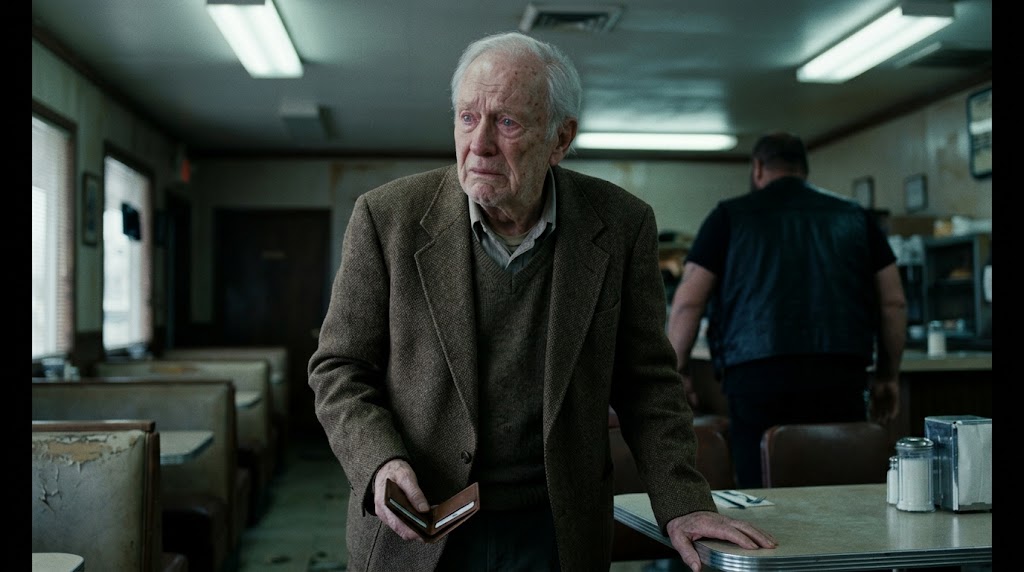
An old man stood in the doorway of the Greasy Spoon, blinking against the fluorescent light like a man who’d just surfaced from deep water. His tweed jacket hung off his shoulders. His hands trembled at his sides. His eyes — pale blue, washed out — moved across the room like he was searching for something he couldn’t name.
He found an empty booth by the window and lowered himself into it one careful inch at a time.
Chloe watched him for a moment. Then she poured a fresh mug of coffee and walked it over.
“Here you are, sir.”
He looked up at her, or through her — she couldn’t tell. “Thank you, dear,” he said, his voice dry as old paper.
He didn’t touch the mug.
He just stared out the window.
In the corner booth, the usual four had taken their regular positions.
Bear sat with his back to the wall, facing the door. Always. His beard was salt-and-pepper and thick as rope. His arms rested on the table like slabs of granite. Jax sat across from him — skull tattoo climbing his neck, eyes alert. The other two, Tiny and Dutch, flanked them. A wall of black leather and denim.
They weren’t loud today. Low voices. Coffee going cold. An easy, settled quiet that belonged to men who trusted each other completely.
Bear’s eyes moved to booth four.
He watched the old man for ten seconds. Twenty. Then he set down his mug.
Rick appeared at Chloe’s elbow. “He’s been here an hour. He hasn’t ordered. Get him to move or call someone.”
“He’s not hurting anything.”
“He’s taking a four-top.”
“Rick—”
But the old man stood up.
The diner didn’t go quiet all at once. It happened in waves — a fork stopping mid-scrape, a sentence dying mid-word, heads turning one by one — as the frail, trembling figure in the oversized tweed jacket shuffled directly toward the corner booth.
Chloe’s stomach dropped.
Jax’s hand tightened on his coffee mug. Dutch sat up straighter. But Bear didn’t move. He just watched, his expression the same flat, steady calm.
The old man reached the booth. He put one spotted, shaking hand on the table’s edge for support.
The entire diner held its breath.
“Excuse me, gentlemen,” he said. His voice was barely a thread. “I’m sorry to bother you. But can you tell me — where am I?”
The silence stretched.
Jax started to react — a short, sharp breath, something almost dismissive — but Bear’s eyes cut to him like a knife. Jax went still.
Bear leaned forward. Slow. Deliberate.
His eyes weren’t on the man’s face. They were on a small pin on the lapel of his jacket. Tarnished silver. Almost invisible. A pair of wings.
“What’s your name, soldier?” he said. Low. Quiet.
The old man fumbled in his pocket. Pulled out a wallet. Opened it with clumsy fingers and a card slipped free, fluttered to the floor.
Dutch leaned down without a word and picked it up.
Set it gently on the table.
It was a military ID. Old. Laminated. The photo showed a young man with a square jaw and the same pale, serious eyes. The text was faded, but readable.
Arthur Jensen. 82nd Airborne Division.
Something passed through the corner booth — wordless, instant. A shift. Like a gear catching.
“Arthur,” Bear said.
The old man looked at him.
“Sit down. Have some coffee.”
Arthur sat. He wrapped both hands around the mug Chloe brought over without being asked. She also cut a slice of apple pie — Bear’s usual — and set it in front of him without explanation.
Bear glanced at her. She held his gaze. He gave one slow nod.
“I was supposed to meet Helen,” Arthur murmured, looking out the window. “She works at the millinery. Down on Elm Street.”
Bear’s eyes found Chloe’s across the room.
There hadn’t been a millinery on Elm Street in fifty years. The whole block was a parking garage now.
“Helen’s running a little late,” Bear said, his voice careful and even. “Where do you live, Arthur? What’s the street?”
Arthur shook his head slowly. A single tear moved down the side of his face.
“I don’t remember the street.” He paused. “I know the house. It has a blue door.”
Bear pulled out his phone. His thumbs moved faster than they had any right to on a man that size. He said two words to Dutch, and Dutch had his phone out too, talking low. Within three minutes they had cross-referenced an address from a veterans’ outreach database — an Arthur Jensen, 89, registered through the VA, on the east side of town.
Bear stood up.
The other three rose with him.
Rick, from behind the pass-through window, made a move toward the booth. Chloe stepped directly in front of him.
“Don’t,” she said.
“Chloe, I swear to God—”
“Don’t.”
Rick looked at her. Then at the four men rising in the corner booth, towering over the small, frail figure between them. His mouth closed.
“All right, trooper,” Bear said, one hand resting on Arthur’s shoulder with the careful weight of someone handling something irreplaceable. “Time to go home. We’ll take you.”
Arthur looked up at the hand on his shoulder. Flinched. Then relaxed.
“Okay,” he said. “Okay.”
They walked him out in a formation Chloe would spend the rest of her shift trying to describe to herself.
Jax held the door. Bear kept a hand on Arthur’s back. Dutch walked half a step ahead, clearing the path. Tiny brought up the rear. They moved like a motorcade — a slow, deliberate wall of leather and iron moving through the quiet diner, the whole room frozen to watch them go.
As they passed her station, Bear stopped.
He reached into his jacket and set a fifty on the counter beside the register.
“For the pie,” he said. “And the water.”
The bell above the door chimed.
Then they were gone.
Rick’s mouth was still hanging open when Chloe walked to the window.
Outside, the four men were lifting Arthur gently into the sidecar of Bear’s Harley. They draped a spare jacket over his thin shoulders like a blanket. Set a helmet on his head with both hands like they were placing a crown. Arthur looked small inside it. He looked safe.
Four motorcycles pulled out onto the street in a diamond formation, the sidecar at the center, and disappeared around the corner with a sound like low thunder.
Chloe stood at the window for a long time after they were gone.
She couldn’t explain why she got in her car after her shift.
She told herself she was just curious. Just making sure he got home okay. That was all.
She found the street easily. Found the house.
The blue door was there — or what was left of it. The paint had peeled down to gray. The lawn hadn’t been touched in a year. The windows were filmed with grime. But the four Harleys were parked out front like sleeping animals, and the door was wide open, and from inside came the sounds of work.
She walked up the cracked path.
Inside: Arthur was asleep in an armchair, a blanket over his legs.
Jax was in the kitchen, his leather vest folded over a chair, systematically cleaning out a nearly-empty refrigerator.
Tiny was on the floor under the sink, wrench in hand, elbow deep in old piping.
And in the backyard, through the window, Bear was pushing a rusted lawnmower through waist-high grass, his face set in the expression of a man completing a mission.
They hadn’t just brought him home.
They had stayed.
Chloe stood at the door for a moment, her throat tight. Then she turned around, drove to the nearest grocery store, and spent almost forty dollars — most of her tip money — on eggs, bread, milk, soup, and a roasted chicken.
She carried the bags back up the broken path. Bear had come inside by then. He stood in the hallway, wiping sweat from his forehead with the back of a gloved hand, and looked at her standing in the doorway with two full grocery bags.
His tired face opened into a slow, genuine smile.
“Thought you might be hungry,” Chloe said.
He took the bags from her.
“You’re all right, Chloe,” he said.
She didn’t say anything. She didn’t need to.
That was the beginning.
The Lost Commandos — Bear’s chapter — made Arthur Jensen their mission. They set up a schedule: two of them, every single day. Tiny replaced the plumbing. Jax repainted every room in the house. Dutch drove Arthur to his VA appointments and sat in the waiting room reading old magazines without complaint.
They found a photograph on the mantelpiece — young Arthur in his jump uniform, chin up, proud, smiling — and had it professionally restored and framed. It hung above the fireplace in the place of honor.
Chloe became part of the family by accident and then on purpose. She came by after her shifts with food from the diner — Rick, now visibly intimidated by the bikers’ vehicles regularly parked out front, never said a word about it. She sat with Arthur in the evenings and listened to fragments of stories about boot camp at Fort Bragg, about jumping into the dark sky over Normandy, about the smell of French mud and the sound of German artillery.
On his clearer days, Arthur would look at her with eyes gone sharp and bright and say, “You’re a good girl, Chloe. Helen would have liked you.”
She learned not to cry until she was in her car.
One evening she sat on the newly-repaired porch steps beside Bear, watching the sky go orange and purple over the neighborhood rooftops.
She asked the question she’d been carrying for weeks.
“Why?” she said. “Why him? Why all of this?”
Bear was quiet for a long time.
“My old man,” he finally said. His voice had a different texture — lower, older. “He was a tunnel rat in ‘Nam. Came back with his body intact but his mind scattered across the jungle. Never talked about it. Just drank. VA forgot him. The world forgot him.”
He paused.
“One day he walked away. They found him three states over, two weeks later. He didn’t know his own name.” Bear’s jaw moved. “He died in a state hospital. Alone. I was on the road. Didn’t find out he was gone for a month.”
He turned and looked at her. The light was going, but she could see what was in his eyes.
“We leave no man behind,” he said. “That’s the code. In the service, in the club — same code. The world forgets these men. We don’t. Not on my watch.”
He looked back at the house. At the repaired porch, the trimmed lawn, the freshly painted window frames.
“Never again.”
Arthur Jensen turned ninety in a backyard full of people.
Bikers. Neighbors. Teachers from the elementary school down the block. The woman from the VA who’d never seen anything like it in thirty years of service. The whole neighborhood, who had gone from locking their doors when the Harleys appeared to saving them seats at the table.
Arthur sat in his chair and wore a custom leather vest the club had made for him — his original 82nd Airborne patch sewn over the heart.
He lifted a small plastic cup of apple juice. The crowd went quiet.
“To the men who found me,” he said, his voice steadier than it had any right to be. “When I was lost.”
Bear stepped forward and touched his cup to Arthur’s.
“To Arthur,” he said, turning to the crowd. “To the ones who show us the way.”
The roar that went up shook the windows.
Chloe stood at the back of the crowd and didn’t try to stop crying this time.
A year after that first day, Bear sat her down at the diner before her shift.
“You’re better than this place,” he said. “I’ve been watching. The way you handle money. The way you manage your time. The way you don’t back down when Rick gets in your face.” He folded his hands on the table. “I need a bookkeeper for the shop. Real salary. Benefits. You want it?”
She said yes before he finished the sentence.
With the steady income, she enrolled in night classes at the community college. The club quizzed her on accounting principles with the same focus they brought to everything else. Bear showed up to her graduation in the front row — the entire chapter, a block of black leather in folding auditorium chairs, louder than anyone when her name was called.
She crossed the stage with her business administration degree and looked out at them and laughed and cried at the same time.
Arthur Jensen lived to ninety-six.
He spent those last years surrounded by sound — engines, laughter, the clink of cups, the low rumble of men who kept their word. He went for rides in the sidecar on Sunday afternoons. He had people to call him by name every single day.
At his last birthday party, he looked out at the yard full of people and said what everyone already knew: that some things can’t be planned, only stumbled into. That a morning in a greasy spoon diner, a lost old man shuffling toward a corner booth, a waitress who didn’t walk away — those things can start something larger than anyone involved could have imagined.
Bear stood at the back this time.
He watched the old man hold court in his leather vest with the Airborne patch and the bright eyes, and he looked like a man who had finally paid a debt he’d carried for thirty years.
Chloe found him standing alone after the crowd thinned.
“You okay?” she asked.
He looked at her for a moment.
“Yeah,” he said. “Yeah, I am.”
He meant it. She could tell.
That was enough.
Original fictional stories. AI-assisted creative content.