I’d worn the black robe for almost twenty years. I thought I’d seen every kind of liar walk through my courtroom.
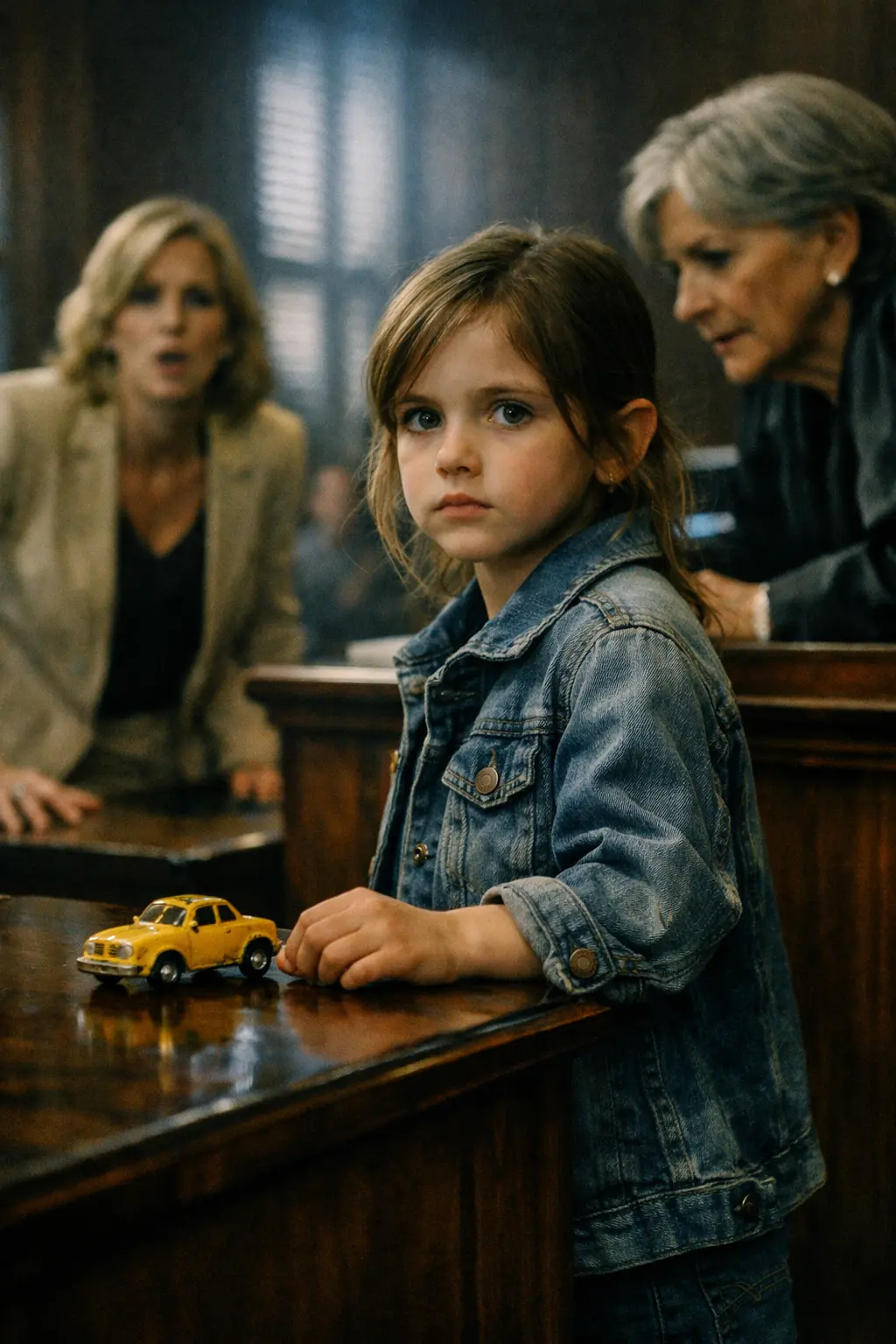
Then a seven-year-old girl stood at my bench and asked, “Am I supposed to choose which one of them goes to jail?”
The room went dead silent.
Her name was Maya. Her mother, Sarah, sat at the petitioner’s table in a tailored beige suit, dabbing perfect tears with a tissue. For three days she’d played the terrified victim flawlessly.
Her father, David, sat hollow-eyed across the aisle. His suit didn’t fit right anymore. He’d barely spoken in three days, crushed under Sarah’s relentless accusations.
I was ten minutes from granting Sarah full custody.
Then Maya asked to speak.
“I wasn’t supposed to bring this,” she said, voice shaking. “She told me she’d hurt Daddy if I ever showed anyone.”
Sarah’s confident smile froze.
Maya reached into her denim jacket and pulled out a cheap plastic toy — the kind you get from a quarter machine. She set it on the table. It made a small, hard clack.
The color drained from Sarah’s face.
“Objection! Get that away from her!” Sarah lunged, chair scraping.
I slammed my gavel. “Bailiff, keep the mother in her seat.”
I looked at the little girl. “Maya. What’s on that toy?”
She hovered her finger over the red button. “The truth,” she whispered.
Sarah’s attorney, Mr. Sterling, shot up. “Your Honor, this hasn’t been authenticated. You cannot allow surprise material during closing arguments.”
He was right by the book. But family court answers to one thing above the book: the safety of the child.
“Overruled, Counselor,” I said. “Sit down.”
I turned back to Maya. “You’re safe here. Where did you get this?”
“From a birthday party. A long time ago. Mommy didn’t know it recorded things.”
“When did you record what’s on it?”
“Last night. After Daddy dropped me off. She was so mad. She’s always so mad when the lawyers aren’t looking.”
I nodded at Maya. “You may press the button.”
She closed her eyes and pushed it.
Static. Then glass shattering. Then Maya’s small sobbing voice: “Please, Mommy, stop! I’m sorry! I don’t want to say it!”
Then a voice that didn’t match the woman I’d watched cry for three days — cold, venomous. “Shut your mouth, you little brat. Stop crying before I give you a real reason to cry.”
A slap. A yelp.
“You’re going to sit in that chair tomorrow and tell the judge Daddy yells at you. You’re going to say he threw a book at your head.”
“But he didn’t! Daddy never hurts me!”
“It doesn’t matter what he did! If you don’t say exactly what I told you, I’ll call the police. I’ll tell them Daddy hit me, and they’ll lock him in a cage forever. You’ll never see him again. You’ll be an orphan.”
The recording clicked off.
Thirty seconds. That’s all it took.
David had both hands over his mouth, tears streaming. Sarah’s mask was gone — replaced by pure, cornered fury.
“You little bitch,” she hissed. Quiet. But in that silence, everyone heard it.
“Bailiff!” I roared. “Detain the petitioner. If she moves toward this child, put her on the floor.”
Sarah jumped up screaming it was a setup, that David engineered it. David was a high school history teacher. He didn’t know this toy existed any more than I did.
“Sit down and shut your mouth, Ms. Evans,” I said, gavel cracking down three times.
I looked to David’s exhausted public defender. “Counselor — emergency motion for sole custody?”
“Yes, Your Honor. Effective immediately.”
I turned to Sterling. “Response from the petitioner?”
Sterling stood slowly, looked at Sarah, then at me. “Counsel for the petitioner has no objection.” He closed his briefcase. “I’m withdrawing as counsel, effective immediately.”
“Are you insane?!” Sarah shrieked at him. “You work for me!”
“David,” I said. “Come get your daughter.”
He didn’t walk, he stumbled. He collapsed against the railing, wrapping Maya in his arms, sobbing into her shoulder. “I got you, baby. You’re never going back there.”
I felt sick. If she hadn’t kept that toy hidden — if she hadn’t found the courage — I would have signed the order myself.
“Bailiff,” I said, eyes on Sarah. “Lock the doors. Call the DA. Tell them to send a detective.”
“What? No! You can’t do this!” Sarah screamed.
“Ms. Evans. You committed perjury. You submitted fraudulent affidavits. And you threatened, coached, and assaulted a child to subvert this court.” I let it land. “You are not leaving this courthouse today.”
The deadbolt slid shut with a final, metallic click.
Sarah sat alone now, Sterling backed against the wall, refusing to even stand near her. Her posture had gone rigid, eyes darting to every exit.
“This is a violation of my rights,” she snapped. “That recording is fake. AI. David engineered it — he’s a programmer.”
David taught American history to sophomores. He’d never written a line of code in his life.
“Ms. Evans, one more word before the detective arrives and Officer Ramirez gags you. Are we clear?”
Her jaw clenched shut.
Across the room, David knelt on the floor, Maya wrapped around his neck.
“It’s okay, Daddy,” she whispered. “I told the truth. I promised I would.”
I had to look away.
I turned to my clerk. “Elena. Draft an emergency ex parte order — sole physical and legal custody to David Evans. Then a full restraining order — one thousand feet from David, Maya, their home, and her school. All visitation suspended pending criminal investigation.”
“Yes, Judge. Now.”
I had David and Maya moved to my chambers, away from Sarah’s eyeline.
Ten minutes later, Detective Marcus Miller walked in — twenty years in Special Victims, a face that had seen everything and still hardened when I played him the recording.
He didn’t flinch outwardly. But his jaw worked, and his eyes went black with something I recognized as restrained rage. He bagged the toy, sealed it, signed across the tape.
Then he turned to Sarah.
“Detective, that’s out of context,” she stammered, trying to sit straighter, trying to look respectable again. “I lost my temper, yes, but my daughter lies, just like her father—”
“Ma’am. Stand up. Hands behind your back.”
“You can’t arrest me! I’m the victim! I have affidavits! A therapist’s report!”
“We’ll be looking into all of it,” I said from the bench. “Every document, every witness — this entire docket is now part of a felony investigation.”
Sterling visibly flinched.
“Sarah Evans,” Miller said, cuffs out. “You’re under arrest for child abuse, terroristic threats, witness tampering, and perjury.”
“My fiancé is a law partner! He’ll sue this whole city!”
Miller didn’t blink. He spun her, cuffed her, and began her rights as she screamed and kicked, the refined mother mask gone for good, replaced by something feral. Ramirez helped drag her out, heels scraping the floor, screams fading down the hallway.
The room went quiet. The air felt lighter, like something toxic had finally been vented out.
In my chambers, David sat on the leather sofa, Maya asleep in his lap, thumb near her mouth, exhausted past the point of dreaming.
“She hasn’t slept through the night in months,” David whispered.
I handed him a water bottle and sat across from him — not as a judge anymore, just a person who’d almost let something terrible happen.
“Is it really over?” he asked. “She has money. Her fiancé is wealthy. Are they just going to post bail and start this again?”
“David. Listen to me. She’s not getting out today, or tomorrow. Detective Miller doesn’t let go of cases like this. Coercing a minor into perjury alone carries a mandatory minimum.”
I handed him the folder. “Sole physical and legal custody. Signed, sealed. A restraining order against her. If she calls your phone, she catches another charge.”
He stared at it like a lottery ticket he was afraid would vanish if he touched it.
“How did it get this far?” he asked. “I told the police when the allegations started. But she cried so well. Everyone looked at me like I was the monster.”
“The system assumes good faith,” I said. “When a real sociopath enters it, weaponizing the language of abuse, it often fails to catch it until it’s almost too late.”
“She wanted to move to California with her fiancé,” David said hollowly. “I told her I wouldn’t let her take Maya out of state. That’s when the fake bruises started. She told me she’d make sure I died in prison before she let me stop her.”
I sat with them another hour. We didn’t talk much. We didn’t need to.
Eventually a police escort took them home, the custody folder tucked safely in David’s coat.
At the door, he turned back. “Thank you for letting her speak, Your Honor. Judges usually shut kids down in court.”
“It was the most important testimony I’ve ever heard,” I told him. “Go home. Lock the doors. Order a pizza. Your nightmare is over.”
That night, I went back through every document Sarah had filed.
By 8 p.m. I found the thread that unraveled everything.
Her “private therapist,” who diagnosed Maya with trauma from paternal abuse, had a license suspended in another state for falsifying records.
Her financial disclosures claiming destitution? A hidden offshore account tied to her fiancé’s company, holding over half a million dollars.
It wasn’t a custody case. It was fraud, layered on fraud, on top of child abuse.
I printed it all, locked it in my safe, and went home knowing exactly what tomorrow would bring.
By morning, Detective Miller had warrants executed at dawn — her apartment, her car, her safety deposit box. The DA assigned her top felony prosecutor.
By 3 p.m., the wealthy fiancé had cut Sarah off entirely, filing civil charges for embezzlement the moment Miller showed him the financial trail.
The therapist was arrested two days later — it turned out she ran an entire underground business selling fraudulent custody evaluations to wealthy clients.
Sterling, Sarah’s attorney, was suspended pending an ethics review for ignoring obvious red flags because the retainer checks kept clearing.
Sarah was denied bail. Flight risk, offshore funds, proven witness tampering. The orange jumpsuit replaced the tailored suits. The guards didn’t care about her tears. For the first time in her life, crying didn’t get her anything.
Fourteen months later, faced with the recording, the financial trail, her former therapist’s testimony, and her ex-fiancé’s full cooperation, Sarah took a plea deal rather than put her case in front of a jury.
I sat in the gallery the day of her sentencing, recused from the criminal case but unwilling to miss it.
David stood for his victim impact statement. He looked nothing like the broken man from a year ago — steady, clear-eyed, in a suit that fit.
He looked straight at Sarah until she was forced to look back.
“For two years I woke up terrified I’d lose my daughter forever,” he said. “You used the law as a weapon against me. But the worst thing you did was try to turn Maya into a weapon against her own father. You failed. She’s safe. She’s happy. She sleeps through the night now.”
He paused.
“I don’t hate you. Hate takes energy I won’t give you. I just pity you. You had a family and you destroyed it because you loved yourself more than you loved your daughter. Now you have exactly what you deserve. Nothing.”
The judge’s sentence came fast and final: fifteen years, no parole for at least ten, plus a lifetime restraining order on release.
Sarah didn’t fight when the bailiffs took her arms this time. The fight was gone.
Three years passed.
I kept that scuffed plastic bear locked in my desk drawer — a reminder that even buried under the most expert lies, the truth finds a way out.
One October afternoon, walking through the park near the courthouse, I heard laughter.
A ten-year-old girl swinging higher than anyone else, dark hair flying, face turned up to the sky.
Maya.
No denim jacket, no fear in her eyes — just a kid in a yellow sweater, laughing.
David stood by the fence holding two cups of hot chocolate, watching her with the kind of calm that only comes after surviving something.
She ran to him and he kissed the top of her head.
I didn’t walk over. They didn’t need a ghost from their worst day stepping into their best ones.
The system is flawed. We get blinded by perfect performances and forged paper. Judges make mistakes.
But sometimes it works. Sometimes one act of impossible courage — a seven-year-old reaching into her pocket — is enough to bring down a lie built to look unbreakable.
I finished my coffee, pulled my coat tighter against the cold, and kept walking, already planning to spend the rest of my career making sure every child who stood at my bench had the same chance Maya did
Original fictional stories. AI-assisted creative content.