The diner in Cedar Falls smelled like coffee and fried pie, the kind of place that looked the same on any Tuesday in October as it did on Christmas Eve.
It was warm. Ordinary. Safe.
Which made it a strange place for everything to fall apart.
Wade Mercer had been coming to Mae’s Diner for eleven years. He always ordered the same thing: black coffee, eggs over easy, wheat toast. He always sat in the same booth by the far window. He always came alone.
Most people in Cedar Falls knew Wade by sight. Long gray hair, beat-up leather vest, a scar that ran down the left side of his face from a wreck he’d survived when he was twenty-six. A man who looked like his best years were behind him and he’d made his peace with that.
Nobody sat with him.
Not once in eleven years.
Until the Tuesday in October when the little girl in the purple wheelchair rolled straight across the diner like she owned the floor.
Her name was Lila Brenner. She was nine years old, small for her age, with dark eyes and a quiet confidence that didn’t match her size. The stars and crescent moons painted on her wheelchair were faded from use. Her small hands gripped the push rims like she had somewhere specific to be.
She stopped directly beside Wade’s booth.
He looked up from his coffee.
She pointed at the empty seat across from him.
“Can I sit there?”
The diner went half-quiet. A waitress named Rosalie paused mid-pour. Two officers at the counter looked over without trying to look like they were looking over.
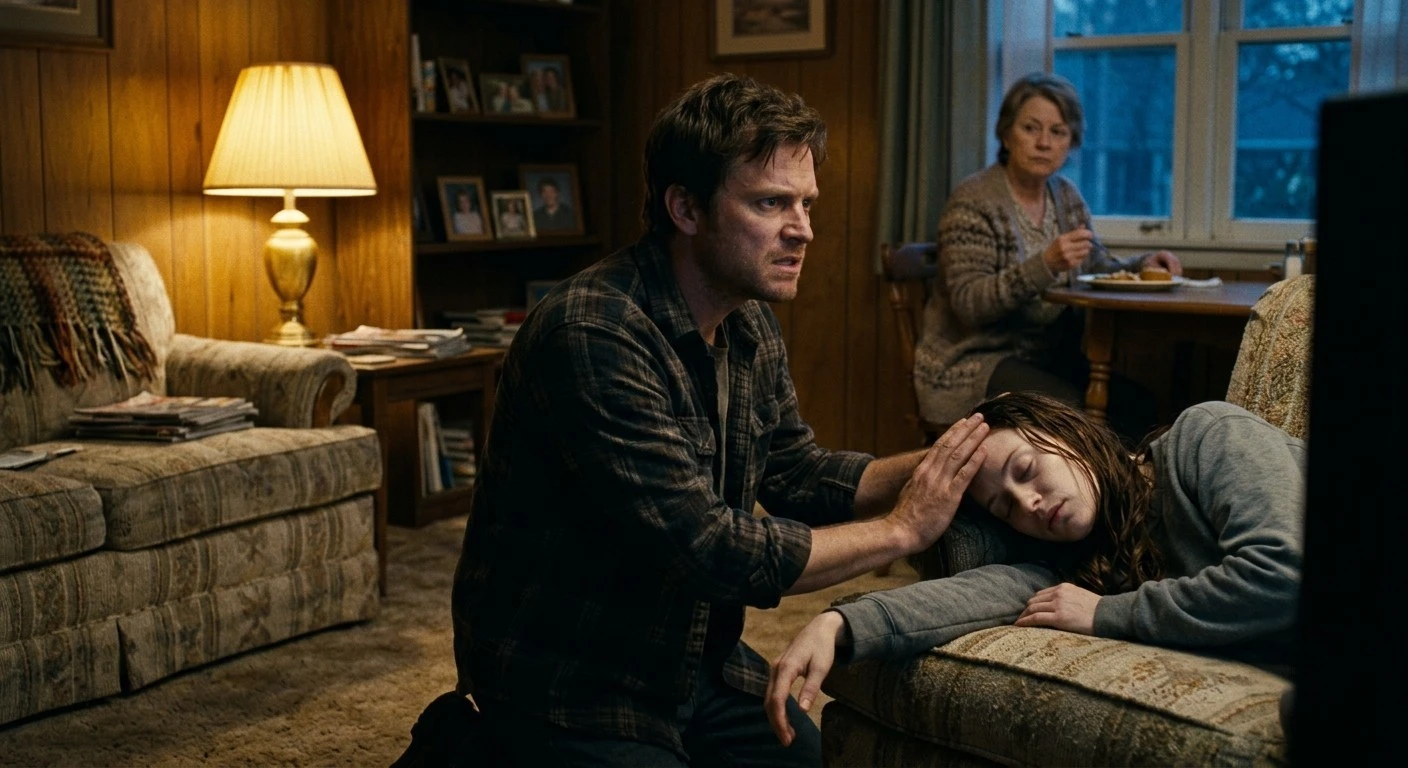
An elderly woman behind Lila — gray-haired, wrapped in a tan coat — whispered, “Lila, honey. Please don’t bother him.”
Wade studied the little girl.
She did not look afraid. She looked like a child who had practiced being brave for a long time and was finally using it.
He nodded once.
“Go ahead.”
Lila rolled forward and settled parallel to the booth, her wheelchair level with the chrome edge of the table. She folded her hands in her lap.
“My name is Lila.”
“I know who you are,” Wade said. “Your grandparents eat here Sunday mornings.”
Lila looked at him carefully. “What’s your name?”
“Wade.”
She let that sit for a moment.
Then she said, “I have something to show you.”
Something in Wade’s face tightened. Not aggression — just caution, the reflex of a man who’d learned to brace for whatever came next.
“Lila, sweetheart—” The elderly woman had followed, stopping just behind her granddaughter’s chair.
But Lila had already reached into the fabric pouch clipped to her armrest.
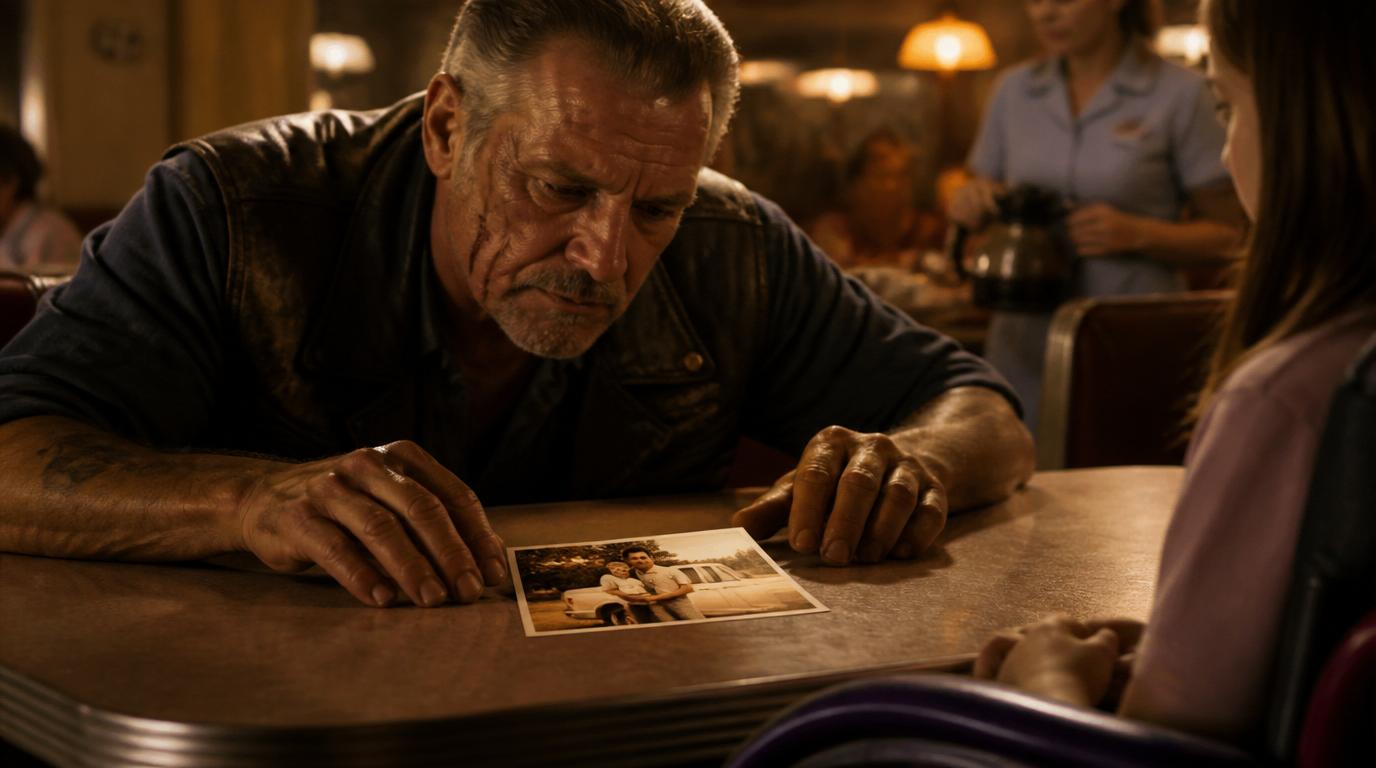
She pulled out a photograph.
It was folded at the corners. Edges soft from being touched a thousand times. Protected in a small square of clear plastic. She placed it on the table’s edge and pushed it toward Wade without a word.
He looked down.
For a moment, nothing in him moved.
The photo showed a younger man standing beside a pale blue pickup truck, one arm around a woman whose face was turned away from the camera, laughing at something. In his other arm: a newborn wrapped in a yellow blanket covered with stars and moons.
The man in the photo had no gray in his hair yet.
But the scar was already there.
Wade’s hand hovered over the photo without touching it.
“Where did you get this?”
“My mom kept it in her Bible.”
He looked up. “Who is your mother?”
Lila held his eyes. She had clearly been waiting for this question her whole life.
“Her name was Nora Whitaker.”
The name landed like a stone dropped into still water.
Wade set down his coffee.
Nora Whitaker.
He hadn’t heard that name spoken out loud in years — not since he’d stopped allowing himself to say it alone. There had been a time when Nora was the only person in Cedar Falls who looked at him without deciding in advance what they were going to see.
She’d known him when he was twenty-four and trying. When he was doing construction days and working on his GED at night and genuinely believing that a person could build something decent out of even the worst raw materials.
Then she was gone.
Her brother Calvin had come to the shop where Wade was working. He’d been calm and rehearsed, the way people are when they’ve decided what they’re going to say before they walk in.
She left. She wanted a different life. The baby isn’t yours, Wade. She asked me to tell you directly: do not contact her.
And because Wade had been ashamed, because his whole history said he was exactly the kind of man women needed protecting from, he’d believed it.
Or he’d let himself believe it.
Because the truth would have been unbearable.
He looked at the elderly woman still standing behind Lila’s chair.
“Sit down,” he said quietly. “Both of you. Please.”
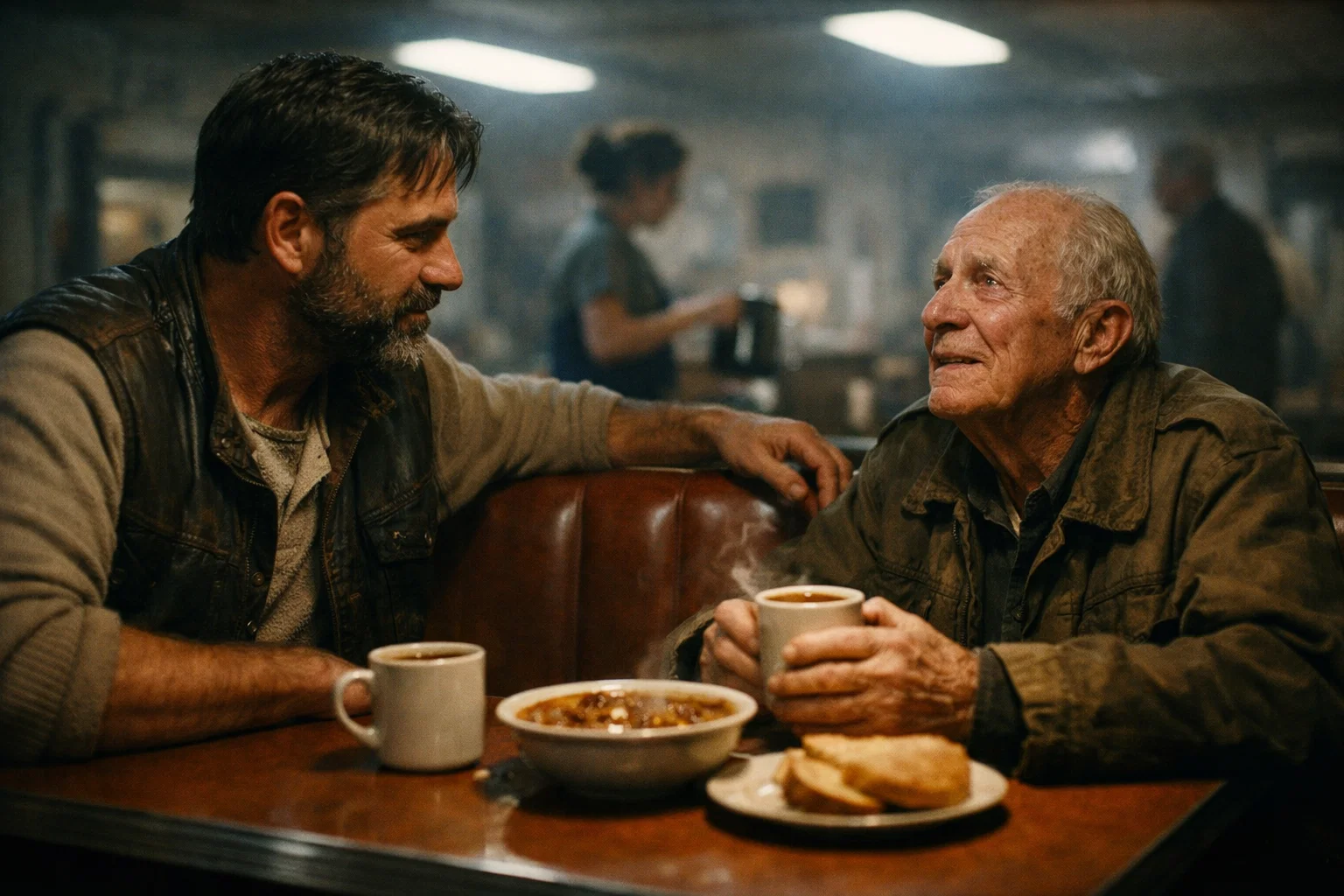
She hesitated. Then she pulled a chair from the nearest table, and the old man — Harold, Wade recognized him now, Harold Brenner, a retired schoolteacher who always ordered the same ham and cheese — came forward and sat beside her.
“Tell me the truth,” Wade said. “Right now. All of it.”
Harold looked at his hands. “We didn’t know the full story for years.”
“Calvin told Nora you didn’t want the baby,” June said. Her voice was steady, but her eyes weren’t. “He told you the baby wasn’t yours. He kept both of you apart. By the time Nora started to suspect something was wrong, she was already sick and she was scared and—” She stopped. Started again. “She was afraid that if she reached out to you, Calvin would find out, and she didn’t want Lila caught in the middle of whatever he would do.”
Wade’s jaw tightened. “She was afraid of her own brother.”
June nodded.
“He controlled a lot of things. The house after her parents died. Her finances. Her medical decisions when she got worse.” She paused. “He has guardianship papers for Lila that he pushed through when Nora was too sick to fight him. We’ve been talking to an attorney. We haven’t been able to do much yet.”
Wade looked at the photograph again.
“How long ago did Nora pass?”
Lila answered before her grandparents could.
“Eight months ago.” Her voice was quiet. Even. Like she’d said it so many times it had gone smooth at the edges. “She told Grandma where the picture was before she went to the hospital the last time. She said if I could find the man with the scar, I should show him.”
“She said you’d know the blanket,” June added softly.
Wade looked at the stars and moons on the wheelchair.
He looked at the blanket in the photograph.
“I bought that blanket,” he said, “at a truck stop outside Des Moines. Nora said the baby kicked whenever she saw stars.” He stopped. “She told you she liked stars.”
“She said they help people find their way home.”
Wade looked down at the table.
For a long moment, nobody spoke.
Then the bell above the door rang.
Lila’s shoulders pulled in before anyone else even turned to look.
Wade noticed immediately.
“What is it?”
“He found us,” Lila whispered.
A man in a gray wool coat stepped inside. Clean. Polished. Controlled. The kind of man who looked expensive at first glance and cold on the second.
Calvin Whitaker scanned the diner.
When he found Lila beside Wade, his expression shifted into something that looked like concern and wasn’t.
He crossed the room without hurrying.
“Lila, sweetheart.” His voice was smooth and familiar, the kind used by people who’ve practiced it. “Your grandparents had me worried sick. Come on, let’s get you home.”
Lila did not move.
Calvin’s eyes moved to June and Harold. Something behind them sharpened.
Wade slowly stood from the booth.
He didn’t rush it. He just unfolded himself to his full height, and the room remembered, without being told, why people had always given this man space.
“She’s not going anywhere,” Wade said.
Calvin looked at him with a small, dismissive smile. “I don’t believe this concerns you.”
“That photograph on the table says it does.”
Calvin’s smile stayed fixed, but something behind his eyes recalculated.
He looked at the photo.
His jaw tightened.
Then he lowered his voice, the way people do when they want a confrontation to look like a conversation.
“Wade. You don’t want old stories brought up in public.”
“No,” Wade said. “I think old stories are exactly what needs to be brought up.”
Officer Dean Ramirez appeared at Wade’s shoulder. He and his partner, Mallory Price, had been at the counter all night. They’d watched the booth since Lila first sat down.
“Everything all right over here?” Ramirez asked.
Calvin turned toward him with the fluid ease of a man who had handled police before.
“This is a family matter. This man is upsetting my niece.”
Lila’s voice came out quiet but clear. “He didn’t upset me. He’s my dad.”
The diner went completely still.
Calvin turned fast. “Lila—”
“He told my mom not to look for him,” she said. “He told Wade the baby wasn’t his. He kept them apart.”
“That’s — she’s confused. She’s a child, she’s been through a very difficult year—”
“Don’t.” Wade’s voice was level. “Don’t explain her.”
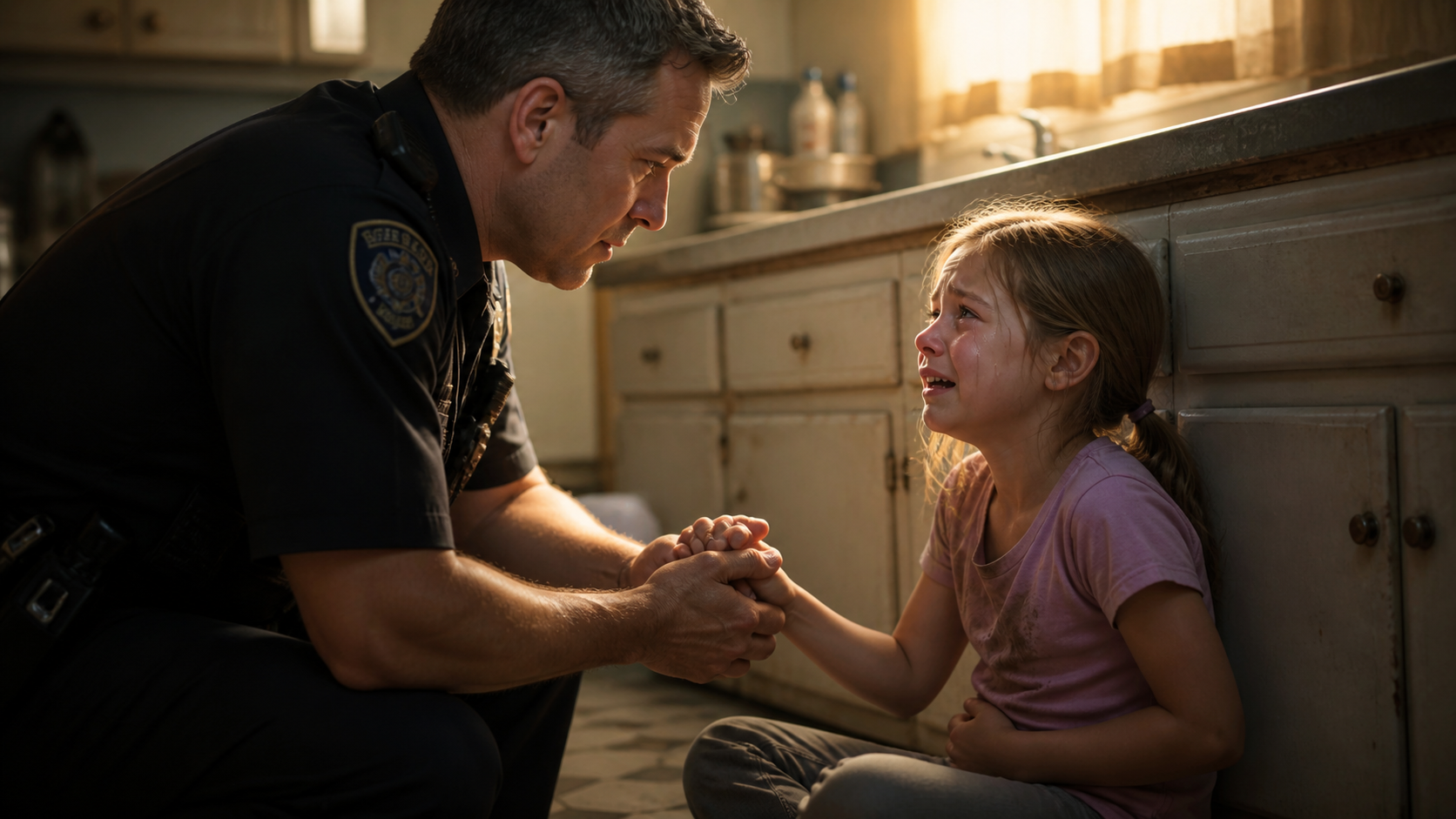
Officer Price crouched beside Lila’s chair, keeping her voice gentle. “Honey, do you feel safe?”
Lila looked at her directly.
“Not with him.”
That single word changed the weight of the room.
June opened her purse with shaking hands.
“We brought copies.” She pulled out a rubber-banded packet of papers. “Letters Nora wrote. Some were never mailed. Some came back. She thought Wade had ignored them.” She looked at Calvin. “She figured out later that you’d intercepted them.”
Calvin said nothing.
Harold added, “We also found documents Calvin had her sign when she was too sick to fully understand what they were. We’ve been working with an attorney in Des Moines.”
“You have no idea what you’re talking about,” Calvin said, but his voice had lost its smoothness.
Ramirez looked at him. “Sir, I’m going to have to ask you to step outside with us.”
“This is absurd—”
“Sir.”
Calvin looked at Lila one more time.
Something passed across his face — not guilt exactly, but the recognition that a certain kind of power had just shifted out of his hands.
He buttoned his coat and walked toward the door.
The whole diner watched him go.
Nobody said a word until the door shut behind him.
Wade sat back down.
He kept his hands on the table so Lila could see them.
“I should have looked harder,” he said. “Even when they told me to stay away, I should have looked harder.”
Lila shook her head slowly.
“Mom said sometimes people get lost because someone moves the signs.”
The broken breath that came out of Wade could have been a laugh or a sob. He wasn’t sure which.
“She always knew how to say things better than me.”
Lila reached over and touched the edge of the photograph with two fingers.
“Are you really my dad?”
“I believe I am.” He held her eyes. “And if you want, I’ll spend the rest of my life proving I should have been there sooner.”
Lila’s eyes filled.
“Mom said you would say something like that.”
Rosalie brought pie without anyone ordering it.
Fresh-sliced apple, still warm, on a plain white plate. She set it in front of Lila and didn’t charge anyone for anything the rest of the night.
Harold stood near the window, watching the blue-white flicker of a police cruiser’s lights against the glass.
June held Lila’s hand across the table.
Wade sat across from his daughter and kept looking at her like he was afraid to blink — afraid she would turn out to be something he had dreamed.
“Do you like your chair?” he asked, because he needed something ordinary to say.
“Mom helped me put the stars on it.”
He looked at the faded moons and crescent shapes.
“She always liked stars,” he said.
“She said they help people find their way home.”
Wade looked at the photograph one last time.
For nine years he had believed home was something that had been taken from him.
He’d been half right.
It had been taken.
But it was sitting across from him now, in a purple wheelchair, eating apple pie with quiet dignity, wearing a face that reminded him, painfully and completely, of the person he had once been trying so hard to become.
Later, outside in the cold night air, while the police took Calvin’s statement three blocks down, Wade stood beside his motorcycle and couldn’t figure out what to do with his hands.
He wanted to hold his daughter.
He was afraid he hadn’t earned it yet.
Lila solved it.
She rolled close and reached up.
He bent down.
She wrapped her arms around his neck.
He froze for just a moment — the reflex of a man who had gone too long without being touched gently — and then he held her carefully. Like she was made of all the years he’d missed and all the ones he might still get.
“I’m sorry,” he said into her hair.
Lila’s answer came against his shoulder, small and steady and final.
“You found me now.”
Three weeks later, Wade sat with Harold Brenner in the waiting room of a family law office in Des Moines while their attorney filed for Wade’s formal recognition of paternity and a challenge to Calvin’s guardianship.
Calvin’s lawyer called twice that morning. Both calls went unreturned.
The guardianship challenge was granted six weeks after that.
The intercepted letters — sixteen of them, found in a box in Calvin’s home office — were submitted as evidence. Two witnesses confirmed what the Brenners had long suspected about how Calvin had managed Nora’s affairs.
Calvin Whitaker quietly accepted a settlement that cost him most of the inheritance he had restructured in his favor during the last years of Nora’s illness.
The judge who signed Wade’s paternity order looked at the photograph of the man with the scar holding a newborn in a star-patterned blanket and said, without any particular ceremony, “Welcome to the record, Mr. Mercer.”
Wade drove home in the dark.
He stopped once at a truck stop outside Des Moines — not the same one, probably, but close enough to mean something — and bought a small star-patterned keychain from the gift rack by the register.
He hung it on the handlebar of his motorcycle.
Three days later, he moved into a rented house four blocks from the Brenners.
Close enough to walk over on Sunday mornings.
Close enough for a little girl who had carried the truth in a photograph for years to roll up the front path whenever she needed to.
Lila came over the first Sunday to help him decide where to put things.
She parked her wheelchair in the middle of his empty living room and looked at the bare walls.
“You need a picture somewhere,” she said.
“Yeah?”
“Mom always said a house isn’t a home until someone hangs something on the wall.”
Wade looked around the room.
“What should I hang?”
Lila thought about it seriously.
Then: “The photograph.”
He looked at her.
She looked back at him.
“You can have it,” she said. “Mom would want you to have it.”
Wade took the photo out of his vest pocket — he’d been carrying it since the night at the diner — and looked at it one more time.
A young man with a scar.
A woman whose face was turned away, laughing.
A baby in a star-patterned blanket.
He walked to the wall above the fireplace.
He hung it there.
Lila rolled back to get a better look.
“Perfect,” she said.
Wade stood beside her.
Outside, the Iowa sky was doing what it always did in late fall — going big and gray and honest, the kind of sky that made no promises but told no lies.
He looked at the photograph on the wall.
Then at the girl who had found him.
Nine years too late.
Not a single day too late to matter.
“Yeah,” he said. “That’s perfect.”
Original fictional stories. AI-assisted creative content.