I’ve been a deep-tech communications analyst for the federal government for nearly five years, but nothing prepared me for the feel of my own bones rattling against solid brick while a sheriff smiled into my face.
It was a routine October morning in the Virginia hills. Cold air, grey sky, empty trails — exactly the kind of isolated terrain I needed to field-test our agency’s latest wearable prototype.
I looked like any other cyclist. Specialized road bike, athletic windbreaker, tinted glasses. That was the idea.
What I was actually wearing: a synthetic jacket threaded with micro-fiber data relays, and a pair of AR glasses designed for hands-free real-time system monitoring. The kind of gear that cost more than most people’s cars.
I was passing through a community park, minding the data readouts scrolling across the inside of my lens, when a police siren split the morning wide open behind me.
A dusty midnight-blue Ford Explorer jumped the curb, tires tearing long ruts through the park grass, and cut off my path entirely.
I squeezed my brakes hard. The front tire stopped six inches from his brush guard.
The door swung open, and out stepped Sheriff Vance.
He was a big man. Thick neck, sun-damaged skin, and the kind of eyes that only come from decades of zero accountability. He walked toward me with his hand resting on his service weapon like a prop in a performance he’d rehearsed a thousand times.
“We don’t much care for out-of-towners tearing through our community spaces looking like some kind of high-tech freak,” he said, his voice coated in a slow, deliberate drawl designed to humiliate.
I unclipped my shoe from the pedal. Kept my voice flat. “Just passing through, Officer. I’m doing a long-distance navigation check before heading back to the highway.”
He stepped closer. His shadow swallowed mine completely.
“You’re speaking when you should be listening, girl.”
His hand shot forward before I could dismount. His thick fingers seized the collar of my jacket and ripped. The internal fiber-optic data threads shredded with a sound like tearing silk. The force pulled me clean off the bike.
The carbon frame hit the gravel with a crack.
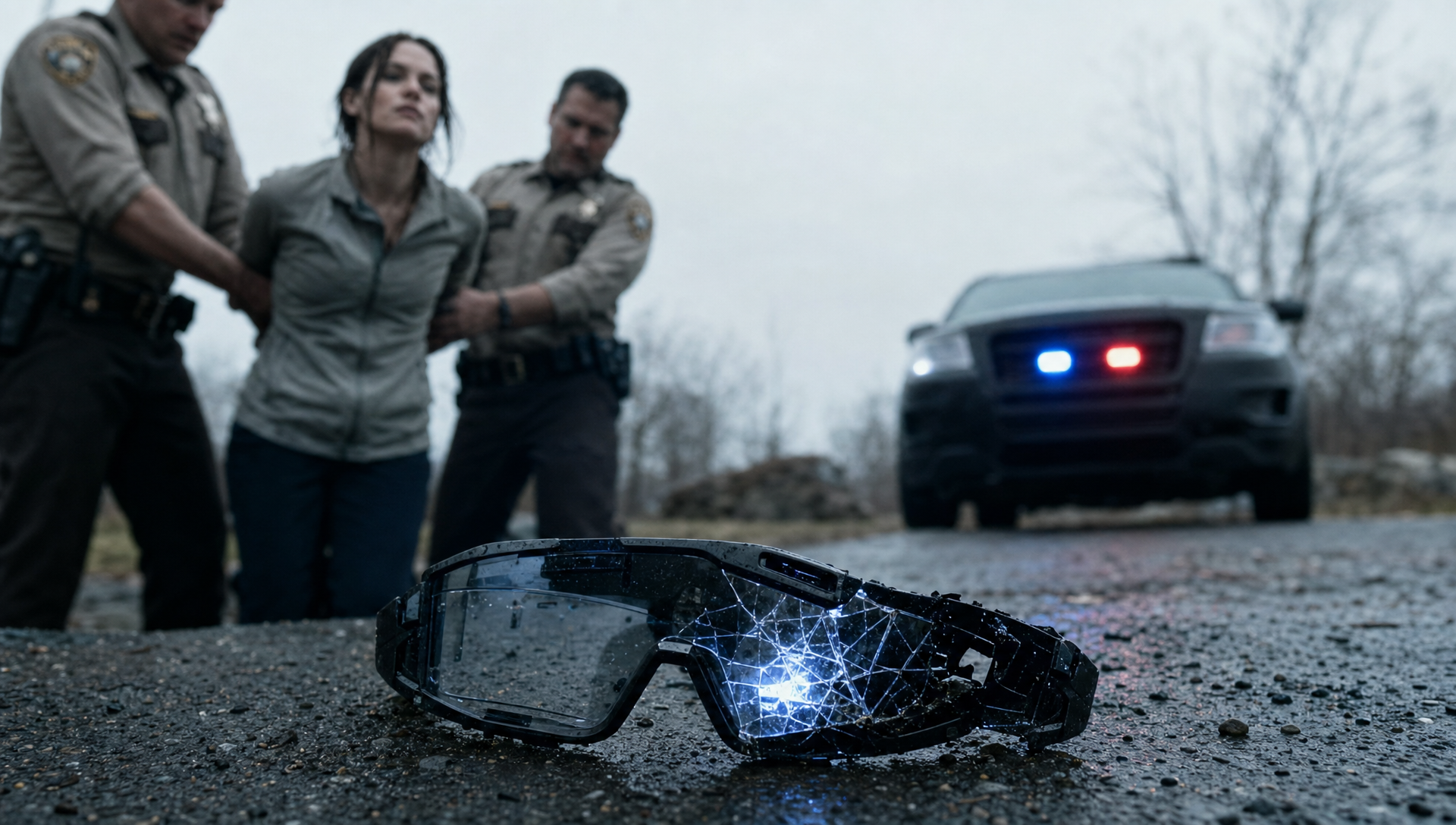
He spun me and slammed me face-first into the brick wall of the park pavilion. The impact emptied my lungs in one brutal, silent rush. My glasses flew from my face, hit the asphalt, and fractured.
“You think you’re smart?” Vance hissed, pressing his forearm into my shoulder blade. “Coming into my town like you own the place?”
He wrenched my wrists behind my back. The handcuffs ratcheted shut so tight they immediately cut off circulation to my fingers.
I managed to turn my head. About a dozen local residents had gathered near the pavilion. An older man in overalls against a rusted pickup. Two women with grocery bags. A group of teenagers with their phones raised.
Not one of them looked horrified.
“Give her hell, Sheriff!” one of the teenagers yelled, tilting his phone for a better angle.
“Show her how we handle freaks in Oakhaven!” an older woman called out, grinning.
The applause of the small and cruel. Vance absorbed it like sunlight.
He grabbed the chain of the handcuffs and yanked me backward. I stumbled across the gravel, barely keeping my feet.
“Seventy-two hours in county holding,” he murmured, close to my ear. “While I decide exactly how many charges I can stack on top of that smart mouth.”
He shoved me into the rear seat of the cruiser. The door slammed. The cage sealed around me — cold vinyl, chemical smell, wire-mesh windows.
I leaned my head back and closed my eyes.
Because I knew something Vance didn’t know yet.
When the jacket tore, the fiber-optic threads had sent an automated emergency ping to an encrypted federal server. When the glasses hit the asphalt and the lens fractured, the impact sensor inside the titanium frame had classified the event as a hostile assault on an active federal asset.
The device had initiated a Level-1 NSA defense override protocol.
It wasn’t alerting a dispatch desk. It was broadcasting a high-priority distress beacon directly to the nearest regional military command center, pinging my exact geospatial coordinates to within three inches.
And no one could stop it. Not me. Not Vance. Not anyone short of a regional commander with a direct executive authorization code.
I could hear Vance outside, still performing for his audience. He walked over to my road bike and kicked the rear wheel. The carbon spokes snapped. More laughter from the teenagers.
Then his footsteps slowed. He had noticed the glasses.
The fractured lens was pulsing with a cold, steady blue light. Through the tinted rear window, I watched him crouch, squinting at it, his brow furrowing. He raised his boot to crush it.
The blue light turned solid red.
A single sharp digital tone rang through the quiet park, clean and hard as a struck bell.
Vance froze with his boot an inch above the glass.
The birds in the oak trees stopped.
The wind died.
The only sound left was the idle of his V8 engine.
Then the vibration started.
It came up through the floorboards first, a deep rhythmic resonance that had nothing to do with construction or traffic. It built steadily, becoming a synchronized mechanical roar that bounced off the surrounding hills.
Through the side window, I saw the first vehicle round the curve.
A matte-black armored tactical SUV, completely unmarked, moving with absolute purpose. Then a second. A third. A fourth.
They swung into tactical formation with mathematical precision, cutting off every exit from the pavilion in under thirty seconds.
The teenagers’ phones dropped to their sides. Every face in the crowd went white.
Vance’s smirk evaporated. He stepped toward his cruiser, hand dropping instinctively toward his holster.
“What in the hell…” he breathed.
The lead SUV’s door opened. A man stepped out in clean dark grey tactical gear — no patches, no insignia, no name tag. Ballistic vest, communication headset, sidearm on his thigh. He moved like someone executing a line of code.
Dozens more fanned out behind him, forming a tight perimeter. No sirens. No shouted commands. Just rifles at low ready and a wall of silence.
The lead operator walked directly to the shattered glasses on the asphalt, picked them up without looking at Vance, and placed them in a secure tactical pouch on his vest.
Then he looked at the sheriff.
“Where is the asset?”
Vance blinked. His skin had gone a strange, bloodless grey. “I don’t know what kind of high-tech nonsense you’re—I’ve got a suspect in the back for a traffic violation and resisting arrest. Now show me some identification before I—”
“Where is the asset?”
Same flat tone. Zero change.
Vance pointed toward the cruiser. “She’s in the back. And she’s staying there until she’s processed at county.”
The operator raised two fingers.
Three operators moved past Vance like he was a piece of road debris, heading straight for my door.
“Get away from my vehicle!” Vance lunged forward and reached for the nearest operator’s shoulder.
It was the last mistake of his career.
The lead operator moved. He caught Vance’s wrist mid-reach, twisted with a sharp, heavy pop, and drove his knee into the sheriff’s midsection.
Vance hit the gravel hard, gasping, his massive frame folding like something hollow.
The crowd made a sound — not horror exactly, but the specific stunned silence of people watching the axis of their world tilt without warning.
“Hands behind your back,” the operator said.
“You can’t do this!” Vance choked, his face against the gravel, pressing into the same surface he’d dragged me across. “I’m the elected sheriff! You have no right!”
“Under Title 50 of the United States Code, this area is now a restricted federal security zone,” the operator replied, pulling heavy zip-ties from his belt. “You have compromised a Tier-1 national security asset and interfered with an active defense protocol. Your local authority is permanently dissolved.”
The ties snapped shut around Vance’s wrists.
My door opened. Cool air flooded in. One of the operators reached inside and helped me out onto the gravel with careful, deliberate hands. He drew a pair of cutting shears and snapped the steel handcuffs clean off my wrists.
The blood rushed back into my fingers in a burning wave.
I stood up. I looked down at Vance on the ground.
He stared up at me — at my torn jacket, the blood dripping from my ear, the ring of black armored vehicles surrounding everything he had ever controlled — and his expression broke completely open.
“Who…” he stammered. “What are you?”
I looked at him for a long moment.
“I told you I was checking my navigation,” I said quietly. “You should have listened.”
A woman in dark civilian clothing stepped out of a fifth SUV, carrying a secure briefcase and a digital tablet. She didn’t look at the crowd. She didn’t look at Vance. She walked directly to me.
“Report, Agent.”
“Physical assault by local law enforcement during atmospheric data-sync testing,” I said, keeping my voice steady. “Device connection severed violently. Level-1 defense override initiated automatically upon asset compromise.”
She nodded, her fingers moving across her tablet. “The regional commander signed the executive detachment order twenty minutes ago. Oakhaven County’s federal funding is frozen effective immediately. Every arrest record, financial log, and communication wire tied to this department is going to a federal grand jury by noon.”
Vance made a sound from the dirt. Low, broken, final.
He finally understood. This wasn’t a dispute he could navigate with a phone call to a state senator or a quiet word with a local judge. His three decades of unchecked authority — built on fear, insulation, and the certainty that no one would ever reach into his corner of the world — was being dissolved in real time.
“Take him,” the woman said simply.
Two operators lifted Vance by the upper arms and dragged him toward the rear of an unmarked black van. His boots left two long furrows in the gravel as he went. He didn’t fight. He didn’t speak. The terror in his eyes was total and clean.
The van doors slammed shut with a heavy, definitive thud.
The operators worked through the crowd methodically. Every phone, every camera, dropped into a reinforced digital suppression bin. The teenager who had yelled at me to get out of Oakhaven held out his phone with trembling hands, staring at the ground, unable to make eye contact with the figure standing in front of him.
Some of the older women were weeping. Not for me. For themselves — for the slow, dawning recognition of what their town had spent years enabling.
They helped me into the medical transport. Clean interior. Cold compress for my cheek. Bottle of water.
I sat down on the padded bench and looked out the tinted window one last time as the vehicle pulled away.
The park looked different without Vance in it. Smaller. Quieter. The townspeople stood in a ring, guarded by operators, waiting to be processed. The pavilion where he’d slammed me into the wall looked like exactly what it was: a slab of old brick in a forgotten park.
He had spent his whole life believing that power belonged to the man with the loudest voice in the smallest room.
He had to learn, face-down in the gravel of his own park, that true power doesn’t shout. It doesn’t warn you. It doesn’t need to.
It simply arrives.
And when it does, it leaves nothing but dust.
Original fictional stories. AI-assisted creative content.